
Wall Street’s Best Kept Money Making Secret
Behind the hedge fund with 39,900,000% total returns even Warren Buffett couldn’t match.
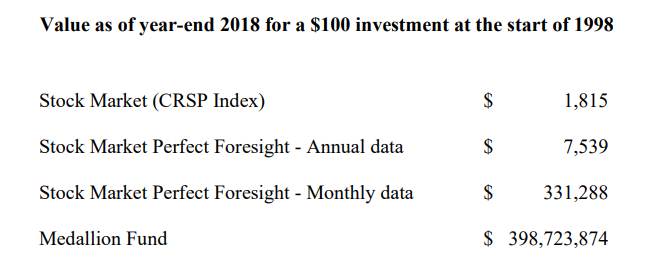
In 1988, a little known hedge fund named Medallion launched, founded by eccentric mathematician Jim Simons along with his company Renaissance Technologies. Over the next three decades, Simons pioneered a data-driven, algorithmic approach to investing that seemed to uncover hidden patterns in markets and predict the unpredictable. His secretive fund quietly turned an initial $100 investment into almost $400 million by 2018, dwarfing even the returns of legendary investors like Warren Buffett along the way.
So how has this quant fund managed to smoke practically every other investor for over 30 years, achieving returns that should not even seem possible? Through extensive research and interviews, I reveal Medallion’s mysterious magic formula — and why you likely can’t get a piece of this investing goldmine.
Absolute Domination: $100 to $398 Million
First, let’s appreciate just how outrageously good Medallion’s returns have been compared to all other options for putting your money to work:
Medallion has absolutely crushed investing legends managing hundreds of billions of dollars with access to the world’s best business minds and financial data.
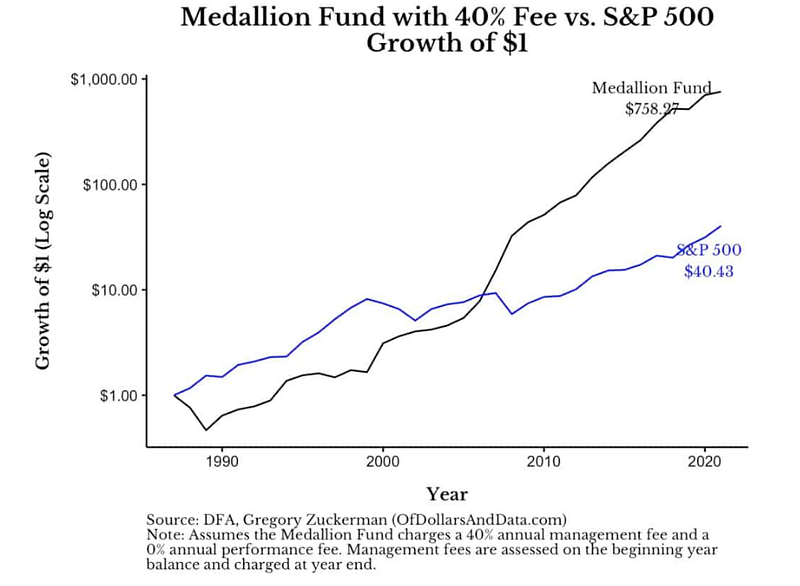
$1 invested in Berkshire in 1988 would now be worth around $152 — quite a good run thanks to Warren Buffett’s brilliance. But Medallion turned that same $1 into over $4000 by 2018.
So what does Medallion know that even the great Warren Buffett doesn’t? Their secret sauce has Medallion outpacing the Oracle of Omaha’s returns by over 263X!
The infographic below shows even a hypothetical “perfect foresight” fund that could perfectly predict when markets would rise and fall each year does not come close to achieving what Medallion has done.
Perfect 30 Year Run — Positive Every Single Year
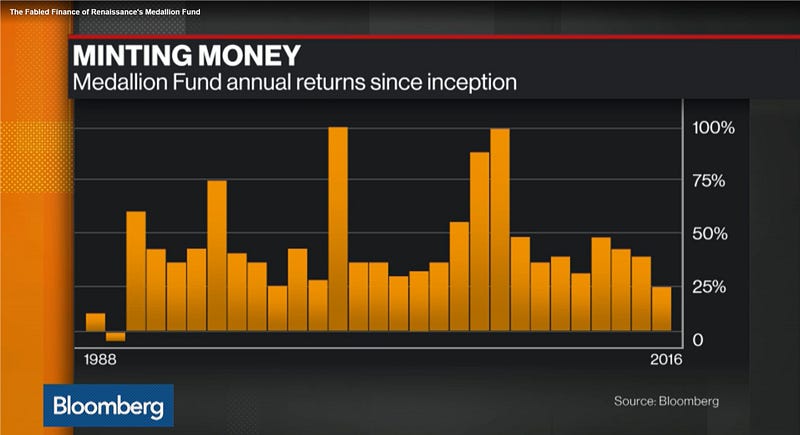
And it’s not just about maximum growth. Medallion has done something most consider impossible — generate positive returns in every single year for 30 straight years. Even when markets crashed over 40% during the dot com bust and 2008 financial crisis, Medallion kept humming along, putting up 51% and 152% returns those years. Simply astounding.
The Man Behind the Magic Formula
Jim Simons was always a bit different. A math genius with a Ph.D. from UC Berkeley, he made breakthrough discoveries in geometry theory before applying his mastery of pattern recognition to the stock market. He launched Renaissance Technologies in 1982 and began bringing in savants skilled in statistics, computational science, physics, and number theory.

They searched massive datasets most didn’t even know existed for hard-to-detect patterns that might predict market moves. It was cutting-edge, unproven, and secretive. But six years later, Medallion Fund was born using these predictive signals and complex math models to structure trades. The secrecy only grew from there — Renaissance employees still can’t access certain floors occupied by Medallion’s team!
Cracking The “Efficient Market” Theory
Why does Medallion’s strategy work so astonishingly well when academic theory states that markets are “efficient” and already account for all known information that could predict prices? Because Medallion has seemingly found inefficiencies related to complex relationships between assets that only advanced computing can detect.
Take this quote from Simons on detecting patterns in commodity futures:
“Commodities used to trend…If you could get the trend right you’d bet on the trend and you’d make money more often then you wouldn’t.”
Medallion develops algorithms to identify assets showing these reliable historical tendencies and uses leverage to maximize gains. Renaissance’s computers are some of the world’s most powerful, allowing them to uncover “anomalies” and subtle patterns in massive datasets that humans could never detect, and leverage 20–50X to maximize gains.
The Brains Behind the Operation
Behind Renaissance’s secrecy, we can glean hints of how they bake market-beating returns through both award-winning math theory and trading pragmatism.
Simons has said a key challenge is “figuring out how much money not to invest” to avoid influencing prices by trading too big. He reportedly still oversees strategy as Chairman while Co-CEO Robert Mercer and his computational linguistics team handle software.
Renaissance also employs scientists from Harvard, IBM, MIT, and more to continually improve predictive signals as part of research staff exceeding 100 Ph.Ds today. Employees describe an intense, intellectual environment that empowers them to innovate. Combining cutting-edge data analysis with precision position-sizing creates uncannily accurate forecasts.
The Secret Sauce Spices Up Returns
Insiders suggest Medallion deploys unique tactics so their algorithms maintain an edge. They likely trade millions of times annually across assets from stocks to currencies using automated programs. Leverage reportedly as high as 50X then juices returns generated by their predictive models.
This extreme use of margin boosts gains but caps risk because Medallion bets so small relative to assets under management. Calculated leveraging of tiny advantage probabilities creates explosion growth over time, while capping downside exposure if the algos ever get it wrong. Of course with sustained success over 30 years, that rarely happens!
Medallion also structures proprietary fee agreements with prime brokers to execute their high volume strategy cheaply. They even restrict external investments to avoid tipping other large funds off to their models.
The Key Ingredients Combining For Market Wizardry
In summary, Medallion’s multi-billion dollar edge likely stems from:
- Massive computing power and datasets detecting obscure, predictive market patterns
- Algorithms structured by math and science geniuses to create forecasts
- Position sizing precision for max advantage without influencing prices
- Margin leverage to juice slight edge probabilities into market beating returns
- Custom cost structures to enable high volume trading profitably
The Takeaway: Brilliance Meets Secrecy Breeds Returns
Medallion is a quintessential example of why Wall Street trading has not been fully open and transparent. By intensely guarding the strategies powering their algorithms, Medallion preserves a monumental edge over other investors — one that has compounded into the best investment return in history. Not even Berkshire’s Buffett can match their numbers.
But ironically, Medallion also shows that markets are NOT efficient as academic theory argues. Their sustained outperformance proves inefficiencies exist to be exploited by those clever enough to uncover them. However, exposing those loopholes eliminates their predictive power. It’s a catch-22 built on secrecy.
So Medallion continues compounding billions behind closed doors, while the average investor remains shut out. All we can do is marvel at Medallion’s numerical mastery from the outside
The fund only manages employee and founder capital, now totaling near $10 billion today compared to the $35 million Simons started with decades ago.
The bottom line is that Medallion has achieved the impossible — generate market-crushing returns for over 30 years using quantitative strategies that outsiders can hardly grasp. For all the academics claiming beating the efficient market is luck and not skill — just take one look at Renaissance Technology’s Medallion Fund.


