
3 Simple Actions Strategic Leaders Take Every Day
As a leader, you likely understand the importance of strategic leadership.
In the article about the 6 Skills You Need to Become a Strategic Leader, I discussed the key skills that strategic leaders develop and use— Anticipate, Challenge, Interpret, Decide, Align, and Learn.
However, skills alone are not enough. To make any difference, those skills need to be translated into concrete actions on the ground.
After all, actions speak louder than words.
In this article, I will discuss 3 actions that strategic leaders take on a day-to-day basis. This will help you to better appreciate what strategic leadership looks like and feels like.
Action #1 — Reflection & Planning
“Once a mistake. Twice a failure”
As a strategic leader, you know the importance of continuous improvement.
You spend a fair bit of time every single day reflecting on your goals, and your team’s progress towards those goals. This could very well form your daily morning ritual.
You look at what worked, and what needs to change. You revisit the long-term goals, map your position in the path towards those goals, and revise your plans to realign with the goals.
Most critically, you adapt your strategy based on what you have learned.

Example: Customer Escalation
As an example, let’s say you are involved in a customer escalation for an issue in the product you lead at your company. You get a call in the middle of the night, and get all hands on deck to tackle the issue.
Your first priority is to address the issue at hand.
In the software world that would mean shipping a hotfix, or rolling back (or forward) the defective changes, or even a change in configuration or a tweak in the cloud infrastructure.
All that is done, and you’ve addressed the issue, and the customer is happy.
But you’re not done.
Post issue resolution, you run a retrospective (aka blameless postmortem or root cause analysis) with your team, that reveals some of the root causes for the issue.
As a strategic leader, you take the customer escalation as a learning opportunity, and you ask a bunch of questions to yourself and your team:
- What process changes can be introduced so we don’t repeat the same?
- Do we have a skillset challenge, and do we need to train our team so they can better handle such situations in the future?
- What can we do differently next time?
Action #2 — Communication & Alignment
“The art of communication is the language of leadership.” — James Humes
As a strategic leader, you don’t wait for things to happen before you communicate.
You plan your communication ahead of time.
You think strategically about the audience, timing, content, and tone. Ultimately, you look at the broader, long-term impact of communication.
For you, communication is a critical part of your daily work, not just a chore.
And you treat communication very seriously.

Example: Scrapping a project
Let’s imagine that a project your team has worked on for many months is being scrapped.
What would you do? Go and share the sobering news with your team, and eat humble pie?
As a strategic leader, you would not be surprised by this outcome.
You would have seen it coming.
You have already worked out the impact of this decision. You have worked with your key people to come up with a strategy. You have a clear communication plan for the broader organization.
As a strategic leader, you don’t just share the news. You share the rationale, the impact, and the plan forward.
You fully own the decision.
And you listen for feedback. You want to make sure your team feels heard.
Action #3 — Decision-Making
“Nothing is more difficult, and therefore more precious, than to be able to decide.” — Napoleon Bonaparte
As a leader, you make decisions on a daily basis — from minor decisions to major decisions.
But what factors do you consider when making decisions?
As a strategic leader, you look at the bigger picture. You look a the data, the trends, the long-term impact. You weigh the immediate “criticality” with the long-term “priority”.
You are intimately aware of your biases, and you stay away from these biases as much as possible.
And you know that the “right decision” is usually the most obvious, but also the most “difficult” decision.

Example: Resource Allocation Decision
Let’s say you need to make a decision on resource allocation between multiple competing projects across your teams.
Tom, a senior manager on your team needs resources for a “high-priority” project. So does Lila, who manages a different project. And they are both very persuasive managers. How do you decide which project should get the resources?
Well, you love stack ranks.
You fundamentally believe that there is always a tie-breaker, no matter what.
As far as priorities are concerned, you draw a stack-ranked list of projects/initiatives that your teams work on across the board.
And you make that list public.
Every team and every manager knows the priority/rank of their project.
Whenever a decision needs to be made between those projects, you always have a reference to look at, to make an objective decision aligned with the overall business.
In many cases, your strategic approach to decision-making ironically reduces the number of decisions that need to be made, and saves countless hours of effort.
Bringing it together: The 3 Daily Actions You Take as a Strategic Leader
Becoming a strategic leader does not need a grand transformation.
Not at all.
All it needs is intentional daily actions. You need to walk the talk.
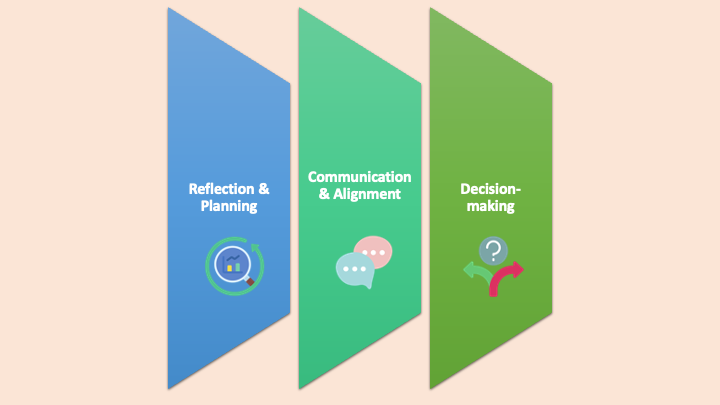
The three daily actions that all strategic leaders take are:
- Reflection & Planning
- Communication & Alignment
- Decision-making
These daily practices not only elevate your individual leadership style, but also contribute to building a forward-looking mindset in your organization.
Like my writing?
If you liked this post, I would appreciate some claps👏 as a form of encouragement. Thank you!
To read similar content you can follow me (Gaurav Jain) and subscribe to get these posts delivered directly to your Inbox. Check out my profile for other ways to connect with me.
Feedback is a gift! I would love to hear your thoughts and suggestions in the comments below 🙏


