
Mental Health
Walk In The Woods To Enhance Your Mental Health and Brain Power
Discover why the Japanese love shinrin-yoku.
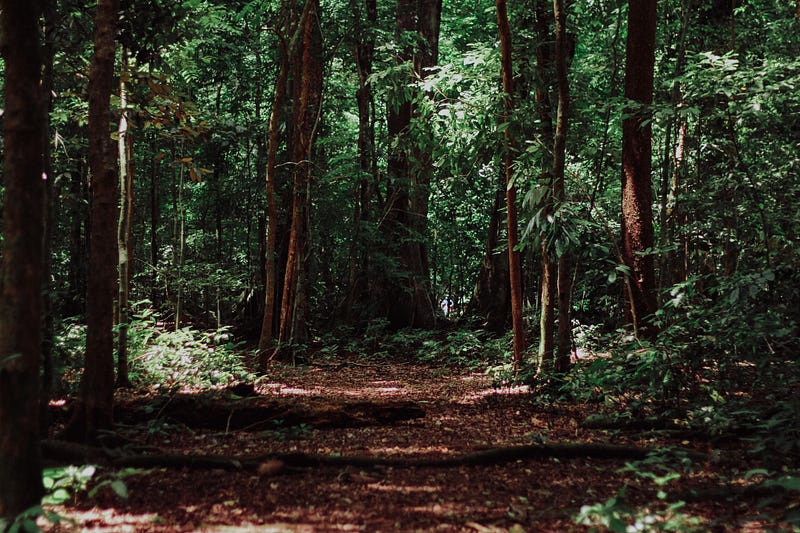
I was pleasantly surprised when I discovered that walking and exercising in green space is a great way to supercharge my brainpower.
I always knew about how great this movement in a forest or park is for our physical health. It gives our cardiac health and blood pressure the right boost. Over 140 studies all confirm the substantial health benefits from being close to nature. Lord Byron could not have summed it up better.
“There is pleasure in the pathless woods….I love not Man the less, but Nature more.” — Lord Byron.
Here are some of the great mental health benefits to be had, all free of charge!
It is great for my mood.
Whether I am in the green space for a quiet walk, chatting with acquaintances, or just enjoying the clean air and the relative peace and calm, this is essential in boosting my mood.
Research also shows that if we encourage our kids to exercise in the open, this can help reduce mental health problems in adulthood. Researchers at the University of Verona found that time spent in green space was a great way to reduce the harmful effects of a negative mindset.
I can reduce my stress levels.
The Japanese are great fans of “forest air-bathing” shinrin-yoku in Japanese. There is no real translation in English for this term but I suppose the closest would be a walk in the woods. We are surrounded by stress and we are now more stressed-out than ever before, according to a 2017 Gallup poll. Walking in a green space is a great way to relieve stress, I have found. It is a pity that billions of people worldwide never get the chance to do this. We should do it much more often!
I want to learn in a garden.
I always wondered about the word “kindergarten.” It is the German word for indoor infant schools. But the original schools were all outdoors in the garden as the name suggests, “children’s garden.” These were started by Friedrich Froebel in 1840.
He wanted children to be in a setting where they could interact with nature, observe, and learn. The first institute he founded was called the “Play and Activity Institute” and then was later called a kindergarten.
The results were encouraging in that the kids who learned in this type of green setting were better at paying attention, improved their memory and they were also more adept at taking risks. What a pity that most kindergartens are now almost always indoors!
What was really interesting for me was that adults had similar results when they were tested for attention and memory recall after walking in the woods. They were certainly doing better than their counterparts who were studying in an urban setting, according to the research carried out at the University of Michigan.
If I want to learn something, I will try and read the material outside on the balcony which overlooks an orchard or better still on a park bench.
I can be more creative.
My favorite color is blue. But maybe I should change that to green. Experiments have shown that when subjects were shown a green rectangle and the control group a white rectangle, the results were notably different. The task was to design some original ideas using a simple tin can. The people who had been shown the green rectangle had produced more creative and imaginative solutions.
We are not sure why green can be so creative but it is most probably due to the link between green and growth which is so powerful. It is all part of our biological heritage.
I can stop brooding.
I began to wonder if urban dwellers brooded more than those fortunate enough to live in the countryside or at least near green space. It is a real issue as, by the year 2050, more than 70% of the global population will be living in towns and cities.
There are not many experiments on this one. But Professor Bratman of Stanford University was determined to find if there was indeed any basis for this. His experiment was a small one but it established clearly that those who went on a 90-minute walk in a green space were much less likely to brood than those who had walked for the same amount of time in an urban setting. It also showed that the parts of our brain connected with the risk of mental illness were less active on the green walk.
I want to let my mind wander and relax.
Letting my mind wander and relax without having to think of my to-do list or all the things I have not yet finished is a luxury. If we do get this chance, the best place to do it is in a forest or a park. My mind is engaged in a very pleasant way and I can contemplate the beauty and peace of my surroundings. How can I do that where cars are honking?
Research on this has been called Attention Restoration Theory and it works best in natural surroundings. This sort of mental restoration has been studied at the University of Ann Arbor, Michigan.
The good news is that if you can control those negative thoughts, your ability to focus on these green spaces will be enhanced. But don’t stray too far!
“Indoors, we tend to use only two senses, our eyes, and our ears. Outside is where we can smell the flowers, taste the fresh air, look at the changing colors of the trees, hear the birds singing, and feel the breeze on our skin. And when we open up our senses, we begin to connect to the natural world.” — Dr. Qing Li. Founder of the Japanese Society for Forest Medicine.
And when green space is not enough, go for blue space or both!