
Abundant Future
Waking Up and Remembering
All lives matter. And all daily choices matter too. Is it enough to adopt an abundant mindset and start a community garden?
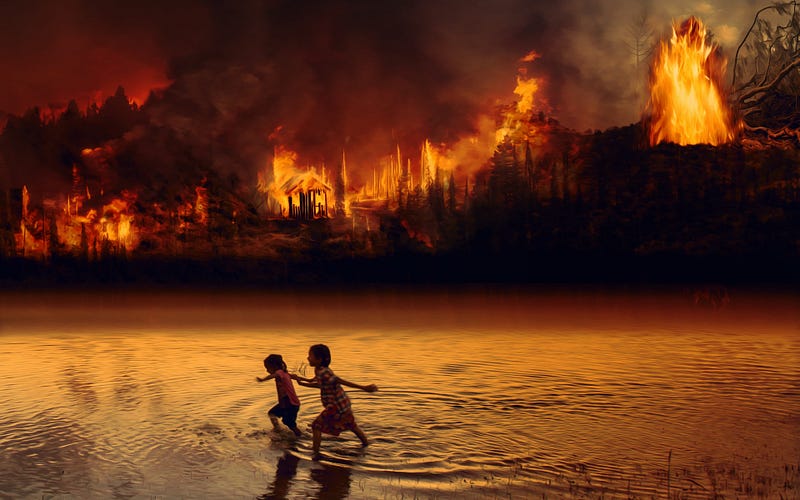
The world has gone haywire. Australia has been burning with bushfires. The Amazon and Papua rainforests are burning. So the land can provide food for the poor and money for the powerful. We are crazy!
And now America is burning over serious racial issues that have been smoldering for centuries.
Black lives matter.
Of course, they do! All lives matter!
Sherry McGuinn wrote her story and tagged me to hear mine.
“How about you? Are your feet still firmly rooted to the ground or are you spiraling off into Never Never Land?” — Sherry McGuinn
Well, Sherry, to be honest, my head is buzzing with bees, all trying to escape the rational thoughts that are in there as well.
I feel.
I mourn.
I try to find ways of being oblivious.
(And wine is my flavor of choice, too…)
But being awake is my state now. I can’t hide. I don’t want to be just a consumer, watch TV, moan about how bad it is, and get on with life. I want to create a better life. I want to be out there and do it.
But on the other hand, what are my options? At the moment, I’m living my very safe life in the Dutch countryside. Mike and I are a mixed-race couple. But nobody judges that, really. It’s accepted. No big deal. No safety-threat (yet).
So what are my options?
I want to name a few.
- Seeing the bigger picture and adopting an abundant mindset
- Small things matter
- Building bridges
- Spiritual action
Seeing the Bigger Picture
Some people say to me: why are you going on about abundance? About growing our own food? About climate change and sustainability? When the world is burning and black people die?
And I answer: it all has the same origins. Narrow-minded thinking.
If we zoom out, look at the complete picture, it all comes down to one truth: we forget that we don’t see the complete elephant. We need to remember.
Let me explain it with the parable of a group of blind men touching an elephant.
“Each blind man feels a different part of the elephant’s body, but only one part, such as the side or the tusk. They then describe the elephant based on their limited experience and their descriptions of the elephant are different from each other.
In some versions, they come to suspect that the other person is dishonest and they come to blows. The moral of the parable is that humans have a tendency to claim absolute truth based on their limited, subjective experience as they ignore other people’s limited, subjective experiences which may be equally true.” — Wikipedia
The problem is that we only see part of another human being. We see the outside and forget that this man/woman is a parent, loves another person, and has her burdens in life.
Barack Obama uses an impressive picture in his story.
The sign in the girl’s hands says:
“My daddy plays with me. My daddy reads to me. My daddy tucks me in at night. Please don’t kill my daddy.”
And if we do wake up and remember this, we won’t judge so fiercely. Be so righteous in our opinions. And fight over ‘being right’.
So this is why I want to have an abundant mindset. I want to be curious, inclusive and inviting. I want to make suggestions without preaching…
The step to sustainability isn’t so big.
If we are inclusive, why not be inclusive to all species? Let them be. Let them express their way of being. Take up the space we need for our own lives and let others have space to breathe as well.
Nature Knows no Good or Bad
The planet is our home and can be our inspiration to create the right circumstances.
Nature knows no good or bad.
Nature just knows circumstances. One thistle is a medicinal plant. Lots of thistles in the wrong place, a crop field, are a pest.
One person is a good human being, loving his mother, playing with her kids. A group of people abusing power is a pest. A group of people plundering is a pest.
But we can demobilize destructive groups with positive group action.
It’s like a group of hooligans in a football stadium. A hundred hooligans in an otherwise empty stadium will destroy everything. These same hundred hooligans spread in a stadium with 50,000 spectators, will be harmless.
So the edges where opposites meet, matter.
I applaud the policemen who kneel in front of the protesters. A gesture that says: I hear you. Power games are wrong. And they kill innocent people. But we, policemen, are not all like that. Please see us as humans, too. We’re all humans, trying to do the best we can…
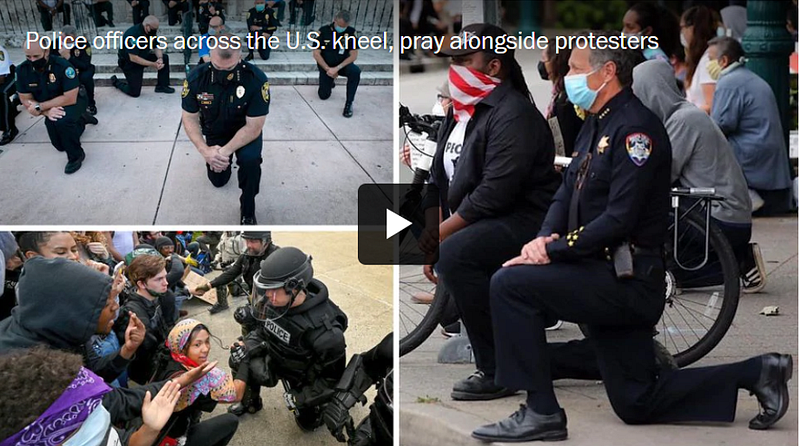
For me, this is an abundant mindset. This is being inclusive. This is an act of peace instead of war. We need to diffuse the edges. Make them vibrant with diversity so that the masses in their bubbles on either side will relate and stop being so tense and full of hatred.
Small Things Matter
Well, so far the bigger picture. But what do I, in my tiny little life in the Dutch countryside do with such vast, far-from-my-bed, it’s-not-affecting-my-life information?
Sherry asked:
“Why should I bother to write, or clean the house, or pay the bills or give a shit if our grass is cut or ten feet high — when the notion of a tomorrow or next week or next year seems irrelevant.”
It might seem irrelevant, Sherry, but it isn’t.
The world will not change with big actions. It will change with the small ones. You and I smiling to someone who’s behind the counter in the supermarket matters.
She might be on the edge. Your heartfelt smile might make the difference between living in a hostile world or feeling a glimpse of warmth.
Listening deeply to a friend in trouble, without judgment or giving advice, might mean the first step toward healing. And toward becoming a giving person herself again…
Starting a community garden in your area might mean the difference between hunger and breakfast before going to school. It might mean the difference between neighbor-fights and tolerance because we’ve met each other at the latest community BBQ.
Nature is made up of ecosystems. Communities of interbeing species. In the center are the I-can-only-see-my-own-bubble ones. Not woken up yet. On the edges are the I-can-see-both-side ones. They can make a choice. Fight the strange ones in the next ecosystem or tolerate and merge…
Building Bridges
I told you before, I’m not a fighter in big protests. I’m uncomfortable in big groups. Fear would be ruling my life and I can’t handle that (yet). But I do admire the fighters tremendously. And I support them.
Non-violent protests are so powerful!
Remember Mahatma Gandhi. He led the Indian people in an anti-colonialist protest in 1930. They walked 400 km (250 miles) to the sea in the Dandi Salt March because the British had imposed a salt tax. He fought for the right to harvest their own salt. And inspired so many in the process…
Remember Martin Luther King who dreamed about equal rights back in 1963.
But people say to me: it didn’t change anything. We need more fierce action. We need to fight harder!
And I don’t agree. The planetary-scale doesn’t think in a few years, it thinks in decades, in centuries. Change doesn’t happen overnight. But we can see it happening.
- It’s in the waking people that we see the change
- It’s in the debates about privilege and colonialism
- It’s in recognizing that slavery isn’t acceptable. And slavery is also happening when women and children are sewing our T-shirts for next-to-nothing-wages in poor countries (link to sustainability…)
- It’s in the young people who have friends outside their own comfort zones
The next thing we need to do is to change the system. The economic system in which some people are filthy rich and others cannot feed their children. The global system in which some big companies rule the world with their polluting, consumerist-stimulating ways. A system based on never-ending growth and greedily acquiring money, money, money.
Economies and governments like ecosystems are possible. They are being made by consumers (aka co-creators), entrepreneurs, and politicians working on the transition. And the most important factor is that these new systems support life in a broad sense. All life.
And here I also agree with Barack Obama, who says:
“But watching the heightened activism of young people in recent weeks, of every race and every station, makes me hopeful. If, going forward, we can channel our justifiable anger into peaceful, sustained, and effective action, then this moment can be a real turning point in our nation’s long journey to live up to our highest ideals.”
Let’s be demobilizing the pests. Let’s all take our own small actions and be a small puzzle piece in the big puzzle. We’ll find a way of living our lives in peace and within planetary boundaries.
We’ll find a way to be the change we want to see in the world (quote Gandhi).
Speaking Out
Today I read a very interesting story on The Correspondent (the Dutch language version) by Vera Mulder titled: “Why Black Lives Matter Concerns Everyone.”
She quotes one of the co-founders of the Black Lives Matter movement, Patrisse Cullors:
“Recognize your privilege and use that power against inequality.” — Patrisse Cullors
On Twitter, a photo circulates in which white (mainly) women form a cordon around black protesters. To protect them from being shot at. It’s sad that it’s necessary, but it’s also beautiful to see such solidarity.
‘In the end, racism will not be solved by people of color, just like misogyny will not be solved by women.’ — Vera Mulder in De Correspondent.
And although I might not be the frontrunner in a protest march, in our daily lives Mike and I do act upon this message.
I speak out when he’s being judged because of his color. He speaks out when I am being judged upon being a woman. And we both speak out when our friends are being judged upon being gay.
These might be small acts. But they do matter…
Spiritual Action
Awakening on our planet is speeding up at an alarming rate now. And I think all the horror-happenings unfolding in 2020 are big-time catalysts. Shaking, shaking, shaking. Wake up! Wake up!
And I really hope that the spiritual beings among us, who don’t think funny thoughts when I mention meditation or purging by feeling-the-pain, will take some time in their day to shine their lights.
Ideas?
‘The Work that Reconnects’ by Joanna Macy has many wise thoughts about feeling the pain and bringing flow again. The world heals when we do this. So don’t think it’s just you flipping out.
As soon as you bring back the flow, your body has healed some of its past pains. And the world heals alongside it.
Of course, we can also just connect to burning places in our meditations and let our lights shine upon them. It seems the effect is even stronger when we do it in groups at the same time. Science is studying it and conclusions are still going both ways.
But I just build up my wisdom with my own experience.
You can do it too. Just pick your own method.
And explore your own wisdom afterward…
I don’t know whether what I’m doing is enough. I don’t know whether I should be doing more. I get on with life (and sometimes numb the pain with chocolate and wine…).
In my view, there’s only one conclusion possible.
ALL LIFE MATTERS
And this is what Mike and I practically do about it.
- We’re fully awake.
- We connect to people whoever they are
- We stop consuming and start creating
- We promote life in everything we do
And we hope our actions matter enough and will contribute to the whole puzzle…
Thanks, Sherry, for nudging me and inspiring me to write this story.
And of course, I’d like to hear from the others tagged in your story, too. I forgot to tag them. But when I read Timothy’s story, I remembered. P.G. Barnett Joe Luca Chris Hedges Gurpreet Dhariwal Jan M Flynn Kevin Buddaeus Kim McKinney Rasheed Hooda (I know you’re planning to, take your time…) Stephen Sovie Marla Bishop and Caroline de Braganza.
And if you want to connect, you can find me on LinkedIn, Facebook, Twitter, Instagram, or my website. Or somewhere putting my hands in the soil and creating healthy food together with my friends…
Thank you, Mike, for adding your wise energy to my words.
Further Reading
About Fighting, Building Bridges, and Being a Player
About the author


