
The Reflective Eclectic
Waiting Room Therapy
At the Psychiatric Emergency Room
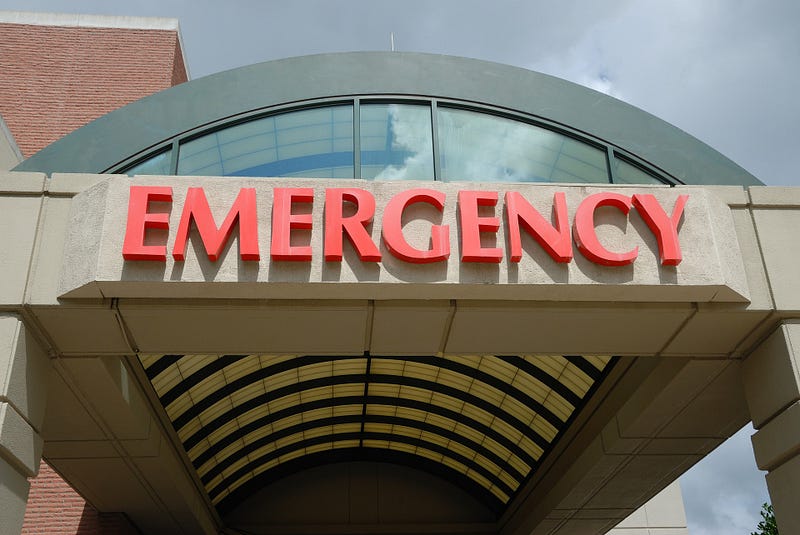
I used to work in a hospital emergency department. I was the guy who handled all the psychiatric emergencies. There were the suicidal people, just talked down from ledges, the homicidal people the police brought, the domestic violence people who wouldn’t settle down, the psychotic people who were trying to fly. Often the people who brought them in: the friends, the relatives, the Good Samaritans, were breathless with excitement and trepidation. People couldn’t wait to help. I had just the thing that would make them all feel better.
I had a waiting room.
The most important thing I learned about the emergency department is, once you get inside, there are no emergencies.
OK, maybe if someone comes in with a carotid artery severed, then, yes, that’s an emergency. Apply pressure to the wound and get more help. Other than carotid arteries, there may be a few other things that are true emergencies. Certainly, not everything is an emergency. In fact, very few things are. I know, I used to work in an emergency department.
We had a name for the principle mode of therapy we provided at the psychiatric emergency department. Waiting room therapy. There’s a change for the better that occurs when people don’t do anything; provided they’re safe, of course. When you don’t do anything, your heart stops beating so fast, your adrenaline wears off. You have time to think, to talk, to reconsider options.
When you don’t rush to solve your problem, you have time to consider all your choices. When someone else doesn’t rush to solve your problem for you, you often solve it yourself; you discover abilities you didn’t know you had. You learn that you can bear most things, they are tolerable, you develop endurance.
It’s not like I purposely made people wait. Far from it. I was always gung-ho about seeing people in a timely fashion. Most of the time I was interested in learning about new cases and, even if I wasn’t, it was in my interest to close them.
When I first went to work there, I would see patients when my bladder was bursting, when I needed to eat, when I should have taken a break. I thought that, since I was in an emergency department, everything there must be an emergency. It turned out nothing was. To prove it, we had waiting room therapy.
All the waiting couldn’t be helped. We were in an emergency department, after all. It’s busy. It’s understaffed. There are a bazillion forms to fill out. That’s what people do there, wait. I was forced to learn the therapeutic properties of the waiting room.
When I had been rushing to take care of someone else’s problem while neglecting my own, I was not only doing myself a disservice, I was also doing a disservice to my patient. I didn’t give her a chance to solve her own problem or, at least, to learn that it doesn’t have to be solved right away. I made her dependent on me, something she’ll resent me for. All my sacrifices, I’ll hold against her, especially the ones she never asked me to make. Furthermore, by neglecting my own needs, I decreased my own effectiveness. How good a listener do you think I was when I took a case when I really needed to pee, to eat, or take a break?
If you want to get a good dose of waiting room therapy, all you have to do is go to your local hospital’s emergency room. They’ll give you plenty of it. However, you can also administer your own. All you have to do is wait before you act. Pause and consider. Try doing nothing and see if that’s all you ever have needed to do.
Read more of The Reflective Eclectic and other stuff by Keith R Wilson


