
Wait for the moment your gut makes itself very clear about hard decisions
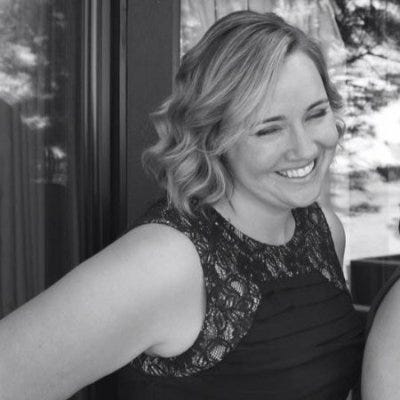
If you don’t know Molly Graham, now is your chance. She started her tech career at Google as a manager of Global Communications and Public Affairs. Then, she moved over to Facebook where she spent almost five years in two completely different roles—first as a manager of culture and employment branding; then as a director of Facebook’s mobile strategy.
One of the things that becomes immediately clear about Molly upon looking at her list of accomplishments is that she’s great at adapting to just about anything. You can throw her in a brand new role, or present her with a totally new challenge, and trust that she will find a way to lead herself and a team of people to success. That’s what she’s doing now as the COO of Quip, a suite of digital productivity tools that makes collaboration easy.
Recently, she joined Product Hunt for a LIVE Chat. Her answers to the community’s questions are filled with such precision and wisdom—it’s easy to see why Molly has become a bright light in the tech world. Enjoy. :-)
Given your experience at Facebook as it was really taking off, were there certain indicators to tell when things were going well or not well? Any small anecdotes or indicators when something was right or needed fixing? — Andrew Lee
That’s a really interesting question. The answer is yes, you could tell when things were off-kilter at Facebook. Usually it was when we were debating a decision that a lot of the company disagreed with. I think a number of us just spent a lot of time listening to all corners of the company. When you get bigger, you can’t know everyone, so you end up needing to connect with people who effectively represent a bunch of people at the company. Some people call them “culture carriers.”
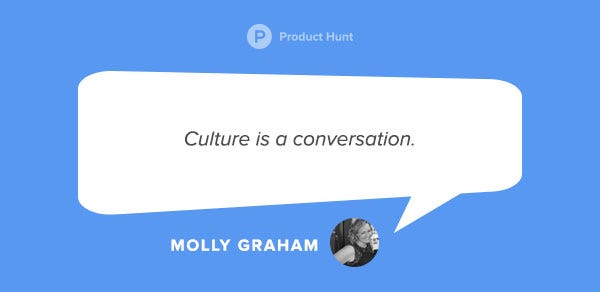
Anyway , when ALL of them were saying the same thing, we always knew that it was time for Mark to do a Q&A with the company (or Sheryl or whoever depending on what the issue was). Ultimately, I walked away from FB with the sentence, “Culture is a conversation.” I believe that pretty strongly. To me, it means a couple things:
- You have to listen to the company to learn what is going on—and to a certain extent, who you really are.
- The conversation evolves over time.
- You (as the founder, leader, etc.) are a huge part of that conversation. CEOs and founders have to see contributing to that conversation—but more importantly, shaping it—as a HUGE part of their job once the company has more than about 30 people.
What attracted you to Quip? — Kate Segrin
I knew I wanted to learn what it meant to build something from nothing, which I knew nothing about. I got some advice from someone much smarter than me. He said the Valley divides itself into pre-traction companies and post-traction companies. Post-traction companies are going to be successful, it’s just a question of how successful. Post-traction companies are the Pinterests and Airbnbs of the world. Pre-traction companies are the companies that are fighting for their lives. They are fighting to be the next Stripe, Pinterest, Airbnb, but they are very far from a sure thing. His advice was that if you wanted to go to a pre-traction company, “the only thing that matters is the team.” He said, “I’m not sure I would even evaluate the idea. I’d just go find the best team you possibly can.”
As you reflect on all of the roles and things you’ve done, can you share one of your defining moments? How has it shaped the way you approach your role at Quip? — Corley Hughes
Defining moments! There have been many. Deciding to leave Google and go to Facebook was very definitive for me. I had a number of options at Google that sounded very impressive, and at the time, Facebook was very much not a sure bet. In 2008 (hard to remember), most people thought FB was just a site for college kids, or that it was going to be bought by Microsoft (funny now, but real). I’m embarrassed to say that even I didn’t fully understand what Facebook was doing in the world when I was offered a job there. And I was confused about the decision for many reasons. Someone said to me: “You have the answer inside you, you just have to listen for it.” And I was sitting outside, drinking a beer and my gut just said, “I want to go work with Elliot Schrage and Sheryl Sandberg at Facebook.” (Elliot was my manager at Google, and Sheryl was a mentor.)
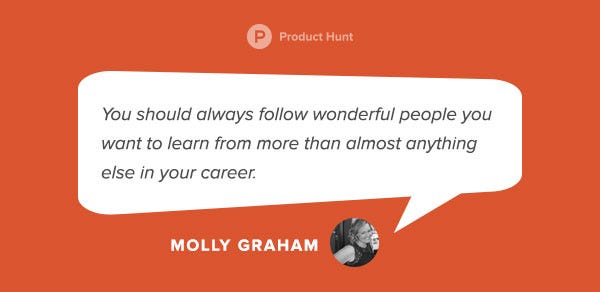
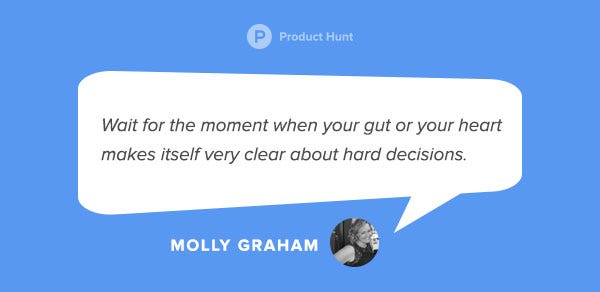
The answer was suddenly very clear and 100% about people. That advice — to wait for the moment when your gut or your heart makes itself VERY clear about hard decisions — has served me very well through every single hard, complicated, emotional decision I have made since. The other thing that is defining about that decision is it ended up being so completely the right decision for me. It taught me that you should ALWAYS follow wonderful people you want to learn from more than almost anything else in your career. I have been so lucky to get to learn from many, many amazing people. And I came to Quip for many reasons, but a very significant one is that we have (VERY humbly put) the best team in the world :)
How do you look at user retention and engagement in a utility startup like Quip? If people aren’t using it everyday, how do you measure the value of their participation and how important is it for a current user to bring in other users? — Tom Limongello
We look at active users in many different ways — MAU, WAU, DAU. We often take the first day of use out of our activity stats to look at the “real” active numbers. We also look at the leading indicators of activity like editing, messaging, and sharing. We have a lot of ways of thinking about the ratios of those things that tell us how healthy a given company or team is.
You did not plan to go into a career in tech — you started down another path. Can you tell us how that’s shaped who you are and what you learned from your experiences outside of tech? — Corley Hughes
I think my family thought I was going to go into development and live in Africa for a long time after college. My first job out of school was actually leading wilderness trips around the world for a company called NOLS. Leading NOLS trips was incredibly valuable to everything I have done since for many reasons.
The next job I got was at a non-profit called the Council on Foreign Relations, and the woman who hired me told me that she responded to my email because my resume said I could do CPR. She said she thought it meant I could handle stress well! I got my job at Google because CFR (the non-profit) was a Google Book Search partner, and after a 45-minute meeting with our book search partner, he said “Have you ever thought about working at Google?”
Moments like this also defined my time at Facebook. For example, I was originally hired in Communications but then I had lunch with Chris Cox who was running HR at the time. He said, “Do you want to come work with me to figure out how to turn these values we wrote six months ago into reality as we scale?” One of my biggest lessons has been that careers are 50% luck and 50% saying yes to a great opportunity when it punches you in the face.
I have made MANY decisions that everyone in my family and many of my friends thought were absolutely crazy, and because I knew how to listen to my gut and decide what was right for me, the “crazy” decisions have always ended up being right for me. Also, leading wilderness trips where the answer to the question “Is anyone going to die if we make this decision?” was occasionally “yes” has really helped me manage stress in the tech world where the answer is always (always) “no.”
What’s your biggest surprise working at Facebook for 4.5 years? — Ryan Hoover
I think I never ceased to be amazed by Mark and Sheryl. People underestimate many things about both of them individually, but also about their partnership. Mark is the fastest learner that I have ever met, and he sees learning as the most important part of his job, which is part of what has enabled him to go from a 19-year-old in a dorm room to the CEO he is now. Sheryl is the best manager I’ve ever met and I learned more about running organizations and teams from her than I thought possible. Her partnership with Mark is also remarkable for many reasons, but part of it is that they really emphasize each others strengths and make room for each other. People underestimate how hard it is for two people that are as strong as the two of them to do that. They have worked very very hard on it.
I’m curious about your philosophy on performance management. Specifically, what do you think is the point at which a company should introduce it? — Jeff Needles
I could talk for hours [about performance management], but the short version is I don’t like the word because I think it means a lot of things — but two very big ones that are very different:
1) How do we help people grow and learn and get better at their jobs? And relatedly, how do we build a culture where people give each other feedback?
2) How do we make sure we are fairly compensating people for their contributions to the company?
I like to separate those two. As a startup, I would aggressively be working on #1 all the time. It is the only way you will build a long-term sustainable company.
#2 is what people are usually talking about. I think you can implement a lightweight, once-a-year review of everyone’s comp, and that should last through about 100 people (maybe less). I don’t think it needs to involve more than the founding team for that time. Once you get a bit bigger, you can involve more managers, but I would avoid heavyweight systems and process. Again, it’s a much longer conversation but I would add process little by little rather than putting in something heavyweight when you’re 50 people.
During your career to date, what has been your a) most challenging moment (and how did you overcome it?), b) proudest moment (and why?), and c) most surprising moment? — Emily Hodgins
One of the things you should know about me is that I love (sometimes to a fault) doing things I’m scared of and am not sure I can do. It has defined all my job choices since I discovered how much I love it. I am a risk-led person. So, I suppose challenge is a part of every day and every job for me. I probably discovered my love of risk and challenge when I decided to move from HR to mobile at Facebook. I literally knew nothing about mobile — the space, the products, etc. And for some reason, someone asked me to come work on some of Facebook’s long-term mobile initiatives. It was terrifying. I remember 6–8 months after I started, I realized that I had gone from knowing nothing to actually being an expert and being able to teach others about the mobile industry and how it works.
I remember a meeting with Mark Z. where my team and I educated him at a pretty deep level about how people purchase and use mobile phones in most countries around the world (Hint: the US is abnormal) — post-paid versus pre-paid plans and all that — and it was so fun to realize how far I had come. The list of mistakes and challenges overcome in my career is pretty long, so that’s just one example!
Who are some people you have looked up to in your career? Have you had any mentors and how did they help you? — Emily Hodgins
I have SO MANY mentors. I actually call them friends. I look up to and learn from almost all my friends for many reasons. There is SUCH a long list of people who have been important to helping me learn and grow that it would actually be impossible to list them all.
But, you asked about people I look up to. I have always admired people who can lead big, complex organizations, do important work that makes the world better, and retain their humanity and ability to connect with people at a very deep, authentic level. The two people who I probably admire most for that in my life—and that I aspire to be like—are my father, Don Graham, and a woman named Patty Stoneseifer who was at Microsoft for many years and was the first CEO of the Gates Foundation. She now runs an amazing non-profit in DC called Martha’s Table. If I can be half the leader that the two of them have been in their careers, I would be so lucky.
What did you like most about Facebook? What do you like most about Quip? — Alex Carter
I loved how fast Facebook learns as a company. It is one of the hidden secrets behind how successful it is. It never stayed still or got comfortable with success. Part of that is who Mark is as a person — he relentlessly focuses on learning and making himself better. The company is a reflection of that. It’s how we went from having virtually no mobile advertising business to having one of the biggest in the world in more or less 1–2 years. Most companies can’t make shifts that big as quickly as Facebook did.
I love many many things about Quip. I love the team I get to work with every day, and I love working with our customers and watching the product make them happy and more efficient. I think the thing I love the most about what we are building as a company at Quip is how efficient and impactful our team is. We take a lot of pride in building a team of extremely high performers that defy expectations of how much a small team can get done.
How did you transition from HR at Facebook into all of those other roles? What advice do you have for young professionals starting off their careers at tech companies? — Alex Carter
All of those transitions were 50% luck based on being in the right place at the right time, and 50% saying yes to a big opportunity when it was offered to me even if it was vague or seemed stupid or crazy or whatever. I optimize aggressively for how much I will get to learn in a given role or project and NOT for whether something is a good “career decision.” Giving myself a tiny bit more credit on the luck front, I think the two best things I have done have been to always focus on being the most useful (and I use that word a lot) person in the room and never ever worry about who gets the credit, and to proactively build relationships with people I think are wonderful REGARDLESS of how “important” they are. It has led many many interesting places.
Do you find changing careers/departments invigorating or terrifying (or a bit of both)? Any tips for starting fresh in a new department? — Russ Frushtick
Both. But I love the bothness. I have taught myself to let myself have all the emotions — terror, insecurity, doubt, anger, frustration — that come with a HUGE learning curve, but to not do anything about them (unless they last for longer than 2 weeks). I have learned to love the roller coaster and the massive insecurity phase of big learning because I have now seen enough times the results of what happens on the other side — and how far forward I have been projected by “jumping off the learning cliff,” which is what I call it.
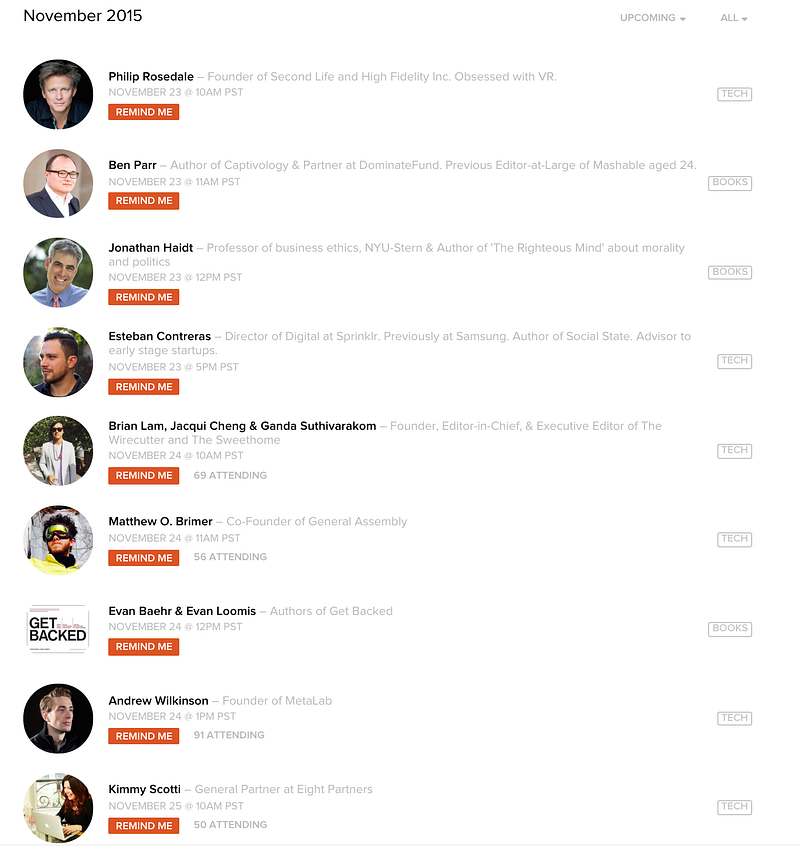
Check out Product Hunt’s full list of upcoming LIVE Chats here:
Editor’s Note: This Q&A text has been edited for brevity and clarity.


