PANDEMICS 201
Voltaire on Pandemics & Inoculations
Here’s what the great thinker had to say about smallpox, Europeans, and the ‘best-governed’ Chinese
Since we’re all Covid buddies now, could we maybe talk about pandemonium? And perhaps invite other friends into the conversation? Not just living friends. Let’s include some old, dead friends, too.

Our old pal Voltaire, for example.
François-Marie Arouet de Voltaire more or less stopped writing for social media in 1778, when he died at the ripe age of 84. But his writings may have something enlightening— ahem — to say about pandemics.
Voltaire made his fortune profiting from an economic bubble (The Mississippi Company) that precipitated the 1720 stock market crash and effectively bankrupted the French government. (And if this being the 300-year anniversary of a stock market crash so dire it bankrupted an entire government feels ominous…well…)
Welcome to the 300-year anniversary of a stock market crash so dire it bankrupted an entire government
Voltaire Takes the Cure
And in another eerie parallel with our modern international pandæmonium, Voltaire — the affable Tom Hanks of 18th-century Parisian society — also came down with the pandemic-de-jour.
Though still young when he was struck down, Voltaire was teetering between life and death for an entire month during one wave of the smallpox epidemic that killed 400,000 Europeans a year in during his era. The New England Journal of Medicine records the following account of Voltaire’s illness and his unusual recovery, an account published originally in Noyes’ 1936 biography:
“Voltaire had just arrived at the Château de Maisons, where he was to read ‘Mariamme,’ his tragedy of King Herod, before some thirty guests at the château.
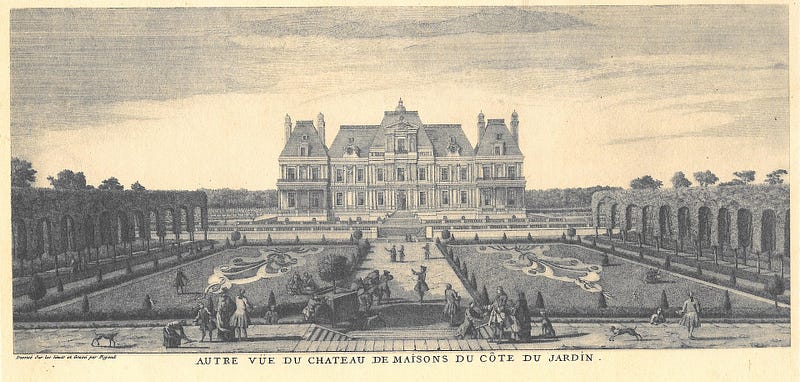
“Late at night he was suddenly taken seriously ill, and the celebrated physician, Gervasi, was sent for from Paris. Smallpox was diagnosed, and the guests fled in panic. Voltaire says that Gervasi ‘had a very poor opinion of my case; the servants noticed it, and did not fail to let me know. I made my will, and awaited death calmly.’
“M. Gervasi did not leave me for a moment. He gave me nothing without telling me the reason of it. He had to give me an emetic eight times. No cordials were given; instead he made me drink 200 pints of lemonade. This treatment, which may seem extraordinary to you, was the only way of saving my life. Any other treatment would have brought me to certain death and I am persuaded that most of those who have died of this dreadful illness would be alive today, if they were treated as I was.”
He made me drink 200 pints of lemonade….Any other treatment would have brought me to certain death.
Voltaire Opines On ‘Modern’ Medicine
An outspoken civil libertarian (he was, after all, French), Voltaire spent his career annoying powerful people. One of his many works is his series of essays, Letters on the English, first published in 1733 following his four-year exile in England — a work that compared the French rather unfavorably to the English.
One of his letters, the 11th, addressed the topic of English vs. French practices of inoculation. The French were 18th-century anti-vaxxers; the English, rather more willing to inoculate their offspring against smallpox.
Here’s how Voltaire described the process of inoculation, a procedure that apparently originated in Circassia on the eastern side of the Black Sea:
“The Circassian women have, from time immemorial, communicated the small-pox to their children when not above six months old by making an incision in the arm, and by putting into this incision a pustule, taken carefully from the body of another child. This pustule produces the same effect in the arm it is laid in as yeast in a piece of dough; it ferments, and diffuses through the whole mass of blood the qualities with which it is impregnated. The pustules of the child in whom the artificial small-pox has been thus inoculated are employed to communicate the same distemper to others.”
Ewww? Makes you grateful to get your own inoculations through a sterile needle?
According to Voltaire, his contemporaries in Europe had much the same reaction upon discovering the English were undertaking the same procedure with their own children:
“It is inadvertently affirmed in the Christian countries of Europe that the English are fools and madmen. Fools, because they give their children the small-pox to prevent their catching it; and madmen, because they wantonly communicate a certain and dreadful distemper to their children, merely to prevent an uncertain evil.”
Voltaire didn’t share their reaction. In fact, he took up for the English:
“The English, on the other side, call the rest of the Europeans cowardly and unnatural. Cowardly, because they are afraid of putting their children to a little pain; unnatural, because they expose them to die one time or other of the small-pox.”
After setting forth a history of inoculation he turns again to praise the English, and in particular, Queen Elizabeth. (Yes, there was a beloved, long-serving monarch named Elizabeth on the English throne in Voltaire’s day. Are the parallels starting to make your eye twitch?)
“It must be confessed that this princess [Elizabeth], abstracted from her crown and titles, was born to encourage the whole circle of arts, and to do good to mankind. She appears as an amiable philosopher on the throne, having never let slip one opportunity of improving the great talents she received from Nature, nor of exerting her beneficence. It is she who, being informed that a daughter of Milton was living, but in miserable circumstances, immediately sent her a considerable present.”
Elizabeth Rex, learning that inoculations might effectively stop the spread of smallpox, pulled four prisoners from death row and inoculated them — reasoning that if they were going to die either way, they’d be no worse off, and if they lived, they’d be grateful to have been experimented on. They lived.
Voltaire does the math in support of inoculations:
“Upon a general calculation, threescore persons (ie, 60) in every hundred have the small-pox. Of these threescore, twenty die of it in the most favourable season of life, and as many more wear the disagreeable remains of it in their faces so long as they live.”
Smallpox scarred faces; COVID-19 apparently scars lungs. Tomato, tomahto.
Finally, Voltaire praises the Chinese and their approach to governing in a time of pandemic:
“I am informed that the Chinese have practised inoculation these hundred years, a circumstance that argues very much in its favour, since they are thought to be the wisest and best-governed people in the world. The Chinese, indeed, do not communicate this distemper by inoculation, but at the nose, in the same manner as we take snuff. This is a more agreeable way, but then it produces the like effects; and proves at the same time that had inoculation been practised in France it would have saved the lives of thousands.”
So there’s today’s contribution to “Those who cannot remember the past are condemned to repeat it.”
From here in locked-down France, I wish you clean hands, comforting thoughts, and safe passage.

More from The Relationship Institute
Angry partner? Don’t get sucked in. Here’s how to stay calm and centered: How to Stop Getting Sucked In
She gets upset when you try to help? Maybe it’s time to change tack. Here’s how: The Words Your Upset Wife Needs to Hear
Who’s at fault when a woman’s appearance leads to sexual arousal? Take a deep breath and read: Well, If Your Clothing is Sexually Provocative…
Is it ok to put your kids ahead of your partner? Take this 10-question test at Who Comes First: Partner or Kids?

The Relationship Institute uses a martial-arts metaphor to coach relationship, communication, and life skills. Visit our digital library, schedule training events, and sign up for our newsletter to receive free therapeutic advice for improving your relationships.
LauraMaery Gold, LMFT, is a licensed marriage and family therapist working via teletherapy with couples and parents, and writes for Relating magazine. She is also executive director of the The Relationship Institute and the author of oh-so-very-many books on family concerns. When all seven of their kids became adults, she and her husband took up residence in a 400-year-old castle — not Voltaire’s — just outside of Paris.


