
Il Douche
A not-at-all ”careless” historical comparison
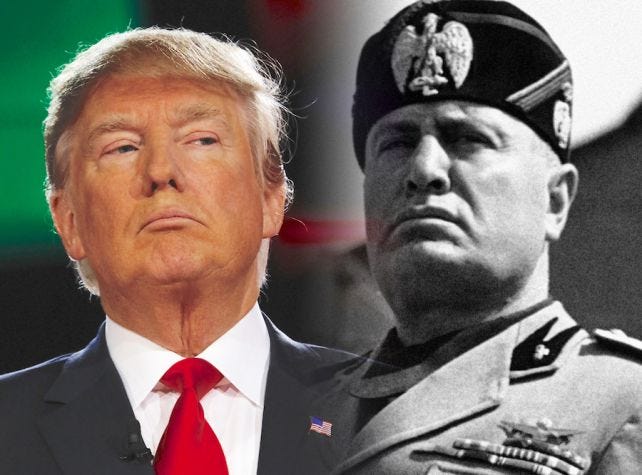
Vanilla Isis
“History repeats itself — first as tragedy; second as farce.” — Marx
It looks like both now.
Alarmingly, the recent would-be bombings, in an “unprecedented event” for the U.S., are attempted assassinations of our President’s critics – objectively, pro-regime terrorism.
As in Syria – technically speaking. Or 1930s Italy. A disturbing precedent.
Our Head of State, after all, previously identified each one of the intended victims — vitriolically.
Each has been called something between “enemy”, “criminal”, and/or “intellectually challenged person” by the President. Of the United States.
How?
Pet Names
The technique Trump uses (simply: “say insult + name; repeat ad nauseum”) is not new.
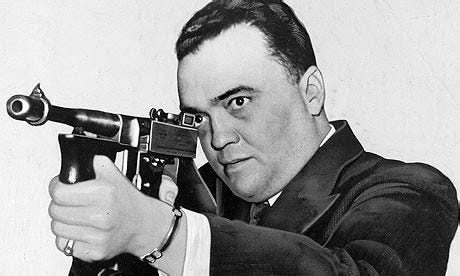
In the 1930s, FBI Director J. Edgar Hoover pioneered it for the FBI’s Most Wanted Fugitives list (not to in any way compare the Spray-on Don to that “historical villain”).
Hoover gave nicknames to Prohibition-era crime figures: “Scarface” Al Capone, “Public Enemy #1” John Dillinger (executed by the FBI), “Baby Face” Nelson (executed by the FBI), and “Pretty Boy” Floyd (killed by local law enforcement and the FBI).
Mussolini never mentioned parliament without noting the “old fossils” who filled it.
[Sayoc — as I correctly guessed, it seems (7PM — 10/26) was a] self-styled vigilante of some variety. He likely believed he was doing his civic duty in some way — albeit extrajudicially.
His duty to assist our perpetually aggrieved, perennially persecuted President.
According to academic Elizabeth Nelson’s article in the Journal of Communication Studies, “Nothing ever goes well enough”: Mussolini and the rhetoric of perpetual struggle, Mussolini was forever under siege too.
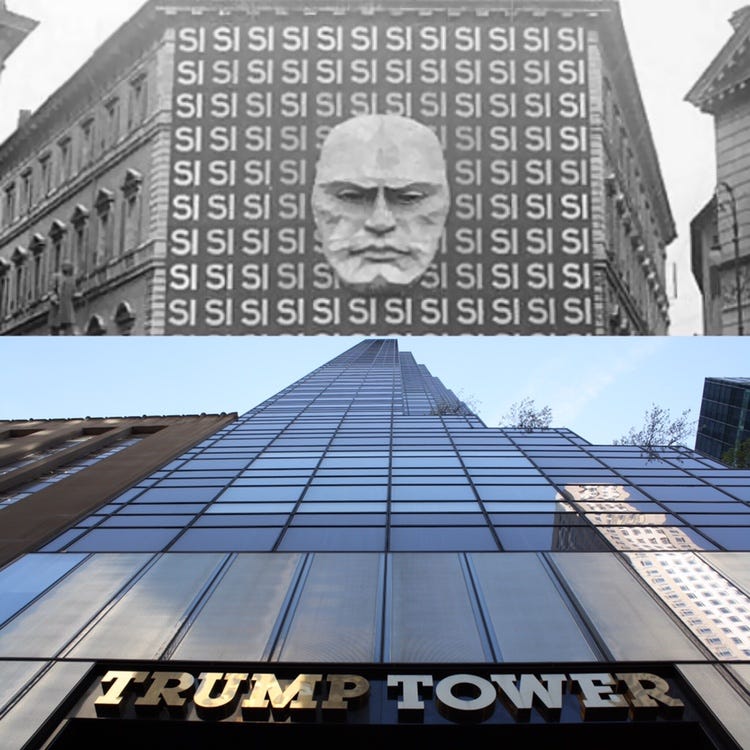
Pet Names and Repetition
Over and over, Trump repeats that “Crooked” Hillary should be “locked up”. Then there is “Cheatin’” Obama, and his old “crony”, “Crazy” Joe Biden. There’s the “Fake” News Network (CNN, which, like all media, is an “enemy of the people” — a phrase Mussolini also frequently used).
Don’t forget poor Low IQ Maxine Waters and Very Low IQ Robert DeNiro (a non-politician who has merely criticized the President). All are Angry Democrats who Trump implies are somehow impeding his transformative “re-great-ification” of America. All were terror targets for Sayoc.
In his 2017 paper, I Alone Can Fix It: Trump, Mussolini, and the Crisis of Authority, academic Daniel Fowler of Roanoke College says:
The notion of a national rebirth, a key fascist precept, reveals the distinctive way in which fascists conceive of the state…fascism necessarily holds, “that a ‘nation’ is an entity which can ‘decay’ and be ‘regenerated.’”
But about (Very) Low IQ Waters and DeNiro: Never mind the basic ethics of insulting someone because of an intellectual challenge (if that were even the situation for either of them).
We already know that Trump openly makes fun of differently abled people anyway [Mussolini railed against “the weak”], just as he frequently does many marginalized groups: women, non-whites, non-Christians, non-citizen residents, and so on. [Mussolini was especially xenophobic.]
The Superlative Leader, that “very stable genius” [Mussolini believed himself “intellectually superior”] dislikes these people, and so that, apparently, is enough [as Mussolini’s enemies were automatic enemies of his loyal supporters, the Blackshirts – his ‘MAGAbombers’]
Trump, in his initial remarks on the subject of this horrifying new wave of domestic terrorism, read a few obligatory words about “unity” (a word I’ve never heard him say) from a teleprompter, sounding far more bored than upset about any crisis, culminating in this wise counsel:
“No one should carelessly compare political opponents to historical villains.”
He then attacked and blamed the media…for attacking and blaming him…for previously attacking and blaming the now would-be terror victims he has so vilified (all the more savagely as the midterm elections approach) for supposedly being people who have done any number of very bad things that generally remain — general; vague. A hypothetical typical Trump “accusation” might go like this:
I’m not saying (s)he stole xyz — but (s)he’s obviously a “total no-good crook”.
Only recently, the President called the media and others “evil” for having dared to be “critics” of his Supreme Court pick, hot-headed former frat bro Brett “Kreepy” Kavanaugh.
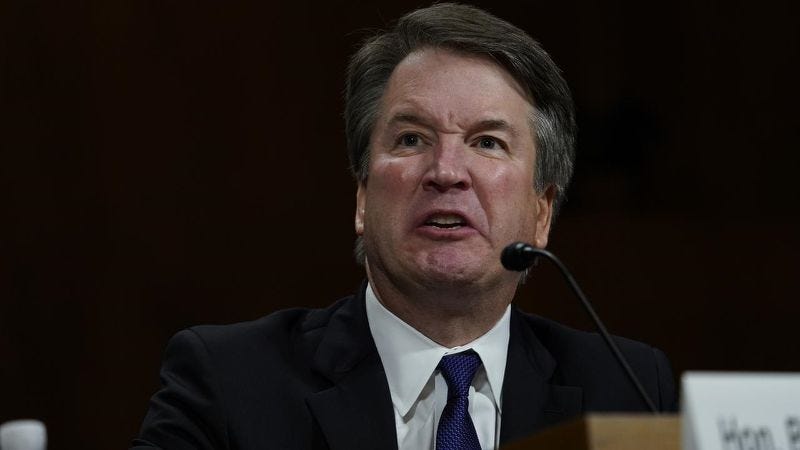
Aside from the allegations against him, many Kavanaugh critics faulted the judge mostly for his overall judge-ment; specifically, his tactless, boorish manner as he repudiated allegations about his tactless, boorish manner — and worse.
For a man accused of being a past drunk and brute (if not also a rapist), Kreepy Kavanaugh was extravagantly combative at his hearing, with his general disposition resembling full-on ‘roid rage as he sputtered rebuttals, conveying a familiar, privilege-derived form of dismay that is the province of Ivy League white men when accused of wrongdoing.
He was, in essence, the picture of an absolute lout that Dr. Ford had no doubt identified correctly from decades ago.
Meanwhile, after offering some sage advice, then the obligatory media-bashing, our venerable Commander-in-Chief went further (as he so often does), going off-script to mock the very notion that inflammatory rhetoric may lead to incivility (let alone violence), adding:
“By the way, do you see how nice I’m behaving tonight? Have you ever seen this? We’re all behaving very well and hopefully we can keep it that way, right?”
The President delivered these latter, off-prompter remarks with a bizarre, seemingly ironic levity — smiling, mugging and shrugging like some vaudeville-era aspiring comedian. [In short, like Il Duce, the last century’s Prince of Pomposity, would have.]
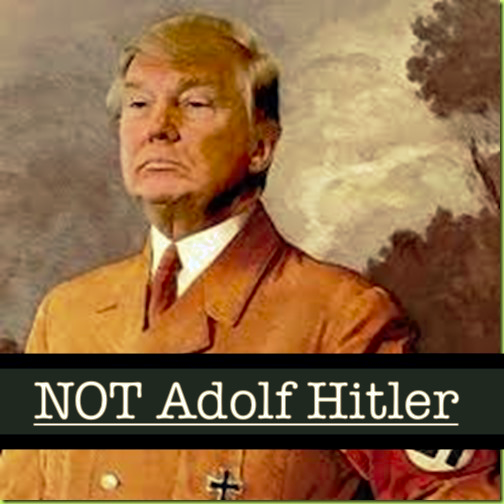
He’s Not Hitler
Not to ‘damn with faint praise’ one we can so easily damn with scorn, but maybe Trump’s non-Hitlerness did need to be explicitly stated, given that the President feels so personally, unfairly compared to “historical villains” these days.
Hitler, of course, has long been the ultimate “historical villain” to Americans (and many others). According to historian Gavriel Rosenfeld, before Hitler, ancient Babylonian King Nebuchadnezzar was the benchmark for evil incarnate to many Americans.
Not a fun name to spell or say in a hurry.
Remember, Trump, who is neither like Nebuchadnezzar nor Hitler, particularly – well, for the most part – deplores “careless” comparison of political opponents to “historical villains.” We may therefore presume that he wouldn’t have, say, tweeted something fitting that exact descrip…..⏧
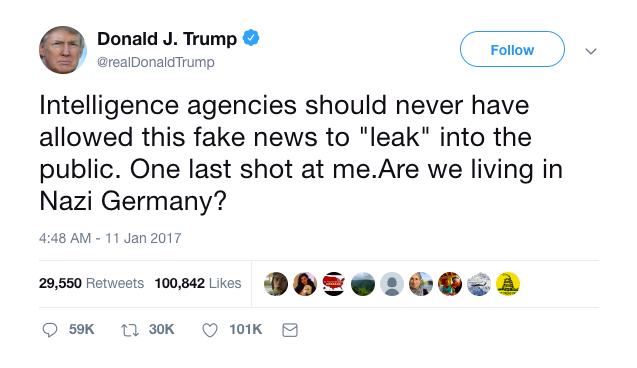
Wait… what?!
Surely the tweet here mentioning “Nazi Germany” is a one-off event, from way back when Donald was just young and naïve…
Nope, it’s from last year.
So, Trump is making some very new rules by asking that no one else ever invoke “historical villains”.
Either that or in January of last year, he was very confused about his general geographical location and historical era (entirely possible). Or, he doesn’t consider World War II-era Nazis “villains” anymore (also possible).
Last I checked, nazis overall are still pretty poorly regarded by most Americans. But he did — almost unbelievably — proudly proclaim himself a nationalist just three days ago (“Use that word!” he said repeatedly to his Houston supporters).
For those who didn’t know, ‘nazi’ is just an abbreviated form of that very same word in German — in that language, it is spelled:
N-a-t-i-o-n-a-l-i-s-t
(German for “nationalist”)
Yep, exactly the same word. (Note to Reader: This is a true, non-fake, fact.)
It’s telling that Trump used the ‘nazi’ invective not against some maniacal foreign dictator (many of whom he likes — “loves”, even, as we learned recently), or a political opponent, or any actual threat, but rather against our own intelligence agencies — the people working often dangerous jobs to prevent things like the political terrorism we are seeing now.
Intermezzo (Intermission)
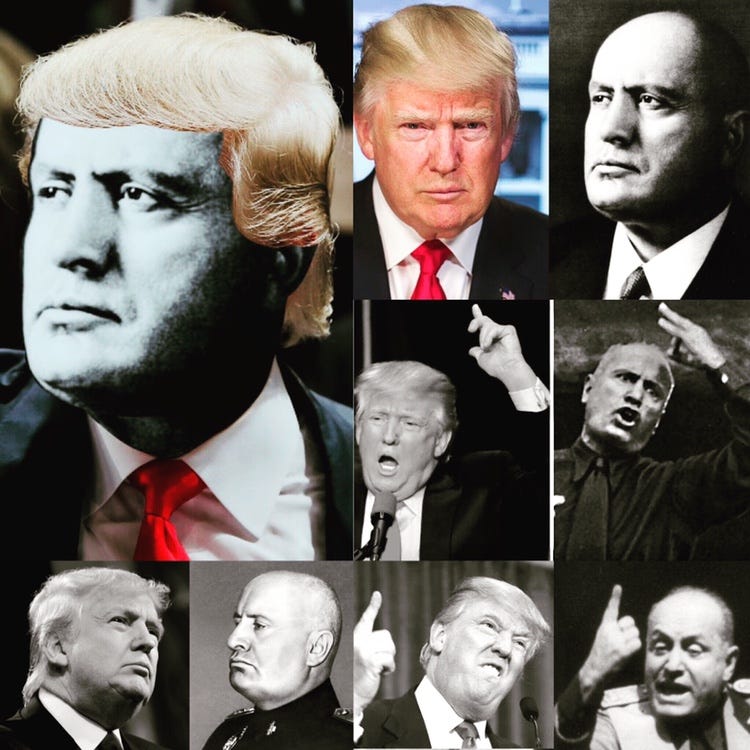
“A mercurial hothead, Mussolini reveled in his role as a political disrupter. His crisis-mongering platforms contained a confusing blend of socialist and nationalist tenets, trafficking in contradiction and paradox, the better to challenge traditional ideas about politics.”
“His grassroots followers spoke more directly, terrorizing Italy’s hinterland as a prelude to claiming control. Taking Mussolini’s incendiary rhetoric to heart, his blackshirts beat and executed thousands of political opponents…”
— History Professor Ruth Ben-Ghiat of NYU, The Atlantic (8/10/16)
Despite his blatantly hypocritical guidance on how and when free Americans may deploy historical analogies, I believe I am adhering to the President’s counsel so far, technically, by avoiding careless historical comparisons.
Where others have indeed carelessly compared the President to, say… Hitler (an unfair comparison to Trump on several levels and to Hitler on a few others, given that Hitler, unlike Mussolini or Trump, was basically competent, in some ways — at least in the beginning. He built the Autobahn, the Volkswagen, and industries like pharma and rocketry from scratch. Hitler, furthermore, was legitimately “the greatest” something, even if that something amounted to “…monster of all time”. Il Duce and Il Douche, as I sometimes affectionately call the man who loves nicknames so much he’s willing to let others die for them… not so much).
Godwin’s Law:
“As an online discussion grows longer, the probability of a comparison involving Nazis or Hitler grows.”
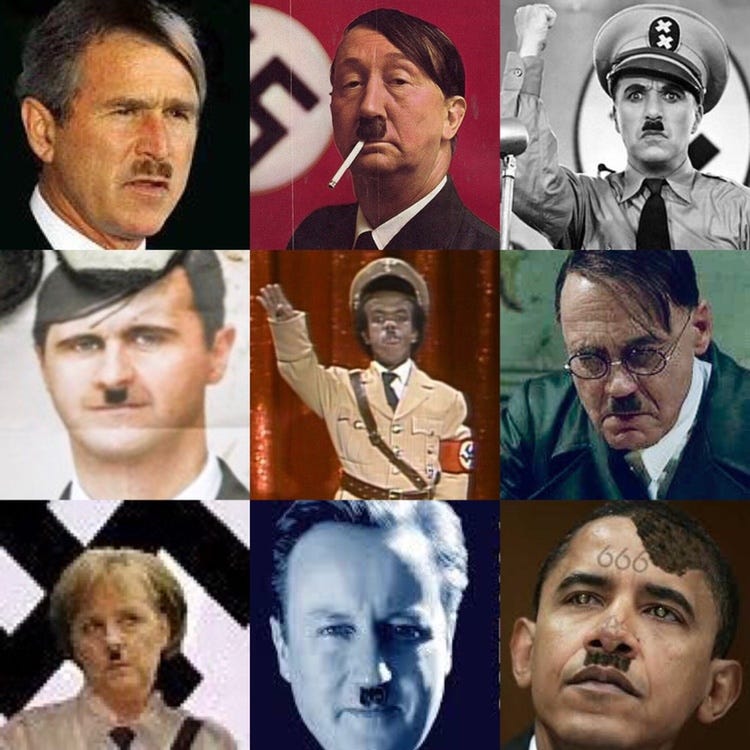
Mussolini, not Hitler, is Trump’s apparent ‘spirit animal’ in many ways, a fact I am far from the first to observe. Il Duce was a man with whom Trump shares many genuine similarities in personality, style, and character, as well as ideology.
Mussolini was famously full of bluster, brashness, bombast, and braggadocio — the latter being the ultimate word to perfectly describe The Donald.
Mussolini was also one of only a few politicians living or dead that Trump has quoted correctly:
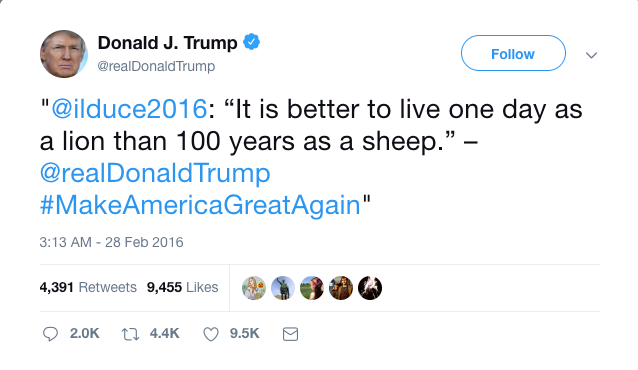
After (one would hope) “inadvertently” retweeting the above direct quote from Il Duce — which, by the way, was planted for Il Douche by the popular blog Gawker, using the handle “ilduce2016” (“Duce” meaning “Duke” or “Leader”, but referring to Mussolini as irrevocably as Der Führer refers to “you-know-who”) — Trump had the opportunity to set the record straight in a previously planned interview.
Speaking to host (“Sleepy Eyes”, as Trump calls him) Chuck Todd of NBC’s (“Ratings-Starved”, he says) Meet the Press (10/26/16), Trump said:
“It’s OK to know it’s Benito Mussolini. Look, Mussolini was Mussolini. It’s OK. It’s a very good quote. It’s a very interesting quote. And I saw it and I know who said it. But what difference does it make, whether it’s Mussolini or somebody else?”
Although the dictator in question was a murderous, oppressive tyrant, the titular Leader of the Free World said: “Mussolini was Mussolini”.
Given his famous fondness for insulting anyone he doesn’t like, this simple, non-judgemental, self-reflexive statement from Trump was and is revealing in very bad ways.
Domestic political opponents are often nearly demonic, to hear Il Douche tell it, but Mussolini is Mussolini.
This phrase has the pungent aroma of the old sexist cliché, “boys will be boys” (like Kavanaugh) or the idea espoused by some especially deranged political consultants that we should “let Trump be Trump” — never question the rectitude or sanity of the Dear Leader.
Increasingly, “let Trump be Trump” seems like the worst advice imaginable.
Todd, to his credit, pressed Trump for clarification on why he retweeted Il Duce’s old “I’d rather be a lion than a sheep” saw.
“Do you want to be associated with a fascist?” Todd asked.
No, I want to be associated with interesting quotes,” Trump replied.
“We do interesting things. And I sent it out and certainly, hey, it got your attention, didn’t it?”
Actually, it may have escaped the notice of many of us, like so many of his vile utterances, because that morally shocking thing was quickly buried beneath another one, then another…
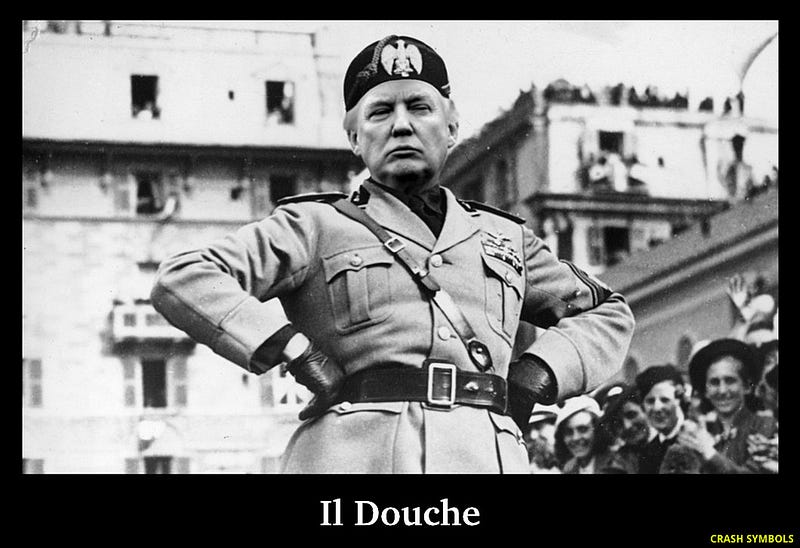
Like Mussolini, Trump apologizes for none of it — ever. Fallibility is not a particularly fascist (or nationalist) trait…at least as they tend to see it.
President Trump has either quoted or paraphrased Mussolini before, if (supposedly) unknowingly. Mussolini often used the phrase ‘drenare la palude’ – ‘drain the swamp’ (as Madeleine Albright noted). But the striking similarities go way beyond mere words. Former Secretary of Labor Robert Reich says:
“[Fascists] created around themselves cults of personality in which they took on the trappings of strength, confidence, and invulnerability — all of which served as substitutes for rational argument or thought…”
“In pursuit of their nationalistic aims, the fascists disregarded international law…”
“Fascists glorified national power and greatness, fanning xenophobia and war…”
Former Secretary Albright, who herself escaped the Nazi occupation of Czechoslovakia as a girl, mentions this and other interesting facts in her recent book, Fascism: A Warning. A Fascist, Albright tells us, is:
“…someone who claims to speak for a whole nation or group, is utterly unconcerned with the rights of others, and is willing to use violence and whatever other means are necessary to achieve the goals he or she might have.”
Mussolini, who historians have called things like an egoist, a narcissist, a bully, and “adept at exploiting all forms of mass media”, said any number of things that sound very (hugely) Trumpian in spirit — or rather, vice-versa.
A Few ‘Il Duce’ Quotes
“To make a people great it is necessary to send them to battle even if you have to kick them in the pants. That is what I shall do.”
“The Liberal State is a mask behind which there is no face; it is a scaffolding behind which there is no building.”
“The definition of fascism is The marriage of corporation and state.”
“Italian journalism is free because it serves one cause and one purpose… mine!”
“We deny your internationalism, because it is a luxury which only the upper classes can afford.”
“If I advance; follow me! If I retreat; kill me! If I die; avenge me!”
“I have been a racist since 1921. I don’t know how they can think I’m imitating Hitler.”
The last quote, though not something Trump would say in terms of content (at least presently — but there’s still time), is utterly Trumpian in its shameless braggadocio.
Trump isn’t Hitler, or Mussolini or Franco — yet. With that said, it is incumbent upon every Real American, to borrow a turn of phrase from Il Douche Massimo, to ensure that none of his minions become incumbents in the coming election, and that he is left like a lonely mime at his imaginary wall.
Quotes from the greatest of the World War II leaders, President Franklin Delano Roosevelt — and two bonus quotes:
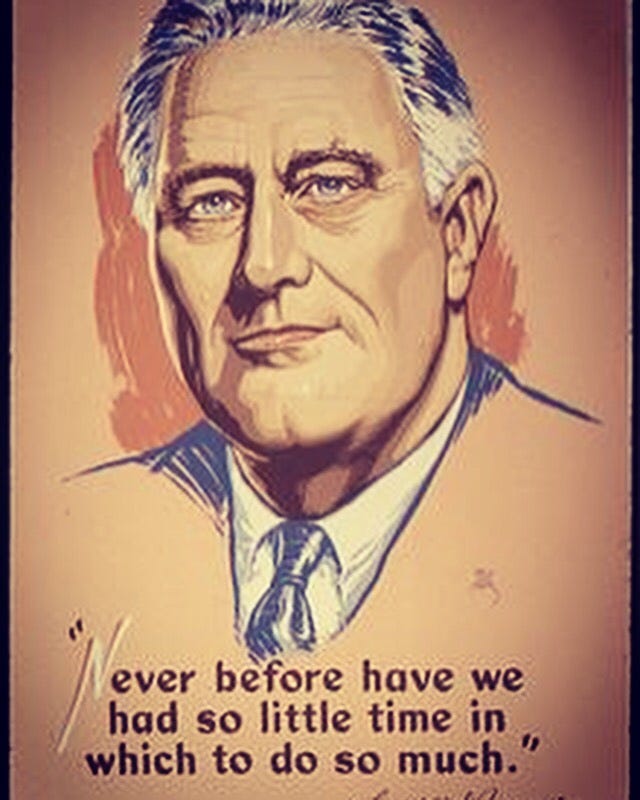
“The liberty of a democracy is not safe if the people tolerated the growth of private power to a point where it becomes stronger than the democratic state itself. That in its essence is fascism: ownership of government by an individual, by a group, or any controlling private power.”
“In these days of difficulty, we Americans everywhere must and shall choose the path of social justice…, the path of faith, the path of hope, and the path of love toward our fellow man.”
“Never underestimate a man who overestimates himself.”
“Freedom means the supremacy of human rights everywhere. Our support goes to those who struggle to gain those rights and keep them. Our strength is our unity of purpose. To that high concept, there can be no end save victory.”
“When Fascism came into power, most people were unprepared, both theoretically and practically. They were unable to believe that man could exhibit such propensities for evil, such lust for power, such disregard for the rights of the weak, or such yearning for submission. Only a few had been aware of the rumbling of the volcano preceding the outbreak.”
– Erich Fromm, Escape from Freedom
“Are you a communist?” “No I am an anti-fascist” “For a long time?” “Since I have understood fascism.”
– Ernest Hemingway, For Whom the Bell Tolls


