
Vita
Live is life… na, na, na, na-na

Today’s New York Times Spelling Bee letters:
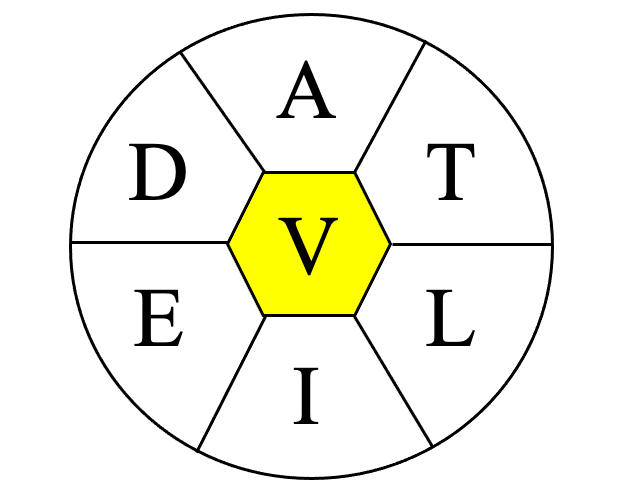
A, D, E, I, L, T, and center V (all words must include V)
Merriam-Webster says…
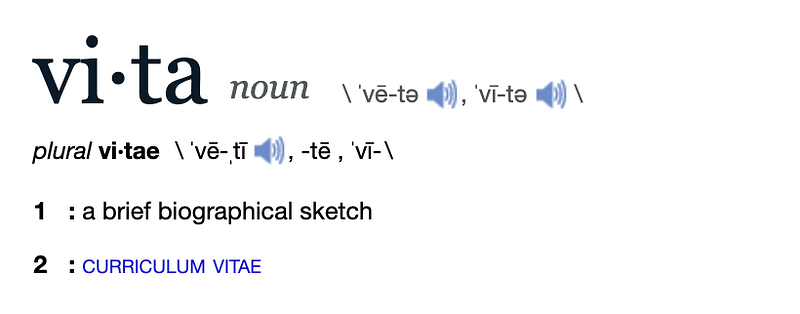
Silly little dictionary! Don’t you know that vita can’t possibly be a word if The New York Times says it ain’t?
For a complete list of rejected words, check out the Spelling Bee Master.
What’s your favorite dord* from today’s puzzle?
My Two Cents
The name of the 1985 summer hit song (first released in 1984) by the Austrian band Opus , “Live is Life”, has a very odd name. I was never able to figure out why it wasn’t called “Life is Life”, especially considering those see to be the words used in the chorus. Or maybe not. Not that much of the lyrics themselves make sense…
Although it barely cracked the Top 40 in the U.S., the tune was a breakout hit for the band in Europe, Latin America, and other parts of the world. Here in Spain (where I now live) it reached the number one spot and can be heard on the radio regularly on those stations that play music from the 1980s, like KISS-FM.
Among fans of football ––soccer for my American readers–– of a certain age, the song is perhaps best known as background music for an amazing series of keep-ups performed by Argentinian star Diego Maradona in April of 1989 during warm-ups for a UEFA Cup game.
And now, after that musical interlude, back to our daily dord*.
The bio
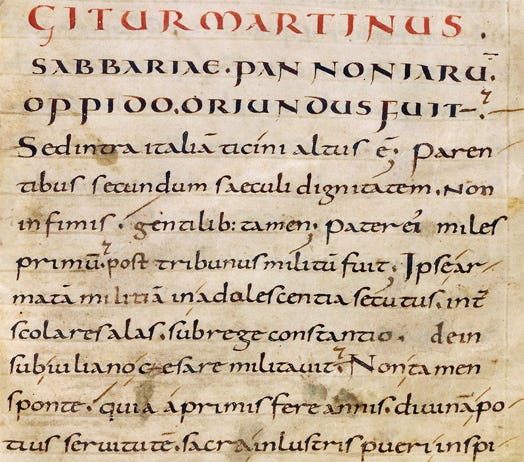
You’ve probably guessed that vita comes from the Latin word meaning “life”. In ancient times, say, more than 1,500 years ago, the word was also used to refer to hagiographies, or biographies of saints. The early Christian ones contained the story of the saint’s life as well as their deeds or miracles. The term vita was often the title itself of said bios.
Below is a section of the vita of St. Martin of Tours, the third bishop of Tours, France, best known for cutting his cloak in two to give half to a beggar in rags during a particularly rough winter.
In modern days vita is used mostly in its plural form ––vitae–– as the second half of the term curriculum vitae, or, as many Americans call it, a résumé. The latter comes from the French word resumer, meaning “to summarize”. On the other hand, Curriculum vitae (abbreviated as CV) is Latin for “course of life”.
There is a misconception that résumés are, in fact, short CVs, since modern-day American résumés tend to be only one or two pages long. In Europe, South America, and elsewhere, longer forms of your life and work accomplishments are more accepted. Some countries (for example, Spain) still demand a photo and date of birth be included, which is considered a big no-no in the U.S.
If you want to see an extreme example of a long CV, click on this link for the 69-page vita of Dr. Gabor B. Racz.
The glass
Merriam-Webster has this odd entry included when one searches for the term vita:
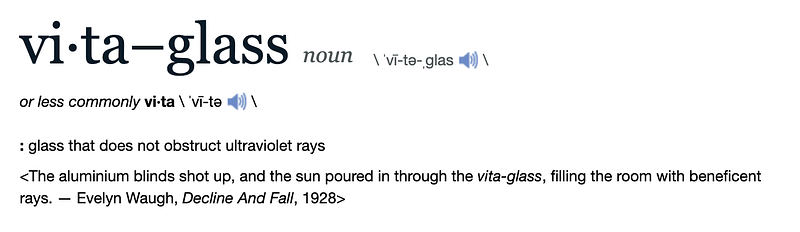
For those not familiar with Evelyn Waugh, his full name is Arthur Evelyn St. John Waugh, and his most famous work may be Brideshead Revisited, a novel that “explores nostalgia for the age of English aristocracy and Catholicism”.
Vita-glass was a big deal for a short while about a century ago, and I couldn’t find much information about it… probably because it was a big deal for a short while about a century ago.
I managed to find a paper in the 1929 edition of the Journal of the Royal Society of Arts, titled “The Properties and Applications of “Vita” Glass”. It was written by F. E. Lamplough, of Trinity College in Cambridge. In it, he explains the advantages of a newly-formulated glass that allows light rays below a wave-length of 3,000 AU (Armstrong Units) to go through. The paper includes this illustration:
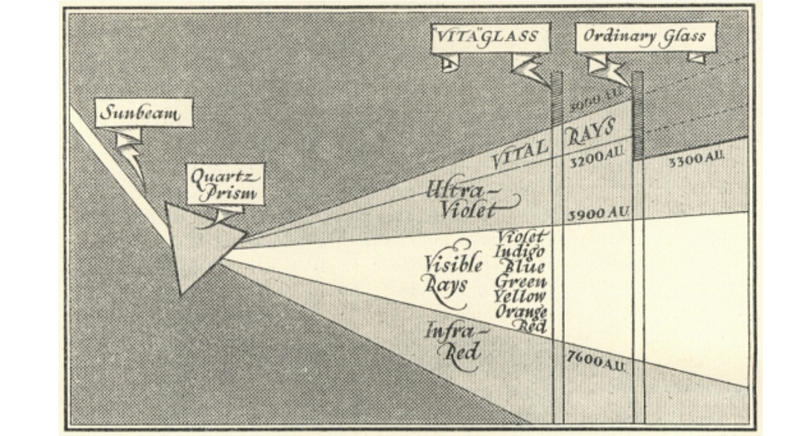
The “vital rays” may, of course, be the inspiration for the glass’s name.
In a 2018 blog post, Malcolm Peaker, fellow at both the Royal Society and the Royal Society of Edinburgh, talks about the efforts made in the 1920s to improve the health of animals at the London Zoo:
Joan Procter’s inclusion of Vita glass was just one manifestation of the Zoo’s pioneering efforts, through Sir Peter Chalmers Mitchell FRS, to improve the health of zoo animals. In fact, he was riding the crest of a scientific and populist wave sweeping across the world in the inter-war years that can be summed up as: fresh air, sunshine and vitamins. The architect, John Stanislav Sadar has put the whole development of Vita glass in that context… In the 1920s it was known that ordinary glass blocked the transmission of ultraviolet rays in sunlight. Ergo, glass that would transmit ultraviolet would be healthier.
He cites the same paper I mentioned earlier. The installation of vita-glass at the zoo was a success, after which “the New Health Society (i.e. Hill et al.) and Saleeby’s Sunlight League promoted its use in hospitals, schools, farms and greenhouses.”
This trend lasted for about a decade, after which sales of the new and improved glass fell rapidly due to “a mixture of doubts over efficacy, errors made in the commercial arrangements for manufacturing and marketing, price and competition.”
Today there is a website called vita-glass.com, but they deal with laboratory glassware, that is, beakers, flasks, petri dishes, and so on. The company is headquartered in Austria and has their plant in Ilmenaue, Germany, known for its glassware and porcelain production in the 19th and 20th centuries.
That’s about it for today. If you’re ever applying for a job in Europe, don’t send them your résumé. Email them your curriculum vitae. Or better yet, just your curriculum… because the editors of the Spelling Bee decided that vita(e) is a dord*.
You can check out my previous entry on another dord* here:
*What the heck is a dord, you ask? Here’s the answer: