
Visiting an Elephant Sanctuary: The Anticipation vs. the Sobering Reality
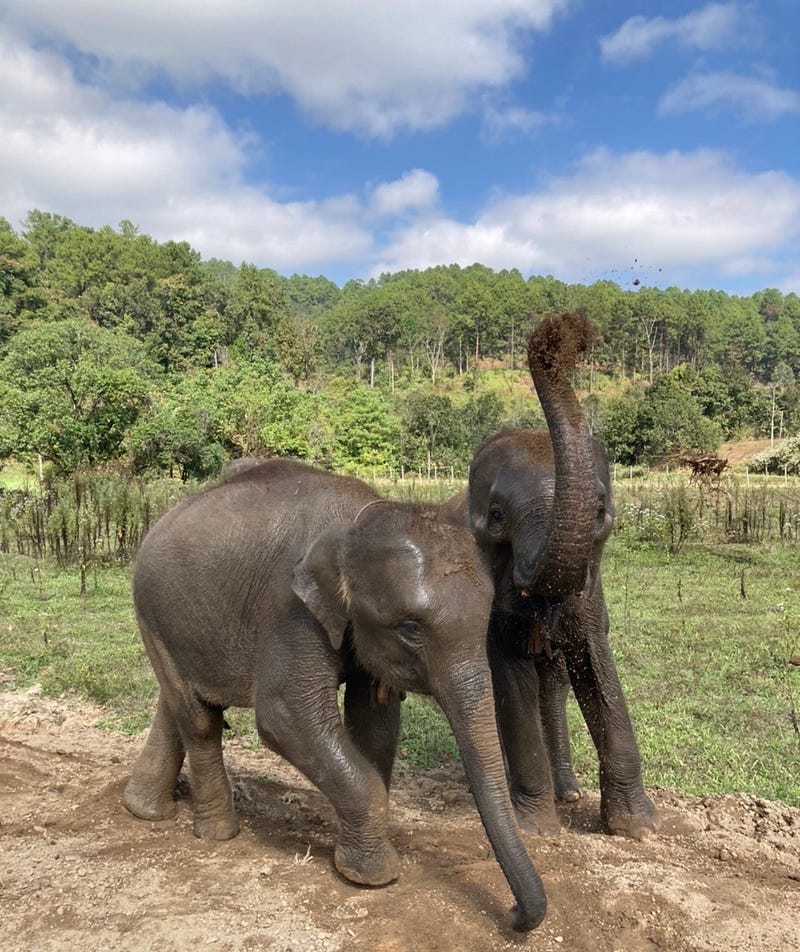
I wonder if I’ve been an animal in a past life. I wouldn’t be surprised if I had been — I feel deeply for animals, especially ones that have been domesticated for our benefit and pleasure. I went to visit an elephant sanctuary yesterday near the outskirts of Chiang Mai, Thailand — this had been something to which I’d been looking forward for a while.
Although I enjoyed spending time with the elephants, I found myself feeling bad for them, despite the fact that they were now living in a sanctuary after having spent their lives working for elephant riding camps, circuses or logging companies. After feeding the elephants, I just wanted to let them be rather than disturb their peace.
Prior to feeding the elephants, our tour guide explained to us that the elephants can be fed one of two ways:
1) Place a stalk of sugarcane or banana on the elephant’s trunk
2) Stand beside the elephant, shout “BON BON”, which will then prompt the elephant to open its mouth, thereby enabling us to place the sugarcane/banana directly in its mouth
Naturally, all of us (myself included) wanted to try feeding the elephants both ways. However, what I noticed was the following:
In order to feed the elephant using method #2, there were people who were literally screaming “BON BON” non-stop at the elephants. In one particular instance, I was getting annoyed. I wondered how the elephant felt with a screaming lady next to it. If an elephant managed to hear “BON BON” and open its mouth, a tourist would deposit food into the side of its mouth only for the elephant to use is trunk to retrieve said food and re-position it in the center of its mouth. This happened over and over again.
It occurred to me that we were feeding the elephants for our own enjoyment, not for their sake. Our tour guide mentioned that elephants need to eat 10% of their body weight each day. A 2-year baby elephant weighs 500 kilograms (~1,1120 lbs.), which means it needs to eat ~112 pounds of food each day. Furthermore, elephants spend ~20 hours a day eating. I imagine they just want to eat rather than being fed food in a way that doesn’t suit their needs.
After feeding the elephants, we were given the opportunity to bathe with them. The weather was a bit chillier than usual, especially in the jungle and it seemed like the elephant trainers had to coax the elephants into getting in the mud pit. Once the elephants were in, tourists took turns splashing them with buckets of water. Unlike cats or dogs, where you can observe their reactions to our actions (e.g.: petting them), I wasn’t able to discern whether or not the elephants actually enjoyed the water splashing.
Five minutes after entering the mud pit, the elephants voluntarily got out, at which point, we were encouraged to scoop up buckets of dirt and splash dirt on them. I was curious as to why we were encouraged to do this as I noticed that the elephants were already using their trunks to scoop up dirt and place it across their backs. The tour guide informed me that the dirt discourages mosquitoes from camping out on the elephants. Soon enough, a swarm of tourists started pouring dirt on the elephants as the elephants were shaking the dirt off their bodies. The tour guide then said, “Be careful not to get dirt in their eyes!” Again, I had this feeling that we were engaging in these activities for our enjoyment, not for their actual needs. If anything, we were engaging in activities that made daily activities harder for the elephants.
Elephant riding camps are practically obsolete in Thailand, whereas even just a few years back, they’d been all the rage. Perhaps we’ll eventually reach a point where elephant sanctuaries are places where elephants are left to be rather than a place for tourists’ enjoyment.
Thanks for reading! Want more?:


