
Engineered Viruses Hold the Potential To Revolutionize Cancer Therapy
Their near-perfect specificity is what cancer therapies are desperate for.

What’s your first impression of viruses? Ask non-virologists, chances are that “disease,” “infection,” “suffering,” or “life-threatening” would be their answers, say virologists Dr. Mario Mietzsch and Prof Mavis Agbandje-McKenna from the University of Florida. “However, as we are now finding out, not all viruses are detrimental to human health.”
The Start
In 1896, a 42-year-old woman was afflicted with leukemia. She later contracted influenza, which mysteriously shrank her enlarged liver and spleen and lowered her leukocyte count by 70-fold. How did influenza cure her cancer, the researchers must have thought at that time.
In 1933, 37 years later, scientists finally understood that influenza is a virus. The idea of oncolytic viruses soon emerged. Onco means tumor-related and lytic means lysis or destruct. Oncolytic viruses have the ability to preferentially attack cancerous cells while leaving healthy cells alone.
This overcomes a key drawback of conventional cancer therapies — such as chemotherapy, radiation therapy, and surgery — that cannot discriminate between cancerous and non-cancerous cells. Adverse side effects are bound to occur.
Since 1933, researchers have pursued the potential of oncolytic viruses to this day. And this is partly thanks to the four pioneering clinical trials — which received harsh criticisms at that time — that set off the field.
Mechanisms of Action
Oncolytic viruses used for cancer therapy are genetically modified to turn off their virulence genes and fine-tune their specificity for cancerous cells. Once inside cancerous cells, they behave like any typical viruses —they replicate and rupture the cell to release new virions. Released virions then enter other cancerous cells and repeat the cycle.
Another way oncolytic viruses fight cancers is by activating the host immune system. Tumors create an immunosuppressive environment to shield cancerous cells from being killed by immune cells. Oncolytic viruses inside tumors, therefore, “wakes up the immune system,” says Yaohe Wang, a professor of cancer cell and gene therapy as a co-author in a 2018 review in the Frontiers of Immunology.
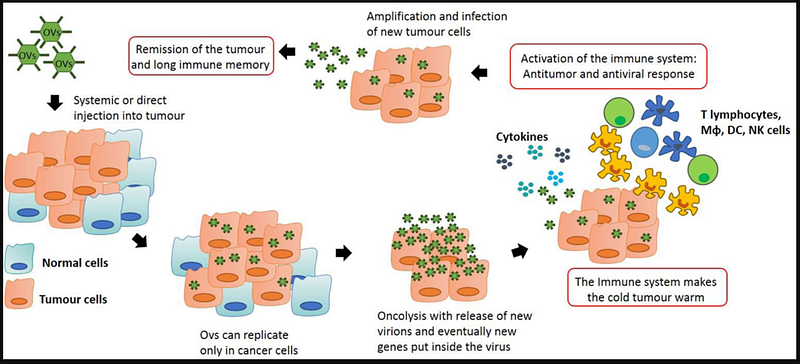
“This action generates an immunological memory that avoids cancer recurrence and synergizes with the oncolytic action of the viruses, potentially leading to tumor remission,” the researchers wrote.
Put simply, oncolytic viruses, while being busy replicating and lysing cancerous cells, also recruit immune cells into the site of action — boosting the overall killing of cancers.
“TVEC allows you to go anywhere in the body that you can have access to. This is a really good therapy for use in all places, not just the extremities.”
The First Approval
In 2015, the US Food and Drug Administration (FDA) and European Medicines Agency (EMA) approved talimogene laherparepvec (T-VEC) to treat stage III to IV metastatic melanoma cancer of the skin and lymph nodes that is non-removable by surgery.
T-VEC is an engineered herpes simplex virus-1 (HSV-1) that lost its virulence yet is able to infect rapidly dividing cells like tumors and recruit the host immune cells.
Clinical results with T-VEC have been ‘stunning’ with very mild side effects and a 39% success rate of treating melanoma, compared to <5% success rate of traditional chemotherapy.
“We know that surgeons will eventually reach a point where surgical resection is no longer feasible,” says the general surgeon and oncologist, Dr. David Ollila at Chapel Hill in North Carolina, who led the T-VEC clinical trial. “TVEC allows you to go anywhere in the body that you can have access to,” he continues. “This is a really good therapy for use in all places, not just the extremities.”
Because of this, “every kind of cancer could be [in theory] treated by viruses.
Gaining Momentum
This first success with T-VEC has sparked further clinical trials to investigate the efficacy of other oncolytic viruses in treating different forms of cancer.
A notable example is the engineered poliovirus used to treat glioblastoma — the most aggressive form of brain cancer. This clinical trial is expected to be completed in 2021. Initial observations, however, have been encouraging. “From the first patients, we observed very clear signs that the virus elicited antitumor immune responses,” noted Dr. Matthias Gromeier, a neurosurgical professor at Duke University who is leading the clinical trial. In 2016, the oncolytic poliovirus therapy earned a ‘breakthrough status’ from the FDA.
Currently, there’re more than 20 ongoing clinical trials on engineered oncolytic viruses. Listed here are a few examples:
- Herpesvirus for breast and pancreatic cancers.
- Adenovirus for bladder, colorectal, pancreatic, prostate, epithelial, multiple melanomas, ovarian, and brain cancers.
- Measles for breast, head and neck, ovarian, multiple myelomas, and nerve sheath cancers.
- Vaccinia virus for lung, head and neck, ovarian, melanoma, liver, colorectal, and renal cancers.
- Reovirus for colorectal, bladder, pancreatic, ovarian, multiple myeloma, and peritoneal cancers.
- Coxsackievirus for lung and melanoma cancers.
Update: In December 2022, one non-oncolytic adenovirus was FDA-approved for non-muscle invasive bladder cancer.
The Revolution
A chief limitation of oncolytic viruses is that they can be marked as foreign by the immune system. This means that oncolytic viruses can be destroyed before they infect cancerous cells. As Professor Wang and colleagues explained,
“It’s important to find a balance between the immune anti-viral response and the immune anti-tumor response in order to find the perfect equilibrium window to give oncolytic viruses and consequently the best way to fight cancer.”
With growing research to improve specificity, delivery, potency, and ‘immune-friendliness’ of oncolytic viruses, researchers at Mayo Clinic College of Medicine, Minnesota, say “that there is a justified sense of optimism in the field and a feeling that the challenges of antiquity are finally (or soon to be) history.” By the challenges of antiquity, they meant the low success rate of conventional cancer therapies.
To recapitulate, oncolytic viruses possess a unique feature that traditional cancer therapies have desperately looked for —that is, their near-perfect specificity that hunts cancerous cells amidst healthy cells. Because of this, “every kind of cancer could be [in theory] treated by viruses,” says the professor of cancer cell and gene therapy, Wang. But this is provided scientists could find the perfect equilibrium window.


