
Vintage Book Review: The Sound & The Fury
Faulkner called it, ‘a real son-of-a-bitch.’ Re-reading the Southern Gothic fever dream
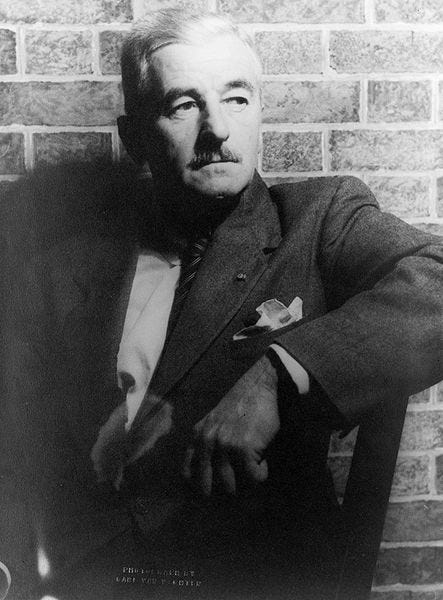
What do you get when you cross Macbeth, a notoriously heavy drinker, and a tale about a family in Mississippi? The Sound & The Fury.
This one is, as Faulkner himself called it, “a real son-of-a-bitch.” Brutally unforgiving, and known for being one of the South’s—and the U.S.’s—most opaque works.
It’s also one of the most rewarding reads in U.S. literature. Let’s start with the sizzle reel:
The Highlights:
- In a Sentence: Notoriously difficult, brutally beautiful.
- Author: William Faulkner
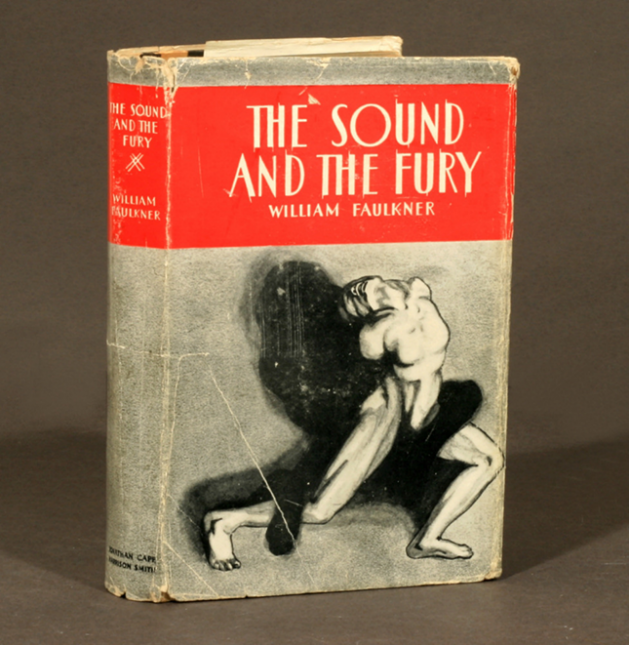
- Published: 1929, Jonathan Cape & Harrison Smith, New York
- Genre: Southern Gothic
- Recommended For: People who want a challenge, and to see a fever dream vision of the South.
- Best Parts: Prose and dialogue, Faulkner’s strong suits. Beautifully written.
- Worst parts: For people who aren’t used to harder literary works, the time and character jumps are brutal.
- Would I Recommend It: Sure thing. It’s one of my favorites—if you’re up to it.
5 out of 5 stars
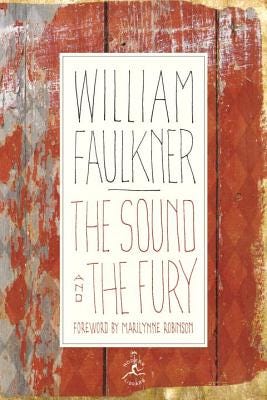
The Sound & The Fury
“It’s not when you realise that nothing can help you — religion, pride, anything — it’s when you realise that you dont need any aid.”
—William Faulkner, “The Sound and the Fury”
The title of this one comes from the, “Tomorrow, and tomorrow, and tomorrow,” soliloquy from Macbeth:
Life’s but a walking shadow, a poor player,
That struts and frets his hour upon the stage,
And then is heard no more. It is a tale
Told by an idiot, full of sound and fury,
Signifying nothing.
There’s both the theme and the setup. “Idiot,” in Faulkner’s time, was a way to describe people with mental and intellectual disabilities. In this case, it’s his unreliable narrator: Benjy is a 33-year-old man, described by the author as being, “severely retarded.”
In context, and in the near 100 years of discussion that’s followed—Benjy’s gotten a range of different diagnoses by psychologists, psychiatrists, and literary theorists (who…don’t actually have the training for that, but that’s none of my business).
Here, he’s likely severely autistic, or has severe mental health issues of some sort (schizophrenia is brought up for Benjy a bit). But it’s neither here nor there. He’s a fictional character, conceived in an era when diagnoses weren’t available—and wouldn’t have made a difference anyway.
It was a bad time for people with disabilities in general, in the late 1920s.
The way Faulkner uses it here, is also arguably far ahead of its time. Benjy isn’t idealized. He’s not infantilized by the author—far from it—he trusts Benjy to tell his story. Which is something incredibly rare, nearly 100 years after this was written. We’re not given Benjy, with the author helping him. It’s just Benjy.
The reason I say all this—Benjy narrates the novel. You’ll spend a lot of time with him. Faulker tells the story through Benjy by dropping bread crumbs of what Benjy hears and sees, and how he interprets it. And Benjy doesn’t have a great sense of linear time.
This is why the novel is so difficult for most people.
Most people expect a novel to be told in a way they’re used to. In a way they’re comfortable with. A way they’re safe with.
Here?
Faulkner yanks the rug and tosses it out the window—and forces the reader to see the world as Benjy sees it. It’s a brilliant conceit, and Faulkner handles it exceptionally. It’s reductio ad absurdum, in that way. It forces the reader out of their box, in order to be rewarded with the story. And what a story.
It’s equal parts literature (obviously), a mystery (because the reader has to piece together and interpret the story), and a deep, soul-wrenching, tragedy broken out of the Greek mold.
For perspective on how difficult this can be for a reader not wanting the challenge—in the first chapter alone: around 14 moments over a 30-year period flow through Benjy’s memory, with very little (and sometimes, none at all) signal to the reader as to a shift.
Faulkner actually lamented a bit about this—he’d wanted a color-coded version (similar to what Mark Z. Danielewski used in his House of Leaves, and the Folio Society actually produced a very limited number of reprints with this, a few years back. Some are available on the used market, but the print run numbers were tiny). But he did use italics to good effect.
Run what you brung, in the vernacular.
“I couldn’t feel the gate at all, but I could smell the bright cold.”
The Sound & the Fury returns to the land of Faulkner’s imagination: Mississippi’s fictional Yoknapatawpha County (what he called his, “apocryphal county”). He’d go on to write eight more novels and a gaggle of short stories set in the same place—but this one remained his favorite.
When he finished it, and likely had his usual celebratory binge drinking extravaganza, took it to a friend, acting agent Ben Wasson, telling him: “Read this, Bud. It’s a real son-of-a-bitch…This one’s the greatest I’ll ever write.”
His advice to readers who couldn’t get through it in three reads?
“Read it a fourth time.”
The book centers around the decline and fall of the Compson family. And a ridiculously fabulous decline and fall. When he was teaching, he was asked by a student why, exactly, the Compsons are such a dumpster fire.
“They lived in the 1860s.”
Which isn’t the whole story—the novel takes place from about 1900 to 1928. The Compsons though, are stuck in an imagined South-that-never-was, a common theme in Faulkner’s work.
They, like the Bard’s own Macbeth, are fixated on tradition, on naive and obsolete attitudes of class, race, sex, and honor.
In that way—it’s the anti-Gone With the Wind. Everything Mitchell loved? He eviscerates.
The self-told lies that damn the Compsons to their fate, are, as the title suggests:
A tale, told by an idiot. Full of sound and fury—signifying nothing.
Plenty in the South, especially in the Ivory Towers of the South have done, as you’d imagine, apologetics for that—it’s Benjy’s viewpoint after all. Maybe the Compsons were right and their tragedy is just that they couldn’t regain whatever wealth and status they’d supposedly had.
Which is also:
A tale, told by an idiot. Full of sound and fury — signifying nothing.
Because of the Compsons themselves. They’re all lost, in their own way.
Benjy tells the story of Caddy—the, “lost woman.” It’s told in how her three brothers interact with her, and in how she’s seen by the Compson’s black servant, Dilsey.
Caddy is an unknown and unknowable character. All of her descriptions are subjective accounts. Faulker places counterpoints in each depiction of her, and the reader can find a kind of truth in that. But the truth of Caddy, like the woman herself, is unknowable. As is the story of our own lives, seen through the eyes of other people.
Caddy is half of the center of the book. The other half? Dilsey.
Dilsey is a marvelous woman. She shares the core values of the Compsons: honor, loyalty, faith, perseverence—but never allows herself to be corrupted by the self-aborbtion of the Compson family themselves. She is both insider and outsider—and in many ways, is the heart of the family itself.
She represents the culture and values of a South that never had slavery. And, at the end of the work, she’s seen as the hope for both the family and for the values of a new, better South.
“Father said it used to be a gentleman was known by his books; nowadays he is known by the ones he has not returned.”
That, in its historical context—wasn’t how black people were depicted, especially among Southern writers. They were written as helpers, as Uncle Toms, as Jims. Not here. And that’s often glossed over in the South’s literary discourse. Faulkner, not just in style, but in theme, was very ahead of his time.
His depictions of Southern black people and of those with disabilities—are still not seen in mainstream publishing to this day.
Which is a part of what I mean by, “the rewards of the book.” There’s a lot to love here, despite its inherent inaccessibility for most readers.
If you want to dip you toes into experimental literature—this is a good place to start. And an excellent introduction to the Southern Gothic genre, though much of Faulkner’s own work is much more accessible.
This one? Despite it being his favorite, he admittedly felt it was imperfect, and it wasn’t ideal:
“I couldn’t leave it alone, and I could never tell it right, though I tried hard and would like to try again, though I’d probably fail again.”
Here, in the story of Benjy, Caddy, and Dilsey, the beauty in the sweeping tragedy of the Compsons is told in imperfection. The Sound & the Fury is a classic for a reason.
Beautiful imperfection is about as perfect as it gets.
Want more Southern Gothic? We have a bookshelf over on Bookshop for that. It’s my favorite. Just like clicking through any of the links here to them, we get a small commission from those sales—at no extra cost to you.
Bookshop is a partner of Fletcher & Co. Booksellers. They help authors get more money from their work—so they can write more. They also help small, independent booksellers stay afloat. That’s something you don’t get when you buy from Jeff Bezos.
You don’t have to buy from them—I won’t be mad. But you can read something you love, support authors and their estates, and keep indies around the world going.
If you’d like to creep on me, my Carrd is right here. Yes, my socials are on there. No, I don’t want to hold your baby, but thanks for asking. You like it here on Medium? Click here to ditch the paywall and get access to the best writing in the world.
Need help with your work, or want to contribute to The Bureau of Creative Control, The Dread Mule, right here at the Union, or want to be a Salty Archivist? Drop me a line. I’d love to hear from you.