
Vienna in 1900: Glorious and Doomed.
All great cities lay claim to at least one golden moment. While we might quibble over what’s required to earn that label, one thing seems clear: Fabled destiny often coexists with searing contradictions.
Vienna in 1900 was a perfect example.
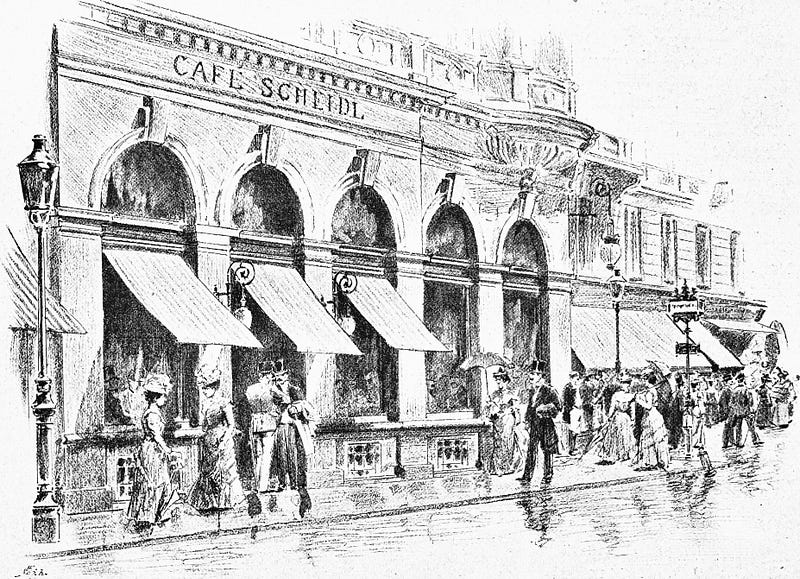
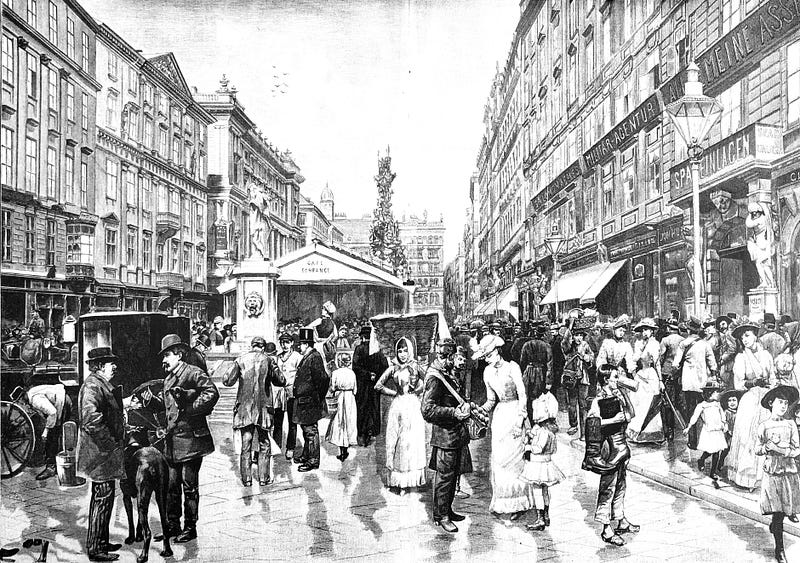
At the beginning of the 20th century, Vienna was the imperial city of the ruling Hapsburgs and Europe’s cosmopolitan center of music and pleasure. It was home to Sigmund Freud and the two Gustavs of music and art (Mahler and Klimt ), a pantheon of poets, composers, literati, and theater notables; a yeasty mix of immigrants from throughout the sprawling Austro-Hungarian empire; the sixth largest Jewish population in the world; and plentiful parks, palaces, coffee houses, and heart-stopping pastries.
Yet as Stefan Zweig (1881–1942) — Vienna’s native son, member of the city’s Jewish bourgeoisie, and famed author — understood well, Vienna’s underbelly was in ferment. Suicide was rampant. So, too, were syphilis, cholera, tuberculosis, and typhoid. Infant mortality was high and life expectancy low at a mere 38 years. Anti-Semitism was also on the rise as was the disaffection of youth, shackled by rules and norms governing every aspect of life.
With the help of Zweig’s 1942, 450-page autobiography, aptly titled The World of Yesterday, here are some keen observations of this paradoxical Viennese era before the golden city’s sudden death in the poisoned air of the First World War.
Security and Delusion
Zweig labeled pre-Word War I Austria as the golden age of security. “Everything had its norm, its correct measurement and weight.” But what was most notable was its liberal idealism and the accompanying conviction that what lay ahead was a “direct and infallible road to the best of all possible worlds… People believed in progress more than in the Bible — hygiene was widespread, dirt was disappearing. People were becoming more attractive, stronger, healthier.”
Yet as Zweig concedes, this world of security was a delusion.
Age and Youth
Zweig was particularly dispirited by society’s distrust of youth and the absurd contortions young people had to endure — from growing beards and wearing “long, black frock coats” to walking with a “measured tread” — all in the hope of appearing much older than they were. “The freshness of youth, its self-confidence, daring, curiosity and lust for life — was suspect at that time, which set store solely on all that was well established.” The young were raised to respect the status quo as perfect and to regard “state institutions as absolute and valid for all eternity.”
Yet another delusion, as events would soon prove.
Morality and Sexuality
Speaking of delusion, when it came to sexual activity, the 19th-century’s strict avoidance of the topic was centered in the belief that as Zweig wrote “the more you hid your natural instincts the more you tempered your anarchic forces…what was natural was dirty.” Inner insecurity was the cause, Zweig believed, which is why the prevailing norm was not to avoid sexual activity per se, but to “deal with that embarrassing business by hushing it up.” Even the literary arts conspired to hide the truth about love affairs, Zweig chides, showing only the “sensitive and sublime” while authorities banned other books, like Madame Bovary, for indecency. The forlorn hope of society was that if “young people were not enlightened about the existence of their own sexuality they would forget it.”
Syphilis and Gender Roles
Despite the prevailing and hypocritical norms around sexuality, young people didn’t temper their anarchic forces. Zweig wrote “…in the army, and in big cities, at least one or two in every 10 young men had already contracted an infection.” Moreover as Zweig walked through the streets of Vienna, “you could read a plate on every sixth or seventh building proclaiming that a ‘specialist in skin and venereal diseases’ practiced there.” Without antibiotics to treat a syphilis infection, doctors of the era could only offer quicksilver (mercury) rubs that lasted weeks. The results, which ranged from loss of teeth to kidney failure, were well known and deeply feared. “No wonder that at the time many young men diagnosed with the disease immediately reached for a revolver.” In general, Zweig asserted (without specifically mentioning the same threat of disease to women), these outcomes were an outgrowth of gender conventions that were “chiefly concerned with concealment and covering up” and that further decreed that a “man was supposed to be forthright, chivalrous, and aggressive, a woman shy, timid and defensive. They were not equals but hunters and prey.”
Nationalist Terrorism
The German Nationalists were a small political party in Austria’s border provinces that advocated for Austria’s inclusion in a Greater Germany under the authority of Prussia — the keystone state of the German Empire. Known for their brutal tactics, the Nationalists, who emerged near the end of the 19th century, previewed the kind of aggressive behaviors and virulent anti-Semitism which, Zweig wrote, set the stage for Hitler’s thuggery and state-organized slaughter. “What the SA (the Nazis paramilitary group) did for National Socialism (the German abbreviation for National Socialism is Nazi), breaking up gatherings with rubber truncheons, attacking opponents by night and striking them down was done for German Nationalists …by the student groups which established an unparalleled, violent terrorist regime.” As Zweig sadly recounts, he and his contemporaries, focused as they were on books and pictures and oblivious to the race and class war that was brewing, failed to see the writing on the wall “in letters of fire.”
The late 19th-century Vienna experiences of Zweig’s youth only fill the first quarter of his memoir. The remaining chapters focus on his accomplished career and travels as a writer, journalist, and playwright and his rise to public acclaim in the intellectually rewarding world of early 20th century Europe.
But it’s the lingering horrors of the first World War followed by the rise of the Nazis that hover with growing menace in the background. Together they would destroy Zweig’s free and cultured world and replace it with one in which “good order was more important than liberty and justice” and Hitler was lauded as “greater that Christ himself.”
Zweig and his second wife, stateless after the Nazi annexation of Austria in 1938, emigrated first to England and then eventually to South America. Suffering from lifelong bouts of depression and anxiety, Zweig, together with his wife, committed suicide in Rio de Janeiro in 1942 soon after his memoir was completed.
Choosing to die in the fashion favored by the Viennese of his youth was perhaps a final expression of both despair for Nazis’ razing of his cerebral and borderless way of life, as well as a disdain for the evil so many in his homeland had embraced.
As for Vienna itself, it has been reborn and now, more than a century later, is ranked as the world’s most livable city. Is another golden moment imminent? Only time — and perhaps a future Stefan Zweig — will tell.