
Victim Blaming, The Dominance Hierarchy, And Trump
He’s the poster child!
We tend to believe on some level that victims deserve what they get and that those with wealth and power have earned it.
“What was she wearing when she was raped? She must’ve been ‘asking for it’ somehow.”
“Poor people are that way because they are lazy and not smart enough to get ahead.”
There was a time when hard work and getting an education was a very good indicator of upward mobility, but children born in the 1980s and afterward have only a 50/50 chance of doing better than their parents did economically. And nobody deserves to be the victim of a crime, no matter what they are wearing.
It all starts with the psychology concept known as the “fundamental attribution error”. This is a natural tendency to see the behavior of others as being determined by their character — while excusing our own behavior based on circumstances.
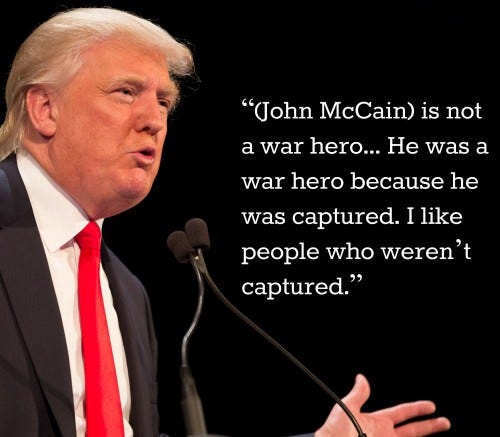
Combine this faulty belief that other people are responsible for their own misfortunes with the social Darwinism aspects of patriarchy, and you’ve got a real recipe for victim-blaming and the elevation of ruthless people. Donald Trump mocked John McCain for getting captured and made a POW. He said that McCain wasn’t truly a hero, because in a terrific example of this dynamic, Trump believes, as many people do, that you get what you deserve. Trump thought that if McCain had been smarter and more heroic, he would have never been captured — despite the fact that this is not actually how the world works.
“Patriarchy allowed for stratification not only between men and women but in the larger society as well. For the first time, you’ve got social castes and elites. Rather than sharing nearly everything for the good of the tribe, individual families are able to accumulate wealth, land, status, and power that belong solely to them. Having become a society of control and separation, you might as well see how much you can get for yourself out of it. If you don’t have power, what can you get out of being proximate to or aligned with a man who does? The men who are the most aggressive get the most power, but also have the responsibility for protecting the rest.
When no-one owned much beyond what allowed them to feed and clothe themselves each day, there is no need to steal or to kill others for what they have. But if someone’s trying to steal your cattle, your land, or the wealth you’ve accumulated, it’s good to have an aggressive and powerful protector. Having more means that you also have more to lose.”
The social system of patriarchy began around the same time as agriculture- about 10K years ago. Prior to that (97% of human history), people lived in highly cooperative and egalitarian bands of about 25–50. But with agriculture, for the first time, you have substantial personal property, property that you’d like to go to your heirs. In order to ensure paternity (hence the name patriarchy) women had to be controlled and their sexuality policed in ways that it had not been in the past.
The result was not just stratification between men and women, but a larger stratification of society in general for the very first time. What you’ve got now is a social system that is based in coercion and control — a pyramid-shaped dominance hierarchy. Although not everyone at the top are men (rich White men in particular), there are more of them at the apex of the pyramid than anyone else. Being born into the right demographic is helpful, but there’s also the social Darwinism aspect where the “fittest” must continually compete for any position they wish to hold in the hierarchy. If in the early agricultural societies, the strongest and most powerful man was also the best one to be aligned with for protection, it stands to reason that we still view ruthlessness as an indicator of who we should elevate into power and privilege.
Donald Trump is the poster child for this. It’s my assertion that very few people actually like Trump, but that instead, they like what he represents. After all, he’s clearly a nasty, boorish, clod with stupid hair. What is appealing about him is that none of that seems to matter because he has enough wealth and power to overcome it. His followers admire and hope to someday be in a position to emulate such a “living large with no fucks to give and no-one can touch me” attitude. Trump also cares about maintaining the dominance hierarchy and that speaks to others who want to maintain it as well, concerned about potentially getting pushed down by some other group coming up a bit too far.
Social Darwinism is a zero-sum game. If someone wins, that means someone else has to lose. Trump's followers want to be sure they aren’t in the loser category. A 2017 analysis of exit poll data confirms this as relates to female voters who opted for Trump. “Researchers Cassess and Barnes concluded that White women with less education and money (and opportunities) wanted to keep the advantages they had compared to non-white women.” For more about this, read here.
Trump is infamous for his derogatory comments, put-downs and name calling of anyone who challenges him in any way. He even went so far as to mock a disabled reporter in a public appearance while he was being filmed. Aligning with Trump means that “lesser” peoples such as immigrants, the disabled, Blacks, and women will understand that they ought not to get too many ideas about moving up the food chain. The people who voted for him did so largely to ensure this.
Donald Trump is a man who does and says what he wants with no consequences. He has a beautiful wife who doesn’t appear to love him, but what of it— that’s the price to pay for getting to the top of the dominance hierarchy where no one can touch you and you live like a king! She’s the right trophy for his position and anyone who has worked the dominance hierarchy that well isn’t likely to have known much love anyway because, in order to constantly step on others to get ahead, you have to numb and dispense with emotions.
The third factor in all of this is that we don’t want to believe in an unjust world where bad things can happen to good people. I have an acquaintance who many years ago was raped at gunpoint and she later recounted to me how many of her friends then told her how something like that would never have happened to them. As cruel as this was, it was a kind of defense mechanism to ward off having to entertain the possibility that something terrible could happen to you through no fault of your own. We desperately want to believe that we are in control of our lives and determine our own fate.
Because of this, we tend to believe whoever has the most power in the hierarchy; pedophile priests over children; those nice young men from the football team rather than the girl they assaulted, the White woman who says that a Black kid whistled at her. We want to believe in order and that the world operates justly, even as we also know that there is a might makes right dynamic where those who are the most ruthless prevail. America has a lot of things confused, as is so aptly described in The Great Perversion.
American women support patriarchy. American proles support capitalism. And American middle classes support supremacy. So how can any progress ever happen? Where is there to go, but backwards? White women are the patriarchy’s bulwark. The American prole, the average working man who’s been left with no capital whatsoever, is capitalism’s fiercest advocate. The downwardly mobile American middle class, the one who has no healthcare, education, retirement, is supremacy’s resurgent force.
We believe in the rightness of power and control, of domination and competitiveness, and of wealth as a sign that we are favored by the gods. We fear vulnerability, softness, empathy, and equality. Too many are willing to suffer tyrants if it promises to keep them safe and to help maintain their position in the hierarchy. Deep down, many of us wish that we could be just like them — independent, untouchable, powerful and strong because we think that is what will keep us safe. The fact that this is a myth is irrelevant because it’s such a pervasive one in our culture that a large percentage of the populations believes it anyway — even if only subconsciously, even if only a little bit.