
Vibrant Synaesthesia: The Inner Workings of a Color-Drenched Brain
Synaesthesia 3: Mapping Consciousness. What is the synaesthesia experience? Is it inspiration or interference, artistry or annoyance? And does it have deeper resonance beyond the color wheel?
Syndromes, Conditions, Disorders, and Gifts
I have been recounting my synaesthesia experiences with intense color attached to letters and numbers and how it affected the way I operated in the world. I offered a few vignettes: my school experience as a child, my first job, and a stint in the United States Air Force.
I am taking a story-telling pause here as readers expressed interest in the internal dynamics of synaesthesia. Parents whose children are synaesthetes are eager to learn something about their offspring.
For five years I was a High School Special Education teacher, dealing with some very unusual learning profiles. I have training in neurological divergence from both purely technical and broad environmental perspectives, and only recently applied the ideas to my own learning profile.
I recall someone complaining about a colleague’s OCD, and I responded: ‘Why call it OC-D, it’s not always a disorder, it’s more like a detail-oriented trait, or maybe syndrome — sometimes those qualities are very useful, right?’ We have this cultural myth about OCD, but there’s value here. One man’s disorder is another man’s gift.
Syndrome probably fits synaesthesia best: ……… from the Greek roots that mean ‘confluence’: a series of qualities often found together, frequently but not exclusively used in medical terms as the precursor to a condition.
Synaesthesia is a confluence of sensory impressions and combinations that affects about 1% of the population. I suppose that could place me in MENSA, in-school detention, as the subject of a military investigation, or restrained in a strait-jacket.
On the Grid
This is what synaesthesia looks like for me:
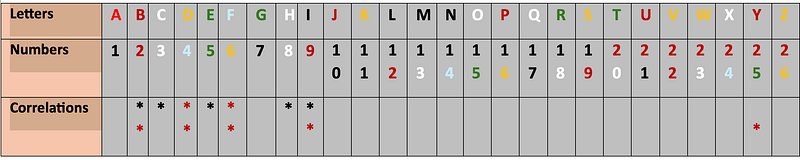
Color Count of Letters: Gold (6), White (5), Burgundy (5), Black (4), Green (4), Red (1), Light Blue (1) Color Count of Base Numbers 1–10: Black (3), Burgundy (2), White (2), Light Blue (1), Gold (1), Green (1) Totals: Gold (7), White (7), Burgundy (7), Black (7), Green (5), Light Blue (2), Red (1)
When I look at a page, I don’t see these colors jumping out at me. Black ink-on-white paper is black and white to me. But as I read, my thoughts contain these colors. When colored pens are near, I create calligraphy of key points or phrases or themes, using the colors from my mental impressions. It’s a parallel inner eye where a range of spontaneous variations on the baseline can emerge.
There is an advanced grid of offsets, asymmetrical correlations that are hinted at by the asterisks in the third row:
Letter/number matches: B and 2 are burgundy; C and 3 white; E and 5 green; H and 8 white Position matches: B is second/Y is second to last: both burgundy; 2 (2nd) and 9 (2nd-to-last): both burgundy Cross-matches: D and 6 are gold: F and 4 light blue Letter/number/color correspondence: ‘F’ is the first letter of 4, letter and number are light blue; ‘S’ is the first letter of 6, letter and number are gold; ‘G’ is the first letter of ‘Green’ and is green wherever it appears Sequencing match: 1–2–3 is black-burgundy-white; 8–9–10 is white-burgundy-black
These various combinations aid memory and retention, allow for quick calculations, suggest ways of presenting statistics, and also lead me to use different backgrounds to offset “jarring” color combinations. There is a fragile balance that is easily disturbed.
Word Perfect
There is another component that is rarely mentioned: the emotional response to colors — the appreciation of beauty, and either rejection or repair when blends are somehow off. Much like the musician with perfect pitch, I can feel physically distressed if something in this finely tuned system clashes: if words are used incorrectly, or put into faulty logic sequences, or presented without care for aesthetics. Colors often reflect the dissonance: while brown is not in my synaesthesia palette at the basic level, a badly constructed idea or a misused word can cause a “brown-out,” where the section becomes a drab, worn-out brown.
I have trouble working in Google docs because of my ideas about what words go together or don’t, and how documents should look. Many hands on a document only works if a single individual pulls it together in the end. Once a poor choice is made in this group editing environment, and others begin to add their contributions, a misjudgment can get amplified and the problem compounds itself.
A frequently occurring example of this is when a difference in point-of-view is labeled a conflict. Immediately, all the shallow impressions that define conflict are activated: grudges, sarcasm, people taking sides — once we’re down that road, there is no turning back, the momentum is too ponderous and the narrative blunders forward. We have a set response and set expectations of what happens in a conflict. Point-of-view differences are a nuance, and nuance is a casualty these days.
There is nothing I can do in a Google doc except tear it all down and start again, but no one wants that.
Modern Mishaps
I have a list of words, phrases, ideas and hidden assumptions that are synaesthesia-related in that they took on their own color pattern and caused me to react in some way based on their misuse.
Appropriate and inappropriate are both bright red, following the color of the root word’s first letter. I have a reaction to the frequent use of inappropriate as a way to describe divergent behavior. The meaning — not the right fit for a place and time — strikes me as disingenuous, condemning the behavior, suggesting that it is a universal judgment, yet leaving open the possibility that the behavior might be fine in a different context. It is judgmental but tries to deny itself; it stigmatizes but then says, there’s no stigma here.
I have never accepted Instagram as a valid name for the image-sharing platform. I associated -gram with telegram, which is all about words, not images. The Greek suffix -gramma is defined as relating to something written. Pinterest, on the other hand, is exquisite — image-rich as pint- evokes paint, or even better in Spanish, pintura, with the blending of concepts able to fit the whole word interest within its nomenclature. Instagram for me is colorless, in synaesthesia limbo, misapplying -gram when they could have used -graph as in photograph, which at least evokes imagery. And was Insta- descriptive of the platform’s qualities? Storygraph gives an accurate name to what the app does, and the pleasing three-syllable format is kept intact; it glows gold and burgundy for me, and Pinterest emerged as purple and light blue. Given Instagram’s popularity, mine is a minority position. When discussion took place in the idea room, did anyone bring up telegram? Of course mammogram is image-based, so maybe it’s my associations that are skewed.
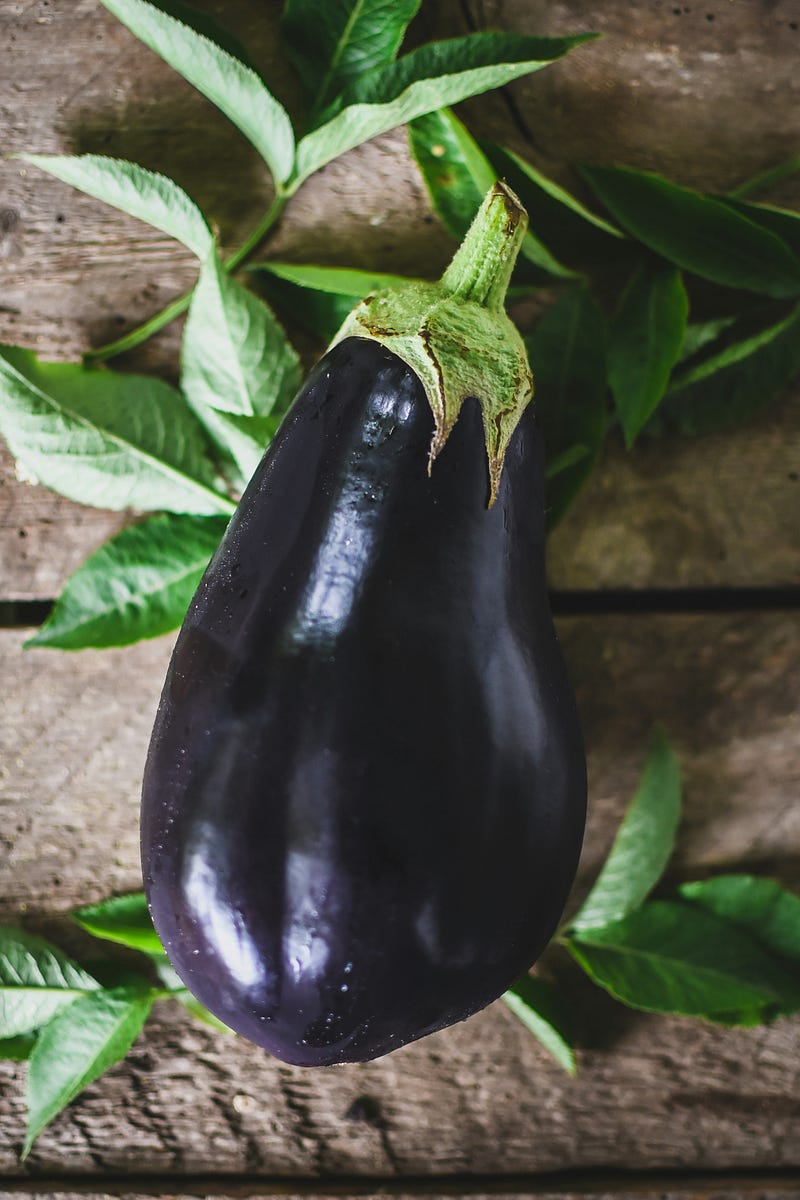
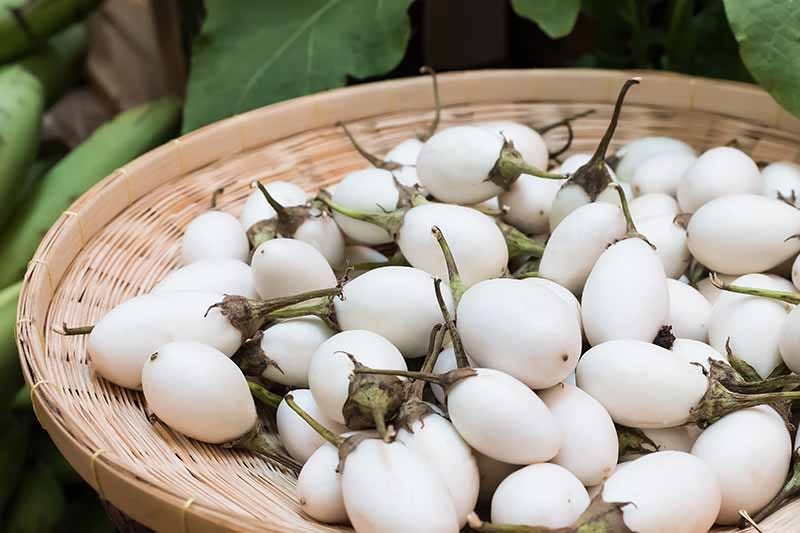
One night at a party I was going off on the word eggplant. The vegetable had received that name in colonial America, someone having seen a strain growing in an off-white, oval-shaped, dwarf variation — looks like eggs! — and now we are saddled with eggplant as another example of poor American language choices. This is especially bad, I was trying to get across to my audience at the party, when we could have had the mellifluous tones and harmonious hues of ……….
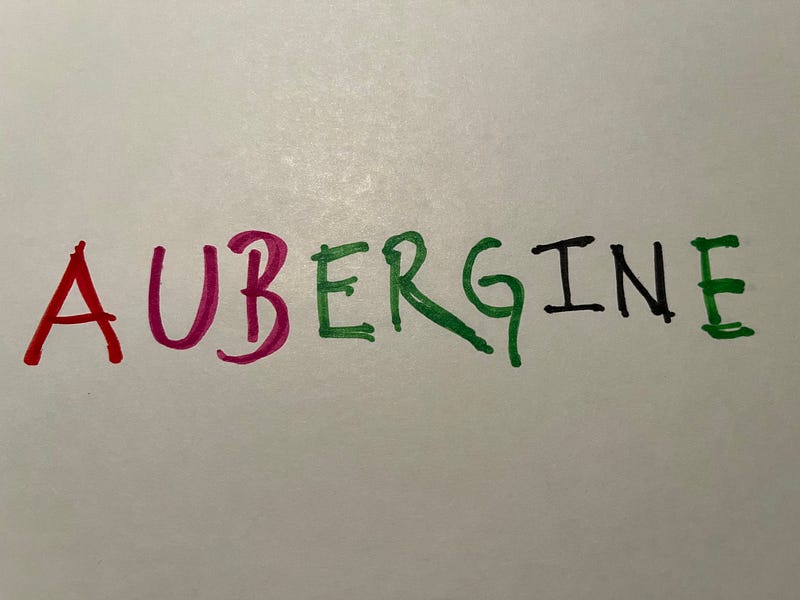
…….. as our vegetable’s name, French in origin, used in British English. Aubergine is also a color, a deep inky purple, like the most common example of the vegetable. But this gorgeous word appears nowhere in American English except as the color, and that only rarely. Some at the party had caught only part of my rant and were recounting tales of this madman renaming vegetables and social media platforms until someone said, He didn’t make up aubergine. That’s what the Brits call it. The storytellers were relieved; it was less hilarious, but they didn’t have to worry about my sanity.
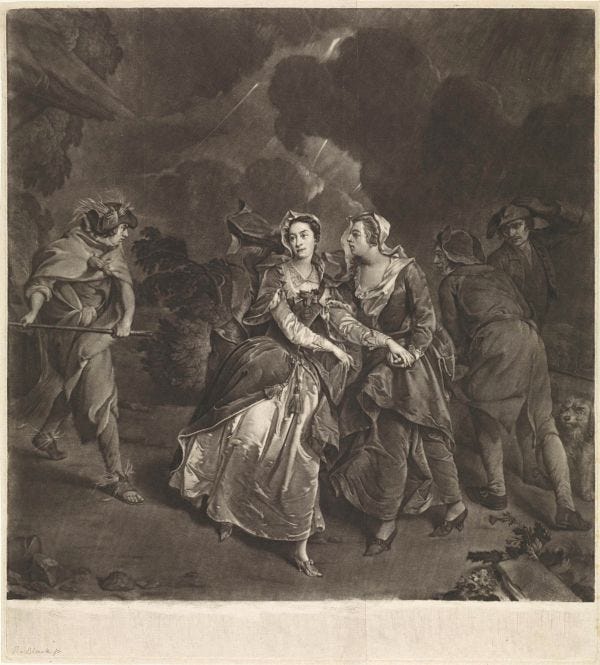
Tragedy is in common usage whenever something bad happens; we should be using catastrophe for unfortunate occurrences. Tragedy is draped in lush black and red to me, and is a special, delicate concept. Tragedy contains specific dramatic elements that gifted playwrights employ to create one of our most profound artistic experiences. The majesty of the concept evokes the sumptuous colors, the red reminiscent of blood — our most refined classical tragedies are drenched in blood: Oedipus, Hamlet, Blood Wedding, Othello ………..
Tragedy, in its pure definition, is a specific type of downfall, with parts of the demise self-inflicted even as Fate closes in, a dramatic pattern that can illuminate truths we rarely face and elevate our human struggle to epic levels. Our careless use of the term to describe misfortune robs us of its power and wisdom.
Betraying the Trust
There is a category of language malfunction that comes from experts who become enamored of details and minutiae in their field, losing touch with the visceral dimension of language. Synaesthesia is primarily a visceral phenomenon, a gut-level reaction powered by color that refuses to wallow in the tedious details with which experts often saddle us.
Pluto, the once and current planet, was expelled from the Planets’ Club in 2006 and placed in some new category, and suddenly we were supposed to accept an 8-planet solar system. What were they thinking? Pluto defined the parameters of the known world. From 1930–2006 between 2 and 6.6 billion people shared the idea that the solar system was of a particular dimension. We built models, colored the planets in fanciful ways, were enthralled by Pluto’s erratic orbit and role as the wild untamed outlaw body, communing with comets and racing through methane clouds and zipping inside of Neptune’s orbit for 20 of its 249-year revolution. As a 7-year-old I had a dozen notebooks with astronomical charts, photographs, statistics, drawings; I was secure, nestled in our Milky Way cocoon, filled with wonder and awe, a child of the vast and mysterious universe. The planets were the onset of my synaesthesia journey: Mercury, dark grey; Venus, green; Earth, blue and white; Mars, rust; Jupiter, orange and dark brown; Saturn, gold; Uranus, a dark burgundy; Neptune, a deep navy blue; Pluto, purple, its fantastical orbit a trail of blue ice and space smoke. What did they mean in 2006 that Pluto wasn’t a planet? I was furious; they had stolen a piece of childhood.
Pluto was ours, the people’s planet, not theirs; back in 1930, it was discovered by a self-educated kid named Clyde on the graveyard shift at the Lowell Observatory in Arizona. Clyde couldn’t afford college, got himself a job by building his own telescope on his family’s failed Dust Bowl farm, and sending night sky drawings to the Observatory. After he discovered the long-suspected 9th planet, the name Pluto was first suggested by an 11-year-old British girl.
But in 2006 the cabal of scientists from the International Astronomical Union tried to downsize our known world; they created new criteria for planet-hood and in their monumental self-importance decided that Pluto didn’t clear its orbital path with enough authority, and so it was banished from the club.
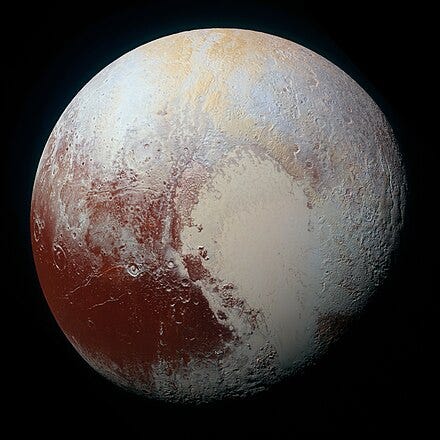
The public outcry was massive, along the lines of Grinch stealing Christmas. A group of rogue astronomers fought the IAU ruling from Day One and it took 13 years, but in 2019 I read that the travesty was reversed and Pluto was reinstated. The Solar System was made whole; it seemed the universe had been returned to its proper dimensions.
Similarly, the Mental Health field lost its bearings in over-thinking the definitions of psychopath/sociopath/narcissism/borderline. The experts didn’t take into account how the public perceived these terms and the very real need for putting a name to certain behaviors many of us experience out in the world. I know the DSM-V has bullet points listing the behaviors that go with each, but it’s a muddled set of indistinct behaviors, and recently Psychopath/Sociopath have evolved as interchangeable terms that vaguely describe personality disorders.
In prior usage, the psychopath was on the verge of psychosis, losing touch with reality, while the sociopath was the coldly calculating manipulator without a conscience — psycho- implies the issue is with the psyche, socio- that it’s a social problem. Why can’t we stick to how the words were constructed? Read the definitions today and there’s no relationship between the word and the characteristics attributed to it.
Borderline is not about the border of anything.
The narcissist — named after Narcissus from Greek mythology, who fell in love with his own reflection and lost interest in anything else—was what we had called conceited, or vain. Now it’s a full-blown evil archetype, the personality disorder describing an individual who lacks empathy, manipulates and lies, does not demonstrate any conscience, gaslights innocent victims and destroys lives. Sociopath would better serve this constellation of egocentric characteristics, as it did for the public for many years. But there is so much literature on the Narcissistic Personality Disorder we’re stuck with it. If anyone finds themselves in the clutches of a narcissist, they are advised to hire an army to fight them off, or to go into a witness protection program. Reviewing the mythology, the entranced Narcissus bears little resemblance to today’s evil manipulator. He didn’t even know the image he worshiped was his own reflection — he’s a clueless dupe, not a scheming perpetrator.
Here the experts became lost in a dense forest of intellectualized verbiage, and they even differ from each other in explaining what all of this means. I hope it works for them, because it isn’t working for the public. Our conversations on these topics are fragmented because the experts took the ground from under us. We no longer have crisply defined terms.
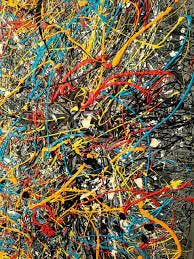
For me, the colors are all over the map; earlier, the Psychopath was burgundy, the Sociopath gold, the Narcissist an icy blue. I never did understand borderline, which showed up as a muddled brown. Like the International Astronomers Union, the American Psychiatric Association members working on the definitions of mental health conditions and personality disorders must not have had clarity as one of their core values. My sensory impressions of this constellation of conditions is a scattershot of color, empty space, uneven textures ….. an abstract bit of absurdity that carries a lot of authority and wields enormous influence.
So these are the deeper levels of the synaesthesia experience: a kind of purified worldview, where I either accept what seems false and empty or — my usual choice — to fight it, often against nearly impossible odds. Synaesthesia is a truth-revealing tool, but the truth can seem like the raging of a madman in a compromised world.
In the country of the blind, the one-eyed man is not king, I have found, contrary to what H. G. Wells postulated in 1904. The one-eyed man is a heretic, and in a lot of trouble.
In checking back in with Pluto, I came across a Master Class taught by a thinker I admire, the American scientist Neil deGrasse Tyson. There is a precision to his thinking, and he lets us in on his doubts. Disappointingly, Mr. Tyson supported the Plutonian expulsion from the Planet Club, buying into the new definition of planet that was ultimately shelved in 2019.
Mr. Tyson was seduced by the fancy categorization mania that affects all experts: after a period of relative stability and equilibrium in a field, the experts need to flex their expert muscles and we end up with some highly disconnected results — concepts that have lost their vitality and specificity; terms and ideas with real presence in the world are cast aside without consideration. The sensory intensity of synaesthesia doesn’t let me get caught up in the over-thinking. Pluto was purple and the solar system needed that color for balance, and its icy blue orbit, with all its renegade eccentricity, littered with stardust and precious jewel-like asteroid matter, was the familiar boundary of our childhood universe, keeping us contained within its vast embrace.
You don’t mess with that. You don’t get to step on our epic dreams and passions for a finicky little rule that you’re all so damned proud of. If you need it, fine, go play in private. We’re out here trying to live, and we had faith in something that mattered.
I went back to the article I had read about the reversal of the expulsion, because on the NASA website it was still saying Pluto was in exile. Was NASA just out-of-touch?
The 2019 article on the reinstatement of Pluto, I understood in a moment of disorienting, crushing recognition, had been written on April 1, 2019. Plunging ahead, fearing what I was about to learn, I caught the irony that was really mockery, the humor that was really biting satire, the fun facts that were not facts at all. I had been taken in by an April Fools’ joke, and the ruse was not that carefully disguised — we were meant to get it by the third paragraph or so. But I had been so hungry for this reinstatement that my reality meter was distorted; I was vulnerable to this hoax.
This was the moment of reckoning — one of the elements of classical tragedy, where the protagonist fully grasps the enormity of his fall and is painfully aware of how his own hand led him to this horror. This was the place in the plot where bad things happened. Oedipus gouged his eyes out; Hamlet went mad.
I took out a pencil case that held my colored pens, and began writing by hand to Mr. Neil deGrasse Tyson and NASA and the International Astronomers’ Union, where all this began.
I wrote in purple in honor of the disgraced former 9th planet:
You are lost in your ivory towers, but you came out for a minute to deliver your wrong-headed message. I should have warned you: Don’t mess with childhood. It was a blissful, innocent time of riotous color and beauty, and I am still holding on to a piece of it. We will reinstate Pluto. As we sit here, still it orbits. I may be just one synaesthete, but I will not capitulate.
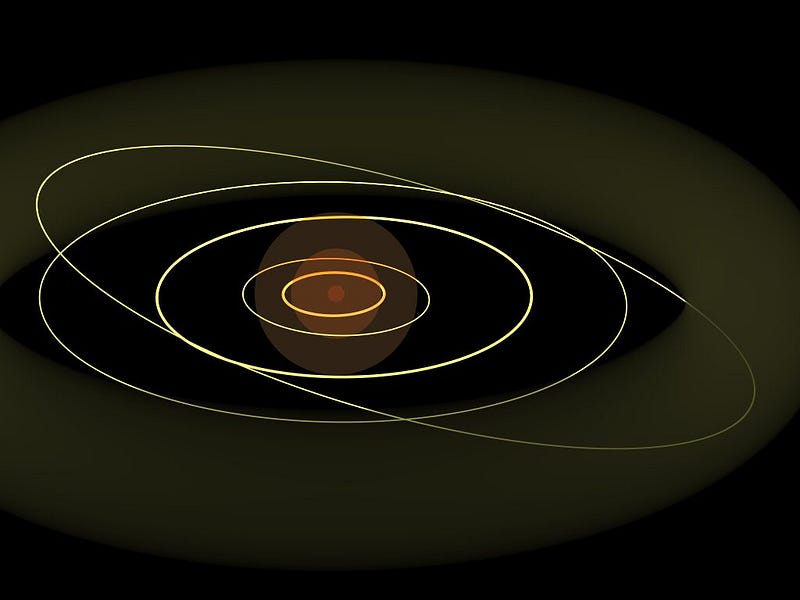
Synaesthesia is a remnant of childhood’s bliss. In the hearts of humans, in this battered heart at least, the pull of childhood innocence is as strong as gravity, as unshakable as the covalent bond.
This isn’t over, not by a long shot, not as long as Pluto glows purple and icy blue in the caverns of consciousness of a single synaesthete.


