
#VettingBernie: Collecting the 2020 Receipts
Don’t you figure SOMEONE ought to?
In 2016, I wrote a timeline exposing some of the more negative aspects of Bernie Sanders’ life and political positions. It was called #VettingBernie, and became a bit of a hit on Medium if I do say so myself.
I stopped feeding it when it became clear that Bernie wasn’t going anywhere, and that there were bigger and oranger fish to fry.
But now, it’s 2020, and…well…Bernie’s back.
Thus, so am I…
In this new 2020 version of #VettingBernie, I will continue to lay out all the things that Bernie and his legion of deranged supporters DON’T want you to talk about or even know about.
I’m laying things out a bit differently this time, putting links directly in the dateline above the text. If you see something underlined, assume it’s a link, and you can go read the material for yourself. This way I think the timeline will load quicker, and you can have access to some research in case the Bros come visiting you.
Needless to say, more material will be added in the coming days, and will try to separate the early part of his life from his Presidential Campaign Life which will have it’s own Medium post in the coming future.
If you have incidents you think should be part of this timeline, feel free to drop me a line on Twitter @admiralmpj.
And now, on with the receipts:
1961: Bernie transfers to the University of Chicago:
After graduating from James Madison High School in 1959, Bernie goes to Brooklyn College for a year before transferring to the University of Chicago, where he joined the Congress of Racial Equality, the Student Nonviolent Coordinating Committee, the Student Peace Union and the Young People’s Socialist League. [5]
Kruse, M. (2015). Bernie Sanders Has a Secret [Profile]. Politico. Retrieved from https://www.politico.com/magazine/story/2015/07/bernie-sanders-vermont-119927.html
1961: Bernie joins CORE:
Sanders’ involvement in the Civil Rights Movent was brief and localized, his sacrifices limited to one arrest for protesting and a bad GPA from neglecting his studies. But Bernie was active in the movement during his three years at the University of Chicago.
Most of his Bernie’s work was in and around Hyde Park, where he became involved with the campus chapter of CORE.
1961: Bernie’s apartment testing goes a bit awry:
During Sanders’ first year in Chicago, a group of apartment-hunting white and black students had discovered that off-campus buildings owned by the university were refusing to rent to black students, in violation of the school’s policies. CORE organized a 15-day sit-in at the administration building, which Sanders helped lead. The protest ended when George Beadle, the university’s president, agreed to form a commission to study the school’s housing policies.
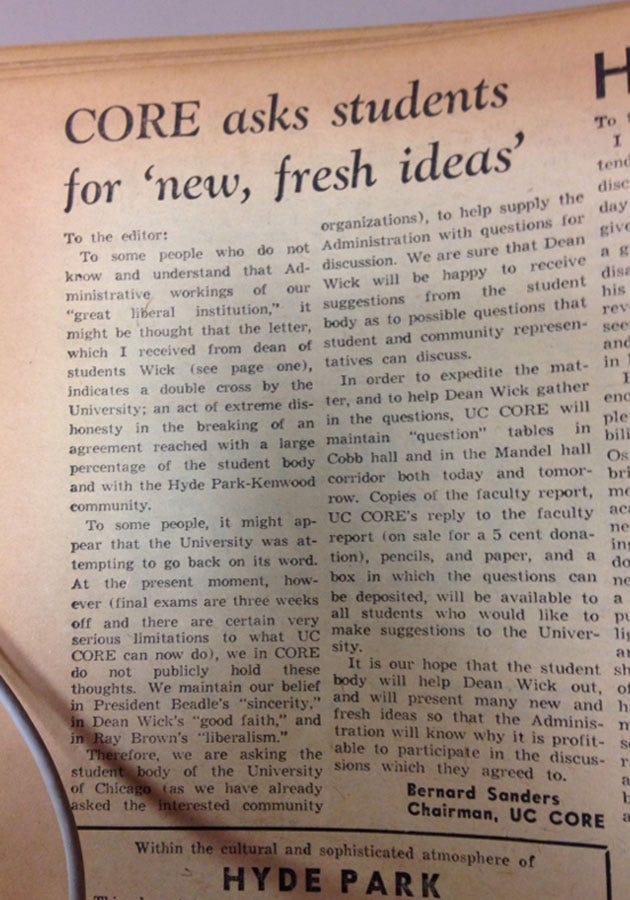
Bernie was one of two students from CORE appointed to the commission, which included the neighborhood’s alderman and state representative, in addition to members of the administration. But soon afterward, Sanders blew up at the administration, accusing Beadle of reneging on his promise and refusing to answer questions from students on its integration plan.
In an open letter in the student newspaper, the Chicago Maroon, Sanders vented about the double-cross:
1961: Bernie decides to take on the City of Chicago:
That spring, with Sanders as its chairman, the University of Chicago chapter of CORE join forces with the university chapter of SNCC. Sanders announced plans to take the fight to the city of Chicago,
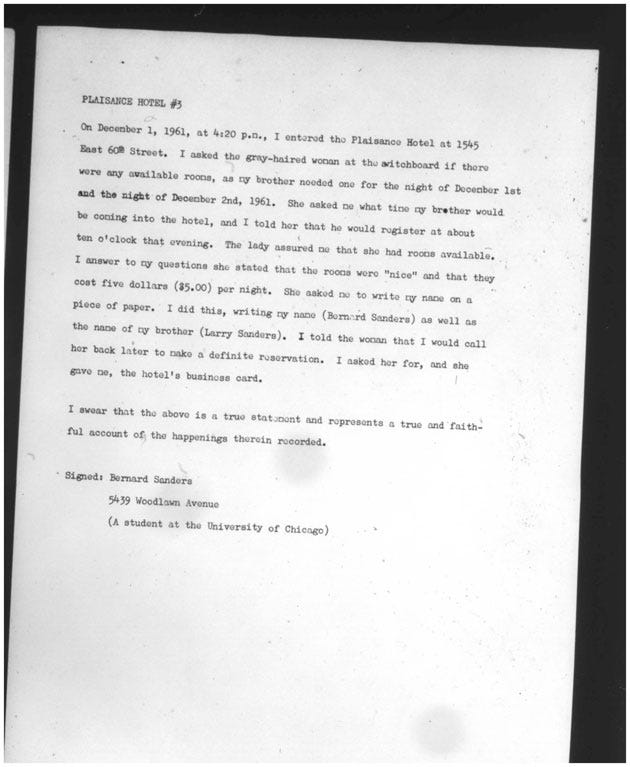
December 1961: Bernie testifies and participates in a Hotel Test:
Bernie testifies about a “test” he conducted of a hotel just off-campus. He visited to see if it would rent a room to his older brother, Larry, and the clerk assured him that they would. When UChicago CORE finished its testing, the results were clear — rooms that were available to white students were not available to black students. The next year they launched a series of sit-ins to force the university’s hand.
Fall of 1962: Bernie protests the Howard Johnson in Cicero, Il:
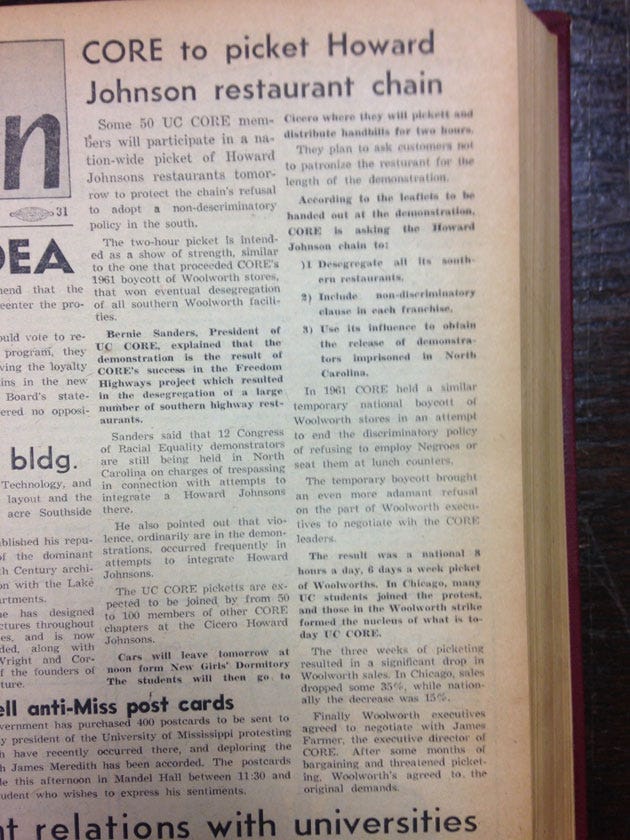
In the fall of 1962, Bernie organized picketers at a Howard Johnson in Cicero. Sanders told the Chicago Maroon, the student newspaper, that he wanted to keep the pressure on the restaurant chain after the arrest of 12 CORE demonstrators in North Carolina for trying to eat at a Howard Johnson there:
Later in 1962: Bernie resigns his chairmanship at CORE:
Sanders left his leadership role at the organization not long afterward; his grades suffered so much from his activism that a dean asked him to take some time off from school. (He didn’t take much interest in his studies, anyway.) But he continued his activism with CORE and SNCC.
28 August 1963: Sanders attends the 1963 March on Washington:
We can confirm that Bernie attended the March on Washington for Jobs and Freedom, but his alleged appearances at the Selma March two years later do not seem to be him at all, despite protestations from his supporters.
Late 1963: Bernie charged with resisting arrest:
Not long after returning to Chicago from the March on Washington, Sanders was charged with resisting arrest after protesting segregation at a school on the city’s South Side. He was later fined $25, according to the Chicago Tribune:
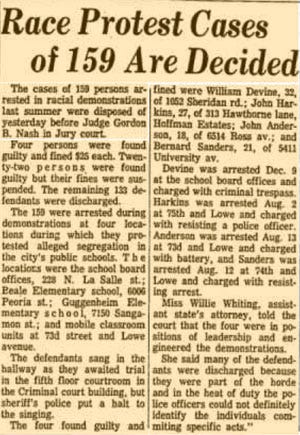
And that seems to be the end of Bernie’s civil rights record.
Sometime in 1963: Bernie visits the Sha’ar HaAmakim Kibbutz:
Bernie visits Israel in 1963 as a guest of the leftist Zionist Hashomer Hatzair movement and stayed at its affiliated kibbutz, northeast of Haifa.
It’s not clear what drew Sanders to Israel; his older brother, Larry, was spending some time there.
Bernie was reticent during the 2016 campaign regarding matters of his Jewish upbringing and his time in Israel, where he traveled with his first wife, Deborah Shiling, who also was Jewish. His 2016 campaign also turns away queries about his Israel stay.
It’s not exactly clear when he was in Israel; although he told Haaretz he was there in 1963, he did not graduate from university until 1964. He also had not married Shiling by June 1964, when she is listed as a maid of honor at her sister’s Baltimore wedding in a New York Times notice.
Ronald Radosh also had some things to say about his stay in the Huffington Post:
Calling Kibbutz Shaar Haamakim simply “leftist” does not sufficiently describe the ideology of Hashomer Hatzair members. At the time, most American students who were Zionists belonged to Habonim, a mainstream group affiliated with Israel’s governing party, Labor.
Hashomer Hatzair, to the contrary, was the affiliate of Mapam, the coalition political group in Israel that united a few different left-wing groups into one political organization. By 1969, Hashomer Hatzair had entered into a unity pact with Labor. Despite this, its own members remained left-wing socialists. Today, its descendants support Israel’s far left political party, Meretz.
But in 1963 when Sanders worked on Hashomer’s kibbutz, its members considered themselves Marxist-Zionists, and they held a pro-Soviet orientation which included supporting Soviet foreign policy. Their ideological orientation on Zionism and socialism came not from the social democrats of the Socialist International, who were strongly anti-Communist and anti-fascist during the years of World War II (like Germany’s Willy Brandt), but from a rather unknown figure, a Zionist named Ber Borochov.
I knew members of Hashomer Hatzair in the same period that Bernie worked on their kibbutz. They would always urge me to read Borochov’s books. Although he passed away in 1917, too early to see the horrendous results of the Bolshevik Revolution, Borochov’s followers argued that he had proved that “socialist Zionism” had to be Marxist-Leninist. Their only criticism of the official Israeli Communist Party was its refusal to see that Stalin was wrong to argue that Jews did not need their own nation and that they instead should work within their own countries to foment a communist revolution. (If you want to know more about Borochov, Wikipedia accurately summarizes his views.)
Another young person who gravitated to the group was Noam Chomsky, who told an interviewer: “I liked the kibbutz life and the kibbutz ideals.” In a Tablet interview conducted by David Samuels, Chomsky said he had gravitated to a Hashomer Hatzair kibbutz, but could never actually join it. That was “because in those days they were split between Stalinist and Trotskyite, and I was anti-Leninist.” But he admired their commitment to a binational state and their efforts to create “Arab-Jewish working-class cooperation” and a “socialist binationalist Palestine.” A binational state would in effect have meant the end of Israel as a Jewish state.
Since the news broke yesterday, a few conservative websites have written about the importance of Sanders’ chosen kibbutz. At Frontpagemag.com, Daniel Greenfield describes its origins and notes how it mourned the death of Joseph Stalin in 1953, ironically just as the Soviet dictator was preparing a major purge of all Soviet Jews, in the so-called “Doctors’ Plot.” In the American Thinker, Thomas Lifson too says that Sanders’ stay at the Hashomer kibbutz “is consistent with Sanders’s honeymoon trip to the Soviet Union” as well as his later visits to Nicaragua and Cuba.
Vietnam War: Bernie applies for conscientious objector status:
Bernie Sanders applied for conscientious objector status during the Vietnam War, his campaign confirmed to ABC News.
“As a college student in the 1960s he was a pacifist,” Michael Briggs, campaign spokesman added in an email. “[He] isn’t now.”
Last week, the Des Moines Register ran a column from a Hillary Clinton supporter and Vietnam veteran, titled, “How can Sanders be commander in chief?”
“My question as a Vietnam veteran is: How on earth could a person claiming to be a conscientious objector become the commander in chief of the most powerful military in the world?” questioned the column author Steve Wikert. According to a profile from the Vermont Senator’s hometown newspaper, the Burlington Free Press, his conscientious objector status application was eventually rejected, but by then Sanders was too old to be drafted.
1964: Bernie graduates from the University of Chicago:
Bernie graduates with a bachelor of arts degree in political science in 1964.
Summer 1964: Bernie marries his first wife:
After getting married in Baltimore, Bernie and his new wife, Deborah Sanders, buy $2,500 worth of property in Vermont, near Montpelier in the town of Middlesex off Shady Rill Road, according to property records. Bernie wanted to live in the country, he has said and had some inheritance money from his father, who had died in 1963. They spent parts of the next few summers on the property, living in what had been a maple sugar shack with a dirt floor.
1966: Bernie’s marriage to his first wife ends:
The marriage ended only two years after it began, in 1966.
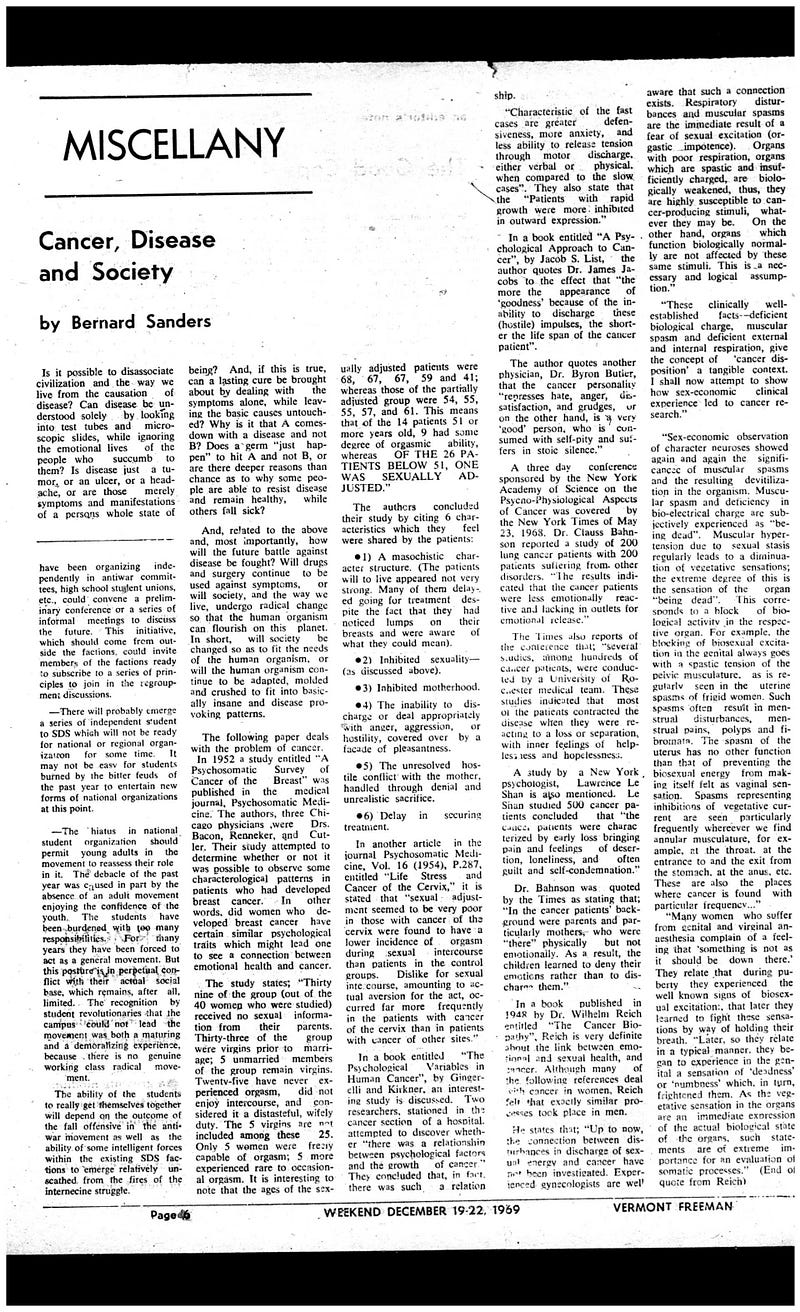
19 December 1969: Bernie publishes “Cancer, Disease and Society”:
In an essay originally published in the Vermont Freeman underground newspaper, Bernie Sanders argues that cervical cancer is caused by a woman’s inability to achieve orgasm, that women who dislike sexual intercourse are more likely to contract cancer, and that women who were raised by mothers who disapproved of their having sex at ages as young as 16 were also more susceptible to cervical cancer.
Researchers have never established any evidence that sexual inhibitions are linked to cancer, and according to the National Cancer Institute, “although stress can cause a number of physical health problems, the evidence that it can cause cancer is weak.”
Sanders also blames schoolteachers for causing the sexual repression that he incorrectly claims leads to cancer, at one point referring to a teacher as an “old b***h.”
17 March 1969: Bernie buys another property in Vermont:
According to records, Bernie buys another property, in out-of-the-way Stannard, with a population of fewer than 200 people, in the rural area of Vermont called the Northeast Kingdom.
21 March 1969: Bernie’s son Levi is born:
Levi Noah Sanders is born, at Brightlook Hospital in St. Johnsbury, Vermont; according to his birth certificate, his mother was a woman named Susan Campbell Mott.
Bernie shares custody of Levi in an informal arrangement with Mott, according to people who knew them. “She was around a lot,” Nancy Barnett, a friend who lived nearby, told me. Barnett called Mott “a pretty quiet, private person.”
Sanders rented a small brick duplex at 295 1/2 Maple Street that was filled with not much furniture and not much food in the fridge but stacks of checked-out library books and scribbled-on legal pads. His son, who called his father “Bernard,” had an upstairs bedroom.
“Pretty sparse,” Gene Bergman, an old friend, said about the apartment.
“Stark and dark,” said Darcy Troville, a fellow Liberty Unionite who lived around the corner and shared with Sanders homemade jellies and jams.
“The electricity was turned off a lot,” Barnett said. “I remember him running an extension cord down to the basement. He couldn’t pay his bills.”
1971: Bernie joins the Liberty Union Party:
Bernie begins his electoral political career in 1971 as a member of the Liberty Union Party, which originated in the anti-war movement and the People’s Party. He will eventually run as the Liberty Union candidate for governor of Vermont in 1972 and 1976 and as a candidate for U.S. senator in 1972 and 1974.
1971: Bernie starts his life in electoral politics by volunteering to run for U.S. Senate:
In the library of Goddard College, a campus that doubles as a lefty hot spot, the nascent anti-war Liberty Union Party was looking for someone to run for U.S. Senate. Sanders was barely 30 years old. His toddler son, Levi was seated in his lap. Bernie raised his hand.
“We didn’t have a lot of choices, and he was willing to do it,” John Bloch, a party member who was at the meeting, told me on the phone.
“Liberty Union was running anybody and everybody they could find,” Martha Abbott, another party member who was there, said when we met in her office in Burlington.
“Sanders said, ‘You know what? I’ll try it. What do I have to do?’” Peter Diamondstone, one of the party’s founders, told me at his home in the woods in Dummerston, Vermont, near Brattleboro.
1971: Bernie starts using his usual line of attack:
“In America today,” Bernie told the Bennington Banner in late 1971, “if we wanted to, we could wipe out economic hardship almost overnight. We could have free medical care, excellent schools and decent housing for all. The problem is that the great wealth and potential of this country rests with a handful of people …”
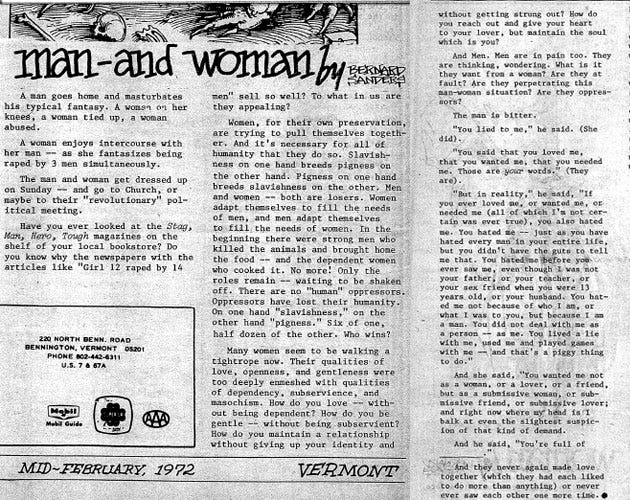
Mid-February 1972: Bernie publishes his so-called “Rape fantasy” essay:
In 1972, Bernie publishes an essay in the Vermont Freeman that is described in a Mother Jones profile as a “stream-of-consciousness essay on the nature of male-female sexual dynamics.” It’s an attempted critique of heteronormativity — a clumsy and weird-as-hell attempted critique of heteronormativity:
A man goes home and masturbates his typical fantasy. A woman on her knees, a woman tied up, a woman abused.
A woman enjoys intercourse with her man — as she fantasizes being raped by 3 men simultaneously.
The man and woman get dressed up on Sunday — and go to Church, or maybe to their “revolutionary” political meeting.
Have you ever looked at the Stag, Man, Hero, Tough magazines on the shelf of your local bookstore? Do you know why the newspaper with articles like “Girl 12 raped by 14 men” sell so well? To what in us are they appealing?
1972: Bernie runs for two offices:
Bernie runs on the Liberty Union ticket for Senate in a special election in early 1972, and for governor later in 1972.
1–15 June 1972: Bernie has admiration and respect for George Wallace supporters:
In his current campaign for the presidency, Sanders is attempting to strike a delicate balance between blistering criticism of Trump — whom he routinely calls a racist and pathological liar — while trying to claw back for the left a swath of working-class white voters who opted for the President’s right-wing populism in 2016.
Sanders demonstrated an ability to win them over in Vermont, whose population was 94.5% white, according to the most recent census, and, in a prescient essay from the second issue of Movement, a small magazine put out by Liberty Union that he published and edited, wrote about the resentment of those voters and the danger presented by a politician who could tap into it.
His subject in 1972 was George Wallace, the former segregationist and governor of Alabama, who won nearly 10 million votes in the 1968 general election.
In interviews with Wallace supporters, Sanders said he found “a certain feeling of admiration and respect for” their anger at the political system but feared that, with Wallace’s influence growing, their collective rage posed an existential threat to civil rights and American pluralism.
“I came away from these Wallace interviews with two basic feelings. First, that democracy in America (in any sense of the word) just might not make it,” Sanders wrote. “My mind flashed to scenes of Germany in the late 1920’s. Confusion, rebellion, frustration, economic instability, a wounded national pride, ineffectual political leadership — and the desire for a strong man who would do something, who would bring order out of the chaos.”
1972: Bernie’s praises Segregationist George Wallace:
Bernie Sanders was accused of praising a segregationist leader on Thursday after a 1972 article resurfaced in which he told a Vermont newspaper that he thought then-Alabama Gov. George Wallace was “sensitive” to what people felt they needed.
The Washington Examiner reports that Sanders — currently a Vermont senator and a 2020 contender — was a gubernatorial candidate for the socialist Liberty Union Party at the time of the interview with the Brattleboro Reformer. Sanders said that while Wallace advocated for some “outrageous approaches to our problems,” he was “sensitive to what people feel they need.” “What we need are more active politicians working for the people,” Sanders added.
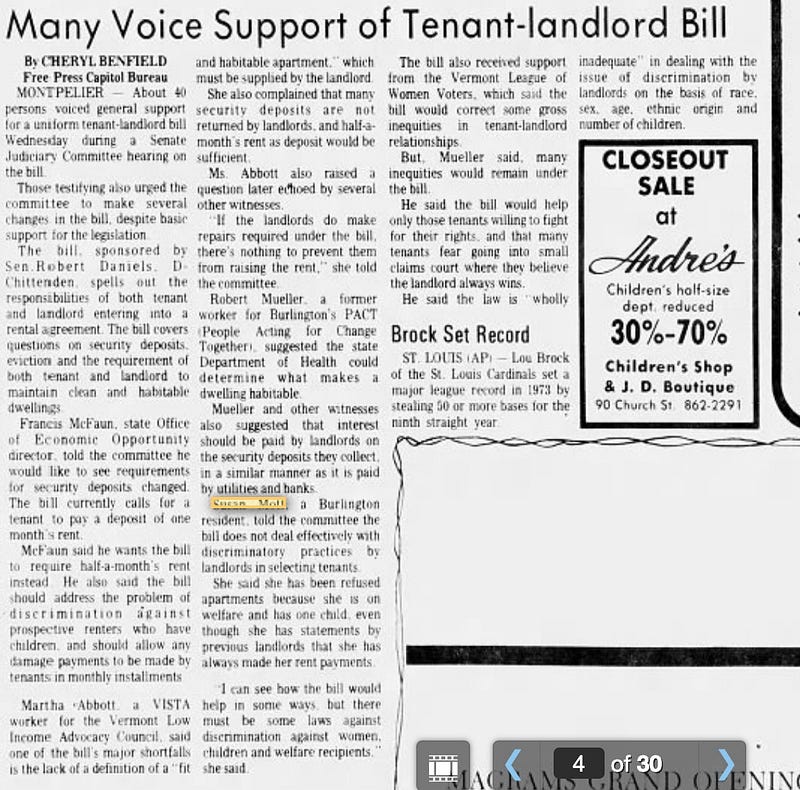
1974: Levi’s Mother admits in a Vermont Paper she is on Welfare:
Great catch by M. Mendoza Ferrer:
Levi Sanders’ mother, Susan Mott, is quoted in Burlington Free Press saying, “she is refused apartments because she is on welfare and has one child. @SenSanders, with a UChicago degree, isn’t working but running for VT Senator where he wins 4% of the vote as a socialist.
1974: Bernie rails against US guest workers from Jamaica:
Back in 1974, Sanders’s rhetorical target was local orchard owners. Vermonters, in their view, were unwilling to do the grueling work, which involved carrying around a ladder and heavy bucket of apples for eight hours a day. The orchard owners said that Jamaicans had more flexibility and experience in agricultural work. Unlike native Vermonters, they were under no expectation of permanent employment.
Sanders, in his second gubernatorial bid of the decade, among several losses for higher office before he finally won the Burlington mayoralty in 1981 and then moved to Congress a decade later, was running under the socialist Liberty Union Party. Sanders attacked state officials for accommodating the Jamaican immigrants and implying that native workers were “lazy.”
“With the Vermont unemployment rate one of the highest in the nation, I could never support importing foreign workers when our own people are out of work,” said Sanders, who was collecting unemployment insurance at the time.
The state’s employment security commissioner defended the program, praising the guest workers for “pick[ing] apples like crazy from sunup to sunset” at rates far greater than U.S. citizens.
“It sounds like she wants to bring slavery back to Vermont,” replied Sanders about his state, then more than 99% white (today, it’s about 91% white).
At the time, Vermont suffered from an unemployment rate hovering around 9%, much higher than the national average of 5.6%. Local college graduates complained about being unable to find work, often choosing apple picking to get by.
Agricultural workers from Jamaica and other Caribbean nations have been brought to the Northeast since the 1940s. In Upstate New York and Vermont, many immigrants have long complained about racial discrimination and abuse from locals in the overwhelmingly white communities where they’ve lived.
Race-based issues were often complicated for Sanders and others on the far left. In 1972, Sanders praised the populist instincts of segregationist George Wallace as “sensitive to what people feel they need,” though he condemned the Alabama Democratic governor’s racism in other writings.
Radicals such as Sanders sought to protect what they saw as a working-class suffering from de-industrialization and stagnating wages, while also guarding against inflaming racial tensions locally.
October 1974: Bernie calls for the abolishment of the CIA:
The CIA is “a dangerous institution that has got to go,” Sanders told an audience in Vermont in October 1974. He described the agency as a tool of American corporate interests that repeatedly toppled democratically elected leaders — including, he said, Mosaddegh. The agency was accountable to no one, he fumed, “except right-wing lunatics who use it to prop up fascist dictatorships.”
November 1974: Bernie gets creamed when he runs as the Liberty Union Party candidate for U.S Senate:
Bernie finishes a distant distant third (5,901 votes; 4%), behind 33-year-old Chittenden County State’s Attorney Patrick Leahy (D, VI; 70,629 votes; 49%) and two-term incumbent U.S. Representative Dick Mallary (R; 66,223 votes; 46%).
1976: Bernie runs as the Liberty Union Party candidate for Governor, preventing the Democratic Nominee from getting a majority of votes:
Bernie manages to collect 11,000 votes for governor and for Liberty Union. This forced the races for lieutenant governor and secretary of state to be decided by the state legislature when its vote total prevented either the Republican or Democratic candidates for those offices from garnering a majority of votes.
However, the campaign drained the finances and energy of the Liberty Union Party.
October 1976: Bernie compares Vermont workers to slaves:
In 1976 Bernie tells a local newspaper that the sale of a privately held mining company by its founders harkened back to “the days of slavery, when black people were sold to different owners without their consent,” and compared the service economy to chattel slavery.
Sanders was the Liberty Union Party’s nominee for governor at the time of the interview. The future senator responded to the announced sale of the century-old Vermont Marble Company to a Swiss conglomerate by calling for worker control of businesses, calling it “absolutely absurd” that the family that owned Vermont Marble could have “the unilateral right” to sell the company without the approval of its employees.
“We believe ultimately that companies like Vermont Marble should be owned by the workers themselves and that workers — not a handful of owners — should be determining policy,” Sanders said. “If a worker at Vermont Marble has no say about who owns the company he works for and that major changes can take place without his knowledge and consent, how far have we really advanced from the days of slavery, when black people were sold to different owners without their consent?”
The population of Vermont was, at the time, more than 99 percent white and roughly 0.2 percent black.
Later in the 1976 article, Sanders called for “the working people of this country, who constitute the vast majority of the population,” to seize control of the economy to thwart poor labor conditions, “if we are free people and not slaves.”
October 1976: Bernie Sanders leaves the Liberty Union Party of Vermont:
Post-October 1976: Bernie Sanders joins the Socialist Workers Party**:
Bernie aligns himself with the Socialist Workers Party (SWP), the self-proclaimed Trotskyist revolutionary party, and became its presidential elector in Vermont. He campaigned for its candidates and platform that defended the Iranian hostage seizure.
** NOTE: Bernie’s affiliation has been completely scrubbed from his campaign website, and mostly from his Wikipedia entries.
Labor Day 1977: Bernie again compares Vermont workers to slaves:
“Basically, today, Vermont workers remain slaves in many, many ways,” Sanders said in another interview in 1977, in which he compared the burgeoning service industry in the nearly all-white state to the enslavement of black Americans at the nation’s founding. “The problem comes when we end up with an entire state of people trained to wait on other people.”
Bernie, now the Liberty Union Party’s chairman — said that the decline of industry and the increase in service-sector jobs meant that “basically, today, Vermont workers remain slaves in many, many ways.”
October 1980: Socialist Workers Party Presidential Candidate Andrew Pulley defends the Iranian Hostage Seizure during a speech at the University of Vermont Campus:
Andrew Pulley speaks at the University of Vermont. Bernie Sanders chairs the meeting. Pulley attracted only 40 students to his rally, where he concentrated, according to the SWP’s newspaper The Militant, “on the Iran-Iraq war,” and condemned “anti-Iranian hysteria around the U.S. hostages.” Military action against Iran was not at that point theoretical — Pulley’s speech comes six months after the attempt to free the hostages in Operation Eagle Claw had failed.
Pulley condemned “Carter’s war drive against the Iranian people,” and said that the U.S. “was on the brink of war with Iran,” which would be fought “to protect the oil and banking interests of the Rockefellers and other billionaires.” Americans, he predicted, would soon “pay on the battlefields with our very own lives.” Their criticism of the Ayatollah was intended “to get us ready for war.” And, Pulley charged, the media who criticized those of us who were against “American imperialism” were “declared insane.” As for the hostages, Pulley said “we can be sure that many of them are simply spies… or people assigned to protect the spies.”
Pulley’s words were a direct echo of what the Islamic Society of University Teachers and Students had declared on Nov. 4, 1979 : “We defend the capture of this imperialist embassy, which is a center for espionage.”
1980: Bernie decides to run for Mayor of Burlington:
Bernie believed he was finished with electoral politics — until in late 1980, when his friend Richard Sugarman, a religion professor at the University of Vermont, showed him a breakdown of his Liberty Union vote tallies. As a whole, they were scant, but Sanders had done better in Burlington than anywhere else — and especially in the city’s poorest wards.
Thus, Bernie decided to run for mayor.
6 April 1981: Bernie Sanders wins his first election in Vermont:
In a shocking victory by only 10 votes, “Landside” Bernie Sanders becomes mayor of Vermont’s largest city, Burlington.
Sanders was elected on a socialist platform and led a mayoral administration that he boasted was “more radical” than any other in the country.
And he had a vision. Sanders believed his work in Burlington could spread socialism throughout America.
The irritant activist was an elected official, now making $33,800 a year, more than he ever had. Reporters started showing up in Vermont.[6]
[6] Kruse, M. (2015). Bernie Sanders Has a Secret [Profile]. Politico. Retrieved from https://www.politico.com/magazine/story/2015/07/bernie-sanders-vermont-119927.html
21 May 1981: Bernie speaks at another Pulley rally:
“For the last 40 years,” Sanders says, “the Socialist Workers Party has… been harassed, informed upon, had their offices broken into, had members of their party fired from their jobs, and have been treated with cold contempt by the United States government.”
Even worse, he went on, apparently referring to the Iranian hostage crisis, “now anybody who stands up and fights and says things is automatically a terrorist.” He claimed that he had been investigated by the FBI because “I was an elector for the Socialist Workers Party,” referring to his formal role in the 1980 election with the Trotskyists.
1982: Bernie speaks at a Boston Socialist Workers Party rally:
Bernie is a featured speaker at a Boston rally for the SWP’s Massachusetts gubernatorial candidate and the party’s slate for Congress in 1982, the year after he was narrowly elected mayor of Burlington.
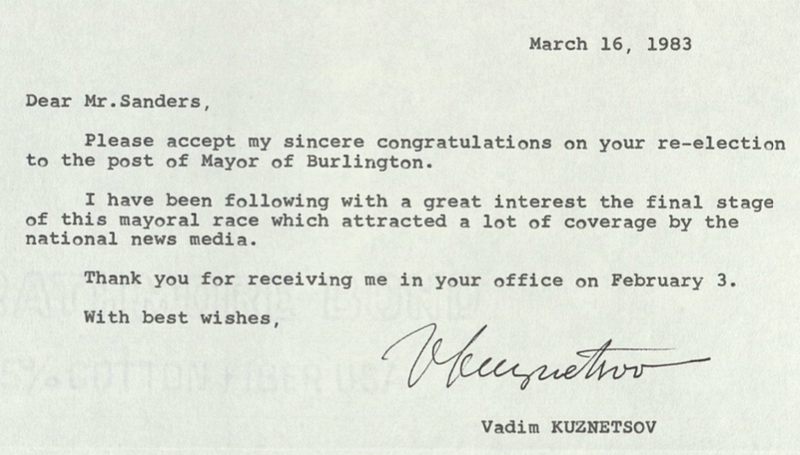
16 March 1983: Bernie is congratulated by the Soviet Embassy:
Bernie receives a letter from Soviet Embassy First Secretary Vadim Kuznetsov, congratulating him on his reelection as mayor and thanking Sanders for receiving him in Sanders’s office.
1984: Bernie calls the Democratic Party “bankrupt” as he campaigns for yet another SWP Presidential Candidate:
In 1984, Bernie speaks again on behalf of the SWP’s presidential candidate, this time former Black Panther Mel Mason, telling The Militant that “at a time when the Democratic and Republican parties are intellectually and spiritually bankrupt, it is imperative for radical voices to be heard which offer fundamental alternatives to capitalist ideology.”
1985: As Burlington Mayor, Bernie Sanders talks out of both sides of his mouth when it comes to local Defense Contractors:
Despite local protests, as Burlington Mayor, Bernie Sanders quietly lets Defense Contractors set up show in his town, despite making regular speeches decrying them.
In 1985, for example, protesters massed at the General Electric plant in Burlington, Vermont, where Sanders was serving as mayor. They were protesting the fact that the plant was manufacturing Gatling guns to fight socialists in Central America.
Jim Condon, now a Democratic state legislator in Vermont, was news director of a local radio station at the time and describes himself as an “old acquaintance” of the senator.
“There were protesters who were unhappy that General Electric was manufacturing Gatling guns at the plant, and so they would lock themselves to the gates and engage in civil disobedience. And so the mayor, Bernie, finally got cops to go in and arrest the protesters,” Condon told The Daily Beast. “The GE plant was one of the largest providers of jobs in the city. So it was economically important that the plant stay open and people who worked there went to work.”
When it comes time to make speeches, Sanders has slammed defense corporations for political gain.
“We know that there is massive fraud going on in the defense industry. Virtually every major defense contractor has either been convicted of fraud or reached a settlement with the government,” Sanders said in Iowa City last year at a town hall. “We need a strong military, it is a dangerous world. But I think we can make judicious cuts.”
But when those defense corporations come to his own backyard, he quietly welcomes them in.
The Vermont senator persuaded Lockheed Martin to place a research center in Burlington, according to Newsweek, and managed to get 18 Lockheed Martin F-35 fighter jets stationed at the city’s airport for the Vermont National Guard.
Sometime during his time as Mayor: Bernie says LGBT Rights are not a priority for him:
Earlier in his political career, Sanders was even more indifferent toward gay rights, which W.J. Conroy recounts in his book Challenging the Boundaries of Reform: Socialism in Burlington. When serving as mayor of Burlington, Sanders told an interviewer that LGBT rights were not a “major priority” for him. Asked if he would support a bill to protect gays from job discrimination, Sanders responded, “probably not.”
28 April 1985: Bernie wants a third party takeover in Vermont:
In April 1985, the Los Angeles Times published a lengthy interview with Sanders in which he outlined his plan to spark “radical change.”:
If the mayor of Burlington, Vermont’s largest city, has his way, Kunin’s successor will be America’s first Socialist governor.
“Vermont is ripe for a third-party takeover, and I may be the one to pull it off,” said Bernard (Bernie) Sanders, 43, a Socialist, re-elected last month to his third term as mayor of Burlington.
And…
Leaning back in a plain wooden chair, his shirt open without a tie, his hair disheveled, his left leg in the air resting on a table with his lunch box and peace-sign coffee cup, Sanders rattled off his thoughts in rapid-fire, staccato fashion:
“I think from one end of this country to the other people are ripe for political revolution. Fifty percent of the people do not bother voting in the presidential and statewide elections. The vast majority of those not voting are low-income people who have given up on America. The whole quality of life in America is based on greed. I believe in the redistribution of wealth in this nation.
“We are demonstrating in Burlington the peoples’ contempt for conventional old-fashioned Democratic and Republican politics. The good news here is that the two-party system and corporate establishment are not invincible.”
July 1985: Bernie Sanders visits Nicaragua as a guest of the Sandinistas:
Bernie goes to Nicaragua as a guest of the Sandinista Government, where he attended an event that one wire report dubbed an “anti-U.S. rally.”
The leftist Sandinista government was celebrating the sixth anniversary of the revolution that saw it take power from an American-backed dictator, Anastasio Somoza. Sanders was in a crowd estimated at a half million people, many of whom were clad in the Sandinistas’ trademark red-and-black colors and chanting “Here, there, everywhere/the Yankee will die.”
Onstage, Nicaraguan President Daniel Ortega accused the U.S. government of “state terrorism” for supporting the rebels who were seeking to overthrow him. The Sandinistas and the CIA-backed Contras would fight into the next decade, with allegations of human rights abuses on both sides. At the 1985 rally Sanders attended, Ortega vowed the Sandinistas would “defend the revolution with guns in hand.”
Sanders was being hosted by the Sandinistas as part of a delegation of American “solidarity groups.” He told reporters their decision to show “support” for the Nicaraguan government was “patriotic.”
“We want to show support for a small country trying to be independent, and we want to tell the truth to the American people when we return,” Sanders said. [1]
And just for clarification…
Sanders had earned his invitation to the celebration because he was a loud critic of President Ronald Reagan’s Central American policies. Burlington in the 1980s was a hotbed of opposition to the administration’s efforts to undermine the Sandinista government by financing Contra fighters, based in nearby Honduras. Reagan claimed the Sandinistas were communists and terrorists.
At a news conference that he and European socialists held in Managua the day of the celebration, Sanders repeated his criticism: “The real issue is a very simple one. Does the government of the United States of America have the unilateral right to destroy the government of Nicaragua because the president of the United States and some members of Congress disagree with the Sandinistas?”
During his visit, largely financed by the Sandinista government — Sanders paid his airfare — Sanders met with President Ortega and other officials. He sat down with the editor of an opposition newspaper, who complained of government censorship. And he walked through Managua’s slums, occasionally asking residents about the impact of the 1979 revolution on their lives.[2]
[1] Walker, H. (2016). Bernie Sanders’ radical past: How the Vermont firebrand started wearing a suit and gave up on taking over big companies [Profile]. Yahoo News. Retrieved from https://www.yahoo.com/news/bernie-sanders-radical-past-how-the-vermont-230255076.html
[2] Remsen, N. (2015). Sanders Siempre: What Bernie Learned in Nicaragua [Feature]. Seven Days. Retrieved from https://www.sevendaysvt.com/vermont/sanders-siempre-what-bernie-learned-in-nicaragua/Content?oid=2948191
8 August 1985: Bernie praises Fidel Castro:
Let’s dispense with the discourse dumbing stuff first. There’s no other way to say this, so I’ll just say it: Jorge Ramos seemed to have believed that he was at a Republican debate and was a shitty host at first. He threw out opening questions about Clinton’s emails and even Benghazi, beating the deadest of dead horses. He also wanted to stoke fears about Clinton being indicted, which there is no possibility of, and she dismissed out of hand, while reminding the public that she testified on Benghazi for 11 hours and even the most zealous Republicans got nothing.
But I guess he needed to look tough on Hillary for “balance” against what was about to happen to Sanders. And for his expose of Bernie Sanders, Ramos deserves a lot of kudos. Being situated in Miami, Florida, a city and state home to a great deal of Cuban Americans, Ramos dropped what can only be described as a bombshell on Bernie Sanders’ past adoration for Soviet-backed repressive Communist regimes like Fidel Castro’s in Cuba and Daniel Ortega and the Sandanistas in Nicaragua.
And he had Bernie’s Fidel Castro love affair on tape.
Sanders’ response was more telling than even the videotape. Given an opportunity to take back his glowing review of the Fidel Castro regime, Sanders refused.
Instead he tried to explain it all away by saying it was nothing more than his opposition to an interventionist foreign policy of the United States, but the tape clearly showed him doing much more than that. Bernie Sanders suggested that the reason Cubans didn’t overthrow Castro in the 1960s was because this benevolent dictator “educated their kids, gave them health care, totally transformed their society.”
The implication here is pretty chilling, if you consider that Sanders’ campaign promises tack pretty closely. It is not at all a far fetch to make the connection that Sanders believes that so long as a government “educates people’s kids and gives them health care”, that government is justified in suppressing key freedoms and depriving its citizens of due process.
There are two possible interpretations of this attitude. First, and the more benign interpretation that this is the exact Marxist tunnel vision of economic determinism that Trevor wrote about yesterday. In his view, human suffering begins and ends with economic troubles, and as long as a government provides for basic economic needs, everything else is inconsequential. Under this view, Sanders is simply ignoring, not actively advocating for the suppression of, civil and human rights.
The second interpretation is far too terrifying for a candidate for President of the United States.
No matter what the interpretation though, Sanders’ open refusal to reverse his words drew audible gasps in the room, and it confirms that Bernie Sanders is no ‘democratic socialist.’ His vision (or at least his defense) of socialism — either by neglect or by intent — extends to Soviet-style Fidel Castro brand communism.
Bernie Sanders patently demonstrated that at the very least, he still has a kinship and affinity for the Soviet brand of socialism, as his economic determinism originates from the same place even if he doesn’t want to jail dissidents in America. At the very least, Sanders has shown that in his warped view of ‘democratic socialism’, it’s the socialism that is operative, not the democracy.
This expose is necessary. Bernie Sanders’ support and praise for repressive communist regimes focusing on their economic distributions while at best ignoring human and civil rights has to come to light. It is important that those who have been duped to believe he’s ‘honest and trustworthy’ and those who have been attracted by his promise of free college and health care understand his true thought process.
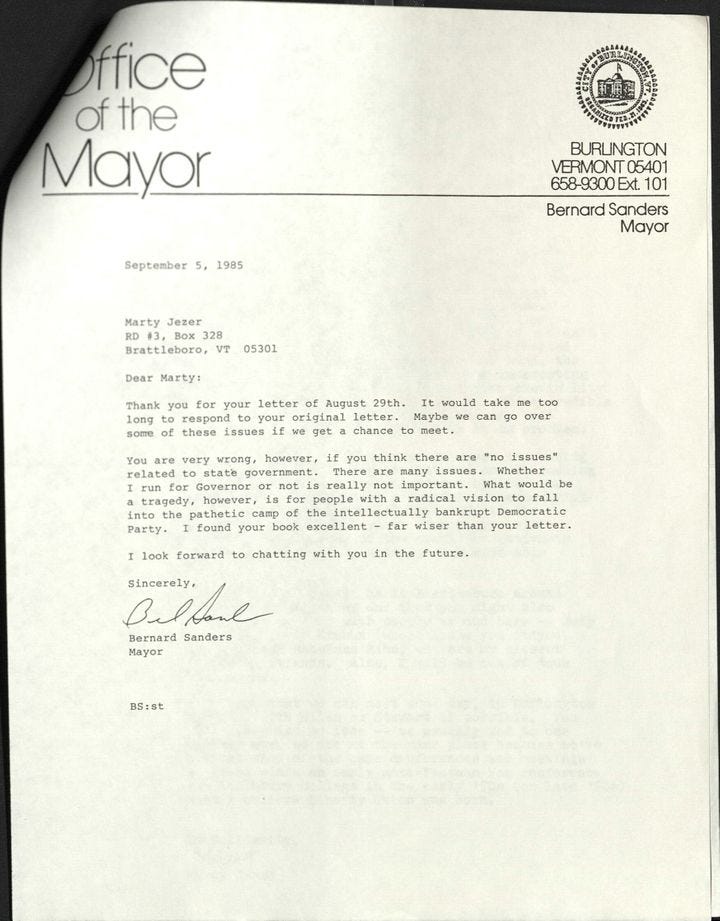
5 September 1985: Bernie Sanders Called The Democratic Party ‘Intellectually Bankrupt’ In 1985 Letter:
Sen. Bernie Sanders (I-Vt.) once told a fellow left-wing activist that the Democratic Party was too “intellectually bankrupt” to allow the progressive movement to flourish within it.
In a 1985 letter newly obtained by HuffPost in which Sanders debated running for governor, he wrote: “Whether I run for governor or not is really not important. What would be a tragedy, however, is for people with a radical vision to fall into the pathetic camp of the intellectually bankrupt Democratic Party.”
1 December 1987: Bernie claims to despise Democrats (again):
Bernie says in a local interview that he despises Democrats and that a JFK speech once made him sick. He also cracked on Jesse Jackson and Walter Mondale:
Vermont senator and Democratic presidential candidate Bernie Sanders once said that he was “physically nauseated” by a speech made by President John F. Kennedy when Sanders was a young man, because Kennedy’s “hatred for the Cuban Revolution […] was so strong.”
“Kennedy was young and appealing and ostensibly liberal,” Sanders reminisced in a 1987 interview with The Gadfly, a student newspaper at the University of Vermont. “But I think at that point, seeing through Kennedy, and what liberalism was, was probably a significant step for me to understand that conventional politics or liberalism was not what was relevant.”
In the same interview, he also criticized Jesse Jackson’s decision to try and affect change by “working within the Democratic party” and offered some pointed remarks about Walter Mondale.
Sanders told The Gadfly that endorsing the Democratic ticket in 1984 and “campaigning for Mondale […] was a very difficult thing to do.”
“When I’d go around talking about Walter Mondale I would say that if elected president, I felt, Walter Mondale was going to be a pretty bad president,” explained Sanders. “Now sometimes you may have to make painful decisions.”
“If you go around saying that Mondale would be a great president, you would be a liar and a hypocrite,” concluded Sanders. “That is not what I was saying.”
Sanders’s remarks about Kennedy, Jackson, and Mondale are in keeping with the Independent senator’s long history of criticizing the Democratic Party.
In a Rutland Herald article published the following year, Sanders explained the crucial difference between himself and Jesse Jackson: “‘Jesse believes that serious social change is possible within the Democratic Party. I don’t.’”
And in a 1989 op-ed in the Burlington Free Press, Sanders lambasted “the corporate-controlled Democratic and Republican parties,” and praised the National Organization of Women “for supporting the need for a progressive third party in this country.”
“Like millions of other Americans, NOW understands that the Democratic and Republican parties are intellectually and morally bankrupt,” Sanders wrote.
“We do not have an effective national political movement which is prepared to fight for power,” argued Sanders, “and which challenges the basic assumptions and priorities of the corporate-controlled Democratic and Republican parties — two political parties which have no substantive ideological differences and are, in reality, one party — the party of the ruling class.”
1987: Medicaid for All Would ‘Bankrupt the Nation,’ Warns Bernie Sanders:
A much younger Bernie warns that expanding Medicaid, the jointly run federal-state health care program for the poor and disabled, to everyone in the country would “bankrupt the nation”:
“If we expanded Medicaid [to] everybody. Give everybody a Medicaid card — we would be spending such an astronomical sum of money that, you know, we would bankrupt the nation.”
Bernie seeks a Soviet sister City for Burlington:
Bernie announces that Burlington, Vermont would seek a Soviet sister city, several dozen other American cities already had such a relationship or had applied for one.
Mr. Sanders reached out to the Soviet Union via an organization based in Virginia, requesting a sister-city partnership with the Cold War adversary in an effort to end the threat of nuclear annihilation.
“We were saying: The goal is to not have a nuclear war, not to plan and prepare for it,” said Terry Bouricius, a Burlington alderman at the time who accompanied Mr. Sanders on the trip.
This was also the era of perestroika and glasnost, economic and cultural changes promoted by Mr. Gorbachev that had sparked optimism among some in the West — along with skepticism from many others — that the Kremlin was prepared to adopt a more conciliatory stance abroad and provide greater freedoms to its own people.
December 1987: Bernie learns that Yaroslavl might be Burlington’s Soviet Sister City:
Records show, that Bernie speaks by phone with Yuri Menshikov, the secretary of the Soviet sister-city organization in Moscow. In a follow-up letter later this same month, Bernie receives word that Yaroslavl would be an ideal partner. He proposed leading a Burlington delegation to Yaroslavl to lay the foundation for a sister-city relationship.
Bernie suggested arriving on May 9 — the day that the Soviet Union celebrated its victory over Nazi Germany — and said he was especially interested in discussing economic development, the police, winter street cleaning, libraries, and plumbing and sewer systems.
“We are living through an amazing time, and I believe I am lucky to play a role in such a time,” Mr. Sanders wrote, according to a Russian version of his letter.
June 1988: Bernie leads a delegation to the Soviet Union to visit Yaroslavl:
Bernie’s visit to Yaroslavl was scheduled for early June, after Mr. Sanders’s 12-person delegation visited Moscow and Leningrad (now St. Petersburg). Mr. Sanders has referred to the trip as a “very strange honeymoon.”
Just before leaving, he had married his longtime partner, Jane O’Meara Driscoll, the director of the Youth Office in Burlington City Hall, in a televised outdoor ceremony on the shore of Lake Champlain.
The delegation’s visit to Yaroslavl was planned minute-by-minute, with tours of schools and theaters and virtually no breaks during the day.
“Visits to Yaroslavl churches and a boat trip on the Volga proved especially memorable to the guests,” an internal Soviet report says.
But the trip wasn’t enough to cinch the sister-city relationship. Mr. Sanders still had to convince Soviet officials in Moscow to grant their approval and allow Yaroslavl representatives to travel to Burlington. He offered glowing reviews in public and ratcheted up his lobbying effort in private.
“People there seemed reasonably happy and content,” Mr. Sanders told reporters in Burlington about Yaroslavl, a city of about 600,000. “I didn’t notice much deprivation.”
Two days after returning to Vermont, Mr. Sanders wrote to the Soviet Embassy in Washington, asking for help in setting up the sister-city program.
“It is my strong belief that if our planet is going to survive, and if we are going to be able to convert the hundreds of billions of dollars that both the United States and the Soviet Union are now wasting on weapons of destruction into areas of productive human development, there is going to have to be a significant increase in citizen-to-citizen contact,” Mr. Sanders wrote.
Throughout their negotiations with Burlington City Hall, Yaroslavl officials were coordinating their messaging with Soviet officials in Moscow.
In a letter to Moscow seeking approval for travel to the United States, Yaroslavl officials pledged that they would talk about the “peace-loving foreign policy” of the Soviet Union and the changes being implemented by Mr. Gorbachev. They attached a seven-point “plan for information-propaganda work” on their visit to Burlington, with specific talking points for each of the delegation’s three members.
The plan is followed by a nine-page guide issued by the Soviet Foreign Ministry on how to communicate Mr. Gorbachev’s policies to international audiences. It describes antiwar movements, sister-city contacts and foreign cultural figures as particularly important targets for Soviet propaganda.
“When carrying out propaganda measures abroad, the forms and methods of the information-propaganda work and its concrete contents must be approved by the Soviet Embassy and take into account the Soviet Union’s relationship with the given country,” the document says.
July 1988: Bernie gets the go-ahead to allow the relationship with Yaroslavl to go ahead:
Yaroslavl officials formally allowed the sister-city relationship to go ahead, reflecting approval from Moscow. Bernie sends an electronic message to a Soviet cosmonaut, Valentina Tereshkova, the first woman in space and the head of the Union of Soviet Societies for Friendship and Cultural Contacts, thanking her for “expediting this process.”
“I believe that sister city programs like the Yaroslavl Burlington one, will help improve Soviet American relations and develop a more peaceful world,” Mr. Sanders wrote.
October 1988: Yaroslavl officials visit Burlington:
Bernie personally manages the Soviet delegation’s visit to Burlington in October to sign the sister-city agreement, holding at least three phone calls with Yaroslavl officials and transmitting a detailed program covering seven days. There was a pilgrimage to the ice cream maker Ben & Jerry’s, where co-founder Ben Cohen told the Soviet officials they could have anything they liked in the gift shop, a delegation member, Yuri Novikov, recalled in an interview.
While the Yaroslavl documents show the Soviets to be planning a propaganda effort in Burlington, Mr. Casca, the Sanders campaign spokesman, said the reality was different when the Yaroslavl delegation arrived in Vermont in October 1988.
“Reporting at the time is clear, rather than propaganda, officials on both sides discussed the limitations of the Soviet system and their common desire to avoid nuclear war,” Mr. Casca said.
Three decades later, amid reports that the Kremlin was looking favorably upon Mr. Sanders’s presidential candidacy (as well as Mr. Trump’s), the Burlington-Yaroslavl relationship lives on in an era of renewed tensions between Washington and Moscow.
1988: Now a candidate for Congress, Bernie talks down the Socialist Worker’s Party:
Asked about the SWP in 1988, Bernie talked down the connection, saying that: “I was asked to put my name on the ballot and I did, that’s true.”
1989: Bernie claims to despise Democrats:
Bernie attacks Jesse Jackson…again:
And in a 1989 op-ed in the Burlington Free Press, Sanders lambasted “the corporate-controlled Democratic and Republican parties,” and praised the National Organization of Women “for supporting the need for a progressive third party in this country.”
“Like millions of other Americans, NOW understands that the Democratic and Republican parties are intellectually and morally bankrupt,” Sanders wrote.
“We do not have an effective national political movement which is prepared to fight for power,” argued Sanders, “and which challenges the basic assumptions and priorities of the corporate-controlled Democratic and Republican parties — two political parties which have no substantive ideological differences and are, in reality, one party — the party of the ruling class.”
28 November 1989: Bernie celebrates Communism’s transformation via Glasnost:
“Bernard” Sanders, now fellow at the Institute of Politics (IOP) at the Kennedy School, writes a piece for the Harvard Crimson: Time for an American Glasnost.
If you’re familiar with Bernie’s speeches, this is not going to be surprising. It’s basically his typical one-note, it’s all about the Income Inequality argument, albeit far more angrier and idealized.
But let’s look at a couple of key passages:
This strongly suggest that, due to the power of incumbency, our system of representative democracy has broken down completely and that election to Congress is now tantamount to lifetime tenure — a House of Lords.
Says the guy who later ran for both Houses in that “House of Lords”. If you can’t beat ’em, join ‘em?
It is now widely perceived that the major political parties in our country, the Democrats and the Republicans, have no basic ideological differences and are, in reality, two wings of the same party — both dominated by Big Money.
And yet now, he’s running to be the nominee of one of those parties who has no basic ideological differences.
Like I said, this article is nothing new. It’s basically the same screed you’ll see on some BernieBro Social Media.
But here’s the killer. Here’s the thing that (rightly or wrongly) will end Bernie’s shot at becoming President:
The news from the Soviet Union is breathtaking. Events which no one would have predicted 10 years ago are now occuring at lightning speed.
Glasnost; perestroika; free speech; open parliamentary debate televised before millions of viewers; the beginning of organized political opposition to the Communist Party; mass strikes and demonstrations by workers and ethnic minorities; serious publications dealing honestly with the nation’s sordid history which had been covered up for deades by official lies. And more.
Whatever the reason (and now is not the time to explore those reasons) enormous credit must be given to Mikhail Gorbachev and the current leadership of the Soviet Union for helping to bring about an extraordinary, non-violent revolution which is forcing citizens of the Soviet Union to rethink, in almost every way, the basic foundations of their na$ion.
Yeah, that’s how he spelled it.
And now let me make a proposal, a proposal which will, undoubtedly, offend many readers — but which has to be made. In my view the time is now for a glasnost in the United States — a soul searching for our own basic truths, a major debate over our current values, an honest analysis of the real structure of our society and the creation of a mechanism to search out our dreams for the future.
The history of the United States and the nature of our society are very different from that of the Soviet Union. But if the citizens of our country believe that this nation does not exist under the blanket of the Big Lie, and that many of the most important issues facing our people are not openly and seriously discussed, they are sorely mistaken. We are told every day by the politicians, and the media how “free” we are. Unfortunately, we are not given the freedom to explore that assertion. We need a glasnost!
Tell me that even the most ham-handed, half-witted Republican Operative won’t take that passage and spin it to mean that Bernie is calling for a Communist Revolution.
1989: Bernie decides to leave Burlington:
He decided to leave the Mayorship in 1989.
November 1990: Bernie gets support for his first Congressional Campaign from the NRA:
To go from praising Communism…just under a year later…to the NRA supporting Bernie’s first campaign for the House of Representatives:
A few days before Election Day in 1990, the National Rifle Association sent a letter to its 12,000 members in Vermont, with an urgent message about the race for the state’s single House seat.
Vote for the socialist, the gun rights group said. It’s important.
“Bernie Sanders is a more honorable choice for Vermont sportsmen than Peter Smith,” wrote Wayne LaPierre, who was — and still is — a top official at the national NRA, backing Sanders over the Republican incumbent.
3 January 1991: Bernie is sworn into the House:
Bernie is sworn in as a member of the House of Representatives.
8 May 1991: Bernie votes against the Brady Bill for the first time:
In May 1991, Sanders votes against a version that mandated a seven-day waiting period for background checks, but the bill passed in the House.
26 November 1991: Bernie votes against the Brady Bill for the second time:
The Senate decreased the waiting period to five days and the bill returned to the House.
In November 1991, Sanders voted against that version. Though it passed in the House, the Senate didn’t muster enough votes.
The Brady Bill and it's gun control stance remained in limbo during 1992.
10 November 1993: Bernie votes against the Brady Bill for the third time…twice?:
He also voted against an amendment that would have ended state waiting periods, and for an amendment giving those denied a gun the right to know why.
10 November 1993: Bernie votes against the Brady Bill for the fourth time:
After some back and forth, a version of the bill resurfaced that reinstated the five-day waiting period. In November 1993, Sanders voted against that version twice in the same day, but for an amendment imposing an instant background check instead (seen by some as pointless, as the technology for instant checks didn’t exist at the time).
22 November 1993: Bernie votes against the Brady Bill for the fifth time:
The final compromise version of the Brady bill — an interim five-day waiting period while installing an instant background check system — was passed and signed into law on Nov. 30, 1993. Sanders voted against it.
1994: Bernie Sanders says country needed more jails and ‘tougher’ penalties in certain cases in 1994 remarks backing crime bill:
Bernie Sanders says that he agreed the country needed “some more jails” and that it must be “tougher in certain instances” on crime.
The then-congressman from Vermont made the comments during a news conference in which he explained his support for the now-controversial 1994 crime bill. His remarks, video of which was obtained by CNN’s KFile from CCTV-Center for Media & Democracy, a Vermont public access station, sheds light on Sanders’ support of the now more controversial elements of the bill, and his reservations about other aspects.
Sanders more recently has described the bill as “terrible” and says he is sorry he voted for it, but his view at the time was that although the bill “isn’t perfect,” he viewed it as “a major step forward in controlling and preventing crime.”
“If you look at the issue of prevention versus punishment, if you like, I would’ve put more effort on prevention,” said Sanders in 1994.
“If you keep kids in school, if you get jobs for young people, in the long run, not only do you prevent crime, but you save the taxpayers substantial sums of money,” Sanders said, “Would I rather invest in education and keeping kids in school and making college opportunity a realistic goal for millions of young people rather than necessarily building one more jail. Yeah. I think I would have gone the other way.”
“On the other hand, do I think we need some more jails? Yup. Do I think we have to get tougher in certain instances? Yes, I do,” Sanders said. “So what you have is a balance here. You have more money going to law enforcement, more money going into jails. You have, on the other hand, significant sums of money going into prevention, beginning to allow us to deal with violence against women, child abuse and other very serious problems,” Sanders said.
Mike Casca, the campaign communications director for Sanders, on Sunday attacked Biden for his role in the tough-on-crime legislation.
“Bernie Sanders was consistently advocating that the Biden approach was coming at the expense of jobs and education needed to keep an entire generation of kids out of jail,” Casca told CNN.
28 June 1994: Bernie Sanders votes for the 1994 Crime Bill:
By now, you may have heard that Hillary Clinton supported the controversial 1994 tough-on-crime bill that her husband signed into law. Black Lives Matter activists have called her out for it. Michelle Alexander, author of The New Jim Crow, did as well. A protester at a Clinton campaign event even asked her to “apologize to black people for mass incarceration” while invoking her comments from the era.
But one thing that’s seldom noted — or only acknowledged as a footnote in stories about the 1994 law — is that Bernie Sanders, Clinton’s opponent in the Democratic primary, supported the 1994 crime law too. And while Clinton wasn’t in a position to vote for the bill as first lady, Sanders was in Congress — and he did actually vote for it.
Now, the 1994 crime law alone didn’t create or cause mass incarceration, as I’ve written in greater detail before. But the law was punitively “tough on crime,” and it did contribute a little to the rise in incarceration from the 1980s through 2000s. (More on the law here.)
Sanders was, based on his comments in Congress at the time, unhappy with mass incarceration. So why did he vote for the 1994 law that’s drawn so much criticism from critics of mass incarceration, and what does that mean for Sanders today?
1996: Bernie votes against the Defense of Marriage Act, but not for the reasons you think:
Sanders deserves credit for opposing DOMA — then a popular measure with bipartisan support — while a member of the House of Representatives in 1996. But Sanders’ efforts to parlay this vote into indisputable proof of his marriage equality bona fides ring hollow in light of his statements at the time. Explaining his vote in 1996, Sanders’ chief of staff told the Rutland Herald that Sanders’ vote was motivated by a concern for states’ rights, not equality. Explaining that he wasn’t “legislating values,” she noted that Sanders believed DOMA violated the Constitution’s Full Faith and Credit Clause by allowing one state to refuse to recognize a same-sex marriage performed in another. “You’re opening up Pandora’s box here,” she said told the Burlington Free Press at the time. “You’re saying that any state can refuse to … recognize the laws of another state if they don’t like them.”
1996: Bernie’s Republican challenger hires a P.I. To look into his life:
In ’96, he faced a Republican named Susan Sweetser. And she paid an investigator to look into his background.
Cathy Riggs called his ex-wife.
Sanders called a news conference.
“This is the kind of activity which makes politics so distasteful to people in the country and I think encourages people not to participate in the political process, not to vote, and certainly not to run for public office,” Sanders said.
His second wife, Jane Sanders, whom he married in 1988 — and to whom he is still married — also talked. “We are who we say we are,” she said.
Riggs said she was just doing her job and that she had done nothing illegal.
Sanders in his book “Outsider” devoted nearly three pages to the episode.
“She contacted my ex-wife, Deborah Messing, from whom I’ve been divorced for over 25 years,” he wrote. “Deborah contacted her friend and neighbor, Anthony Pollina, who used to work with me, and Anthony contacted me. Deborah and I then talked.
“Clearly, Riggs was hoping to find a disgruntled ex-wife who would spill the beans on her former husband. But that was not going to happen with Deborah, who has been remarried for over 20 years. While we don’t see each other very often, we remain good friends, so Deborah told Riggs where to get off. Her sentiments were reflected all over Vermont.”
Sanders cited a chunk of an article from the Associated Press written by Christopher Graff, who at the time was the AP’s longtime Montpelier bureau chief (and whose son, Garrett Graff, is the editor of Politico Magazine).
“What may be considered fair and proper in other states leaves Vermonters apoplectic,” Graff had written. “It is against this background that Vermonters viewed Susan Sweetser’s hiring of a private eye to probe Sanders’ background. Such a hiring would not even gain a passing mention in most states these days. It is accepted practice.”
Sweetser, seeing that this attempt at a thorough vetting of Sanders had backfired, denounced the woman her campaign had hired. “I want to make it clear to the people of Vermont that Cathy Riggs went too far,” she said. Too late. Sanders trounced Sweetser, winning the election by more than 20 percentage points.
6 February 1997: Bernie co-sponsors a bill that would dump Vermont’s Nuclear Waste in Sierra Blanca, Texas:
Rep. Bernie Sanders co-sponsors the Texas Low-Level Radioactive Waste Disposal Compact Consent Act (with the Congressman from BP, Joe Barton).
In the late 1990s, when now-U.S. Sen. Bernie Sanders of Vermont was a member of the House, he supported a compact between Maine, Vermont and Texas that originally proposed dumping low-level radioactive waste in a small minority community in far-West Texas, putting him at odds with other progressive congressmen.
Though the waste never made it to Sierra Blanca, a low-income, largely Hispanic town in Hudspeth County, Sanders’ efforts have attracted renewed attention online in the lead-up to Tuesday’s Texas primary. Critics suggest that the candidate’s role in promoting the compact — which ultimately brought the waste to a different site in West Texas — undermines his otherwise progressive record.
“It reflects very poorly on him,” said longtime environmental justice activist Dr. Robert Bullard, dean of the Barbara Jordan-Mickey Leland School of Public Affairs at Texas Southern University and the author of Dumping in Dixie. “Shoving this down people’s throats is not progressive politics. It was business as usual. It’s a classic case of rich people from a white state shifting something they don’t want to a poor minority community somewhere else.”
11 September 1998: Bernie Sanders tells Texas to “Drop dead”:
According to a Texas Observer article from the time — provocatively headlined, “Sanders to Sierra Blanca: ‘Drop Dead!’” — when activist Gary Oliver and others confronted Sanders to ask if he would at least visit Sierra Blanca, the representative offered a terse response.
“Absolutely not,” Sanders said. “I’m gonna be running for re-election in the state of Vermont.”
20 September 1998: Bernie’s bill to dump Nuclear Waste on Sierra Blanca is signed into Law:
The Texas Low-Level Radioactive Waste Disposal Compact Consent Act is signed into law by Bill Clinton.
2000: Bernie refuses to give a straight answer about his position on Marriage Equality:
Columnist Peter Freyne has this to say in Seven Days:
Obtaining Congressman Bernie Sanders’ position on the gay marriage issue was like pulling teeth…from a rhinoceros. Last month, shortly after the decision of the Amestoy Court was issued, Mr. Sanders publicly tried walking the tightrope — applauding the court’s decision and the cause of equal rights without supporting civil marriage for same-sex couples.
This week we were no more successful getting a straight answer. All we did get was a carefully crafted non-statement statement via e-mail from Washington D.C. And Bernie’s statement wins him the Vermont congressional delegation’s Wishy-Washy Award hands down.
Once more he “applauds” the court decision but won’t go anywhere near choosing between same-sex “marriage” and domestic partnership. “By all accounts the legislature is approaching this issue in a considered and appropriate manner and I support the current process.”
Supports the current process, does he? What a courageous radical!
That’s as far as Ol’ Bernardo would go. It’s an election year, yet despite the lack of a serious challenger, The Bern’s gut-level paranoia is acting up. He’s afraid to say something that might alienate his conservative, rebel-loving rural following out in the hills. Something that could be interpreted as “Bernie Loves Queers!”
2 October 2000: Bernie votes against a Bill that would help rape victims find out if their attacker has a disease:
H.R. 3088: To amend the Omnibus Crime Control and Safe Streets Act of 1968 to provide additional protections to victims of rape.
Alternate Title: Victims of Rape Health Protection Act.
Basically, the Bill helps Rape Victims find out of their attacker has a disease.
Bernie was one of 19 people to vote against it.
21 April 2006: Evil Wall Street NeoLiberal Schill Hillary Clinton donates money to Bernie’s Senate Campaign:
Hillary Clinton felt the bern…for a bit.
New York Sen. Hillary Clinton shared her wealth in March, doling out $190,000 to Democrats in Iowa, New Hampshire and elsewhere, according to a campaign report filed late Thursday.
Clinton’s political action committee, HILLPAC, raised $272,477 and spent $327,484 in March, according to the group’s filing to the Federal Election Commission.
A potential 2008 candidate for the White House, Clinton donated $5,000 each to the Democratic organizations in New Hampshire and Iowa — two states that play key early roles in presidential primaries. She gave the same amount to state parties in Michigan and Arizona.
Clinton spokeswoman Ann Lewis said the Iowa and New Hampshire donations were part of a larger effort to help Democratic candidates for governor in 2006.
The Senate Democrats’ campaign committee, the House Democrats’ campaign committee and the national committee each received $15,000.
Two congressmen trying to make it to the Senate also got boosts from Clinton. Rep. Bernie Sanders, who is running for the seat held by retiring Vermont lawmaker Jim Jeffords, received $10,000, as did Harold Ford Jr. of Tennessee, who is campaigning for the seat being vacated by Majority Leader Bill Frist. Newly minted Sen. Robert Menendez of New Jersey also got $10,000.
6 June 2006: Bernie votes to protect the Minutemen:
A few months before Democrats swept the 2006 elections, an outcry raged in the fringier corners of the immigration debate. Treasonous American officials were tipping off the Mexican government about the whereabouts of Minutemen patrols, the argument went, making it impossible for the private army bent on preventing undocumented immigrants from crossing the border to do their jobs.
The outcry made it to Congress, where Georgia Rep. Jack Kingston, a Republican, introduced an amendment clearly directed at the Minutemen story. The amendment barred the Department of Homeland Security from providing “a foreign government information relating to the activities of an organized volunteer civilian action group, operating in the State of California, Texas, New Mexico, or Arizona.”
Kingston’s amendment overwhelmingly passed the Republican-controlled Congress, including the votes of 76 Democrats, most of them from the party’s then-strong Blue Dog conservative wing. Another person voted for the measure, too: Rep. Bernie Sanders, an independent in the midst of the campaign that would send him the U.S. Senate.
Click here for the actual vote record.
21 September 2006: Bernie votes for Indefinite Detention:
Bernie votes for the Community Protection Act of 2006. It was authored by James Sensenbrenner of Wisconsin, Republican. Its purpose?
To restore the Secretary of Homeland Security’s authority to detain dangerous aliens, to ensure the removal of deportable criminal aliens, and combat alien gang crime.
When Hillary says Bernie voted for Indefinite Detention, this is the bill she’s talking about. It passed the House but died in the Senate. (Guess where Bernie would be in four months?)
2006: Running for the Senate, Bernie remains…at best…indifferent towards Marriage Equality:
In 2006, Bernie took a stand against same-sex marriage in Vermont, stating that he instead endorsed civil unions. Sanders told the Associated Press that he was “comfortable” with civil unions, not full marriage equality. (To justify his stance, Sanders complained that a battle for same-sex marriage would be too “divisive.”) At the time, he also opposed a federal anti-gay-marriage amendment — but so did his Republican opponent for the Senate seat, Richard Tarrant, who also supported civil unions. With a wide lead in the polls and little at stake, Sanders declined to differentiate himself from his opponent by taking the lead on gay rights.
3 January 2007: Bernie Sanders is sworn in as a U.S. Senator:
24 June 2007: Bernie’s appearance on Lou Dobbs’s broadcast:
Dobbs, for those who’ve forgotten, was a business news broadcaster who refashioned himself as a somewhat Trump-esque anti-immigration, anti–trade deal populist in the mid-aughts.
If you watch the interview you’ll see that Sanders isn’t particularly interested in working conditions for guest workers and he’s also not narrowly focused on the H2 programs the SPLC report was about — he also talks about H1 programs for skilled workers that, whatever their flaws, are clearly not slavery.
Dobbs is opposed to the whole idea of “amnesty,” which Sanders was not, but Sanders also doesn’t argue with Dobbs about it. Sanders doesn’t really say anything about the costs and benefits to immigrants themselves — whether that’s people who’ve been living illegally in the United States or potential future guest workers — one way or another. His focus is on the idea that “what happens in Congress is to a very significant degree dictated by big-money interests” and that “I don’t know why we need millions of people to be coming into this country as guest workers who will work for lower wages than American workers and drive wages down even lower than they are now.”
7 July 2007: Bernie Sanders votes against Immigration Reform:
“What this legislation is not about is addressing the real needs of American workers,” Mr. Sanders said in a speech on the floor of the Senate in 2007. “It is not about raising wages or improving benefits. What it is about is bringing into this country over a period of years millions of low-wage temporary workers with the result that wages and benefits in this country, which are already going down, will go down even further.”
He made a similar comment at another point that year, saying that the bill would “end up lowering wages for American workers right now.” It was, he said at yet another point, a “bad piece of legislation” for laborers. [3]
ThinkProgress put it like this:
“I frankly do not believe that we should be bringing in significant numbers of unskilled to workers to compete with [unemployed] kids,” Sanders said. “I want to see these kids get jobs.”
Studies have shown that immigrants actually create jobs for American workers. Researchers recently found that each new immigrant has produced about 1.2 new jobs in the U.S., most of which have gone to native-born workers. And according to the Atlantic, an influx in immigration can cause non-tradable professions — jobs like hospitality and construction that cannot be outsourced — to see a wage increase because the demand for goods and services grows with the expanding population.
But Sanders fails to see it that way, pointing on Thursday to the 36 percent unemployment rate for Hispanic young people. “You bring a lot of unskilled workers into this country, what do you think happens to that 36 percent?”
Sanders’ poor track record on immigration goes back further than just his presidential campaign. In 2007, he voted against a bipartisan immigration reform bill sponsored by Sen. John McCain (R-AZ) and Sen. Ted Kennedy (D-MA). At the progressive Netroots Nation conference earlier this month, Sanders said the reform bill would have allowed for low wage workers to enter the country who would “be competing against kids in this country who desperately need jobs.” [4]
But Sanders did vote for the 2013 immigration reform bill, which also included guest worker programs and contained most of the same measures as the 2007 bill that he opposed.
So in 2013, considering a run for President, he voted for the Bill?
Still, at the end of the day…Bernie Sanders voted against Immigration Reform in 2007.
The record of the final vote is here:
[3] Haberman, M. (2015). Bernie Sanders Can’t Escape Questions About 2007 Vote on Immigration Overhaul. The New York Times. Retrieved from https://www.nytimes.com/politics/first-draft/2015/10/19/bernie-sanders-cant-escape-questions-about-2007-vote-on-immigration-overhaul
[4] Lerner, K. (2015). Why Immigration Is The Hole In Bernie Sanders’ Progressive Agenda [Analysis]. Think Progress. Retrieved from https://thinkprogress.org/why-immigration-is-the-hole-in-bernie-sanders-progressive-agenda-604e5ce56e9f/
1 October 2008: Bernie votes for the standalone Auto Bailout:
Sanders votes against the Emergency Economic Stabilization Act of 2008.
Hillary votes for TARP while Bernie voted against it. TARP became law.
15 January 2009: Bernie votes against using TARP Funds to bail out the Auto Industry:
In 2008, Sanders voted for the standalone auto bailout, which did not pass. But he later opposed using TARP funds to bail out the auto industry because those funds were also earmarked for bailing out financial institutions — that measure passed.
Vox explained it this way. (Both are accurate from what I can tell):
Senator Clinton voted against a resolution of disapproval to release the second $350 B of TARP funds while Senator Sanders voted for this resolution. The vote failed and the resolution died, thus allowing the full TARP funding to be used by President Obama and his team when they took over. This is the vote she highlighted last night.
2 April 2009: Bernie votes to allow Guns on Amtrak:
Now a U.S. Senator, Bernie votes to allow Guns on Amtrak.
12 May 2009: Bernie votes to allow guns in National Parks:
Yes, Virginia. Bernie voted to allow guns in National Parks. (I know, President Obama signed it, but it was part of the Credit Card Accountability Responsibility and Disclosure Act of 2009, and Tom Coburn knew that when he added this amendment.)
22 May 2009: Guns in National Parks passes:
The Credit Cardholders’ Bill of Rights Act of 2009 passes with that dang Coburn Amendment (See May 12, 2009). Thanks Bernie!
9 March 2009: A Koch Brothers funded group praises Bernie:
The group at the center of the Koch brothers’ vast political network is praising Bernie Sanders for opposing the Export-Import Bank and for his attacks on corporate welfare.
Freedom Partners put out the web video highlighting its common ground with the Vermont senator ahead of Wednesday night’s Democratic debate.
The video features a clip of Sanders responding to a question from the previous debate about why he opposed the Export-Import bank, a favorite punching bag of the Koch brothers. Sanders’ stance has put him at odds with many of his fellow Senate Democrats, including Elizabeth Warren.
22 July 2011: Bernie suggests primarying President Obama:
While on Thom Hartmann’s show, Bernie says this:
SANDERS: Brian, believe me, I wish I had the answer to your question. Let me just suggest this. I think there are millions of Americans who are deeply disappointed in the president; who believe that, with regard to Social Security and a number of other issues, he said one thing as a candidate and is doing something very much else as a president; who cannot believe how weak he has been, for whatever reason, in negotiating with Republicans and there’s deep disappointment. So my suggestion is, I think one of the reasons the president has been able to move so far to the right is that there is no primary opposition to him and I think it would do this country a good deal of service if people started thinking about candidates out there to begin contrasting what is a progressive agenda as opposed to what Obama is doing. […] So I would say to Ryan [sic] discouragement is not an option. I think it would be a good idea if President Obama faced some primary opposition.
I can’t believe I didn’t add this earlier. Video below.
26 September 2011: Bernie’s wife resigns as President of Burlington College:
From the Bennington Banner:
The president of Burlington College has resigned after months of talks with the board of trustees, the college announced Monday.
Jane O’Meara Sanders, the wife of U.S. Sen. Bernie Sanders, submitted her letter of resignation on Monday, the same day the trustees planned to discuss her future during a meeting.
An agenda item for the trustee’s meeting included an item, “Removal of the President.”
Sanders, 60, who has led the 200-student college since 2004, will officially step down on Oct. 14.
She plans to take a sabbatical over the next year during which time she says she will consult with the private liberal arts college on fundraising, site development and other matters. The college did not say why she had resigned.
“We reached a decision which I believe is best for both the College and me,” she said in an email to the Burlington Free Press (http://bit.ly/peVYgC) after the meeting.
The question has been whether she would remain in the post for another six years, when her current contract expires in 2013, she said.
“The board and I have different visions for the future and that’s perfectly fine,” she told the newspaper.
The college credited Sanders with negotiating the $10 million purchase of the Burlington Catholic Diocese headquarters and its lakefront property on North Avenue, where it moved earlier this year.
14 December 2012: Bernie defends liability protection for Gunmakers, on the day of Sandy Hook:
The day of Sandy Hook, Senator Sanders continues to defend liability protection for Gunmakers on the Thom Hartmann Show.
8 January 2013: Bernie co-sponsors a broad Human Cloning Ban:
Bernie Sanders voted YES on “forbidding human cloning for…medical research. Voted to pass a bill that would… punish violators with up to 10 years in prison and fines of at least $1 million.”
The specific bill is H.R.234 — the Human Cloning Prohibition Act of 2003 (Introduced in House) January 8, 2003, by Dave Weldon (R) of Florida.
Not only did Bernie Sanders give his support to this anti-science bill, but he is officially listed as a co-sponsor.
24 January 2013: Joe Rogan compares Black people to Apes:
A clip of a 2013 Rogan podcast has begun to circulate, in which he talks about going to see a “Planet of the Apes” movie in a black neighborhood. He tells his co-hosts that the driver assured him that the film was playing in a “good neighborhood.”
“We get out, we’re giggling, ‘We’re going to go see Planet of the Apes,’ We walk in to Planet of the Apes. We walked into Africa,” Rogan says in the clip.
Why add Joe Rogan here? Fast forward to 2020…
5 April 2013: Bernie keeps saying that he’s not Obama’s biggest fan:
Repeated theme: “I’m not Obama’s biggest fan…”:
18 October 2013: Bernie starts focusing on the White Working Class:
Okay, first read this:
Sen. Bernie Sanders (I-VT) made the case for a broader progressive push in an interview with MSNBC host Ed Schultz on Friday, saying his recent sojourn into southern states showed him there was still a Democratic base in a region usually known for supporting Republicans.
“I’ve been meeting with unionists, independents, progressive Democrats,” Sanders explained via satellite from Columbia, South Carolina. “And they are tired of being abandoned by the national Democratic party. They want some help, and they believe that with some help they can start winning in these conservative states.”
One cause for concern, Sanders explained to Schultz, was seeing many white, working-class voters in “low-income states” like Georgia, Alabama and South Carolina voting against their own best interest.
Overall, he’s not too far off the mark here…until that last graph. This goes back to his eternal theme of raising only the concerns of the White Working Class, which is it’s own form of racial resentment toward Blacks and people of color.
Why is it only the white working-class he’s on about? Robert Reich later said the same thing. (See January 21, 2016)
Well, people of color noticed, and they voted for Hillary accordingly.
12 July 2013: Sanders: Immigration bill threatens American workers:
Sen. Bernie Sanders (I-Vt.) says the guest worker provisions are problematic with high unemployment in the U.S. But he also insists the bill’s fate remains in the hands of Republicans at a political crossroads.
16 April 2014: Buddy Roemer firm invests $4 million in Young Turks Network:
A firm led by former Republican governor and congressman Buddy Roemer is investing millions into The Young Turks Network to significantly increase its content, sales, and platform presence.
The investment of $4 million, with an option to go up to $8 million, came out of a conversation Roemer and The Young Turks Network founder Cenk Uygur had backstage before speaking at a conference about money in politics last year. The relationship between the conservative Louisiana politician and the founder of the progressive media outlet stemmed from both making the removal of money’s influence on politics their signature issues.
“One thing led to another, and it turns out we’re terrific partners for one another and that’s how it came about,” Uygur, who also has a PAC devoted to campaign finance reform, said in an interview.
In a statement, Roemer said his firm, Roemer, Robinson, Melville & Co., LLC, has been looking for two years to find the best new media platform in which to invest.
“We believe TYT will be one of the critical players moving forward in a new media world — edgy, unfiltered news commentary at its best,” Roemer said. “They are a lot like me, sometimes wrong but never in doubt. We expect their news to continue to push the envelope and their business to grow exponentially.”
Uygur said Roemer’s group will sit on The Young Turks Network’s advisory board but will not have influence over content. The network, which has a popular online news show that once broadcast on Current TV, has just announced that Hulu will carry a 30-minute version of “The Young Turks” and the network’s entertainment show “PopTrigger.”
“People are seeing that online media is a powerhouse and it’s a very logical investment; if you’re at all savvy you can see the handwriting on the wall which is that the audience is obviously going online for video content, and more so even in younger audiences,” Uygur said. “I think whether in media or out of the media business, if you’d like to make money, online video and digital media is a great way to do and I think people are just wising up to that.”
Uygur said the money will mostly be spent on hiring a larger sales team, creating more content, and expanding the number of platforms they currently broadcast on.
19 November 2014: Bernie on how Democrats lost white voters:
Well, here’s what you got. What you got is an African-American president, and the African-American community is very, very proud that this country has overcome racism and voted for him for president. And that’s kind of natural. You’ve got a situation where the Republican Party has been strongly anti-immigration, and you’ve got a Hispanic community which is looking to the Democrats for help.
But that’s not important. You should not be basing your politics based on your color. What you should be basing your politics on is, how is your family doing? … In the last election, in state after state, you had an abysmally low vote for the Democrats among white, working-class people. And I think the reason for that is that the Democrats have not made it clear that they are prepared to stand with the working-class people of this country, take on the big money interests. I think the key issue that we have to focus on, and I know people are uncomfortable about talking about it, is the role of the billionaire class in American society.
Spring 2014: Bernie drags his feet on the VA Scandal:
Dozens of veterans died while waiting for medical care at Phoenix Veterans Health Administration facilities, a scandal CNN broke in the spring of 2014. The imbroglio spread with reports of secret waiting lists at other VA hospitals, possibly leading to dozens more preventable deaths.
He held one-sixth of the hearings on oversight that his House of Representatives counterpart held. Republicans griped that they had made multiple requests for more oversight hearings, but received no response. A news host even challenged Sanders as the scandal erupted, saying he sounded more like a lawyer for the VA than the man responsible for overseeing it.
“We feel that he did not live up to his responsibilities as SVAC chairman to provide oversight into this. He keeps hiding behind the mantle [of the title]. And yes, he did pass the $15 billion piece of legislation, but that’s… akin to closing the barn door after the chickens have escaped,” said Matthew Miller, the chief policy officer of Iraq and Afghanistan Veterans of America.
By the time the scandal broke, Sanders had been chairman for more than a year. While the House VA committee held 42 hearings on VA oversight, the Senate VA committee chaired by Sanders held only about seven hearings on the matter.
“The House needed a partner in the Senate to help flesh out the problems at the VA, and unfortunately Bernie Sanders was not that partner. Jeff Miller and his committee were the ones who pursued this and ultimately uncovered [the VA scandal]… only when the VA scandal broke was when [Sanders] ultimately decided to do oversight hearings,” said Dan Caldwell, the vice president for political and legislative action of Concerned Veterans for America.
Republicans on the committee signed a letter shortly after the scandal broke, demanding to hold multiple oversight hearings on the VA, and complained that they had requested “multiple oversight hearings since the beginning of the 113th Congress with none of the requested hearings taking place and no response.”
Even as the scandal was breaking, Sanders was challenged for his defense of the VA.
“You sound like a lawyer defending the hospital, as opposed to a senator trying to make sure the right thing is done,” CNN host Chris Cuomo lectured Sanders as the scandal unraveled.
It was his progressive worldview that blinded him to the problems of the VA, some veterans advocates argued, and it prevented him from seeing the problem as it emerged.
1 June 2015: Bernie continues to criticize the Obama presidency:
Not running against the President, huh?
At another point in the interview, he offered a sweeping criticism of Obama’s presidency, despite the fact that he believes history will be kinder to him than many of his Republican critics have.
After Obama won the presidential election in 2008 with a campaign that Sanders called “one of the great campaigns in American history,” Sanders believes Obama abandoned the movement that brought him to the White House.
“The day after he was inaugurated,” said Sanders, Obama said “thank you very much for getting me elected and I’ll take it from here.”
This is the reason, Sanders believes, that his most strident Republican critics have been able to gain a foothold. President Obama, he said, did not take advantage of the scores of new voters he brought into the political process to enact real change.
10 June 2015: Bernie votes down the Export-Import Bank:
Bernie votes against the Export-Import Bank, and goes so far as to brag about it on his website:
Do I you what the Export-Import Bank is? It’s okay, neither do I. But here’s what Hillary Clinton said about Republican opposition to it:
“It’s wrong that candidates for president, who really should know better, are jumping on this bandwagon,” she said in New Hampshire. “It’s wrong, it’s embarrassing. … The idea that we would remove this relatively small but vital source of funding for our businesses to compete is absolutely backwards.”
30 June 2015: Bernie still hasn’t released his tax returns:
Hasn’t released his tax returns.
Sanders, who has been rising in the polls in his bid for the Democratic nomination against Hillary Rodham Clinton, voluntarily released the first few pages of his 2014 federal and Vermont tax returns Tuesday at the request of The Washington Post.
But that’s it, and…truth be told, not even his whole tax return, the released 3-page document is missing Schedule C and Schedule A.
5 July 2015: Bernie backs tax exemptions for Churches that discriminate against Gays:
Bernie says he’d let Churches that discriminate against Gays keep their Tax-Exempt Status:
Democratic presidential candidate Bernie Sanders on Sunday highlighted his record on LGBT rights but stopped short of endorsing the removal of tax-exempt status from religious organizations that refuse to recognize same-sex marriages, which were recently legalized nationwide by the Supreme Court.
“I don’t know that I would go there,” the Vermont senator said on CNN’s State of the Union. “You know, we have religious freedom and I respect people who have different points of view. But my view is that people have a right to love each other regardless of one’s sexual orientation.”
7 July 2015: Bernie makes his infamous Chicago Guns/Vermont Guns comment:
Yeah. This happened:
I come from a state where there is virtually no gun control. But the people of my state understand, pretty clearly, that guns in Vermont are not the same thing as guns in Chicago or Los Angeles. In our state, guns are used for hunting. In Chicago they are used for kids killing other kids or gang members shooting at police officers, shooting down innocent people. We need a sensible debate about gun control, which overcomes the cultural divide that exists in this country, and I think I can play an important role in this.
9 July 2015: Bernie declares asking questions about him being a deadbeat to his son off-limits:
One morning last month in Burlington, Vermont, at the law office of John Franco, one of Bernie Sanders’ best friends since the 1970s, Franco talked to me at length about Sanders’ commitment and his consistency and his charisma. Even at the beginning of Sanders’ career, he said, four decades before he started packing arenas in college towns and liberal havens as a renegade 73-year-old, self-described socialist taking on Hillary Clinton and the Democratic Party establishment, “People didn’t want him to stop talking.” He talked about how Sanders “completely changed the political culture” in Vermont. He talked about how Sanders’ surprising current surge in national polls is “validation.”
“I’m proud of Bernard,” he said.
All of that was interesting. But I wanted to know not just about what Sanders has done. I wanted to know more about who he has been. So I asked what I thought was an innocuous question about Sanders’ son. How did Sanders juggle aspirations as an eager political activist with his role as a divorced young father?
“That’s out of bounds,” Franco said.
Out of bounds?
“It’s none of your f — -ing business,” he said. He smiled, but he wasn’t joking.
16 July 2015: Bernie continues to attack Obama:
This:
Sanders: In many respects, the president was not strong enough on many issues. For example, he’s wrong on the trade issue, dead wrong. Also, the president made a mistake, that after his brilliant campaign of 2008, he essentially said to his most motivated supporters, thanks very much for electing me, but I’ll go from here on my own. I’ll sit down and negotiate with Boehner and Mitch McConnell and I really don’t need you anymore. Terrible mistake. Because the only way forward, to bring forth a progressive agenda, is to have the American people mobilized.
This is the second time he said the President abandoned us. The first time was July 1st.
18 July 2015: The Black Lives Matter Incident at Netroots Nation:
A town hall for liberal activists featuring two Democratic presidential candidates was interrupted by dozens of demonstrators on Saturday who shouted down the contenders and demanded they address criminal justice issues and police brutality.
Former Maryland Gov. Martin O’Malley and Vermont Sen. Bernie Sanders planned to attend a public sit-down interview with journalist Jose Antonio Vargas in front of a left-leaning crowd here at the annual Netroots Nation conference, a gathering of progressives, when the tone of the program shifted just a few minutes into the event.
…
When Sanders approached the stage a moment later, the demonstrators continued. The candidate, a favorite of Netroots Nation, threatened to leave if they continued to interrupt him.
“Black lives, of course, matter. I spent 50 years of my life fighting for civil rights and for dignity,” he said. “But if you don’t want me to be here, that’s OK. I don’t want to outscream people.”
Sanders proceeded to deliver his usual presidential stump speech over sporadic shouting from below.
After talking over one another, Sanders eventually ditched pre-planned remarks and tried to address questions from demonstrators.
“Black people are dying in this country because we have a criminal justice system which is out of control, a system in which over 50% of young African-American kids are unemployed,” Sanders said. “It is estimated that a black baby born today has a one in four chance of ending up in the criminal justice system.”
When Sanders cited the Affordable Care Act as a law he supported that helped people of color by making health insurance more accessible, one man shouted, “we can’t afford that!”
Before Sanders finished speaking, many of the protesters walked out on him toward exit doors in the back.
The spectacle was a far cry from what was expected of the forum. Sanders, who is running as a more liberal alternative to Democratic presidential candidate Hillary Clinton, was one of the most highly anticipated speakers at the gathering. Hours before the event, excited supporters lined up to hear him speak, and some ran to secure seats close to the stage when organizers opened the doors.
Attendees who were not part of the rally said they supported the protesters’ message, but debated how it was carried out.
Conference organizers issued a statement following the townhall.
“Our aim was to give presidential candidates a chance to respond to the issues facing the many diverse communities represented here,” Netroots Nation spokeswoman Mary Rickles said. “Although we wish the candidates had more time to respond to the issues, what happened today is reflective of an urgent moment that America is facing today.”
30 July 2015: Bernie says Wall Street Wants Immigration Reform To Depress Wages:
Bernie Sanders says increasing the number of foreign-worker visas in the United States would further stifle lagging wage growth here and make it harder for citizens struggling to find jobs.
This populist economic position puts him at odds with some immigration-reform groups and technology companies, which are seeking a lift on the cap for such visas, known as H-1B, as part of broader immigration reform.
The independent Vermont senator and Democratic presidential candidate supports a comprehensive approach to immigration reform, including a path to citizenship for workers in the country illegally.
But he’s balked at visa expansion, describing it as a way for large corporations to employ low-wage foreign labor, rather than Americans.
“There is a reason that Wall Street and all of corporate America likes immigration reform. And it’s not, in my view, that they’re staying up nights worrying about undocumented workers,” Sanders told the Hispanic Chamber of Commerce during a forum Thursday. “There are corporations who would prefer to bring people from other countries into America for lower wages.”
Earlier in the program, he left no mystery about where he thinks the motives of big corporations lay: “I personally believe the business model of Wall Street is fraud.”
The failed 2013 immigration legislation, drafted by a bipartisan group in the Senate known as the “Gang of Eight,” included a provision to raise the cap on H-1B visas from 65,000 to 110,000 annually. Tech companies argued the change was necessary to lure more high-skilled workers to the country to fill open positions at some of America’s most innovative companies.
Sanders asserted that concern was overblown, citing Hispanic youth unemployment at 34 percent and African-American youth unemployment at over 50 percent.
“There are hundreds of people in this country who would like to do that work,” he said, arguing that companies should conduct a more exhaustive hiring process among Americans out of work.
6 August 2015: The Sanders campaign publishes a false graphic about Hillary’s donors:
Well, the Bernie Campaign put out a graphic of all of Hillary’s Top Donors being all Bankers and Fatcats.
Let’s just say it was selectively edited.
In the time since the 2016 campaign, the graphic has been deleted.
6 August 2015: The Black Lives Matter incident in Seattle:
Black Lives Matter activists interrupted Democratic presidential candidate Bernie Sanders at a rally in Seattle, stopping the politician from speaking at the first of two engagements he attended on Saturday.
The activists took over the rally at a city park, marking the anniversary of Social Security and Medicare, before Sanders could even speak, according to The Hill. Two women and a man from a Seattle chapter of Black Lives Matter shoved Sanders aside, grabbed the microphone, and addressed the crowd. After some confusion, campaign officials allowed the group to take the stage for four and a half minutes to commemorate the four and a half hours Michael Brown lay in the streets of Ferguson, Mo., last year after being shot by a police officer.
Sunday marks the one year anniversary of Brown’s death, which helped launch the Black Lives Matter movement and a national conversation to address police brutality.
“Bernie says that he’s all about the people and about grassroots,” a protester identifying herself as Marissa Johnson, told the attendees. “The biggest grassroots movement in this country right now is Black Lives Matter.”
Sanders released a statement expressing his disappointment at not being able to speak at the rally.
“I was especially disappointed because on criminal justice reform and the need to fight racism there is no other candidate for president who will fight harder than me,” he said.
16 August 2015: Bernie promises to address racial divisions:
Bernie promises to address racial divisions…while campaigning in mostly white Iowa:
After bounding atop a blue trailer in a community park, Bernie Sanders quickly reminded people here that Iowa had helped elect the nation’s first black president.
The next step, he said, is addressing racial discrimination and the recent shootings of unarmed blacks by law enforcement.
“I know that I speak for all of you that we are sick and tired of reading about and seeing videos of unarmed African-Americans being shot,” Sanders said Sunday at a Democratic picnic. “We know that if those individuals were white, the odds are very strong that would not have happened to them.”
During three days of campaigning before largely white audiences in Iowa, the Democratic presidential candidate repeatedly vowed to address racism, police brutality and the nation’s criminal justice system. It followed disruptions of the senator’s appearances in Phoenix and Portland, Oregon, by Black Lives Matter protesters who say his message to cure economic inequality fails to address institutional racism.
16 August 2015: Bernie denies apologizing to Black Lives Matter:
After Staffer apologizes in letter form on behalf of the Sanders Campaign for the Black Lives Matter mess, Sanders Campaign says they did not apologize:
Here’s the full email:
Hello all!
My name is Marcus Ferrell, I am a senior staffer for Senator Bernie Sanders presidential bid in 2016.
I am reaching out to you on behalf of our campaign because you are the folks doing the work for Black Lives Matter. I apologize it took our campaign so long to officially reach out. We are hoping to establish a REAL space for REAL dialog between the folks on this email and our campaign. If you guys know of anyone that should be on this email chain and is not, please feel free to forward them this message and my contact information.
As you may or may not know, our campaign and your movement has run across each other on 2 different occasions. We would like to have a more formal interaction with the movement. We wanted to let you know that we hear you, we want to do a better job speaking out on the issues, and as a sitting U.S. Senator, possibly introducing legislation and making a constitutional change. We would like to know what YOU would like to see happen. Would you be willing to have a preliminary conference call to set up a face to face meeting with the Senator in DC? I’d like to get feed back from you to see if that could even be an option.We would like to meet with you within the next month.
We have introduced a Racial Justice platform on our website. Please feel free to take a look at it and tell us where we can improve and strengthen our platform. https://berniesanders.com/issues/racial-justice/.
My contact information is below. Feel free to call, email, direct message me at any time. Thank you for the diligent work for our community. Onward and Upward.
Marcus Ferrell Southeastern Political Director/African American Outreach Director www.BernieSanders.com [CONTACT INFO]
During an appearance on NBC’s “Meet the Press,” the Democratic presidential hopeful was asked about the apology email that BuzzFeed obtained.
“Well, that was sent out by a staffer, not by me,” Sanders responded. “Look, we are reaching out to all kinds of groups, absolutely … But on this issue of Black Lives Matter, let me be very clear. The issue that they are raising is a very, very important issue. And there is no candidate for president who would be stronger in fighting against institutional racism, and by the way, reforming a broken criminal justice system.”
Sanders stressed the need for “real changes” to the system before “MTP” host Chuck Todd raised the question again.
“You said a staffer put it out, but you felt an apology was necessary?” Todd asked.
“No, I don’t,” Sanders said. “I think we’re going to be working with all groups. This was sent out without my knowledge.”
28 August 2015: Bernie warns the Democratic Party that they may not win without him:
At long last, the origins of #BernieWouldaWon
Taking his outsider message into the heart of the Democratic establishment, Senator Bernie Sanders, the Vermont independent, challenged hundreds of the party’s leaders on Friday to embrace his candidacy, warning that the huge crowds of supporters he has drawn may not vote for Democratic candidates in 2016 unless he is at the top of the ticket.
Mr. Sanders, who has been gaining ground in the polls, was warmly complimentary at first in addressing the Democratic National Committee’s summer meeting here, crediting the party faithful for fighting on behalf of working people and low-income Americans.
But he soon turned pointed, suggesting that the Democrats’ electoral losses in 2014 — when Republicans won control of the Senate — could be repeated if the party nominated a traditional politician.
“My friends, the Republican Party did not win the midterm election in November: We lost that election,” Mr. Sanders said. “We lost because voter turnout was abysmally, embarrassingly low, and millions of working people, young people and people of color gave up on politics as usual and they stayed home. That’s a fact.”
As the audience sat largely in silence, Mr. Sanders continued: “In my view, Democrats will not retain the White House, will not regain the Senate or the U.S. House, will not be successful in dozens of governor races across the country, unless we generate excitement and momentum and produce a huge voter turnout.”
While he did not criticize his leading rival, Hillary Rodham Clinton, by name, Mr. Sanders argued that “establishment” politicians like her — and like the very Democrats he was speaking to — were uninspiring to voters.
“With all due respect — and I do not mean to insult anyone here — that turnout, that enthusiasm, will not happen with politics as usual,” Mr. Sanders said. “The people of our country understand that given the collapse of the American middle class, and given the grotesque level of income and wealth inequality we are experiencing, we do not need more establishment politics or establishment economics.”
September 2015: Bernie: “Aren’t most of the people who sell the drugs African-American”?:
By the time his campaign aides scrambled to release a detailed criminal justice platform on Aug. 9, Sanders was still struggling. In a September meeting with Campaign Zero, a movement formed out of the Ferguson protests, activists asked Sanders why, in his opinion, there were a disproportionate amount of people of color in jail for nonviolent drug offenses. Sanders, seated across the table, a yellow legal pad at hand, responded with a question of his own, according to two people present: “Aren’t most of the people who sell the drugs African American?” The candidate, whose aides froze in the moment, was quickly rebuffed: The answer, the activists told him, was no. Even confronted with figures and data to the contrary, Sanders appeared to have still struggled to grasp that he had made an error, the two people present said.
In a statement to BuzzFeed News, Bernie Sanders said he “clearly misspoke” during the meeting:
During this extremely important meeting three years ago, where I learned a great deal, we had a very open discussion about the issues of systemic racism and the intersection of race and class. I am grateful to the participants in this meeting for engaging with me. The experiences and perspectives they related were incredibly impactful on me as a person and as a presidential candidate. While I clearly misspoke and had more to learn with regard to the causes of this problem, we all came to the meeting understanding what is absolutely true: the criminal justice system is broken and disproportionately arrests and jails African Americans. I am thankful to the participants for their work and willingness to have the kind of discussions that we need to have in order to move forward as a country. I intend to continue having conversations with activists and experts about how we, as a nation, create the society all of us deserve.
29 September 2015: Sanders: I won’t be as naïve as Obama was with Congress:
If Bernie Sanders were president, he wouldn’t be as naive about compromise as President Barack Obama.
At least that’s what the Vermont senator told David Axelrod on the former Obama adviser’s first episode of his podcast “The Axe Files with David Axelrod.”
Sanders said that after a “brilliant campaign,” Obama made a mistake by expecting that he could easily negotiate with the other party.
“He thought he could walk into Capitol Hill and the Oval Office and sit down with John Boehner and Mitch McConnell and the Republicans and say, ‘I can’t get it all. You can’t get it all. Let’s work out something that’s reasonable,’ because he’s a reasonable guy. He’s a pretty rational guy,” Sanders said. “These guys never had any intention of doing [serious] negotiating and compromising. … I think it took the president too long to fully appreciate that.”
But Sanders didn’t have a firm answer for how he would more successfully broker deals, saying the only way things will actually get done with a divided Congress is if the general population stays engaged in the political process and demands it.
“I don’t have any illusion that I’m going to walk in, and I certainly hope it is not the case but if there is a Republican House and a Republican Senate, that I’m going to walk in there and say, ‘Hey guys, listen. I’d like you to work with me on raising the minimum wage to $15 an hour,’” he said. “It ain’t gonna happen, I have no illusion about that. The only way that I believe that change takes place … is that tens of millions of people are going to have to stand up and be involved in the political process the day after the election.”
Sanders disputed Axelrod’s analogy of Sanders’ strong liberal views to conservative Republicans like Texas Sen. Ted Cruz who say the GOP has been too compromising with the other side and should stand on its principles.
“It sounds a little like the same argument which is it is better to be pure than to be pragmatic,“ Axelrod said.
“No, you didn’t hear me say that that’s not what I said,” Sanders said.
“What I said is that, if you are good at politics, and you have 70 [percent]-80 percent of the people behind you in issues like raising the minimum wage or rebuilding our infrastructure or family and medical leave. … You should win those fights and it’s not good enough to sit down with Boehner and say, ‘No, I can’t support’ — ‘Oh OK, guess we’re not going to do it.’”
11 October 2015: Bernie supports drones:
The Peaceniks of the world who think Drones are terrible should remember, Bernie supports them and would continue to use them as President.
In an interview with NBC’s Meet the Press scheduled for broadcast on Sunday, host Chuck Todd asked the independent senator from Vermont if drones or special forces would play a role in his counter-terror plans.
“All of that and more,” Sanders said.
Asked to clarify, he added: “Look, a drone is a weapon. When it works badly, it is terrible and it is counterproductive. When you blow up a facility or a building which kills women and children, you know what? … It’s terrible.”
The Obama administration’s use of drones to target terrorist suspects has proved controversial, particularly with the political left. Sanders, a self-professed democratic socialist, has proven popular in such circles in the 2016 campaign so far.
Todd asked Sanders: “But you’re comfortable with the idea of using drones if you think you’ve isolated an important terrorist?”
Sanders replied: “Yes”.
21 October 2015: Sanders won’t take up the Obama mantle:
Sen. Bernie Sanders (I-Vt.) (I-Vt.) is not interested in continuing President Obama’s legacy, saying he would go “further” than the president to tackle the defining issues of the day.
“I think we’ve got to go further,” the White House hopeful said on MSNBC’s “All in with Chris Hayes” on Wednesday night. “I think we need to stand up to Wall Street in a way that the president and the vice president have not.”
He said Obama and Vice President Biden, who announced on Wednesday that he will not run for president, were “not really” interested in creating a “political revolution” to overthrow the corporate interests he says have taken over Washington. “We need to mobilize tens of millions of people to begin to stand up and fight back and to reclaim the government, which is now owned by big money,” Sanders said. “Do I think that that was the work — was that the goal of the president and the vice president? Not really, I don’t think so.”
27 October 2015: Bernie is questioned about his 2006 stance on Marriage Equality, and stands by it:
Bernard Sanders has been critical of Hillary Clinton for her recent characterization of the Defense of Marriage Act as a “defensive action” against discrimination against LGBT people in 1996. On Tuesday, the tables were turned when he was pressed about his stated opposition in 2006 to the legalization of same-sex marriage in Vermont.
The Democratic candidate made the remarks during an interview on “The Rachel Maddow Show,” where Clinton on the same set last week invoked the ire of gay activists for her questionable recollection of the context of DOMA’s enactment.
Sanders reiterated his criticism of Clinton he first articulated Saturday during the Jefferson-Jackson dinner, saying her position DOMA was intended to stave off a U.S. constitutional amendment “bothered” him. In 1996, Sanders was among 57 House members to vote against DOMA, which was signed into law by President Bill Clinton.
“We live in a tough world and leadership counts,” Sanders said. “It’s great that people evolve and change their minds. I respect that. I’m not being demeaning her. But it is important to stand up when the going is tough, and that was a particularly tough vote.”
But then host Rachel Maddow turned the scrutiny to Sanders, questioning him on a little-noticed quotation in 2006 in the Vermont-based Times Argus at the time a Federal Marriage Amendment was discussed in Congress.
At the time, Sanders was opposed to the amendment, but is quoted as saying when asked if Vermont should legalize same-sex marriage, “Not right now, not after what we went through.”
Sanders defended his 2006 opposition to same-sex marriage to Maddow by recalling Vermont had legalized civil unions just six years ago in 2000.
“Vermont was the first state in the union to pass civil unions, and trust me, I was there and it brought forth just a whole lot of emotion, and the state was torn in a way I have never seen the state torn,” Sanders said. “So Vermont led the nation in that direction, and what my view was give us a little bit of time.”
It should be noted Vermont legalized civil unions as a result of a court order requiring the legislature to enact some kind of relationship recognition for same-sex couples legally equal to marriage. The state legislature opted for civil unions, not outright marriage equality.
When Maddow mentioned the internal rancor in Vermont at the time, Sanders replied, “I felt that at the time, given Vermont had gone first in breaking new ground, let’s take it easy for a little while. That was my reasoning.”
Maddow tempered her questioning by saying she doesn’t think Sanders at all was anti-gay, prompting Sanders to talk about the revolutionary nature of civil unions in Vermont. The state didn’t legalize same-sex marriage until 2009.
“It’s a huge deal to say that if you are gay you can get the same benefits as a straight couple,” Sanders said, “That was pretty revolutionary at the time. it spilt our state. And I thought that things she calm down before we go further. That was my motive.”
When Maddow asked whether that opposition to same-sex marriage in 2006 was the same kind of political calculation for which he criticized Clinton over DOMA, Sanders denied the similarity, saying he was instead taking her to task for a revision of history.
“All that I criticized Secretary Clinton on was saying something that wasn’t accurate,” Sanders said. “You can argue that somebody may — I don’t agree with DOMA, but politically I have to do it. You can make that argument, but you can’t say that DOMA was passed in order to prevent something worse. That is just not the case. That was the only point that I want to make.”
Although Sanders and Clinton both have undertaken an evolution on the issue of same-sex marriage, both have come to support marriage rights for same-sex couples.
3 November 2015: Bernie tries to pivot towards Immigration, but can’t because of his record:
Via Buzzfeed.
Sanders is set to announce executive actions he would take as president on immigration, and has made a string of major hires of immigration activists focused on Nevada and the southwest. But as he tries to position himself to the left of Hillary Clinton on major issues, Democrats and activists aren’t sure immigration qualifies.
5 November 2015: Commemorating the day Bernie actually became a Democrat…in one state:
Presidential candidate Bernie Sanders successfully filed for the New Hampshire Democratic primary Thursday, just days after Secretary of State Bill Gardner left uncertain whether he would allow the independent US senator to do so.
Sanders arrived at the State House a little before 3 p.m. to enthusiastic cheers from a crowd of about 200 supporters. He was accompanied by Raymond Buckley, chairman of the New Hampshire Democratic Party, who was there to support Sanders’ filing in case any challenges were made to his status as a member of the party.
None occurred.
Gardner accepted Sanders $1,000 filing check, which the 74-year-old senator assured “won’t bounce.”
5 November 2015: Sanders campaign inks joint fundraising pact with DNC:
I point this out so when you later see how much money Bernie is raising for down-ballot Dems ($1000 total)…
Bernie Sanders’ presidential campaign has signed a joint fundraising agreement with the Democratic National Committee, the DNC confirmed to POLITICO.
The move, which comes more than two months after Hillary Clinton’s campaign signed such an agreement in August, will allow Sanders’ team to raise up to $33,400 for the committee as well as $2,700 for the campaign from individual donors at events.
The candidate rarely headlines fundraising events, and is not close with many big-money Democratic donors, but he has been working to prove his proximity to the party in recent months as he competes with Clinton.
The Vermont senator, who is an Independent but caucuses with Senate Democrats, also recently lent his name to a fundraising letter for the Democratic Senatorial Campaign Committee, according to a campaign adviser, in another indication of his slowly growing ties to the party’s infrastructure.
19 November 2015: Sanders calls for new NATO that includes Russia:
Sen. Bernie Sanders (I-Vt.) called for a new accord between America, its closest allies and Russia as well as Arab nations as a major plank on how to destroy the Islamic State in Iraq and Syria (ISIS).
“We must create an organization like NATO to confront the security threats of the 21st century — an organization that emphasizes cooperation and collaboration to defeat the rise of violent extremism and importantly to address the root causes underlying these brutal acts,” the Democratic presidential candidate said Thursday during a speech at Georgetown University in Washington, D.C.
“We must work with our NATO partners, and expand our coalition to include Russia and members of the Arab League.”
NATO, the North Atlantic Treaty Organization, started at the doorstep of the Cold War and eventually became a major alliance against the then-Soviet Union. So accepting Russia into NATO, or creating a new defense group all together, would rearrange one of the world’s most powerful bonds by uniting the former rival countries around ISIS as the modern enemy.
But Sanders immediately added that the fight against the terror organization, which has taken responsibility for last week’s attacks in Paris, “must be done primarily by Muslim nations with the strong support of their global partners.”
He criticized America’s allies in the region, specifically Saudi Arabia, Kuwait, Qatar and the United Arab Emirates, which he believes “have contributed far too little in the fight against ISIS.”
He bashed Saudi Arabia, with the third-largest defense budget in the world, for devoting more resources to the fight against Iranian-backed Shia Muslims in Yemen than ISIS. And he criticized Qatar for spending a reported $200 billion on the 2022 FIFA World Cup, “yet very little to fight against ISIS” and for not being “vigilant in stemming the flow of terrorist funding.”
“All of this has got to change,” he said. “Wealthy and powerful Muslim nations in the region can no longer sit on the sidelines and expect the United States to do their work for them.”
23 November 2015: Bernie wants to dismantle the ACA Exchanges:
Sanders’s health care proposals would dismiss the gains made under the Affordable Care Act and take the national debate over health care back to square one.
Sanders has said repeatedly that he wants to build on the health-care system created under the Affordable Care Act and to expand it to provide health insurance regardless of income or age. It’s clear that the provision in his bill to “repeal” ACA state exchanges was not just for the sake of repealing the law, in the way critics who oppose passage of ACA use the term “repeal.”
But the language of his legislation — all three times he introduced it — clearly stated that existing federal programs would be replaced with a new program that he sought to create. It wouldn’t simply increase current levels of coverage but would create a whole new health insurance system with new quality-control methods, a new standards board, and more.
12 December 2015: Bernie slams the Paris Climate Accord:
Sanders slams the Paris climate accord, which has been called “President Obama’s biggest accomplishment.”
Sen. Bernie Sanders (I-Vt.) is slamming the climate pact that nearly 200 countries are likely to agree on Saturday in Paris, saying it’s far too weak for the task at hand.
Sanders, a Democratic presidential candidate, said the agreement is a good first step in fighting climate change, but not much more.
14 December 2015: Sanders Pulls Negative Web Ad on Clinton:
Throughout his improbable run for the White House, Bernie Sanders has boasted that he “has never run a negative ad.”
That seemed to change over the weekend, when a Washington Post report noted a new digital advertisement from the Sanders campaign, portraying Hillary Clinton as a candidate funded by banks and “other big money interests.” Within hours of initial reports, the ad had been taken down.
Speaking exclusively to ABC News, Sanders insisted he has stuck to his “no attack ad” pledge — though he limited his language to television ads.
“You’re looking at someone who has never run a negative TV ad in his life and never will,” he said. “There are sometimes there are gray areas, we felt that it was a gray area, we took the ad down.”
The Vermont senator’s communications director Michael Briggs characterized the “small digital ad buy” as “a miscommunication in our communications shop,” and disputed the idea that it was a full-blown attack ad.
“We make comparisons,” he said of his team’s strategy regarding Hillary Clinton.
Sanders has made the source of donations a frequent point of comparison over the last few months.
“I am the only candidate running for the Democratic nomination who does not have a Super PAC,” he boasted to New Hampshire community college students on Monday. He noted his campaign is largely bankrolled by small donors, with an average contribution of just over thirty dollars.
15 December 2015: Bernie rebuffs one of his own constituents on the F-35:
“In very clever ways, the military-industrial complex puts plants all over the country, so that if people try to cut back on our weapons system what they’re saying is you’re going to be losing jobs in that area,” Sanders said at a Q&A in New Hampshire back in 2014. “[W]e’ve got to have the courage to understand that we cannot afford a lot of wasteful, unnecessary weapons systems, and I hope we can do that.”
History has shown that Sanders has not had the courage to do that.
Immediately after he made those comments, an audience member pointed out that the F-35 fighter jet project had a lifetime cost of $1.2 trillion: “When you talk about cutting wasteful military spending, does that include the F-35 program?” the questioner asked.
The F-35 stealth fighter is untold billions over budget, years behind schedule, and plagued with embarrassing problems. There have been problems with its software, its sensors, and its gun (which won’t be able to fire until 2019). A few months ago a military spokesman said that the fighter jet “wasn’t optimized for dogfighting.” In fact, in a test battle with the 40-year-old F-16, the brand new F-35 jet lost.
“The F-35 will, in my opinion, be 10 years behind legacy fighters,” one Air Force official affiliated with the F-35 program told The Daily Beast about a year ago.
Sanders countered that the plane was “essentially built.” He acknowledged in his 2014 Q&A that while the F-35 was “incredibly wasteful,” it is now the “plane of record… and it is not going to be discarded.”
During his 2012 reelection campaign, Sanders ran against a Republican who opposed the F-35 as a waste of resources. Sanders was all for it. In a 2012 statement, Sanders made the point that the F-35 would have to be located somewhere, whether in Florida or South Carolina or Vermont. “I would rather it be here,” he said.
Some of his constituents would rather it not. Residents around the Burlington airport sued to block the placement of F-35s there, but were rebuffed by the courts. The F-35s are scheduled to be based in the town starting in 2020.
Sanders’s campaign did not respond to a request for comment.
18 December 2015: Bernie’s campaign breaks into Hillary’s database:
Campaign Staffers break into Hillary Clinton’s VAN/NGP Database, and downloaded 30+ files in violation of Campaign’s contract with the DNC:
Officials with the Democratic National Committee have accused the presidential campaign of Sen. Bernie Sanders of improperly accessing confidential voter information gathered by the rival campaign of Hillary Clinton, according to several party officials.
Jeff Weaver, the Vermont senator’s campaign manager, acknowledged that a staffer had viewed the information but blamed a software vendor hired by the DNC for a glitch that allowed access. Weaver said one Sanders staffer was fired over the incident.
The discovery sparked alarm at the DNC, which promptly shut off the Sanders campaign’s access to the strategically crucial list of likely Democratic voters.
The DNC maintains the master list and rents it to national and state campaigns, which then add their own, proprietary information gathered by field workers and volunteers. Firewalls are supposed to prevent campaigns from viewing data gathered by their rivals.
NGP VAN, the vendor that handles the master file, said the incident occurred Wednesday while a patch was being applied to the software. The process briefly opened a window into proprietary information from other campaigns, said the company’s chief, Stu Trevelyan. He said a full audit will be conducted.
The DNC has told the Sanders campaign that it will not be allowed access to the data again until it provides an explanation as well as assurances that all Clinton data has been destroyed.
Having his campaign cut off from the national party’s voter data is a strategic setback for Sanders — and could be a devastating blow if it lasts. The episode also raises questions about the DNC’s ability to provide strategic resources to campaigns and state parties.
Sanders spokesman Michael Briggs said four Sanders campaign staffers accessed Clinton data, and that three of them did so at the direction of their boss, Josh Uretsky, who was the operative fired.
18 December 2015: Bernie sues the DNC:
Bernie Sanders’ campaign on Friday sued the Democratic National Committee in federal court after the party organization withheld the campaign’s access to a crucial voter database.
The internal warfare exploded after the DNC cut off Sanders from the database and said the Vermont senator’s presidential campaign exploited a software error to improperly access confidential voter information collected by Hillary Clinton’s team.
The revelation poses a setback for Sanders, who is mounting a liberal challenge to the former secretary of state. The DNC database is a goldmine of information about voters and being blocked from it could complicate Sanders’ outreach efforts. The timing is also challenging, just weeks before Clinton and Sanders are slated to compete in the Iowa caucuses.
And coming the day before a Democratic debate, the developments fueled a long-held belief in the Sanders camp and among his allies that the DNC has stacked the deck in favor of Clinton.
At a press conference in Washington on Friday, Sanders campaign manager Jeff Weaver accused the DNC of trying to sabotage the campaign.
“The DNC, in an inappropriate overreaction, has denied us access to our own data,” Weaver said. “In other words, the leadership of the Democratic National Committee is actively trying to undermine our campaign.”
18 December 2015: Bernie votes against 9/11 First Responders:
Congress comes up with a Year-End Compromise to fund the Government and extend the Zadroga Act, the bill that helps 9/11 First Responders.
Bernie votes against it.
Congress on Friday sent President Barack Obama a bipartisan a trillion dollar spending bill to fund the government through next September, which includes an agreement to reauthorize the Zadroga 9/11 Health and Compensation Act.
A 65–33 Senate vote on the measure was the last act that shipped the measure, combining $1.14 trillion in new spending in 2016 and $680 billion in tax cuts over the coming decade, to Obama.
The legislation earlier swept through the House on a pair of decisive votes on Thursday and Friday, marking a peaceful end to a yearlong struggle over the budget, taxes, and Republican efforts to derail Obama’s regulatory agenda.
New York’s elected officials applauded the inclusion of the Zadroga Act, which extended federal health monitoring and treatment to Sept. 11 first responders through 2090.
The legislation also would pay an additional $4.6 billion into a compensation fund for victims and extend if for five years.
And later…
Republicans in the Senate were evenly split with 27 of them voting in favor and 26 against the bill. Presidential contender Marco Rubio was absent. Only six Democrats and Independent Bernie Sanders, another presidential hopeful, voted against the measure.
19 December 2015: Bernie gets back access to the DNC Voter File:
Bernie Sanders has settled a bare-knuckled dispute with the Democratic Party over his campaign’s voter records, with the Democratic National Committee agreeing on Friday night to give the Sanders campaign back its access to its voter data.
Both the DNC and the Sanders campaign claimed victory, saying they had come away with what they wanted in the vicious brouhaha that unfolded late this week.
“The Democratic National Committee on Friday capitulated and agreed to reinstate Sen. Bernie Sanders’ campaign’s access to a critically-important voter database,” the Sanders campaign said in a statement.
“The Sanders campaign has now complied with the DNC’s request to provide the information that we have requested of them,” DNC chair Debbie Wasserman Schultz said in a statement.
27 December 2015: Bernie is pursuing Trump Supporters:
Democratic presidential candidate Bernie Sanders said Sunday he believes he can win over supporters of Republican front-runner Donald Trump, explaining that Trump has been successful at channeling working-class anger.
In a pre-taped interview for CBS’ “Face the Nation,” Sanders said many of Trump’s supporters are “working-class people” who have “legitimate” angers and fears because of decreasing wages and the rising cost of college tuition, among other reasons.
“What Trump has done with some success is taken that anger, taken those fears, which are legitimate, and converted them into anger against Mexicans, anger against Muslims,” Sanders said.
The Vermont senator said he would instead work to channel that same anger into support for proposals such as raising the minimum wage — as opposed to “dividing us up and having us hate Mexicans or Muslims.”
“We need policies that bring us together, that take on the greed of Wall Street, the greed of corporate America,” Sanders said.
To be continued…


