avatarShaunta Grimes

Free AI web copilot to create summaries, insights and extended knowledge, download it at here

2698

Abstract

of the stats page two minutes ago. As you can see, two-and-a-half years later, it’s still routinely pulling in between 100 and 150 views per day via Google.</p><p id="a0cb">It’s had 161,000 total views and only 10% of them are ‘internal’ — which means that only 10% have come from Medium itself. The rest originated externally from searches, social media, etc.</p><p id="f0eb">The rest are the result of SEO or Search Engine Optimization.</p><p id="616a">Here’s at least one reason: When I Google ‘Books for Writers,’ my post is the fifth response on the first page.</p><figure id="fc0d"><img src="https://cdn-images-1.readmedium.com/v2/resize:fit:800/1*vijbou3bh5baVsdKZkRzBA.png"><figcaption>Screenshot: Author</figcaption></figure><p id="7516">Our friend Neil Patel’s Ubersuggest.com says that ‘books for writers’ gets searched on Google 320 times a month.</p><figure id="931b"><img src="https://cdn-images-1.readmedium.com/v2/resize:fit:800/1*Smc5EwRuw_aLjSI8H5Vjxg.png"><figcaption>Screenshot: Author</figcaption></figure><p id="b807">I’m the number-one search response for ‘books to become a better writer’ and ‘books that will make you a better writer’ — neither of which have such a high volume, but both of which I’m very likely to be the link clicked if someone does make that particular search.</p><p id="fd4e">That’s a particularly good post to have been successful with my limited SEO skills because it’s a list of books and it’s full of Amazon affiliate links. Every time someone reads it, clicks a link, and then buys something from Amazon, I make a little commission. I earned about 1000 from that post when it was first published, and I continue to earn about 50 a month from it to this day.</p><p id="979e">OK. So have I convinced you that non-existent SEO skills are useful to have?</p><p id="fa8e">Good.</p><h1 id="5867">Now, It’s Time to Choose a Keyword</h1><p id="686e">This is actually the hardest part. Your brain might start to swim a little. Because — keyword? What the hell? That sounds very techy.</p><p id="5ebf">A keyword is just what someone might type into a search engine if they wanted to find your post. It really is that simple.</p><p id="9b6e">The keywords for this post? ‘Basic SEO.’</p><p id="8de0">That’s all. Nothing fancy. Nothing magic.</p><p id="249a">Once I’ve picked a keyword, I go to Ubersuggest and type it in there (thank you, Mr. Patel, for being so, so much smarter about this crap than I am. Really.) I’m looking for a <i>high </i>search volume and a low SEO difficulty. I don’t care about anything else. I literally ignore everything else. It all just confuses me.</p><figure id="efef"><img src="https://cdn-images-1.readmedium.com/v2/resize

Options

:fit:800/1*1wiyolGn8Ozo1GbcBahsWQ.png"><figcaption>Screenshot: Author</figcaption></figure><p id="cbb3">High, of course, is relative. High compared to what? I aim for over 250. Over 1000 is better. Most of my posts have a keyword with a search volume of over 1000. But, if I can’t get to 250, I rethink my keyword direction altogether.</p><p id="e862">‘Basic SEO’ is a very good little set of keywords. About 1900 people search Google for ‘basic SEO’ every month, and the difficulty is easy (which, btw, is beyond my capacity for understanding. I don’t know what makes it easy. I just know that Neil puts a green ‘easy’ button there and I trust him).</p><h1 id="d38a">Once You Have Your Keyword, Use It in These Five Places</h1><h2 id="e219">The title</h2><p id="09d5">I create my title around my keyword. This is kind of cool, because if I know that 1900 people search for ‘basic SEO’ every month, then I can be pretty sure that a title that focuses on ‘basic SEO’ is probably going to do well for my blog post.</p><p id="06b5">Score.</p><p id="0514">You’re not going to do any keyword stuffing here, by the way. I mean it. Don’t shove as many keywords as possible into your title. Don’t use your keyword a second time in your subtitle. Just use it in your title, once, and make it read naturally. You can do it. I have faith in you.</p><h2 id="b471">The URL</h2><p id="8f06">As long as you type your keyword into your title properly the first time, it’ll be in your URL. If you need to change your URL to reflect your keyword, do that by going to the three dots next to ‘ready to publish?,’ then ‘customize story link,’ then choose ‘custom,’ then type in a custom link with the keyword.</p><h2 id="9d30">The intro</h2><p id="fbdb">Use the keyword in the intro to your post. My advice here is to only do this if you can make it sound natural. There’s nothing worse to me than keyword stuffing — it comes across as stiff and weird to me.</p><h2 id="756a">The content</h2><p id="c3a0">Use your keyword where it makes sense in the content of your post. Again, don’t be weird about it. Just be aware that you’re trying to rank on Google, so you need to let Google know that. Two or three times is enough.</p><h2 id="576f">The SEO description</h2><p id="5f2c">The SEO description isn’t actually visible in your post. It’s what shows up when someone searches Google and comes across your post. If you don’t write your own description, they’ll get the first characters of your post.</p><p id="8ac9">Go to the three dots again. Click ‘Change display title/subtitle,’ and then type a description that includes your keyword.</p><p id="64af">Voila. Very basic SEO for neophytes. Have fun!</p></article></body>

Basic SEO for Tech Neophytes

A seriously simple plan to drive traffic to your posts

Photo by Mindspace Studio on Unsplash

I promised a post about basic SEO. But before I write it, I want to make something very clear. I don’t know what I’m talking about.

That should make you take a deep breath and relax.

If you care about whether I know what I’m talking about, you probably know more than me and you don’t need this post. If you care, really you probably would be better off reading Neil Patel or someone way more talented at this shit than I am.

Not me. Because, me? I’m an analog girl. If I had my way, I’d promote my work with a sandwich board. Or a broadsheet. An ad in a newspaper. Something that at least makes some kind of rational sense to my brain.

So all of that is to say that if I don’t know what I’m talking about and none of this makes sense to me and I’ve still managed to make it work, then you can too.

Yes, you. Yes, you. No. I mean it. YOU. You can SEO. You can.

OK, now that we have that cleared up. I’m going to teach you the very, very basics of SEO for the most neophyte of analog Gen X or Boomer or whatever-you-might-be bloggers.

First, I Want to Make Sure You Really Understand Why This Is Important

Let’s take a look at one of my posts that’s got some SEO juju going on.
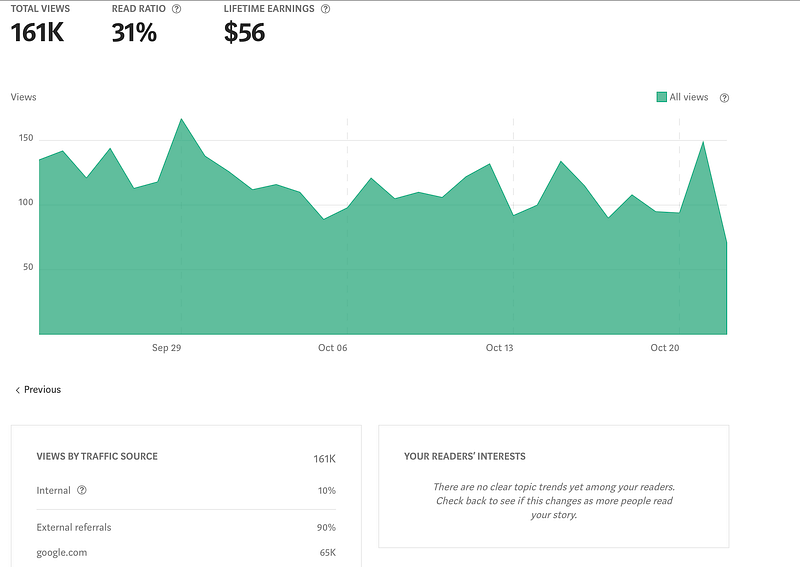
I wrote this post in April 2017. It was one of my first posts. I took the screenshot of the stats page two minutes ago. As you can see, two-and-a-half years later, it’s still routinely pulling in between 100 and 150 views per day via Google.

It’s had 161,000 total views and only 10% of them are ‘internal’ — which means that only 10% have come from Medium itself. The rest originated externally from searches, social media, etc.

The rest are the result of SEO or Search Engine Optimization.

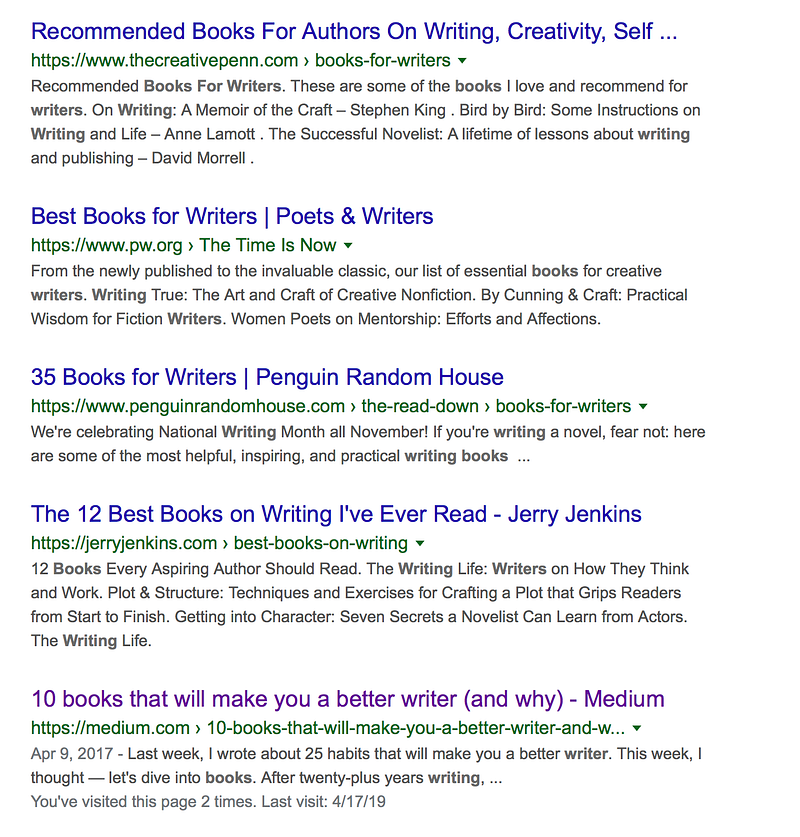
Here’s at least one reason: When I Google ‘Books for Writers,’ my post is the fifth response on the first page.
Screenshot: Author

Our friend Neil Patel’s Ubersuggest.com says that ‘books for writers’ gets searched on Google 320 times a month.

Screenshot: Author

I’m the number-one search response for ‘books to become a better writer’ and ‘books that will make you a better writer’ — neither of which have such a high volume, but both of which I’m very likely to be the link clicked if someone does make that particular search.

That’s a particularly good post to have been successful with my limited SEO skills because it’s a list of books and it’s full of Amazon affiliate links. Every time someone reads it, clicks a link, and then buys something from Amazon, I make a little commission. I earned about $1000 from that post when it was first published, and I continue to earn about $50 a month from it to this day.

OK. So have I convinced you that non-existent SEO skills are useful to have?

Good.

Now, It’s Time to Choose a Keyword

This is actually the hardest part. Your brain might start to swim a little. Because — keyword? What the hell? That sounds very techy.

A keyword is just what someone might type into a search engine if they wanted to find your post. It really is that simple.

The keywords for this post? ‘Basic SEO.’

That’s all. Nothing fancy. Nothing magic.

Once I’ve picked a keyword, I go to Ubersuggest and type it in there (thank you, Mr. Patel, for being so, so much smarter about this crap than I am. Really.) I’m looking for a high search volume and a low SEO difficulty. I don’t care about anything else. I literally ignore everything else. It all just confuses me.

Screenshot: Author

High, of course, is relative. High compared to what? I aim for over 250. Over 1000 is better. Most of my posts have a keyword with a search volume of over 1000. But, if I can’t get to 250, I rethink my keyword direction altogether.

‘Basic SEO’ is a very good little set of keywords. About 1900 people search Google for ‘basic SEO’ every month, and the difficulty is easy (which, btw, is beyond my capacity for understanding. I don’t know what makes it easy. I just know that Neil puts a green ‘easy’ button there and I trust him).

Once You Have Your Keyword, Use It in These Five Places

The title

I create my title around my keyword. This is kind of cool, because if I know that 1900 people search for ‘basic SEO’ every month, then I can be pretty sure that a title that focuses on ‘basic SEO’ is probably going to do well for my blog post.

Score.

You’re not going to do any keyword stuffing here, by the way. I mean it. Don’t shove as many keywords as possible into your title. Don’t use your keyword a second time in your subtitle. Just use it in your title, once, and make it read naturally. You can do it. I have faith in you.

The URL

As long as you type your keyword into your title properly the first time, it’ll be in your URL. If you need to change your URL to reflect your keyword, do that by going to the three dots next to ‘ready to publish?,’ then ‘customize story link,’ then choose ‘custom,’ then type in a custom link with the keyword.

The intro

Use the keyword in the intro to your post. My advice here is to only do this if you can make it sound natural. There’s nothing worse to me than keyword stuffing — it comes across as stiff and weird to me.

The content

Use your keyword where it makes sense in the content of your post. Again, don’t be weird about it. Just be aware that you’re trying to rank on Google, so you need to let Google know that. Two or three times is enough.

The SEO description

The SEO description isn’t actually visible in your post. It’s what shows up when someone searches Google and comes across your post. If you don’t write your own description, they’ll get the first characters of your post.

Go to the three dots again. Click ‘Change display title/subtitle,’ and then type a description that includes your keyword.

Voila. Very basic SEO for neophytes. Have fun!

SEO
Marketing
Blogging
Writing
Busines
Recommended from ReadMedium