
Venezuela’s Interim President Juan Guaido: A Timeline to Explain #23Ene
Venezuela now has an interim president. But Nicolas Maduro is still president. How does that work? Why is this happening precisely on January 23rd? What’s going to happen now?
Venezuela is back on the headlines of pretty much all media, but not for the news we’ve gotten used to see for the last FIVE years: outrageous poverty, a collapsed healthcare system, violence, and the Venezuelan exodus… What we call the destruction of any bearable living conditions for 32 million people.
This time, Venezuela is on the headlines — and will continue to be throughout the year, for sure — because of what could be the most uncanny political event in Latin American history: the leader of the National Assembly (the Congress) proclaimed himself as interim president of Venezuela, which has been under the presidency of Nicolas Maduro after Hugo Chavez’s death.
His name is Juan Guaido, and he represents the Legislative body of the country, composed by 167 members elected by direct, universal and secret votes.
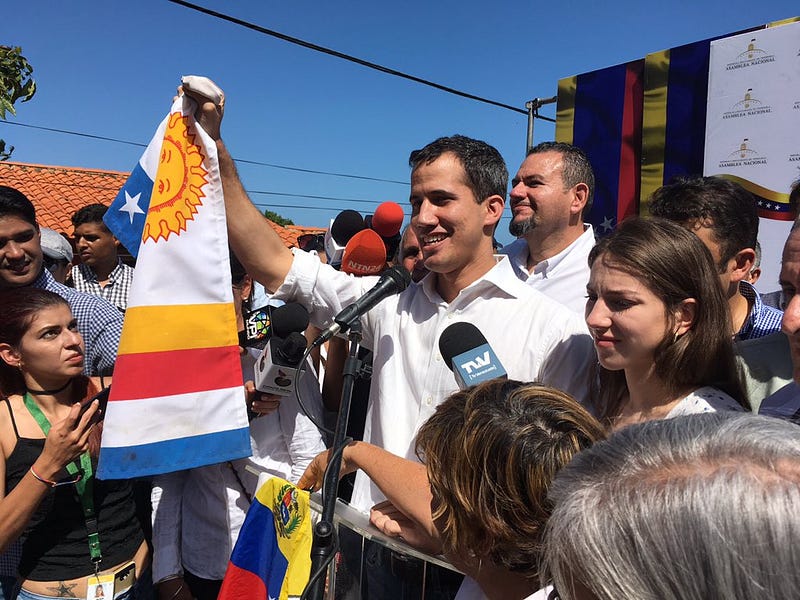
Yes, him (more details in this NYT’s profile):
This has caused a myriad of political division worldwide about whether or not to recognize him as an interim president. I woke up yesterday to find out the U.S. had sided with Guaido. You need to know this was sort of expected, after vice-president Mike Pence streamed this video early on the day of Guaido’s self proclamation, with some phrases in Spanish (gotta recognize the effort, folks):
[UPDATE 1/25/2019: The Wall Street Journal published a story about the coordination between the Trump administration and Juan Guaido the night prior to #23Ene. It is undeniable that U.S. support reflects a more interventionist foreign policy from the U.S. Whether than invalidates the legitimacy of the National Assembly actions on #23Ene remains unanswered]
In Latin America, pretty much all the countries have sided with Guaido, except by Mexico, Uruguay and Bolivia. The countries’ governments, known for their leftist presidents, have urged Venezuela to “seek for a political and negotiated end of the crisis” (whatever that actually means), and will continue to recognize Maduro as Venezuela’s president.
This is the time to take things slowly and really, really, just do not believe the very first thing you read. Yesterday there were news saying Facebook and Instagram had taken off the “verified” badge from Nicolas Maduro’s accounts, but it turns the accounts actually never had that badge. It literally passed a couple of hours to get the real news.
Amidst the myriad of speculation, this is an attempt to draw a timeline to understand why we’re here today. Some U.S. media is covering the events as a celebration of freedom — which is not an incorrect interpretation, but technically, there has not been a change of government yet. Celebrating, at least in the news, does not contribute to distinguish false or misleading information about the legality and legitimacy of what the National Assembly of Venezuela is doing.
So, Nicolas Maduro is still president?
Theoretically, yes. Politically, the answer is leaning towards ‘no’, since many multinational institutions and countries have recognized Guaido as Venezuela’s new president. Bloomberg lays it out real nice here.
Let’s not forget Maduro is where he is because he was the vice-president of Hugo Chavez, who died on March 5th of 2013. He replaced Chavez for 30 days, and then called for elections that same year. He won the presidency with a really narrow difference against Henrique Capriles, a long-time opposition leader to the chavismo.
The elections in 2013 were meant to appoint a successor to Chavez, who had won the elections for the period of 2013–2019. New elections were to happen in 2018 for a new presidential period from 2019–2025. Here, I will select some of the event that lead to what is happening today, based on what I believe are the most important landmarks:
December 6, 2015: The elections for the National Assembly, that happend every five years, take place. The opposition wins the majority of this Legislative body with 112 seats out of 167 (that’s 67 percent). This is important because more than 51 percent makes up what we call a mayoria calificada. Whichever party has mayoria calificada can approve laws faster than those that not. I clearly remember how many people thought there was finally going to be some check and balance on the Executive branch.
Now, here’s another very important event that no one is talking about: the Consejo Nacional Electoral — the electoral authority — was supposed to be renewed in 2014, before the National Assembly finished his mandate. But that did not happen. Just like Efecto Cocuyo explains it here, since the National Assembly did not agree on the people to appoint to the CNE, the Tribunal Supremo de Justicia, which is like the Supreme Court of Justice in the U.S., had to appoint the “new” members of the CNE. In the end, three of the four members remained the same. This meant the country was just re-confirming the CNE would remain under Maduro’s control.
December 15, 2015: A politically defeated Nicolas Maduro installs what could be translated as a Parliament of the Comunas (Parlamento Comunal), arguing that, all of a sudden, the Legislative power needed another body to “give it some balance”. Diosdado Cabello, a chavista congressman, said the National Assembly was “under the service of the bourgeoisie,” as an argument to defend Maduro’s decision. The creation of this Parliament was interpreted as a first move to neutralize the Congress, although in practice this Parliament couldn’t do much. The real hit would come a couple of years later.
May 1, 2017: Now Venezuela is going through its deepest economic, financial and humanitarian crisis ever. Nicolas Maduro calls for elections — with a CNE under his control — to create an Asamablea Constituyente or Constituent Assembly, which is basically another Congress designed specifically to rewrite the Constitution. The body actually exists in many Latin American Constitutions, but it’s usually in the realm of a referendum, meaning the people have to vote whether they want a Constituent Assembly or not. Nevertheless, we know by now that Maduro is only trying to stay in power. This is a fact. Some more evidence, as follows:
July 30, 2017: Venezuelans cast a vote to elect 545 members of the Constituent Assembly in favor or Maduro’s intentions. Amidst violent repression of protesters on the streets, leading to the death of a least 10 people, the government said more than 8 million Venezuelans voted, around 40 percent of turn out, which should have reflected some opposition votes. But the opposition counted only 12 percent, reflecting, supposedly, chavistas votes. At this time, no one really knows the real turn over, but the stakes of the government manipulating data should not be underrated. Indeed, it was the company that provided the technology to count the votes, SmartMatic, that reported the Venezuelan government had “undoubtedly manipulated the turn over data.”
Another behavior from the government that supports why we should not trust their data is on this thorough journalistic work by Efecto Cocuyo. It reveals the government has stopped providing accurate data about its activity, such as healthcare and other economic indicators, for at least a decade. In 2016, Bloomberg encountered the same problem when wanting to measure inflation, so they created their own index, based on real, on-the-ground reporting about the price of a cup of coffee tracked every day in Caracas.
One more aspect to keep in mind about the elections for the Constituent Assembly is that the ballots did not include all political factions, as it should have had, and the criteria for electing the members was designed by Maduro. The opposition considered the elections were a fraud, so they refrained from running for them. Therefore, the candidates for the Constituent Assembly were all Maduro’s supporters, to the extent that his son and wife are now members of it.
August 18, 2017: Now we’re getting closer to the presidential elections in 2018. Remember the Constituent Assembly was made to rewrite the Constitution? Well, it didn’t. It took over the functions of the National Assembly — the Venezuelan Congress. Why? Because the members of the National Assembly did not attend a session called by the Constituent Assembly. Why didn’t they go? Well, in March of 2017, the Tribunal Supremo de Justicia stripped the NA of its functions and voided all of its legislative initiatives. In practice, like BBC correspondent Daniel Garcia Marco says in this article, “the National Assembly had been cut off from its functions for months already.”
Here it comes the breaking point.
January 23, 2018. The Constituent Assembly issues a decree calling for elections, a function that corresponds to the CNE. But we know that the CNE is controlled by Maduro, so they just follow orders. They do not oppose the decree. The CNE then announces elections for April 30, way earlier than the six months it should have allowed to organize the elections. But then it was delayed until May 20. Why? The opposition candidate Henri Falcon ended up registering his candidacy, against the decision of his party, the coalition of MDU, which had pledge not to recognize the elections. The opposition experienced its own crisis as well.
He was widely criticized. But he deserves to be heard as to why he did it:
May 20, 2018: Maduro wins the elections. Only 46 percent of the registered voters actually cast a vote. With 6.2 million votes, Maduro announced it won with 68 percent of the total votes. But as it is explained by the BBC and El Pais, this represents only 30 percent of the registered voters.
The 46 percent turn over that marked these elections is actually the lowest in Venezuelan history.
With 3 million Venezuelans out of the country, two of the biggest opposition leader out of the way — Henrique Capriles (banned to be a candidate) and Leopoldo Lopez (serving jail time) — , Maduro was about to initiate a six-year presidential period by an electoral process that he called himself through a pseudo Legislative body that ordered it by decree. It is an inordinate amount of Constitutional violations.
Now let’s rewind a little. I have read comments on Twitter asking things like: how is it possible that a country has a Congress democratically elected and a president that is not democratically elected? The National Assembly was elected in 2015, and Maduro cannot intervene as easy in the candidacies of hundreds of people. The elections that got Maduro elected happened in 2018, and by that time, as we have seen, the Congress was shut down, the elections ignored due process, the political opponents were either banned from running or in jail, and the turn out was the lowest in Venezuela’s history.
January 10, 2019: The Venezuelan Constitution, which you can easily Google, requires the elected president to officially take his pose on the 10th of January in the year the presidential period starts. Therefore, during 2018, Maduro was finishing his mandate as a successor of Hugo Chavez. He now takes his presidential oath in a way that only sheds a brighter light on everything that went wrong in the last three years:
- Maduro doesn’t take his presidential oath before the National Assembly, but the Tribunal Supremo de Justicia. The Constitution states that the president should take his oath in a session of the National Assembly, that represents the people. But if “an unexpected motive” were to occur, the TSJ could validate the president’s oath. The only reason why the National Assembly is unable to do what the Constitution mandates is because Maduro has stripped it of its power.
- Maduro’s legitimacy of exercising his post as a president depends on him respecting international treaties, which include not violating human rights. According to two different experts interviewed by BBC and Voz de America, Maduro has long lost this legitimacy. With the irregular electoral process of 2018, he also lost his core legitimacy to hold power, which can only exist if the elections are conducted with transparency.
Why is January 23 so special that Juan Guaido chose that day to declare himself as interim president?
It turns out that 61 years ago, on January 23 of 1958, a civic-military movement overthrew dictator Marcos Perez Jimenez from power. Basically, Venezuela recovered its democracy through a coup d’Etat. Not surprisingly, in fact, Perez Jimenez got to the presidency in 1945 through a coup d’Etat he lead against the government of Isaías Medina Angarita.
The opposition was already organizing a big march for this day. They publicly called people to get out on the streets to manifest against Maduro’s usurpation of power:
Prior to Maduro’s presidential pose, on January 5 of 2019, Juan Guaido was elected as president of the National Assembly. Although shut down in practice, the Congress was technically still alive. That day, Guaido announced he would not recognize Maduro as new president of Venezuela:
And January 23 finally happened. The march was astonishing popular, with streets flooded with people in all states of the country.
When taking his oath in front of a vast crowd, Guaido said the Constitution protects his actions. The Constitution states that all citizens, regardless of their level of authority, can take action to defend it. Since Maduro is not recognized as president by the National Assembly — don’t forget he sworn before the TSJ because he banned the NA from being able to do so — , he would be acting as president in violation of the Constitution. This void in the presidential seat allows the president of the NA to become an interim president.
This legal stuff, I believe, is better explained by journalist Diego Fonseca, who is also an opinion writer for the NYT. It’s only in Spanish, as much of the information you will find on how to read the Venezuelan Constitution. Here you have his thread, naming the correct articles in the Venezuelan Constitution:
I have read myself these parts of the Constitution, and I think he’s right about the interpretation. There are people on Twitter taking the first paragraphs of the articles in the Constitution that support Guaido’s actions, saying that nowhere it says the president of the National Assembly can declare themselves as interim president, but that is not the way to read the Constitution. Never will you find literal descriptions of actions.
What’s going to happen now?
Juan Guaido proclaimed himself as interim president arguing there is actually no president elect, thus, a new electoral process is needed. Guaido has made it very clear this is his objective: to call for new elections.
Now, well, there are only questions. Would this be enough to throw Maduro out of power? It doesn’t look like it. But it’s only been one day, so anything can happen. Some institutions, like the Inter-American Development Bank, already said it supports Guaido. Some G-20 countries, like Canada and the U.S., have said the same. What that really means to the actual operation of the government in Venezuela is unclear. So far, the answer seems to be in who will control the military, The Economist and Bloomberg report.
To be continued.


