
Opinion
Value of “Experience Based” Certification Approach in Data Science
A look at experience-based Certifications / Open Badges in Data Science and AI and how they bring value to the table
As someone who has spent the last few years discussing, advising, advocating, coaching / mentoring, implementing certain strategies to help prepare businesses for the future, this is a topic of interest to me. I strongly feel that the proof point helps build confidence not only to those who are practicing it but also to those who are the recipient of the outcomes and impact. Therefore the experience-based certification approach in Data Science and Artificial Intelligence is very much critical since it involves proven project implementation experience in a real-life scenario.
“Looking at the difference between “Experience-based” and “skill-based” certification”: Data Science sector is much closer to domain/industry, problem-solving and storytelling aspects and hence experience around that is much more powerful in addition to just skills and this aspect is a “no brainer”. Data Science practitioners need to understand and appreciate it and of course plan towards investing time in such accomplishments that bring value and growth potential to them.
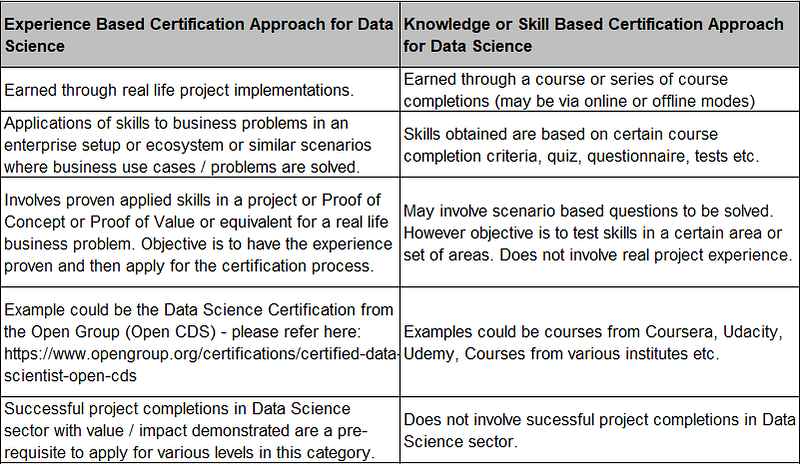
If we look at the top 12 data science certifications from here, we could note the importance of these certifications. At the same time, the ones around “Experience-Based Certifications” are critical from the list. The “Open Certified Data Scientist (Open CDS)” is the one that involves experience-based certifications. We can go to their site here to get details. It also has multiple levels to recognize Data Scientists at various levels in their journey. The step-wise details for the Open CDS can be found here. The parameters around professional development, professional communication, and experience profile-based evaluation dimensions are valuable.
“The Framework of understanding”: Let’s explore the framework that gives reflection about various dimensions that a Data Science practitioner should be familiar with. The below framework represents a list of really critical parameters (if not exhaustive):
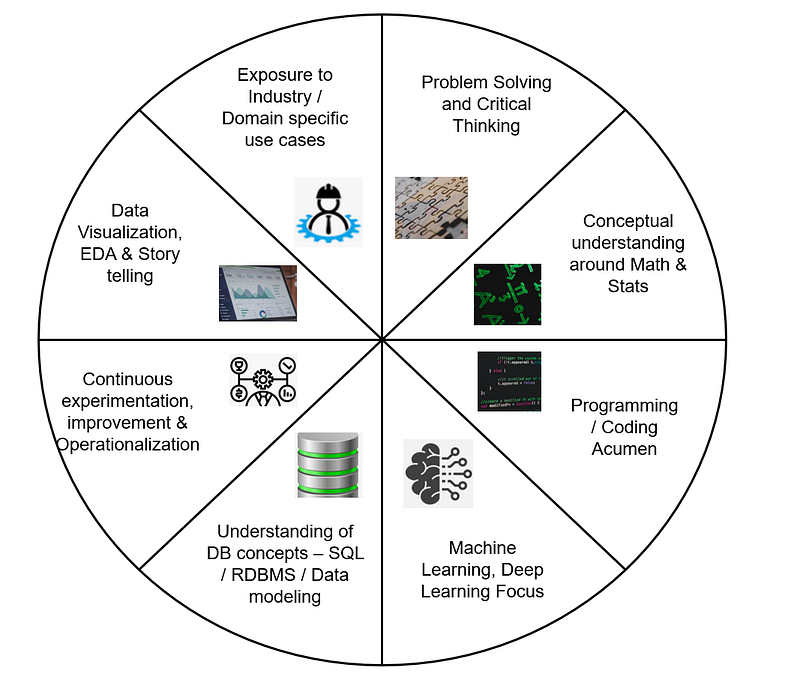
a) Problem solving and critical thinking skills b) Conceptual understanding and fundamentals around mathematics and statistics c) Programming or coding acumen d) Focus towards Machine Learning and Deep Learning e) Understanding of Database Concepts such as SQL, RDBMS, Data Modelling, etc. f) Data Visualization / Exploratory Data Analysis skills and storytelling g) Domain / Industry knowledge and understanding of relevant use cases associated with an industry and how Data Science / AI / ML can help solve those problems h) Approaches, understanding around continuous experimentation, improvement, and operationalization aspects
If the above parameters are critical, then one should have proof of pudding to have shown outcomes, experienced such scenarios by solving real-life problems on the ground. Therefore experience is important when we execute an end-to-end problem or use-case in a specific context or scenario for an industry.
Ingredients for “Experience-based” certification approach: Ingredients could be a combination of various factors and not just showing a project experience already executed. Based on different levels of maturity and guideline, expectations may differ. However, to summarize, some of the below parameters could be useful. All of this helps reflect an “Applied Data Science Practitioner” in a true sense since it is much more than just skills.
a) Project experience — First and foremost, of course, it is the project experience and more importantly “end to end experience”. This should involve all lifecycle stages of a typical CRISP-DM framework. It should ideally capture at least two best practices and two lessons learned etc. (e.g. how did we perform data exploration better and in a unique way in the context of data given that led to realizing better features which can influence target variable much effectively in case of a prediction, how did we interact and collaborate with stakeholders earlier in the “game” to steer conversations and expectations effectively, how did we perform generalization aspect in our experimentations to measure best possible solution in the given context, how did that help answer to the hypothesis and questions that are being asked as part of the business goal, how could we reduce “time to value” by doing data cleansing or data transformation process better in future from current learnings, etc.) While drafting this, one may have to demonstrate the end outcome realized, value, and impact realized after implementing the solution as part of the project work. This helps not just articulate the holistic technical solution but also aids in showcasing the “storytelling” art that one has!!
b) Contribution to community — Contributions could be in the form of reusable components, assets, contributions to open source community, contributions related to mentoring efforts at various levels and building the ecosystem, contributions related to innovation or IP creation, and so on.
c) Thought leadership — Contribution to the Data Science fraternity in terms of evangelizing the “next key factor”, roadmap ahead, blogging, “stay current” scenario, how to drive innovation better with the help of efforts, publications, patents, and so on.
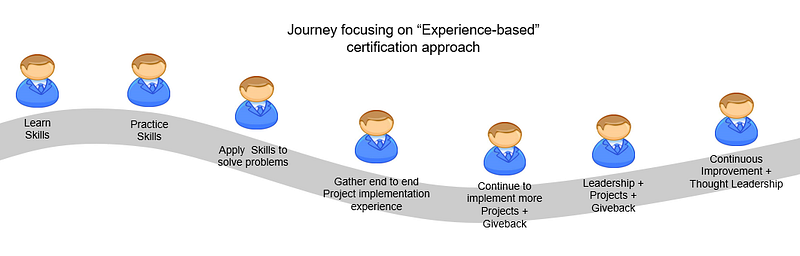
The Data Science Profession is such a hot career that many people are trying to pass themselves off as data scientists when they do not have the appropriate skills or expertise needed for this mission-critical position. Hence the experience-based approach of obtaining certifications helps in recognizing real data science practitioners. It helps firms solve a couple of problems at the same time — a) get the “right” candidate they are looking for to solve their initiative, b) create a pool of practitioners with real-life experience who can, in turn, help build and nurture similar talent within their team over some time.
Disclaimer: The postings here are personal point of views from my experiences, thoughts, and readings from various sources and don’t necessarily represent any firm’s positions, strategies, or opinions.