Using Structs to Represent Chromosomes
Genetic Algorithms in Elixir — by Sean Moriarity (28 / 101)
👈 Chapter 3 Encoding Problems and Solutions | TOC | Using Behaviours to Model Problems 👉
The chromosomes you created in the previous chapters are enumerable objects that represent solutions to a problem. At the most fundamental level, this is correct; however, in practice, this isn’t a viable implementation.
Consider this: you’re attempting to solve a problem in which the age of the chromosome determines its fitness. One reason you’d do this is to ensure enough variance between generations. Ideally, you’d persist older chromosomes between generations to a certain point, before killing them off once they’ve reached a certain age. In this respect, you ensure an equal distribution of both old and young chromosomes and, thus, naturally occurring variance in the population. Solving a problem like this using only an Enum type to represent a chromosome creates unnecessary complexity. It’s often the case that you need a more robust data structure to keep track of a number of metrics at a time. In Elixir, you can accomplish this task using a struct.
A struct is a map with a few additional features. Structs allow you to define default values and required fields. They also cannot take on additional fields after their creation.
The guarantees that structs provide make them a perfect fit for defining custom types — without the fear of breaking your programs. With structs, you can ensure that a predefined chromosome type is initialized with a predefined set of genes — one that won’t break your genetic algorithms.
Creating a chromosome struct offers a number of conveniences that you wouldn’t have if you simply used an Enum or some other data type to represent a chromosome. For example, if you wanted to calculate the average fitness of a population, you would need to recalculate the fitness of each individual chromosome first, which can be a computationally expensive task. Using a struct, however, you can save time by only calculating the fitness once, and then storing it as a key-value pair within the struct itself.
Understanding Chromosomes
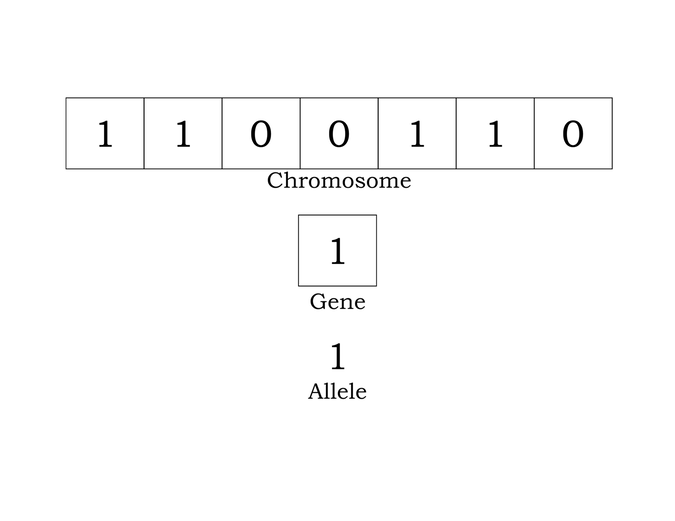
Before you’re ready to create a struct that models a chromosome, you first need to understand what a chromosome is and what characteristics it has.
At the most basic level, a chromosome is a single solution to your problem. It’s a series of genes consisting of values known as alleles. Genes can represent any number of things. For example, in the shipping problem introduced in Chapter 1, Writing Your First Genetic Algorithm, each gene represents a successive stop in a city. The entire chromosome, then, represents a complete path to every city defined in the problem.
Genes are typically represented using list types or other enumerable data types, like trees, sets, and arrays. In Elixir, the Enum library provides a number of useful functions for manipulating any data type that implements the Enumerable protocol. In fact, the framework you wrote in the previous chapter exclusively uses Enum library functions. Therefore, you can represent genes using any data type that implements the Enumerable protocol — even ones that are not part of the Elixir standard library.
While genes are the most fundamental piece of a chromosome, there are several characteristics you can track for both convenience and functionality. A basic chromosome struct could include fitness, size, and age on top of genes. For simplicity, the chromosome struct in this book will consist of these exact features. In later chapters, you’ll see the convenience that tracking these characteristics can provide.
The characteristics you may choose to add to your chromosome struct have no limits. Some problems may require additional features not described in this chapter — the beauty of structs is in their flexibility. Choosing to represent a chromosome in this manner gives you the ability to rapidly adjust what you need for each problem.
Creating a Chromosome Struct
Open a terminal and navigate to the genetic/lib directory. From there, create a new directory named types, as well as a new file named chromosome.ex, like this:
$ mkdir types
$ touch types/chromosome.exYou’ll create the chromosome struct within types/chromosome.ex. Open the types/chromosome.ex file and add the following code:
defmodule Types.Chromosome do
defstruct [:genes, :size, :fitness, :age]
endThis code defines a module Types.Chromosome, which contains a struct consisting of the keys :genes, :size, :fitness, and :age. Remember, defstruct is used to define a new struct. The atoms that follow are the fields the struct contains. You can create a new chromosome struct using the %Types.Chromosome syntax.
This version of the chromosome struct will work, but it lacks a bit of functionality. Currently, none of the fields have default values and there are no required keys. This means that a newly created chromosome struct could technically contain fields with all nil values.
Change the chromosome struct by adding defaults for :size, :fitness, and :age, like this:
defstruct [:genes, size: 0, fitness: 0, age: 0]Now, any newly created chromosome will have a default size, fitness, and age of 0. You could technically make the default values whatever you want — it all depends on what you’re trying to accomplish.
Finally, all chromosomes must contain genes. If a chromosome doesn’t have any genes, it’s not really a chromosome. To make this chromosome require genes, add the following code above defstruct:
@enforce_keys :genesYour final module will look like this:
defmodule Types.Chromosome do
@enforce_keys :genes
defstruct [:genes, size: 0, fitness: 0, age: 0]
endYou can now create chromosome structs that track the genes, size, fitness, and age of a chromosome in your populations.
Creating a Chromosome Type
Elixir is a dynamically typed language; however, it’s often useful to create typespecs for custom data types. Typespecs are useful for documentation and static code analysis using tools like dialyzer. This book won’t cover the use of dialyzer, but you’ll use the types you create in this section later in the chapter.
A typespec is defined using the @type attribute followed by the name and definition of the type. Elixir supports compound types as well as the creation of custom types using structs.
You’ll create your chromosome type in the types/chromosome.ex file. Open the types/chromosome.ex file and add the following code above the struct you defined in the previous section:
@type t :: %__MODULE__{
genes: Enum.t,
size: integer(),
fitness: number(),
age: integer()
}This code creates a custom type t, which is an instance of a Types.Chromosome struct. The __MODULE__ keyword is a macro that gets replaced with the name of the module in which it’s defined. t is a standard practice for defining module types in Elixir.
The chromosome type also declares specific types for the fields of the chromosome. As mentioned previously, genes must be an Enum type. Size and age are both integers. Fitness is a number, which is a built-in Elixir type representing a float or integer.
The final Chromosome module will look like this:
defmodule Types.Chromosome do
@type t :: %__MODULE__{
genes: Enum.t,
size: integer(),
fitness: number(),
age: integer()
}
@enforce_keys :genes
defstruct [:genes, size: 0, fitness: 0, age: 0]
end👈 Chapter 3 Encoding Problems and Solutions | TOC | Using Behaviours to Model Problems 👉
Genetic Algorithms in Elixir by Sean Moriarity can be purchased in other book formats directly from the Pragmatic Programmers. If you notice a code error or formatting mistake, please let us know here so that we can fix it.