
Using Matlab to Solve for Kalogirou’s Solar Desalination System
Soteris Kalogirou describes fully how to desalinate water using common materials and sunlight in his book “Solar Desalination Systems for Solar Energy Engineering.” To automize the quantifiable nature of the problem we will use Scilab (Matlab’s open language and environment twin) in this article to simplify the problem and solve it quite quickly. The code will be included below and can be replicated by anyone which would like to give it a try and experiment with it in the real world to give people in dry places access to fresh water.
clear
//INPUTSw = 20; //Daily water need in L/day, WHOhcw = 2.5; //Convective heat transfer coefficient in W/m^2K, Michigan Techtw = 55; //Water temperature in C, Kalogiroutg = 45; //Surface temperature in C, Kalogirouc = 0.032; //Empirical constant dimensionless, Kalogiroun = 0.41; //Empirical constant dimensionless, Kalogiroulv = 23701; //Latent heat of vaporization of water at 55 C in kJ/kg, Kalogiroumu = 1; //Dynamic viscosity of water in centipoise, The Engineering Toolboxdw = 1; //Density of water in Kg/L, The Engineering Toolboxk = 0.018; //Thermal conductivity of humid air in W/mC, Lasancecp = 4.181*10^3; //Specific heat of fluid in J/kgK, The Engineering Toolboxv = 1.004*10^-6; //Kinetic viscosity of water in m^2/s, The Engineering Toolboxg = 9.81; //Gravitational constant in m/s, The Engineering Toolboxb = 0.207*10^-3; //Coefficient of volumetric expansion of water in 1/K, The Engineering Toolboxs = 4; //Solar assumed available for maximum irradiance to produce water in hours, Baldizon//CALCULATIONSpw = 100*(0.004516+0.0007178*tw-2.649*10^-6*tw^2+6.944*10^-7*tw^3);pg = 100*(0.004516+0.0007178*tg-2.649*10^-6*tg^2+6.944*10^-7*tg^3);qew = 0.0163*hcw*(pw-pg)*10^3;mw = 3600*(qew/(lv*10^3));pr = (cp*mu*.001)/k;d = (((0.349/(0.0163*(pw-pg)*10^3*(3600/(lv*10^3))*c))^(1/n)*v^2)/(pr*g*b*(tw-tg)*k))^(1/2);a = (w/s*dw)/mw;//OUTPUTdaAll calculations were done by the using Matlab with the recommended amount of total potable water per capita by the world health organization, this means that even if the system ends up producing less water than calculated due to design changes, it will most likely provide enough at least for survival. The proposed design is displayed below in the figure titled basin-type design with detailed measurements.
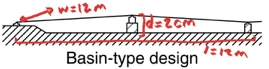
The system displayed will have an area of 144 m² and a height of 2 cm which both are more than what the calculations had suggested due to construction feasibility. We expect that the system will produce enough water since the number of sun hours will likely be more than what assumed, making temperatures higher. To build this solar still we will take utilize an area with no shading but which keeps it safe from possible damage. The height needed is only 2 cm for which digging will be done using bare hands. We would hope to have enough glass for the cover, but there likely is not enough for which we will use parachute plastics as covers, this will reduce irradiance but as previously described there is expected more solar resource than what used for calculations. The parachute material will then behold under tension with the needles available in the extremes and kept in the basin type design inclination utilizing a needle that provides the required height differential at the center.
References
- Kalogirou, Soteris. “Solar Desalination Systems — Solar Energy Engineering — Chapter Eight”. Sciencedirect.com. N.p., 2009. Web. 16 Nov. 2016.
- Lasance, Clemens. “The Thermal Conductivity Of Moist Air | Electronics Cooling Magazine”. Electronics Cooling Magazine. N.p., 2003. Web. 16 Nov. 2016.
- Michigan Tech,. “Typical Convection Coefficients To Estimate Thermal Transfer”. Me.mtu.edu. N.p., 2016. Web. 16 Nov. 2016.
- The Engineering Toolbox,. “Water — Thermal Properties”. Engineeringtoolbox.com. N.p., 2016. Web. 16 Nov. 2016.
- World Health Organization,. “What Is The Minimum Quantity Of Water Needed?”. World Health Organization. N.p., 2016. Web. 16 Nov. 2016.
Please follow up with any feedback or doubts about this article, thanks.
~Roberto Baldizon


