
Using Explainable AI in BigQuery ML
Google BigQuery now supports Explainable Artificial Intelligence for your Models

BigQuery ML makes it easy to design machine learning models using SQL. You can find a Tutorial here [1]. With Explainable AI you can know let you explain the result.
Why you wanna know?
When you design machine learning models, you naturally want to know why you behave the way you do. Often, this may also be required by law, for example, discrimination must not occur. An example is lending, an algorithm that might discriminate against a gender or ethnicity.
How to use the Feature
The feature help you to understand the results that your predictive machine-learning model generates for classification and regression tasks by defining how each feature in a row of data contributed to the predicted result. This information can be used to control the model is behaving as expected, to recognize biases and to inform ways to improve your model and your training data [2].
After you
- create
- evaluate
- predict
your model you can then let you explain the results. For explaining a linear model you would work with the following example statement:
SELECT
  *
FROM
  ML.EXPLAIN_PREDICT(MODEL `mydataset.mymodel`,
    (
    SELECT
      label,
      column1,
      column2,
      column3,
      column4,
      column5
    FROM
      `mydataset.mytable`), STRUCT(3 AS top_k_features))
A full example with predicting penguin weight and then using Explaining AI you can find on Google [3].
You when would get the outputs of the top feature attributes (in this case three) per row of the table:
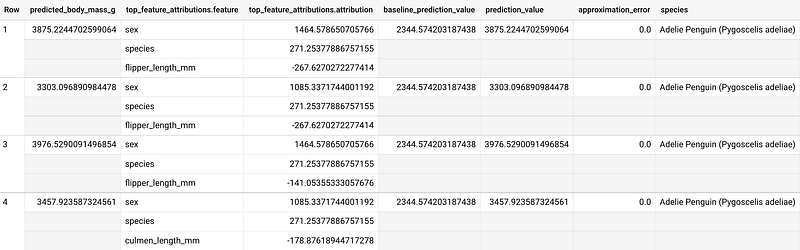
This is a good way to find out which attributes have how strong an effect on your model.
Summary
All in all, this is a super feature. On the one hand, it makes models comprehensible and, on the other, it reveals potential for improvement. On the other hand, it may even be legally necessary to check the results in order to avoid discrimination, for example. It makes BigQuery and BigQuery ML a bit more powerful. It also strengthens the trend of Bring Machine Learning to the Data.
Sources and Further Readings
[1] Christian Lauer, Bring Machine Learning to the Data (2021)
[2] Google, BigQuery Explainable AI Overview (2022)
[3] Google, Using BigQuery ML to predict penguin weight (2022)


