
Using a Retainer for Steady Income
Dry Spells hurt. This is how I avoided them
“I’m doing fantastic, thanks to you”
My eyebrows furled downward in puzzlement. “Thanks to me?”, I asked. “The last lead I gave you turned into a nightmare where I bet you worked a hundred or more hours for almost nothing”.
My breakfast companion smiled wryly. “True, but actually that turned out fine. I’ll be getting enough other business from them to make up for that mess. But that’s not what I’m thanking you for.”
I took another mouthful of eggs and raised my eyebrows quizzically.
“It’s the retainers. You told me to do that first thing, but I just didn’t get it. Now I understand, and I’m doing it, and I have to thank you. You were so right.”
Retainers
Ahh, yes. When he had first started his business, we had shared another breakfast, and I had given him a whole brain dump of advice, including the suggestion to bill clients a small yearly retainer. The purpose of the retainer is to establish a business relationship, to cover all minor phone calls and emails that are otherwise annoying for both you and your customer to account for, and to provide a justification for a discounted billing rate.
I used that model for years for just those reasons, but many consultants resist the concept, insisting that their customers won’t like it. In fact, customers do like it, because it is to their advantage: they get a lower hourly rate and you don’t nickel and dime them with small invoices for little services. They also feel, quite rightly, that they “have your attention”. But, as I said, some consultants just don’t see that.
My companion went on. “I’ve got ten clients on retainer now, and that’s just in the past three months. The clients love it, it’s so much easier for me, and I know I’m going to love it even more when I have a hundred of them.”
Dependable income
Right. After a few years, it becomes dependable monthly income that lets you coast through the inevitable dry periods. At the time of this conversation, I had about two hundred clients on retainer. As they had each started with me at different times, their yearly billing was also at different times. I had a steady monthly income whether I actually had any work or not.
“And just as you said, for most of them, it really isn’t much of a discount, so I’m not losing any money.”
The “discount”
That’s the part some consultants just don’t grasp. I suggest setting the retainer amount approximately equal to a third of what you’d ordinarily expect to bill in a year. So, if your typical client uses twenty hours of service, set the retainer to the cost of six or seven hours, and discount their hourly rate approximately 33%. If they use less than what you expect, you have effectively raised their rate, and if they use about the same amount they will pay about the same amount overall.
But if they use much more hours, it will cost them less. That’s fair and the clients liked that. It’s an ideal billing model that is much more difficult and confusing to implement any other way.
An example
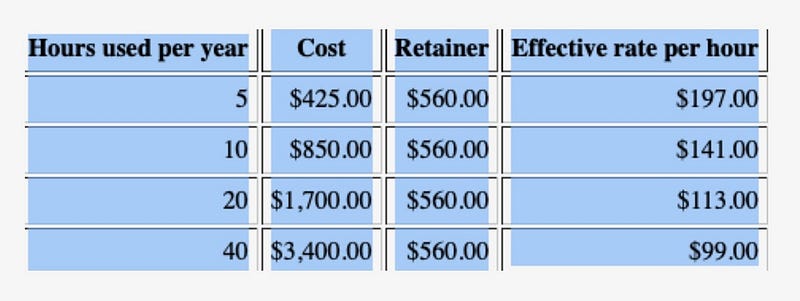
In my business, I expected an average client to use me about ten hours per year. My ordinary rate was $150.00 per hour, but for clients who paid a $560.00 per year retainer, I dropped that to $85.00. Let’s see how that worked out:
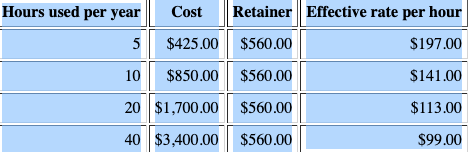
See how nicely that scaled? You would need to set your retainer to scale reasonably for your customer mix, but this worked out very nicely for mine. The big customers got a discount, the minor folks paid almost full rate but also had the advantage of small issues included in the retainer. Everybody was happy.
Other Advantages
There are other advantages. When you are invoicing yearly or monthly for a retainer, you will know when you have lost a client. If you only do business on an ad hoc basis, you never really know if that client will call you again. The invoice gives you that knowledge.
Client Retention
It also helps avoid losing clients because your contact left that company and took the institutional knowledge of you with her. Your invoice will cause someone to find out what you did for them in the past. If they cannot find out internally, they almost certainly will contact you and you have a chance to resell them on your services.
We finished our breakfast and split the check as we always do. My companion said he had some leads for me for mail server customers and some general Unix support clients he’d pass to me by email. I thanked him for that, and we went on to face the day.
Some caveats
Very small customers may not like this. You can either give in to them or shrug and tell them that’s how your business works. I usually found a way to make both of us happy. Sometimes I did get them to switch to the retainer later, sometimes I did not.
More important is that if you do put someone on a plan like this, they will have expectations of performance. That is part of what you’ve promised: your attention to them. When you have more than one client, you can’t promise instant availability and attention to each of them. But neither can you take on so many retainers that you almost never can respond in a timely manner.

I limited my clients to slightly less than two hundred. For the specialized troubleshooting work I did, that worked for me and for them. In the thirty three years I consulted, I only had serious conflicts once. That was a very tense day for me and the two clients who both needed me right then, but we got through it. If you take on too many clients, you may make more money for a time, but you will have much more stress and you may ultimately lose important clients because of your inability to respond when needed.
Originally published December 2005 at https://aplawrence.com. © Anthony Lawrence. Revised and expanded for Medium
Hey! If you like Medium, you could sign up as a member by using my referral link! If you do that, I get a boatload of money! Well, a dinghy-load. A tiny dinghy will pull up to my dock every month and cross my palms with silver. Neat, right?Or you can buy me a coffee here.
More of my posts: