Use Your Strengths to Help in the U.S. Election
It’s a crucial election. There are only a few days left, and you might have decided you want to help out. You might know a lot or a little, and you might have plenty of time or not very much. Many organizations are running full speed ahead, with a variety of things to do at a variety of levels of commitment. The standard offerings are phone banking, text banking, and get-out-the-vote efforts. Lots of people are needed for these. And if this is what is asked for, it will probably matter.
I’m a liberal, deep in a solidly blue state and an area without even a battleground Congressional election, and I’m really bad at phone banking and text banking. I’m awkward on a call with someone I don’t know and don’t expect to hear from again. But there are other things I’m much better at. So I’ve spent a while looking up groups and candidates, planning how I might best help.
Think About What You Can Offer

Is it money, or time, or your network? Do you have specialized skills? If you have money but not very much time, it doesn’t take long to make a quick donation to the Biden presidential campaign or to your favorite Senate candidate in a contested election. Myself, I would choose the Senate. Not only is the Senate the most difficult branch of the government for the Democrats to recapture, but additional Senate seats will help them cement control. Donating to a race also helps drive turnout for candidates up and down the ballot. However, it’s also good not to put your eggs in one basket. In addition to donating to Biden, I have also donated to battleground Senate, governor, and House races based on my attachment to specific regions, organizations, or candidates. You might also want to donate to state legislative elections, to help provide state-level safeguards against the more conservative Supreme Court’s decisions.
If you have a couple or a few hours of time, read a bit about the candidates or the logistics of voting in a battleground race and sign up for a volunteer shift. Many local and national organizations offer volunteer shifts all day, every day. In the rest of the article, I’ll describe some of these groups.
If you have some friends, it’s also good to reach out to them to invite them to volunteer or donate with you or vote in battleground elections. Campaigning is more fun when you do it with someone else you know. You might want to post to the social media you use the most, to spread the word that you are involved in the election campaign. For example, I’d be likely to post about the election on Facebook, LinkedIn, and Quora, where I have the most followers and connections. People tend to follow others they know, so you may well influence someone else you know by example. I’ve invited friends to phonebank with me. And this post is another part of my effort for the election.
Focus on One or a Few Areas
I had time months before the election, so I read about some of the groups, battleground states, and campaigns. Part of my goal was to continue my involvement in a region after the election, so I chose to focus on North Carolina. From New York and New Jersey, I was already doing activism related to the area, on a political issue that tends to unnecessarily polarize U.S. liberals. Not only is North Carolina a battleground state in the presidential election, but it also has battleground gubernatorial and Senate races this year. Even if it is not the number one most critical state for the presidential election, it is still in the top seven or so and these down-ballot races are also very important. As I read about other races and learned about other groups, I expanded to those, such as Jaime Harrison’s Senate race against Lindsey Graham in South Carolina.
Several groups and programs stood out.
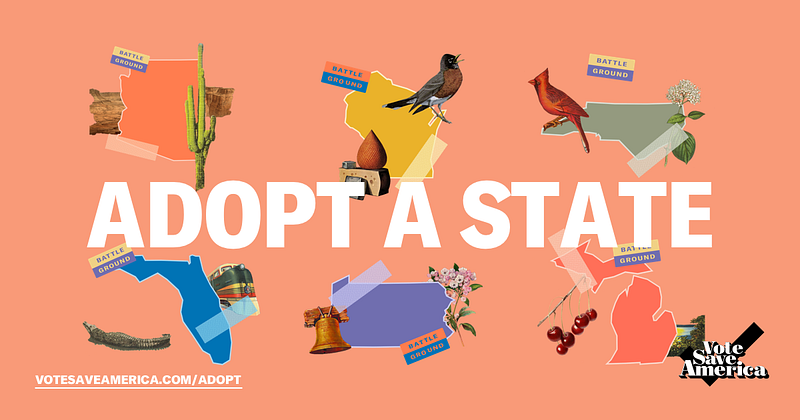
Vote Save America’s Adopt a State program identified six swing states — Arizona, Florida, Michigan, Pennsylvania, North Carolina, and Wisconsin — that were likely to be crucial in the election. In particular, Pennsylvania and Florida are the most likely to decide the presidential election, and will probably have tight margins if the election is close. A few votes can make a difference. I joined the Adopt a State program, adopting North Carolina.
J Street, a group focused on U.S. lobbying related to Israel-Palestine, has endorsed Biden and most of the other mainstream Democratic candidates in highly contested national elections. It has a particularly good lineup of volunteer activities for the candidates. You will need to sign up to join them, but it’s free and is not a big deal. The organization’s official position is to promote two states, Israel and Palestine, side by side with an agreed-upon peace as a strategy for helping stabilize the Middle East region. However, even prominent members of J Street are open to accepting other types of solutions to Israel-Palestine, as long as both parties agree. J Street offered the best-organized, best-paced phonebanks I attended. These don’t touch explicitly on Israel-Palestine but are standard candidate phonebanks.
As a woman who doesn’t like conforming to my gender and is interested in the South, I also found Southerners on New Ground— an LGBTQ advocacy group — offered a particularly interesting and diverse array of volunteer opportunities and allied groups. SONG has a new associated group called SONG Power, which includes a campaign against South Carolina Senator Lindsey Graham called #CrackGraham. You can sign up for #CrackGraham events here. Although the U.S. Senate race in South Carolina is probably not the highest priority for the 2020 election, it is still a battleground election and I look forward to continuing to follow what SONG is doing after November.

As a technologist, I was also impressed by the work done by Tech for Campaigns matching progressive and centrist candidates, especially down-ballot, to volunteers who knew about technology and marketing. Tech for Campaigns is a very good example of a group that can leverage individual volunteers’ specialized skills. If you don’t have these skills and want to help this group, Tech for Campaigns has a donation drive for state legislative elections, to help provide state-level safeguards against the more conservative Supreme Court’s decisions. After this election, their work is not done. For example, they recently had a call for volunteers to analyze the election data postmortem and should be announcing more volunteer opportunities.
Happy volunteering!