avatarMathcube

Free AI web copilot to create summaries, insights and extended knowledge, download it at here

2663

Abstract

and 𝑗 in the double sum run from 1 to 3. You don’t think that this makes life simpler? Hold on! You will see. :-)</p><p id="e554">There is one more formula, you need to know before we can get into action. This formula relates the Kronecker symbol to the Levi-Civita symbol:</p><figure id="0452"><img src="https://cdn-images-1.readmedium.com/v2/resize:fit:800/1*FV9p9TKCbKOKuZUN8GN9nw.png"><figcaption></figcaption></figure><p id="bcf0">This formula is so useful, that it is definitely worth to memorize by heart. Now we are ready to go.</p><h1 id="7444">𝛿 and 𝜖 in Action</h1><p id="c092">As a first example, let’s consider the well known (?) identity for</p><figure id="87ca"><img src="https://cdn-images-1.readmedium.com/v2/resize:fit:800/1*2dijK3dKzqQRToafTsMEWw.png"><figcaption></figcaption></figure><p id="7388">Write the vector products in terms of 𝜖:</p><figure id="f1f2"><img src="https://cdn-images-1.readmedium.com/v2/resize:fit:800/1*GW126WU9cn41TpBmQYQeOQ.png"><figcaption></figcaption></figure><p id="74a5">Don’t be afraid of the four-fold sum. Just focus on the structure of the indices. Comparing with the formula for the double-epsilon, we see that the summation index is the third one. So we exchange the 𝑗 and 𝑘 in the second epsilon to match this structure, which yields a factor of minus 1:</p><figure id="a3e3"><img src="https://cdn-images-1.readmedium.com/v2/resize:fit:800/1*0I2XsCrYNPW4BmF9ne_3qQ.png"><figcaption></figcaption></figure><p id="7b01">Now we can apply our magic formula:</p><figure id="487b"><img src="https://cdn-images-1.readmedium.com/v2/resize:fit:800/1*wahw7DXtSEkU8DWDdJRMXg.png"><figcaption></figcaption></figure><p id="fab6">All symbols in the sum are just number, so we do everything we are used to numbers. Here, we expand the parentheses, pull in the minus sign and change order:</p><figure id="8ee1"><img src="https://cdn-images-1.readmedium.com/v2/resize:fit:800/1*lexVhEi7vzK8oX6dMDbU0Q.png"><figcaption></figcaption></figure><p id="fe17">Now we can let the sums collapse. In the first sum, we can replace every 𝑚 by a 𝑘 and every 𝑛 by an 𝑖 and remove the sums over 𝑚 and 𝑛. In the second sum, we can replace every 𝑚 by an 𝑖 and every 𝑛 by a 𝑘 and remove the sums accordingly. So we have</p><figure id="6c1b"><img src="https://cdn-images-1.readmedium.com/v2/resize:fit:800/1*FPPKlvAmweiNTofe-zaNhg.png"><figcaption></figcaption></figure><p id="f3cc">Look at the sums. They just contain scalar products! So we can write</p><figure id="097a"><img src="https://cdn-images-1.readmedium.com/v2/resize:fit:800/1*SOvvfwNJ7kUlymb607InRQ.png"><figcaption></figcaption></figure><p id="807a">This is the �

Options

�-th component of the identity we are looking for. But since 𝑘 is arbitrary, we immediately have</p><figure id="ea73"><img src="https://cdn-images-1.readmedium.com/v2/resize:fit:800/1*vGGvSOCaxF5lIXSsI3h_8A.png"><figcaption></figcaption></figure><p id="438f">I admit that when you first see this trick, you will doubt that this is really easier. But in fact, if you have done that once or twice, it will become second nature and can easily be carried out. And when it comes to more complicated identities than this one, the trick absolutely rules!</p><p id="3900">As a second example, let’s calculate</p><figure id="6fac"><img src="https://cdn-images-1.readmedium.com/v2/resize:fit:800/1*L7qiFprBNfzqw_HN5iALDQ.png"><figcaption></figcaption></figure><p id="65ef">First replace the scalar product by index notation:</p><figure id="25be"><img src="https://cdn-images-1.readmedium.com/v2/resize:fit:800/1*-oVBpd1wCu-8CioDP8Dy-A.png"><figcaption></figcaption></figure><p id="0cf9">Then replace the vector products:</p><figure id="10d8"><img src="https://cdn-images-1.readmedium.com/v2/resize:fit:800/1*KDxeQfba5awkl97Avz5tHQ.png"><figcaption></figcaption></figure><p id="152e">Again, don’t be afraid of the five-fold sum. This time, the summation slot of the epsilons is already correctly aligned. So we can replace it by deltas:</p><figure id="6fe5"><img src="https://cdn-images-1.readmedium.com/v2/resize:fit:800/1*qQLgWbhD3FzIUpzCq3lsuQ.png"><figcaption></figcaption></figure><p id="21a8">Again, let the sums collapse:</p><figure id="166d"><img src="https://cdn-images-1.readmedium.com/v2/resize:fit:800/1*_vBj0cSolA5iISZ0Kngkaw.png"><figcaption></figcaption></figure><p id="a183">Rearrange and recognize the expressions as scalar products:</p><figure id="0ab1"><img src="https://cdn-images-1.readmedium.com/v2/resize:fit:800/1*qUXXkodlghi3AmBp1Ffs7g.png"><figcaption></figcaption></figure><p id="1fe0">A pretty powerful tool, don’t you think?</p><p id="6501">Why not try it for yourself? How about</p><figure id="6e30"><img src="https://cdn-images-1.readmedium.com/v2/resize:fit:800/1*trKvu97srWnuq62NCOfNRw.png"><figcaption></figcaption></figure><p id="db0f">and</p><figure id="a4da"><img src="https://cdn-images-1.readmedium.com/v2/resize:fit:800/1*XD1t07etX3yNEVgw9hXVGA.png"><figcaption></figcaption></figure><p id="3e12">The latter one involves a nine-fold sum, and still easy to do! You can find the solutions on the <a href="https://mathcube.science/use-this-powerful-trick-to-derive-vector-identities/">supplementary page of this article</a>.</p><p id="452b">Thanks for reading! If you have questions or comments, please post a reply.</p></article></body>

Use This Powerful Trick to Derive Vector Identities

Photo by Karsten Winegeart on Unsplash

Do you belong to the group of people who just cannot memorize these nasty vector identities like

Surely I’m one of those people. Was it bac-cab or cab-bac? I simply can’t remember. Fortunately, there is a trick how you can derive this identity and practically any vector identity easily. If you don’t find the trick easy, then try to solve this one using any other approach

and you will change your mind. ;-) To understand the trick, I must introduce you to Mr. Kronecker and Mr. Levi-Civita.

Kronecker and Levi-Civita Symbols

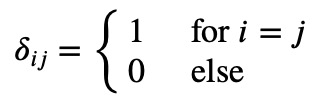
There are two symbols which make your life so much easier: the Kronecker symbol
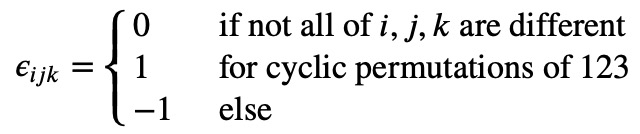
and the Levi-Civita symbol
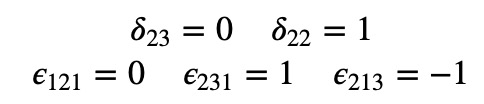
For example, we have
These symbols allow for a compact notation of vector identities. The Kronecker symbol comes handy to let multiple sums collapse. For instance, the 𝛿 in the double sum
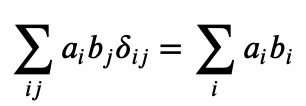
kills one of the sums because all terms with 𝑖≠𝑗 are zero.

The 𝜖-symbol, on the other hand, allows to rewrite vector products. The 𝑘-th component of the vector product 𝑎⃗×𝑏⃗ can be written as
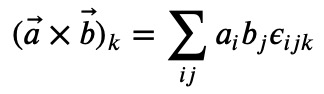
where both 𝑖 and 𝑗 in the double sum run from 1 to 3. You don’t think that this makes life simpler? Hold on! You will see. :-)

There is one more formula, you need to know before we can get into action. This formula relates the Kronecker symbol to the Levi-Civita symbol:
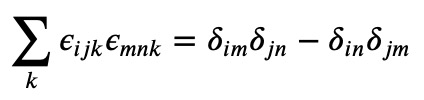
This formula is so useful, that it is definitely worth to memorize by heart. Now we are ready to go.

𝛿 and 𝜖 in Action

As a first example, let’s consider the well known (?) identity for
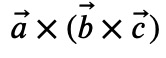
Write the vector products in terms of 𝜖:
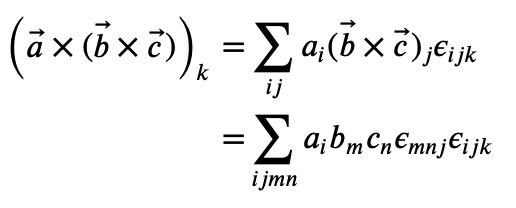
Don’t be afraid of the four-fold sum. Just focus on the structure of the indices. Comparing with the formula for the double-epsilon, we see that the summation index is the third one. So we exchange the 𝑗 and 𝑘 in the second epsilon to match this structure, which yields a factor of minus 1:
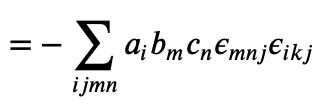
Now we can apply our magic formula:
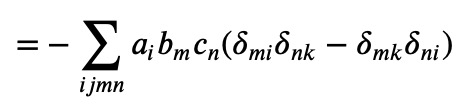
All symbols in the sum are just number, so we do everything we are used to numbers. Here, we expand the parentheses, pull in the minus sign and change order:

Now we can let the sums collapse. In the first sum, we can replace every 𝑚 by a 𝑘 and every 𝑛 by an 𝑖 and remove the sums over 𝑚 and 𝑛. In the second sum, we can replace every 𝑚 by an 𝑖 and every 𝑛 by a 𝑘 and remove the sums accordingly. So we have
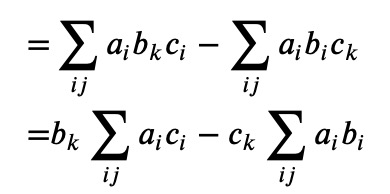
Look at the sums. They just contain scalar products! So we can write
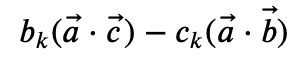
This is the 𝑘-th component of the identity we are looking for. But since 𝑘 is arbitrary, we immediately have

I admit that when you first see this trick, you will doubt that this is really easier. But in fact, if you have done that once or twice, it will become second nature and can easily be carried out. And when it comes to more complicated identities than this one, the trick absolutely rules!

As a second example, let’s calculate
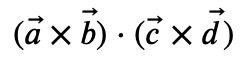
First replace the scalar product by index notation:

Then replace the vector products:
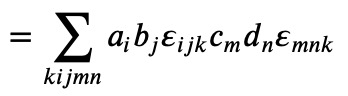
Again, don’t be afraid of the five-fold sum. This time, the summation slot of the epsilons is already correctly aligned. So we can replace it by deltas:
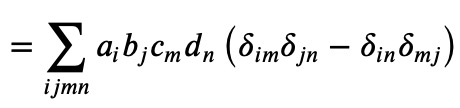
Again, let the sums collapse:
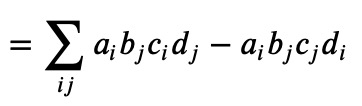
Rearrange and recognize the expressions as scalar products:
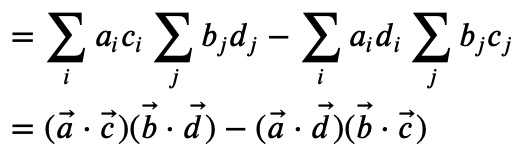
A pretty powerful tool, don’t you think?

Why not try it for yourself? How about
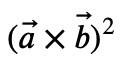
and

The latter one involves a nine-fold sum, and still easy to do! You can find the solutions on the supplementary page of this article.

Thanks for reading! If you have questions or comments, please post a reply.

Math
Physics
Science
Math Tricks
Mathematics
Recommended from ReadMedium