
Use Science to Take the Perfect Profile Picture
This article was originally posted on ScienceofPeople.com as 8 Science Backed Ways to Choose A More Attractive Profile Photo.
Think your profile picture doesn’t matter? Think again! Research has found that people make their first impression of you within 100ms of seeing your photo! Here’s what’s crazy:
Different photos of you send different messages.
Princeton University Researcher, Dr. Alexander Todorov found that different images of the same person can create drastically different first impressions. The researchers took slightly different pictures of the same person and asked participants to rate them for various characteristics, like intelligence, trustworthiness and attractiveness. Each pose got different ratings. The question is:
What is your profile picture saying?
We decided to do an experiment to figure out what makes a good profile picture. Using photos from the dating website HotorNot.com, we coded hundreds of pictures looking for patterns between the highest rated and lowest rated photos.
8 Ways to Make Your Profile Picture More Attractive:
First impressions are essential and, more and more, they are happening online. Your profile picture is your introduction to a new connection. Some of these results surprised us — things we thought mattered really don’t and others we don’t even think about actually do! And, of course, we also confirmed some clichés.
Here’s how to put your best selfie forward.
#1: Skin or no skin?
Are you ready for this? Even though men get a bad rap for wanting to see skin, women actually were more interested in men who showed off! Yup, women like it hot and steamy! Cleavage, short skirts, lots of skin did not make a difference between low and high-ranking women. However, men really benefited from showing off their skin. High-ranking men tended to show off their chest and go shirtless more than low ranking men. Flexing didn’t hurt either.
#2: Don’t Hide
Want to show you’re available and open to a relationship? Then be open and show yourself. Photos with hats and glasses were a total buzz kill for the hot factor. Sunglasses were especially detrimental. This is most likely because we use eye gaze to build connection. When we make eye contact with someone (even in a picture) our body produces the hormone Oxytocin, which makes us feel connected to someone. When raters can’t see eyes, they don’t get the hormonal boost for connection.
- Funny Note: While hats and glasses weren’t great, headphones didn’t seem to effect ratings at all.
#3: Front Me
Ever wonder how you should face the camera? The results are in — we find it more attractive when people fully face the camera. This is especially important for men. Why? Fronting is a nonverbal sign of respect. When you are really engaged with someone you align your entire body with theirs — head-to-head, torso-to-torso and toe-to-toe. In photos, when we are trying to gauge how attentive someone might be as a mate or how much they would respect us, fronting gives us a subconscious cue. Without realizing it, we think people who angle towards the camera are also angling towards us, this makes us see them as more in tune with us.
Bonus: In my book Captivate, I dive even deeper into body language, first impressions and how to project confidence in every interaction.
#4: Context Matters
Think your hotness is only about you? Think again! The hottest photos also tended to have some kind of background story — hiking, beach trip, travel, cooking, driving. Photos that included some kind of activity added to the hotness of both men and women.
- Trophies: We also counted what we call ‘trophies’ these are objects that people put on display in their photo in addition to themselves. Men’s favorite objects were guitars, cars, motorcycles and guns. Although none of these impacted hotness scores. Sorry guys, not all women are impressed by a guitar.
#5: To Smile or Not to Smile?
The biggest question we get around profile pictures is to smile or not. The answer might surprise you:
- For women closed mouth smiles were worst. The lowest ranking women used the closed mouth smile. High-ranking women had either a full smile or a neutral face. So, if you’re going to smile, go big.
- For men, surprisingly, neutral faces tended to do best. High-ranking men had serious or still faces (often looking off into the sunset) and those seemed to do better than low-ranking men who smiled wide.
Bonus: Want to learn even more about smiles and other expressions? Check out my book Captivate where I explore how to decode anyone you meet.
#6: Get Handsy
Ever wondered if you should show your hands in your picture? If you’re a woman the answer is YES! Half of the high-ranking women had their hands visible in their photo, while only a third of low-ranking women did. Hands are our nonverbal trust indicators. It seems that when men are rating women on attractiveness they are also factoring in trustworthiness and visible hands is a positive indicator of trust.
#7: The Monroe Gaze
Marilyn Monroe was famous for her flirty head tilt and sultry stare. Our coder noticed that many of the high-ranking women used the Monroe Gaze in their photos. This seems to be a hallmark of ‘hot’ women. A Monroe Gaze is when a woman tilts her head, looks up through her lashes, hoods her eyes, pouts her lips and sometimes exposes her neck. This is a very flirtatious gesture because it looks very similar to what a woman does when she is experiencing physical pleasure. Exposing her neck also releases pheromones.
Remember Lola Bunny?
Notice how even in action she shows the Monroe Gaze — tilted head, low eyes, exposed neck:
Or how about Jessica Rabbit who almost rests in the Monroe Gaze during her scenes:
#8: What Color is Best?
What’s the best color to wear in your profile picture? Confidence is the best color in your closet. We looked at colors in both male and female shots and found no significant difference between high and low ranking women and men. However, confident poses were markedly different for both high and low ranking women. Attractiveness is as much about attitude as appearance.
Bonus: Test Your Photo
Does your LinkedIn photo look competent? Does your Twitter photo look fun? Does your OkCupid look attractive?
I partnered with a website called PhotoFeeler to do this study. PhotoFeeler is a free profile photo testing tool that helps people choose better profile photos by cluing them into what their photos really are saying.
We gave this tool a little spin ourselves. Here’s the three photos of me and how they ranked:
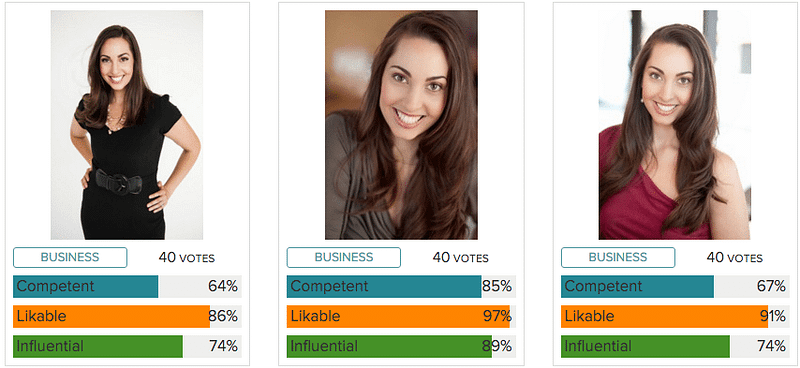
With the current votes, the second photo has scored highest in all three areas!
So, what’s your impression saying? How smart, likable, fun and trustworthy are your photos compared to the average? Let’s find out!
How it works:
- Upload your photo
- Vote on other people’s photos (or buy vote credits)
- Wait for the results
This is super helpful if you are trying to decide which photo is best–and in which situation. The best part is PhotoFeeler has agreed to share their data with us so we can analyze the photos to see why certain ones perform better than others. In a few weeks, we will let you know the patterns of the most effective profile pictures.
We would love your help! Please use our link to be part of the experiment:
http://bit.ly/1Vf0n4z
We’ll be looking for patterns in the photos. What types of photos get the most votes? The least? Is there a color, angle or environment that tends to do better than others? We want to find out! Thank you for your help. We can’t wait to share with you what we find!
Bonus: Why We Don’t Like Pictures of Ourselves
I recently made my way down to the DMV to get my driver’s license renewed. Since I’ll be carrying this photo ID around with me for the next eight years, I wanted to make sure my hair looked nice, my makeup was done, and that I looked “picture perfect.”
I was feeling pretty good about myself, until the camera flashed and I got a look at my picture. I cringed, “I look like that?”
Whether it’s a group picture, passport photo, or candid shot a friend took of you, we’ve all had similar reactions to our own pictures. But why is that?
Thankfully, science comes to the rescue to explain why our pictures don’t look like we expect.
Your profile picture can make or break your online connections. Research has found people make their first impression of you within one-tenth of a second of seeing your photo!
Choosing the right profile picture matters because different photos of you send different messages. Princeton University Professor Alexander Todorov found that changing your profile picture drastically can change the first impression people have of you. In his study, he took slightly different pictures of the same person and asked participants to rate them for various characteristics, such as intelligence, trustworthiness, and attractiveness. He found even slight variations in the pictures could change people’s perceptions of all of those traits.
The challenge is how do you make sure you choose the right profile picture?
Simple answer: you need to enlist the help of others. Here’s why:
Our Pictures Don’t Look Like Us
An interesting new study found that the pictures we choose to represent ourselves aren’t accurate depictions of what we look like. In fact, strangers are better at choosing pictures that “look like us” than we are.
Dr. David White conducted a study where participants downloaded 10 pictures of themselves from their Facebook page and ranked them from most to worst “likeness.” Then he had a group of strangers try matching up the pictures to a short webcam video of each person.
The strangers ended up picking a different set of “good likeness” pictures for each participant than the participants chose themselves — with seven percent more accurate identification.
Dr. White stated,
“It seems counter-intuitive that strangers who saw the photo of someone’s face for less than a minute were more reliable at judging likeness.”
But this makes sense: Even though we see our own faces everyday, multiple times a day, our existing memory representations of ourselves actually interfere with our ability to choose images that accurately portray our current, true appearance.
Your Face is the Wrong Way Around
Our existing memory representations of ourselves see ourselves in the mirror. So, we tend to choose and like pictures of ourselves where our features are reversed in that way. Enter: selfies. We’re used to seeing ourselves in the mirror. So, when that image is reversed, it doesn’t look quite right.
This is known as the mere-exposure effect–the more familiar we are with something, the more we like it. We are unfamiliar with seeing ourselves head-on, the way friends or strangers view us. So, we don’t like the way we look.
We all know ourselves to look a certain way: our hair is parted on the right, our left eye squints just a bit when we smile, and we have a beauty mark on our left cheek. When we see a picture of ourselves from the opposite perspective, none of our features are where we’re expecting them to be. It makes us feel uncomfortable–the picture is us, but it doesn’t look like us.
You’re Not as Attractive as You Think You Are
Okay, I know this sounds harsh, but let’s go to the science. A joint study between researchers at the University of Chicago and the University of Virginia had participants come to a lab and have their picture taken with a neutral expression. They then made several copies of the pictures and edited them to make the participants look more or less attractive. A few weeks later, the participants came back to the lab and were asked which one of their photos was the original, unedited one. The majority of the participants believed that an enhanced picture was their original, indicating that people see themselves as more attractive than they really are.
Interestingly, this effect was not the same when participants judged strangers’ photos. In that case, the majority of people chose the unedited photo, or a photo that was edited negatively, as the stranger’s original picture.
Seeing yourself as more attractive than you actually are isn’t necessarily a bad thing. It gives you confidence that makes your appearance and presence more attractive in ways that natural good looks can’t do. Research shows that people can pick up on your confidence in your photos and perceive you as more attractive, likeable, and competent as a result.
Strangers Have a Different Vision of Attractiveness
Not only do people view themselves as more attractive, they are also unable to judge their own attractiveness. An Australian study had participants submit twelve headshots and decide which ones made them look the most and least of the following traits:
- Attractive
- Trustworthy
- Dominant
- Competent
- Confident
They then had the participants rate each other’s pictures on the same characteristics. After comparing the results, researchers found there was almost no overlap between what individuals thought were their best pictures and what others thought, revealing that what we think of as attractive can vary.
There are two ways you can overcome this cognitive quirk and identify your best profile pictures:
1) Get feedback from other people. Before uploading a new profile picture, pick three or four options and ask other people which one they like most. If you are choosing a profile picture for LinkedIn or an online dating site, tell the individuals that you’re going for a professional/attractive look so they know how to judge you.
Pro tip: This strategy will be much more effective if you choose acquaintances or strangers, not friends, to judge your pictures. Your friends think you are an awesome person and are around you frequently, which causes them to have a favorable bias toward you, similar to the one you have toward yourself. They also likely know what looks make you feel the best — not the most professional, attractive, competent etc.– and may feel inclined to say they like the photo that they know you like the best even if it is not the most ideal one.
Acquaintances and strangers on the other hand, typically don’t have a favorable bias toward you and they don’t know you well enough to be aware of your preferences.
The easiest way to get stranger feedback is to use the website Photofeeler. Upload your photos and strangers will rate on different traits depending on if you plan on using them for online dating, professional, or social sites. Photofeeler’s algorithms automatically normalize your scores to give you statistically significant results for all the traits you are seeking feedback on.
Alternatively, you could ask co-workers you’re not close with, mutual friends, and other people you don’t know well for opinions that may not be as uniform but are still better than your own.
2) Choose photos that look like people you find attractive. If you don’t feel comfortable seeking profile picture advice from people you don’t know well, look for profile pictures of people that best match the image you want to create for yourself. Whether that’s competent, sexy, fun, etc. Identify what it is about their pictures that makes them look that way and choose a profile picture that shares those characteristics.
This is better than solely looking through your pictures because we see other people’s photos more objectively. However, it is still much less effective than getting a stranger’s feedback. Your bias toward yourself may trick you into believing your favorite photo looks more like your comparison attractive person’s picture than it actually does.
Don’t know where to start? Research shows these features improve your photos:
- Face the camera: This mimics the body language strategy of fronting — directly facing people — which conveys respect to the people who look at your photo.
- Squint: Slightly squinting your eyes prevents you from looking wide-eyed and scared and makes you look more attractive, according to research.
- Tilt your head: This is the universal sign of engagement and subtly shows people that you’re open to making connections.
- Smile, don’t smirk: A lot of people smirk in their profile pictures without realizing it. Smirking is the universal facial expression for contempt and conveys that you think you are better than other people. On the flip side, a genuine smile, with your eye muscles engaged, makes you look warm and approachable.
Look for people with profile pictures with those characteristics as a baseline for attractiveness and see if there are any additional traits from your favorite person’s photos that you can mimic.
What Does this Mean?
Contrary to what you may believe, you’re not the most un-photogenic person in the world. You’re just not used to seeing yourself the way other people see you. I promise, you look normal in the group photograph. It’s still your face in that passport photo and you’re just not used to the angle your friend used to take that candid pic of you.
Keep taking baller selfies, if that’s what you prefer, but maybe in time you’ll finally get used to how your face looks the way everyone else sees it.
I hope this fun research experiment has shed some light on what goes into attractive profile pictures. Luckily, our appeal is about attitude. In your photos you want to show trustworthiness, confidence and openness — this is what makes you truly attractive.
Researchers:
Vanessa Van Edwards is a behavioral investigator and published author. She figures out the science of what makes people tick at her human behavior research lab, the Science of People. As a geeky, modern-day Dale Carnegie, her innovative work has been featured on NPR, Business Week and CNN.
Jose Piña is a certified Body Language Trainer and researcher with the Science of People lab. One of his favorite topics is the face and microexpressions. Decoding the face is a fascinating task just like learning the cues that help your impression and personality. All experiments are executed with the ambition to find out how and why do humans function and how the results can benefit you.
Bonus: Take Your (Platonic) Attraction to the Next Level
Science of People can help you take your memorability and charisma to a new level. Check out our professional training program, People School.
Citations:
Willis, J., and A. Todorov. “First Impressions: Making Up Your Mind After a 100-Ms Exposure to a Face.” Psychological Science 17.7 (2006): 592–98. Web.
Todorov, A., and J. M. Porter. “Misleading First Impressions: Different for Different Facial Images of the Same Person.” Psychological Science 25.7 (2014): 1404–417. Web.
Originally published at www.scienceofpeople.com on April 5, 2017.


