avatarChristopher Kokoski

Free AI web copilot to create summaries, insights and extended knowledge, download it at here

3149

Abstract

other way you can think about the subheadings is size or importance.</p><p id="93a2">H1 headings are usually the biggest, H2 headings are the second biggest, and H3 headings are the smallest of the three.</p><h1 id="624a">Here Is My Exact SEO Article MAP</h1><p id="b60d">Here is how I structure my articles for higher Google rankings:</p><ul><li><b>H1</b> — I only use H1 for the title of the article.</li><li><b>H2 </b>— I use H2 headings for the main subheadings or sections of an article.</li><li><b>H3 — </b>I use H3 headers for the “sub-sub headings” under H2 headings</li></ul><p id="a295">Each article should only have one H1 heading (the title), and a unique mix of H2 and H3 subheadings.</p><p id="73db">Sometimes my articles only have H1 and H2 headings without any H3 headings at all. However, most of my blog posts include several H2 and H3 headings.</p><p id="dda3">Here’s an example with the “H-tags”:</p><blockquote id="738a"><p>H1</p></blockquote><blockquote id="7070"><p>H2</p></blockquote><blockquote id="c503"><p>H3</p></blockquote><blockquote id="a7d5"><p>H3</p></blockquote><blockquote id="f270"><p>H2</p></blockquote><blockquote id="1a9d"><p>H2</p></blockquote><blockquote id="6efa"><p>H2</p></blockquote><blockquote id="2a5f"><p>H3</p></blockquote><blockquote id="9f1e"><p>H3</p></blockquote><blockquote id="079d"><p>H3</p></blockquote><blockquote id="0f9e"><p>H2</p></blockquote><p id="6456">Remember, your article might not look exactly like this example. It depends on how many of your H2s you break down into more specific H3s.</p><p id="0d05">I know this still might be confusing, so let me use an actual example of a real article.</p><h1 id="c635">SEO MAP Real Example</h1><p id="95eb">I found the article <a href="https://coldgeeks.com/why-does-gum-make-water-cold/">Why Does Gum Make Water Cold? (Solved & Explained)</a> and thought it would be a fun one for our example.</p><p id="ad7b">Here is the SEO MAP for this article:</p><p id="af7d">H1 — Why Does Gum Make Water Cold? (Solved & Explained)</p><p id="f994">H2 — Why Does Gum Make Water Colder? (Scientific Answer)</p><p id="98e4">H3 — Thermal Illusion</p><p id="b1c0">H3 — TRPM8</p><p id="8a3c">H3 — Methanol</p><p id="bb9c">H2 — Does Gum Make Water Colder?</p><p id="d5d4">H2 — What Happens When You Drink Water When Chewing Gum?</p><p id="367d">H2 — Why Does Fruit Gum Make Water So Cold?</p><p id="5172">H2 — Does All Gum Make Water Colder?</p><p id="f626">H2 — FAQS Related to Why Does Gum Make Water Cold?</p><p id="6d86">H3 — Why Does Peppermint Make Water Colder?</p><p id="0ca4">H3 — What Does Chewing Gum and Drinking Water Mean?</p><p id="0e44">H3 — What Does Gum and Water Mean on TikTok?</p><p id="c60d">H3 — Does Gum and Water Make You Lose Weight?</p><p id="c1df">H3 — Why Does Chewing Gum Get Harder When We Drink Water?</p><p id="6a73">H2 — Final Thoughts: Why Does Gum Make Water Colder?</p><p id="ef35">H2 — Sources</p><p id="fbda">To hopefully make the SEO MAP crystal clear, here is a screenshot of the Table of Contents (TOC) for this article:</p><figure id="7c9a"><img src="https://cdn-images-1.readmedium.com/v2/resize:fit:800/1*Z

Options

QPjDeVbybI8kL8CAOo_mA.jpeg"><figcaption>Screenshot by the <a href="https://medium.com/@christopherkokoski">author</a> of the article on <a href="https://coldgeeks.com/why-does-gum-make-water-cold/">coldgeeks.com</a></figcaption></figure><p id="1614">Note that the left-aligned titles (such as Why Does Gum Make Water Colder?) are all H2 headings.</p><p id="9ebd">The indented subheadings (such as Thermal Illusion) are H3s.</p><p id="ee7d">That’s because Thermal Illusion is a sub-topic within the “Why Does Gum Make Water Colder?” topic.</p><h1 id="ba11">Ok, Here’s One Last Example for the Road</h1><p id="34dd">If you wanted to go into different types of thermal illusion, then you would probably use H4 headers to further nest the smaller topics within their larger topical sections.</p><p id="1130">A good rule of thumb is the deeper you drill down into the details of a topic, the higher your “h-tag” headings.</p><p id="36f0">Here’s another basic example:</p><ul><li>H1–Why You Should Wash Top-Down in the Shower</li><li>H2 — What Is Top-Down Washing?</li><li>H3 — Start With Your Head (Your Top)</li><li>H3 — Move To Your MidSection (Your Middle)</li><li>H4 — Why You Should Wash Your Middle Second</li><li>H4 — Tips for Washing Your Middle</li><li>H3 — End With Your Toes (Your Bottom)</li><li>H4 — Why You Should Wash Your Toes Last</li><li>H4 — How to Wash Your Toes</li><li>H2–7 Good Reasons to Wash Top-Down in the Shower</li></ul><h1 id="6d18">Final Thoughts</h1><p id="e07e">As a final reminder: SEO MAPs are all about organizing your blog post in a way that makes your content look good to Google AND to human readers.</p><p id="ccd2">Your map will look different than my map, but it should still look like a map.</p><p id="3a20"><b>Related posts:</b></p><ul><li><a href="https://readmedium.com/how-i-use-copy-paste-to-make-myself-a-better-writer-355d9445a3c9">How I Use Copy + Paste To Make Myself a Better Writer</a></li><li><a href="https://readmedium.com/how-i-make-5-000-each-month-writing-about-tiny-topics-7f65f92cb224">How I Make $5,000 Each Month Writing About Tiny Topics</a></li><li><a href="https://bettermarketing.pub/3-low-effort-seo-tips-for-better-rankings-on-google-e9edfe9adf10">3 Low-Effort SEO Tips for Better Rankings on Google</a></li></ul><p id="ab33"><b><i>Don’t miss my next SEO and writing article — sign up to my <a href="https://christopherkokoski.medium.com/subscribe">Medium email list</a>. Thanks!</i></b></p><div id="a1e1" class="link-block"> <a href="https://christopherkokoski.medium.com/membership"> <div> <div> <h2>Join Medium with my referral link - Christopher Kokoski</h2> <div><h3>As a Medium member, a portion of your membership fee goes to writers you read, and you get full access to every story…</h3></div> <div><p>christopherkokoski.medium.com</p></div> </div> <div> <div style="background-image: url(https://miro.readmedium.com/v2/resize:fit:320/0*kh_bugF7ZUrUA2G6)"></div> </div> </div> </a> </div></article></body>

Use My SEO Article Map for Higher Google Rankings

Content structure for rankings, readership, and revenue

Image by Author via Canva

I use a simple SEO Article Map for higher Google rankings, more reader engagement, and increased revenue from display ads and affiliate marketing.

In this article, I’ll explain my SEO Article Map so that, if you want, you can copy it for your own blog posts.

Here is my SEO Map for writing high-traffic, high-earning articles.

What Is My SEO Map?

Let me break my SEO Article Map into its two main parts:

  • SEO
  • MAP

SEO: Easy Definition for Beginners

SEO stands for search engine optimization. Basically, SEO makes you look good to Google and helps your articles rank higher in Google searches.

You are dressing up to impress Google.

Searchengineland describes SEO as:

In simple terms, it means the process of improving your site to increase its visibility when people search for products or services related to your business in Google, Bing, and other search engines.

Moz defines SEO this way:

SEO stands for search engine optimization, which is a set of practices designed to improve the appearance and positioning of web pages in organic search results.

The MAP

Keeping with our analogy, if SEO is dressing up for Google, the MAP is the dress (or outfit) we put on.

The MAP:

  • Helps Google understand the subject and context of the article
  • Helps readers read and understand the content
  • Helps your article rank higher in Google search
  • Helps beat competitors with bad (or less effective) maps

Basically, the MAP is the structure of your blog post.

Every article should have only one H1 heading, which is the title at the very top of the article.

For example, the title at the top of this article is technically a H1 header.

Everything else on your article should be an H2 or H3 header. The “H” stands for “header” and the numbers simply refer to the organizational structure of the subheadings.

Google likes H1, H2, and H3 headers because it helps Google understand what the article is about (which helps with rankings).

If you use something like WordPress, the inbuilt editors make creating H1, H2, and H3 subheadings pretty simple. There are more subheadings (H4-H6), but you probably won’t need those very often.

If at all.

Another way you can think about the subheadings is size or importance.

H1 headings are usually the biggest, H2 headings are the second biggest, and H3 headings are the smallest of the three.

Here Is My Exact SEO Article MAP

Here is how I structure my articles for higher Google rankings:

  • H1 — I only use H1 for the title of the article.
  • H2 — I use H2 headings for the main subheadings or sections of an article.
  • H3 — I use H3 headers for the “sub-sub headings” under H2 headings

Each article should only have one H1 heading (the title), and a unique mix of H2 and H3 subheadings.

Sometimes my articles only have H1 and H2 headings without any H3 headings at all. However, most of my blog posts include several H2 and H3 headings.

Here’s an example with the “H-tags”:

H1

H2

H3

H3

H2

H2

H2

H3

H3

H3

H2

Remember, your article might not look exactly like this example. It depends on how many of your H2s you break down into more specific H3s.

I know this still might be confusing, so let me use an actual example of a real article.

SEO MAP Real Example

I found the article Why Does Gum Make Water Cold? (Solved & Explained) and thought it would be a fun one for our example.

Here is the SEO MAP for this article:

H1 — Why Does Gum Make Water Cold? (Solved & Explained)

H2 — Why Does Gum Make Water Colder? (Scientific Answer)

H3 — Thermal Illusion

H3 — TRPM8

H3 — Methanol

H2 — Does Gum Make Water Colder?

H2 — What Happens When You Drink Water When Chewing Gum?

H2 — Why Does Fruit Gum Make Water So Cold?

H2 — Does All Gum Make Water Colder?

H2 — FAQS Related to Why Does Gum Make Water Cold?

H3 — Why Does Peppermint Make Water Colder?

H3 — What Does Chewing Gum and Drinking Water Mean?

H3 — What Does Gum and Water Mean on TikTok?

H3 — Does Gum and Water Make You Lose Weight?

H3 — Why Does Chewing Gum Get Harder When We Drink Water?

H2 — Final Thoughts: Why Does Gum Make Water Colder?

H2 — Sources

To hopefully make the SEO MAP crystal clear, here is a screenshot of the Table of Contents (TOC) for this article:
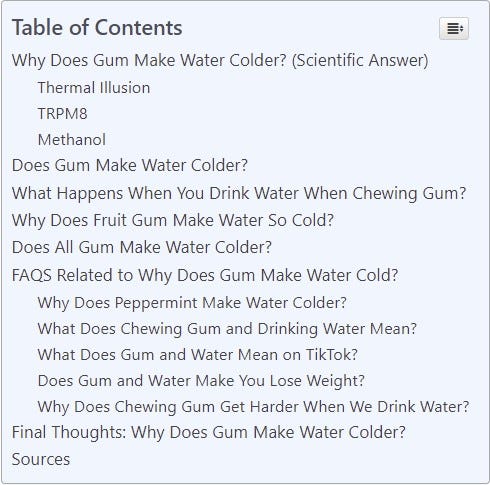
Screenshot by the author of the article on coldgeeks.com

Note that the left-aligned titles (such as Why Does Gum Make Water Colder?) are all H2 headings.

The indented subheadings (such as Thermal Illusion) are H3s.

That’s because Thermal Illusion is a sub-topic within the “Why Does Gum Make Water Colder?” topic.

Ok, Here’s One Last Example for the Road

If you wanted to go into different types of thermal illusion, then you would probably use H4 headers to further nest the smaller topics within their larger topical sections.

A good rule of thumb is the deeper you drill down into the details of a topic, the higher your “h-tag” headings.

Here’s another basic example:

  • H1–Why You Should Wash Top-Down in the Shower
  • H2 — What Is Top-Down Washing?
  • H3 — Start With Your Head (Your Top)
  • H3 — Move To Your MidSection (Your Middle)
  • H4 — Why You Should Wash Your Middle Second
  • H4 — Tips for Washing Your Middle
  • H3 — End With Your Toes (Your Bottom)
  • H4 — Why You Should Wash Your Toes Last
  • H4 — How to Wash Your Toes
  • H2–7 Good Reasons to Wash Top-Down in the Shower

Final Thoughts

As a final reminder: SEO MAPs are all about organizing your blog post in a way that makes your content look good to Google AND to human readers.

Your map will look different than my map, but it should still look like a map.

Related posts:

Don’t miss my next SEO and writing article — sign up to my Medium email list. Thanks!

Writing
Marketing
Blogging
SEO
Freelancing
Recommended from ReadMedium