
US Government Social Media Law
US Supreme Court Addresses Claims of Government Coercion in Social Media and NRA Case Controversies: An In-Depth Analysis
Government Coercion Claims in Social Media and NRA Cases: A Comprehensive Analysis of US Supreme Court Decisions
As we delve into the recent claims of government coercion pertaining to social media and NRA cases, our primary focus will rest on decisions made in the hallowed halls of the U.S Supreme Court. You’ll gain a deeper understanding of the complex issues at play and their implications for freedom of speech in the digital epoch.
“The framers of our Constitution enshrined in the First Amendment the right to freedom of speech, a right that remains fundamental to our democracy. As we navigate through the intricacies of the digital age and social media, it’s imperative that we uphold these constitutional liberties, while also ensuring a safe and responsible space for dialogue”.
Table of Contents
- 1. Overview of the Cases
- 2. Government Coercion Decoded
- 3. The Social Media Case: A Deep Dive
- 4. The NRA Case: Facts and Findings
- 5. Implications for Freedom of Speech
- 6. Decoding the Supreme Court Decisions
- 7. Conclusion
- 8. A personal Reflection from Jason
1. Overview of the Cases
You’ve probably heard about these high-profile lawsuits: Murthy v. Missouri, NRA v. Vullo, NetChoice v. Paxton, and Moody v. NetChoice. Each one deals with complex issues of government coercion and censorship in relation to our precious First Amendment rights — our right to freedom of speech.
2. Government Coercion Decoded
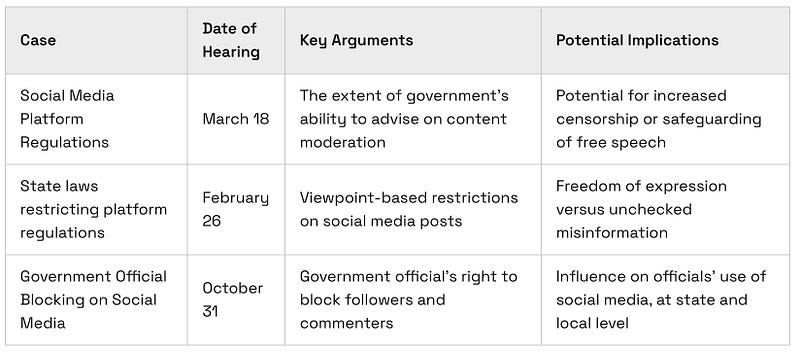
But what is government coercion exactly? In layman’s terms, it’s when the government crosses the line from merely expressing an opinion about content moderation on social media platforms to actually pressuring these platforms to censor specific content. If you feel this sounds like a slippery slope towards government censorship of lawful speech, you’re not alone. This is the very issue that the Supreme Court is grappling with.
3. The Social Media Case: A Deep Dive
The social media case in point originates from claims by Republican attorneys general and social media users. They allege that certain government officials applied pressure on social media platforms to moderate — or, let’s call it what it is, censor — content based on the viewpoint being expressed. This raises some uncomfortable questions: To what extent can government influence what we see and hear on our timelines? When does influence become coercion?
4. The NRA Case: Facts and Findings
Let’s turn our attention to the NRA v. Vullo case. Here, we see how state laws could prevent social media platforms from restricting a user or post based on its viewpoint. This might seem like po-tay-to, po-tah-to, but stay with me — it’s about more than mere semantics. The ruling from this case could drastically reshape the way officials use social media, particularly at the state and local level.
5. Implications for Freedom of Speech
These cases aren’t just a courtroom drama. They have far-reaching implications for every U.S. citizen and the foundation of our democracy — freedom of speech. Will we have the liberty to express our views freely even on the vast realms of social media, or will government pressure influence what we can and cannot say?
6. Decoding the Supreme Court Decisions
When the Supreme Court concludes hearing arguments and presents its decisions, the outcome could potentially redefine the contours of freedom of speech and government interference in the digital age. As the date approaches, we’ll be here to help you make sense of the rulings and understand their impact on you and your online interactions.
Conclusion
As we conclude, the outcomes of these cases in the Supreme Court will undeniably reshape the future of content moderation on social media platforms and potentially even spill over to editorial decisions in journalism. With varied and potent implications, a widespread concern of increased government censorship is brewing. Furthermore, the decisions will also set an important precedent for the freedom of expression on these platforms. A delicate balance needs to be struck between protecting free speech and curtailing harmful or misleading content. Hence the conclusion of these cases bear profound weightage for both individuals and platforms alike.
Significantly, these cases are also expected to influence how government officials interact on these platforms, especially at state and local levels. Thus, beyond influencing private citizens and corporate entities, these decisions will also affect the more broad realm of political interaction.
While we wait for these landmark rulings, it’s essential to note that we are treading uncharted waters. The intersection of technology, social media, free speech, and government intervention is a complex area that is yet to be thoroughly explored. Thus, how the Supreme Court navigates this legal complex is something we’ll have to closely watch and potentially learn from, for years to come.
A personal Reflection from Jason

As you read this, I’m reminded of the essential truth that legal cases aren’t just about dry facts and figures; they’re about real people and real-world impacts. These landmark cases related to social media and the NRA are no different. They strip away the illusion that legal battles are only waged in courts and reveal the greater battlefield: society itself.
“At stake here is no less than the issue of our fundamental freedoms, specifically freedom of speech. It’s no longer a debate confined to the four walls of a courtroom but something that impacts all of us, on a daily basis, through the platforms we visit, the information we consume, the associations we belong to.”
It’s not just about understanding the legal technicalities like ‘government coercion’. Take a moment to delve into the details, feel the human stories being told, and question the implications. As you navigate this guide, I encourage you not become overwhelmed by the layers of legal speak:
Take it slowly: each section is there to break down complex issues into digestible chunks
Ask questions: if something doesn’t make sense, don’t hesitate to research or ask experts
Engage actively: don’t just read the words, but think about the implications in a broader societal context
Ultimately, these cases and the Supreme Court’s eventual decisions are more than just legal milestones. They’re a reflection of the ongoing tug-of-war between individual rights and the sometimes blunt instrument of government power. So, brace yourself. Let’s journey together, into the heart of what it means to be part of a democracy in the digital age.
