
Urbino’s Renaissance Echoes: A Chronicle of Artistic Majesty
Traversing the Halls of Palazzo Ducale and the Birthplace of Raphael
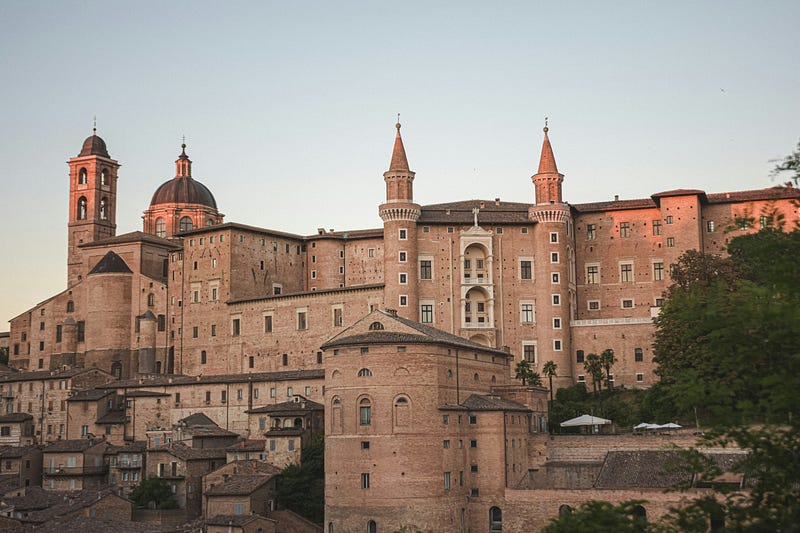
Nestled within the lush landscapes of Italy’s Marche region, Urbino is a town that seems untouched by the relentless march of time. It also cradles the Palazzo Ducale, a fortress of culture and beauty, and the humble yet historically profound birthplace of Raphael, a master of Renaissance art.
My sojourn in Urbino commenced with the majestic Palazzo Ducale, a structure that commands respect and admiration. Its façade, a harmonious blend of grace and fortitude, whispers tales of the past, when it served as a court of the Renaissance and a beacon of culture and intellect. As I approached, the palazzo’s twin turrets reached towards the sky, as if guarding the rich history within its walls.
Stepping inside, the Courtyard of Honor greeted me with its understated elegance. The geometric harmony and the interplay of light and shadow cast by the columns created a tranquil yet dynamic space. It was in this courtyard that the dukes of Urbino once welcomed illustrious guests, and now, it welcomed a solitary wanderer, eager to uncover the layers of history embedded in the stone and mortar.
The interior of the Palazzo Ducale was a treasure trove of artistic and historical marvels to. Each room, each corridor, seemed to narrate its own saga. The Studiolo of Federico da Montefeltro, a compact chamber, was particularly captivating. Encased within its wooden inlays and intarsia, the studiolo whispered secrets of a bygone era when it served as a sanctum for contemplation and learning. The meticulous craftsmanship of the woodwork, depicting illusionistic shelves laden with books and instruments, spoke of the reverence for knowledge and the arts during the Renaissance.
The Palazzo’s art collection, displayed in the Galleria Nazionale delle Marche, speaks of the artistic fervor that defined the era. Works by Piero della Francesca, Titian, and Paolo Uccello adorned the walls, each canvas a window into the minds of the masters. Their depiction of light, shadow, and perspective not merely a representation of the world around them, but a dialogue between the artist and the viewer, transcending time and space.
From the grandeur of the Palazzo Ducale, my path led me to a more humble yet equally significant site: the birthplace of Raphael. In a modest home, now a museum dedicated to his early life, I found myself standing in the very rooms where one of the greatest painters of the Renaissance took his first steps and drew his first breaths. The atmosphere is thick with a sense of reverence, not for the physical space but for the legacy that had its genesis there.
The exhibits, though few, are poignant, offering a glimpse into Raphael’s formative years and the environment that nurtured his prodigious talent. His early sketches, marked by precise strokes and an emerging grasp of human anatomy and perspective, hint at the brilliance that was to flourish and leave an indelible mark on the world of art.
As I wandered through the rooms of Raphael’s home, I couldn’t help but reflect on the journey of an artist, from these modest beginnings to the grandeur of the Vatican’s frescoes. It was a journey not of distance but of transformation, driven by an unyielding pursuit of beauty and perfection.
In the quiet of the evening, as the sun dipped below the horizon, casting a warm glow over Urbino, I found a spot to sit and gather my thoughts. The experiences of the day, the art, the architecture, and the palpable sense of history, melded into a tapestry of memories. With its timeless charm, Urbino offered me not just a glimpse into the past but a connection to the continuum of human creativity.
It was an encounter with the spirit of the Renaissance, a period that redefined the boundaries of art and thought. And in this encounter, I found a renewed appreciation for the unending quest for knowledge and beauty that defines the human experience.