
Uprising of 5G in Future HealthCare System
A Revolution in Healthcare
In this story, I am going to discuss how 5G plays an important role in the health care sector, portable and wearable sensors, apart from that how wearable and portable devices battery run with better efficiency, the concept of wireless power transfer, and energy harvesting also discussed in detail. Apart from that, we visualize algorithms related to the energy harvesting model that defines the architecture of energy harvesting and in last we describe conclusion and future work that how 5G will be the revolution in the health care sector. In this fast technological world, ‘Telehealth taking so much importance in developing and under-developing countries, and soon though 5G technology the telehealth will prevail all over the modern world in the domain of healthcare. Telehealth will provide better outcomes in health sectors. Although 5G is not available anywhere in the world as yet. Few countries already have all set targets of 2020 for the launch of 5G services. Our Government of Pakistan was planning to launch the ‘5th Generation’ cellular services “soon” for faster connectivity having the Vision of 2025.

INTRODUCTION
5G network will be innovation in the field of communication, this generation will change our life whether it’s our private or professional by the application of novel services, for example, distant healthcare, driverless cars [6], autonomous vehicles, downloading an interactive 3-D video in a few seconds and lots more [4]. It will remove the boundaries between the cyber and real-world, apart from that the usage of smartphones is the root of connection that connect trillions of devices for the future by Internet Of Thing (IoT), supporting thousands of devices per square km. in the concept IoT, the sensors is the backbone for connecting the physical world (temperature, CO2, light, noise, moisture)with the digital world of IoT (Evans,2011,[1]). This model (IoT) expresses many innovative ways in healthcare promotion by reducing the cost and increase the quality of care such as distant monitoring of patients with acute or chronic illnesses. Remote health monitoring can be performed by wearable sensors that detect patient physiological behavior and physical activity with the help of IoT that connect the peripheral sensing and computing devices for example wearable sensors, smartphones, and cloud computing devices. One problem for any portable or wearable device is to reduce power consumption and increase a very important battery life. To get 10% times more battery life is required for 5G scenario, in which the technologies such as wireless power transfer and self-power mechanisms are under-discussed for this purpose body-worn sensors typically consume power to perform sensing and communications functions, while some sensors can work as passive scatter devices for sensing, whereas other sensors can require needed operation energy from the wireless technology that sensed parameters of the human body [4]. The interconnections of networks are useful with the help of IoT because it leads to giving good QoS and QoE among users. The low latency and reliability is the key challenge in 5G technology. To achieve high effectiveness and the efficiency of a product which is under research by pharmaceutical companies that to introduce in the market aiming to get real-time information from the patient, for example, smart asthma inhalers, insulin pens, or smart wound dressings. In biomedical companies, manufacturers of medical devices such as infusion pumps, monitors, ventilators, and hospital beds are looking for strategies to hyper-connect these machines to connect patients and professionals, to give the real-time services [7]. Remote health monitoring, collecting and communicating personalized health, wellness information with physiological parameters, and physical activity are maintained and calculating by wearable sensors and portable devices which IoT allows the connectivity. One of the problems is that battery life is worn out but our keen focus is that battery life should not be worn out and minimization of power consumption in order to get 10 times longer battery life as provide for 5G network, technologies such as wireless power transfer, energy harvesting, and self-powering mechanisms are being considered [6]. In this report we will discuss how 5G plays an important role in the health care sector, portable and wearable sensors, apart from that how wearable and portable devices battery run with better efficiency, the concept of wireless power transfer and energy harvesting also discussed in detail. Apart from that, we visualize algorithms related to the energy harvesting model that defines the architecture of energy harvesting and in last we describe conclusion and future work that how 5G will be the revolution in the health care sector.
TELEMEDICINE /TELEHEALTH: The word telemedicine means medicine provided at a distance [11]. It significantly improves the use of ICT in order to achieve the patient’s physiological results by using medical information. The healthcare activities are challenging tasks for healthcare care professionals because of the critical issues of distance, thus using the medical information, patient history and communications technologies make the way easy in order to achieve better results of the diagnosis, scanning and safeguarded from disease and injuries. Apart from that training and continuously providing education to health care providers, and the training-related to technologies may give rise to the skills of healthcare professionals.
TELEHEALTH SERVICES AND PRODUCTS: telemedicine includes a combination of medical products and services. There are various products and services including telemedicine and medical devices to delivery systems [14]. Medical instruments extract electronically transmitting information that can be digitized in order to used in telemedicine methods, that contains blood glucose meters, blood pressure measurement devices, imaging devices, and other related physiological measurement devices. Also, these devices focus targeted towards rural/urban home-based healthcare and basic medical needs of patients increasingly monitored their health status, whereas the others facilitate the arrangement and exchangeable information between hospitals, clinics, medical laboratories, and physicians. Key industry associations and stakeholders involved in these types of products include the Advanced Medical Technology Association (AdvaMed), the Medical Industry Technology Alliance (MITA), and the Medical Device Manufacturers Association (MDMA) [14]. The medical products utilization provides a great impact on telemedicine related services by providing electronic exchange capabilities.
LITERATURE REVIEW
A. MM WAVES (5G) IN MEDICAL HEALTH
In medical health, 5G will bring stability, large capacity, low cost, better energy efficiency, security, privacy, large coverage, network flexibility, and spectrum management. This network also includes technologies such as implanted sensors, wearable, and an implanted device that covers the wide frequency spectrum range i.e. 5–50mhz to the mm-waves frequency band for 5G portable devices. The capability to easily densify and scale the network with a huge number of connected sensors and wearable devices is the main task for the wireless body area network (WBAN) in the internal environment (home, hospital, etc). On the other side, remote monitoring connects a large range of area and to connect the patients and doctors which is achieved by wireless local area network [7]. IoT (internet of-thing which will be the evolution in the world of internet connect all devices, smartphones, computers with better advancement no-latency and cost-effective manner. Remote and self-monitoring based on different wireless networks i.e.(Bluetooth, wireless PAN, Wi-Fi, and NB-IoT). self and remote monitoring are divided into three phases i.e. imaging, diagnostic, and data analyst or treatment.
B. IMAGING
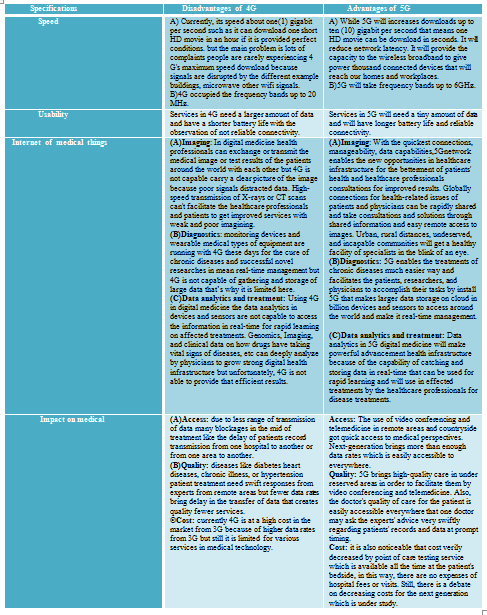
Currently, imaging is done and sends through a 4G network which is not quite enough to transmit a clear focus view of the image. To send the imaging result to an urban area or geographically send to anywhere will be far most easy and convenient with the 5G network. In this way, the rural population can get full benefits for health specialist expertise views and get their results. X-ray, CT-scan, and ultrasound imaging high-speed transmission can enable patient treatment to amalgamate with 5G can bring the 2nd third option towards patients at home-based or in hospital and that option can be achieved by home country doctors or globally located doctors with cost-effective and efficient manners.
C. DIAGNOSTIC
The diagnostic phase enhances the capability is to use wearable medical devices and portable types of equipment. This phase is especially for chronic disease patients Such as diabetes, cardiovascular disease, blood pressure patients, and cancer patient. Patients with severe diseases need doctors all the time to continuously check-up.
D. DATA ANALYTICS OR TREATMENT
The data provided by the patient gives digital medicine towards the patient by doctors. This provides the ability to access data in real-time enables rapid learning on treatment effects also visualizes which treatment is effective or not. A wearable device also creates alerts for a patient.
E. WIRELESS NETWORK SENSORS
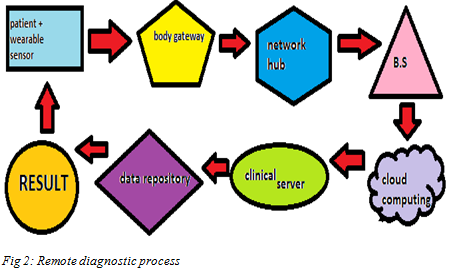
System architecture For remote patient monitoring by wearable sensors [10]. Due to the rapid advancements in wireless all the time for their real-time physiological measurements such as ECG/EKG, EEG, EET, etc, and daily data from a cancer patient. These tools are very helpful for senior citizens. Few counties implement these tools but due to low data rates it cannot accommodate all patients but with the help of 5G, we can remove these limitations.
F. SELF-MONITORING/REMOTE MONITORING
The diseases such as cancer treated by this phase are valuable and accumulate all data from different organizations and shared history of the patient, patient genomic, imaging, and clinical data for patient lifesaving. This process gives the patient very effective therapy and treatment. Communications and physiological sensing devices has creates an interest in body-worn sensors, or wearable health monitoring devices. The wireless network which helps to properly monitor the human body by the wearable sensor is achieved by WBAN, which includes lots of miniatures, lightweight, ultra-low power, and smart biosensors. Also, these wearable sensors communicated with wearable computers and smartphones, through specialized networks and i.e. WBAN network, this network is a radio frequency wireless network that is specially designed for body-worn sensors in order to communicate between these sensors. Such kind of portable devices facilitates doctors and patients for early detection of disease in order to prevention of serious results. Whereas the smart biosensors functions may be limited because of the battery life that can be worn out at any time Wearable devices traditionally work in wireless body area networks (WBAN) for continuous sensing or computing physiological activities. One of the examples of wireless sensors is the Doppler radar sensor that can be used for cardiopulmonary monitoring and ambulatory gate monitoring and wearable ultra-band (UWB) transceivers are used for ambulatory human locomotion tracking system favorable for clinical gate assessment which is low cost and low complex system [6].
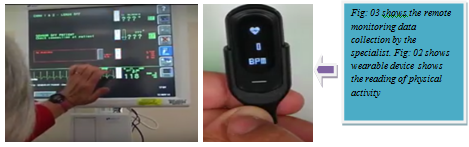
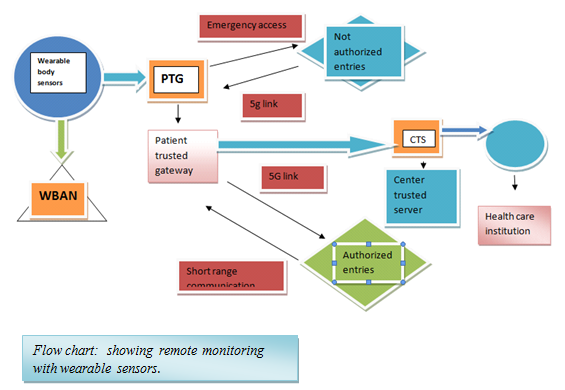
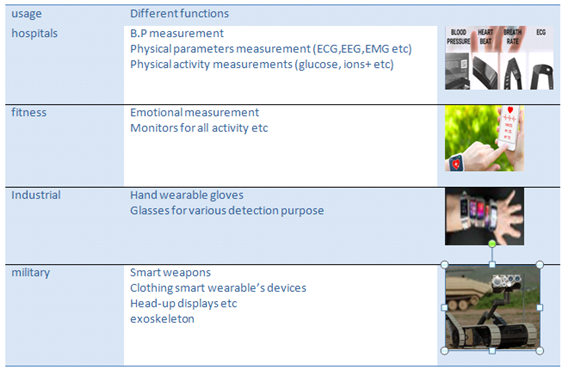
Chart of wearable sensors usage
RESULTS
There are various benefits as we are observing that the use of telemedicine in our society is increasing day by day but unfortunately only in urban areas also the several perspectives of telemedicine observed nowadays. But imagine the era whereby invasion of 5G in society leads to the modern view in the healthcare sector especially for people who are residing in rural areas. That may raise the instrumentation such as drug delivery products which will be cost-effective for users, better delivery of healthcare services hospitals or clinics, and improved skills of healthcare professionals by these new technologies and their experiences with new inventions that motivate the healthcare sectors in many ways. Treatment of chronic diseases such as diabetes, congestive heart failure, vascular diseases require long-term treatment will be easily accessible by health care professionals especially the patients who are residing in rural areas patients such as senior citizens, home-bound and physically challenged patients. Telehealth in 5G will change the whole face of healthcare sectors.
COMPARATIVE ANALYSIS
CONCLUSION
As we better clarify ourselves by go through many applications that how 5G makes patient life very easy especially for senior citizens. These kinds of tasks achieved by various wearable devices for remote and self-monitoring purpose and replacing the battery for wearable devices is very costly so in order to overcome these kinds of problem, we have energy harvesting system and how this energy harvesting system gives energy to wearable devices we have to develop such kind of energy harvesting system models that human develop his own energy to charge the wearable devices. With such types of technologies, we can make better health outcomes. Awareness about Telemedicine or Telehealth. In today’s Healthcare is very demanding and competitive all over the world even our country Pakistan as well as needed. Pakistani Governance should establish legislative policies of laws and regulations by connecting internationally and nationally funded projects. Governance should be maintained in such a way that best policies for Sustaining development of healthcare.
REFERENCES
- M.J.McGrath, C.N.Scanaill,’healthcare,wellness and Environmental applications’.
- C.Thuemmeter,A.Gavras,A.K,L.Junelle,A.Paulin,A.Sadique,A.Scheider, C.Fedell,D.Abraham ,D.Trossen, ”5G and health”, September 2015.
- M.Chen,J.Yang,Y.Hao,S.Mao and K.Hwang ,”a 5G cognitive system for healthcare”,30 march 2017.
- D.M.West,”How 5G Technology Enables the health internet of Things”,july 2016.
- O.P.Gandhi,Fellow,IEEE,and A.Riazi,”Absorption of Millimeterwaves by Human Beings and its Biological Implications.
- O.B-luberke,V.M.Lubecke,B.Jokanovic,A.Singh,E.Shahhaider and B.Padasdao,”microvace and wearable Technology for 5G.
- C.Politis,”Anew Generation of e-health Systems Powered by 5G”, volno:17,November 2016.
- E.Ibarra,A.Antonopoulos,E.Kartsakli,J.JP.C.Rodrigues,C.Verikoukis,”QoS-aware management in body sensor nodes powered by human energy harvesting”,6 dec 2015.
- Directorate general for communications and technology,”Smart wearables: reflection and orientation paper”, 28/11/2016
- V.Oleshchuk.R.Fensli,”Rmote monitoring within fute 5G infrastructure”, Springer Science+Business Media, LLC. 2010
- goe_telemedicine_2010.pdf.Global observatory e-Health Series, Available athttp://www.who.int/goe/publications/goe_telemedicine_2010.pdf,Telemedicine by WHO.
- WHO. A health telematics policy in support of WHO’s Health-For-All strategy for global health development: report of the WHO group consultation on health telematics, 11–16 December, Geneva, 1997. Geneva, World Health Organization, 1998.
- Matthew A. Hein ,Telemedicine: An Important Force in the Transformation of Healthcare June 25, 2009.telemedicine_2009.pdf
- Alexander Vo PhD, G Byron Brooks MD EE, Ralph Farr, and Ben Raimer MD. Benefits of Telemedicine in Remote Communities & Use of Mobile and Wireless Platforms in Healthcare available at https://telehealth.utmb.edu/presentations/Benefits_Of_Telemedicine.pdf.
- Mar Domingoa,b,c, Josep Lupóna,d,⁎, Beatriz Gonzáleza , Eva Crespoa , Raúl Lópeza , Anna Ramosa , Agustín Urrutiaa,d, Guillem Perac , José Mª. Verdúd,e, and Antoni Bayes-Genisa, Evaluation of a telemedicine system for heart failure patients: Feasibility, acceptance rate, satisfaction and changes in patient behavior Results from the CARME https://www.philips.at/bdam/b2bhc/de/Whitepaper/Carme_Feasibility_eng_2011.pdf
- Telemedicine for the benefit of patients, healthcare systems and society COMMISSION STAFF WORKING PAPER SEC(2009)943 final June 2009 available at http://www.cupidproject.eu/sites/default/files/StaffworkingpaperTelemedicineforthebenefitofpatientshealthcaresystemsandsociety.pdf