
Updating My Portfolio…Again (some tips for less stress)

I hate this. I hate this so much. I hate my portfolio. I hate working on my portfolio. Everything I’ve ever done is less than perfect and so it is basically TRASH.
Anyone else feel this way?
I’ve been dreading the inevitable for far too long, and now, as a Senior Product Designer, I know it’s time to update my portfolio to reflect all of the crazy, cool sh*t I’ve done.
But where to start?
Ask For Help

The first thing I did was ask for help. The person I asked is a friend who is a seasoned Product Manager and Product Leader.
I recommend going to someone who has hired designers and reviewed portfolios as part of their process. Maybe you’ll want to connect with a Creative Director, UX Manager, or someone else who has previously supervised or mentored you. Or maybe you’re a little greener in your career, and you want to connect with someone new, through such channels as Lunchclub, ADPList, or Linkedin — or maybe even a writer you follow on Medium. You can also employ a career consultant, which may cost you a few hundred dollars — but could pay off in the thousands, you know?
While you work on figuring out who to ask for help, I’ll share with you a few pointers my friend gave me, which you can use now.
Tell a good, clear story

Some of my friend’s favorite case studies were those that lacked technical details, a huge amount of high fidelity mockups, and any of the other razzle dazzle I would expect a hiring manager to want to see.
I was commended for having case studies that told a story, no matter how simple, so long as it had the arc we all strive for: problem → clarify problem → solution/s → test solution/s → results → final solution → metric of success (if it ships).
Also, I got bonus points for parts of the story that were fun, or even funny.
And any old case studies that I could not condense or clarify into compelling narratives, I did put in the trash, so to speak.
Spell It Out, Don’t Assume

I got called out for using jargon, making assumptions about users’ understanding, not reiterating main points, and other easy pitfalls of rushing through a case study.
If you find abbreviations in your case studies, please spell them out.
If you think your reasoning is clear, this is why having an honest review of your portfolio is clutch. Just like we test our hypotheses (assumptions) with users, we need to test our portfolios with users (potential hiring managers).
Give Context

Some good context that I was missing from some of my case studies:
- Time constraints
- A clearly stated goal at the top (vs. several meandering paragraphs about the problem)
- The recipient of deliverables (eg. is the case study actually a deck you created for a client? or a stakeholder? or colleagues on another team? this will help explain why the content is more or less technical)
- Research recruitment — how are you finding testers? Again, what are your constraints?
Don’t Forget Your Resume!
So, I came up with this idea to make my resume interactive.
Using drop-down modules, available on Squarespace’s no-code website building platform, I created a choose-your-own-adventure story about my career.
But wouldn’t you know it, when my friend reviewed my portfolio, I hadn’t yet linked my resume as a pdf at the bottom of my interactive resume!
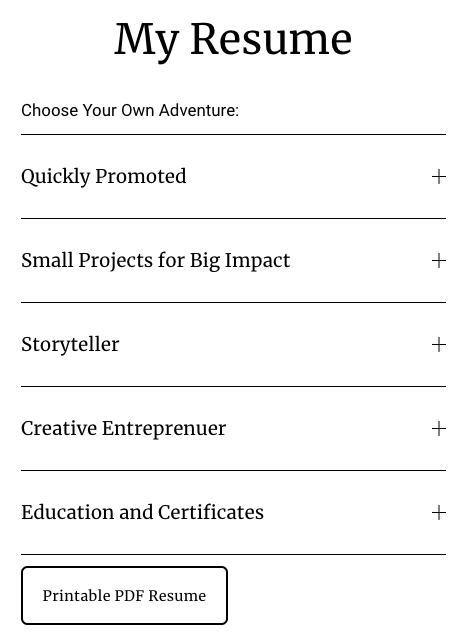
So I guess this is a no-brainer (that totally slipped my brain), but make sure hiring managers can find your portfolio and find your resume. My portfolio is on my resume, and my resume is on my portfolio…now.
You can see my current portfolio, including the updates discussed in this article, at ashleydrewes.com


