Updated Carbon Budgets Could Reset Our Global Warming Expectations
We’re still in big trouble, but we may be overestimating our worst-case scenarios for human-caused heating

I’ve argued that our climate/resource crisis is essentially an optimization problem. How do we make sure our fossil fuel binge doesn’t stop too soon, before we have built out an infrastructure to replace it, nor too late, leaving us with a planet too hot for human habitation? Recent work on the concept of carbon budgets provides new insights on when “too late” might be. It also raises the possibility that current IPCC models are overestimating how much heat our fossil fuel reserves are capable of producing.
How late is “too late” to quit fossil fuels?
One definition of “too late” might be this: If we allow warming to increase to a level that triggers an irreversible tipping point, we have waited too long to quit fossil fuels (source).
In a 2022 report that builds on tipping point research I summarized in a previous post, David McKay and an international team of climate scientists estimate the global heating thresholds at which various tipping points would become more likely than not. Here is a high-level summary of their estimates (derived from McKay et al. Table 1, Supplementary materials, Table S4):
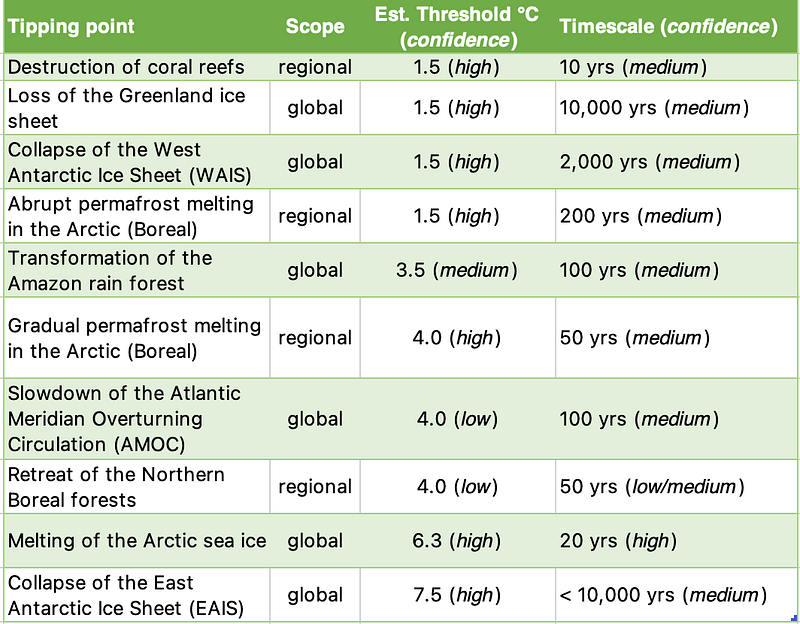
McKay and colleagues identify four tipping points likely to be breached if global temperatures rise to only 1.5°C above preindustrial levels, a level of warming that most climate scientists see as already “baked in” (source). However, with the exception of the destruction of low-latitude coral reefs, which are already suffering significant damage, the other three are likely to tip at timescales that would not intersect with our 21st Century efforts to transition away from fossil fuels.¹
The next temperature threshold McKay and team identify with a major tipping point is the loss of the Amazon rainforest at 3.5°C (likelihood range 2–6°C). This would indeed be a catastrophic development, as has been documented extensively (source, source, source). So here we have one good way to define “too late”: it’s too late to quit fossil fuels if we’ve already heated up the planet to a point where the Amazon rainforest is turning into a savannah. According to McKay et al., as well as many other climate scientists, that outcome could become likely if we let Global Mean Temperature (GMT) climb to 3–3.5°C above preindustrial levels.
Many other studies have recognized 3°C as an especially dangerous level of warming, even if irreversible tipping points are not triggered immediately (source, source, source). Examples of impacts scientists expect to see at 3–4°C warming are described in my “future of humanity” series and include heat waves reaching wet-bulb temperatures, droughts, floods, sea-level rise, food and water shortages, mass migrations, political violence, and other calamities (source). Such a litany of disasters could dramatically impact human populations, especially in tropical regions that are most vulnerable to the first and worst ravages of global warming.
So let’s draw a line in the sand and say 3°C of warming over preindustrial times is a threshold we want to avoid.
How close are we and how close can we risk getting?
To find a likely date at which a particular level of warming can be expected to occur, we need three pieces of information:
- a carbon budget indicating how much more carbon we can burn before risking that level of warming,
- a model of how aggressively we will act to decrease our reliance on fossil fuels, and
- based on (2), a rate at which CO2 will continue to be pumped into the atmosphere, measured either in gigatons of CO2 emitted over a period of time, or parts-per-million (ppm) of CO2 concentrated in the atmosphere at a point in time.
The carbon budget determines how much carbon we can afford to burn, the model tells us how we will plan to grow or shrink our emissions over time, and the rate tells us when that flow of emissions is likely to produce a given temperature increase.
A “remaining carbon budget” is a measure of how much CO2 the atmosphere can hold if the planet is to remain below a given GMT threshold. Climate scientists presented a major update of global carbon budgets in the IPCC Sixth Assessment (AR6) Working Group I (WGI) report published in 2021 (see Table 5.8, p. 753). A second update was completed in November 2022, incorporating updated models and newer estimation methods. Using these most recent updates, remaining carbon budgets as of January 2022 (units = gigatons of CO2 or GtCO2) are estimated as follows:
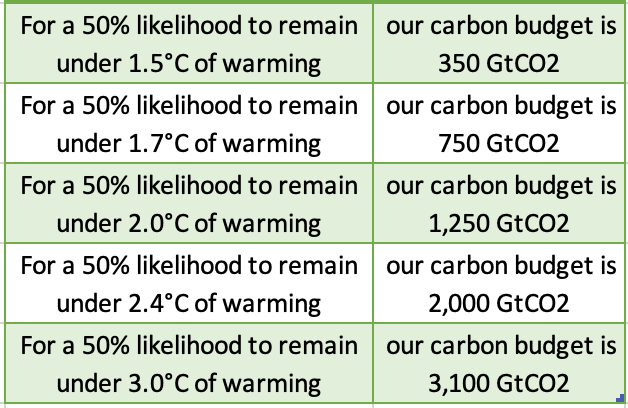
If you’re asking yourself, like I did, whether we should be betting the future of humanity on a coin flip, the scientists provide additional estimates, which of course require smaller carbon budgets to achieve higher likelihoods. For example, if you would prefer a 67% likelihood of staying below 1.5°C of warming, your carbon budget would shrink to 150 GtCO2. If you wanted even less uncertainty, say an 83% likelihood of staying below 1.5°C of warming, the IPCC scientists tell us your remaining carbon budget is negative, essentially meaning “you can’t get there from here”. Which is why most climate scientists believe keeping global warming under 1.5°C is no longer in our reach (source).
For context, humanity released about 2,455 (±275) GtCO2 into the atmosphere between 1750 and 2021 (source, p. 4837; note: 1 GtC = 3.67 GtCO2).
How much CO2 would be released if we burned all remaining fossil fuel reserves? According to a 2021 study by Welsby and colleagues (source), approximately 3,150 gigatons of CO2 remained in the ground as of 2018, embedded in known coal (2,250 GtCO2), oil (610 GtCO2), and natural gas (310 GtCO2) reserves. For a variety of well-documented reasons, we will never actually burn it all, but this number gives us an outer boundary for considering how much damage we are capable of inflicting if we are unable to end our addiction to fossil fuels before exhausting them.²
When combined with the carbon budget calculations shown above, we can find a temperature level likely to be reached with a carbon budget of 3,150 GtCO2.⁴ We see that releasing this amount of CO2 into the atmosphere would produce a 50% likelihood of reaching somewhere around 3.0°C of warming over preindustrial times. There’s also a 33% chance of that budget generating only 2.7°C of warming, and a 66% chance of it avoiding warming higher than 3.4°C over preindustrial times. These estimates provide an upper boundary for the amount of warming we might anticipate (on average, globally) if we manage to burn all fossil fuels to power our civilization. (This of course all depends on not breaching some tipping point that would push us into a climate apocalypse somewhere along the way.)
The key point here is that global warming directly attributable to fossil fuel emissions essentially stops when we stop adding greenhouse gases to the atmosphere; that is, when our CO2 emissions reach zero.³ This will only happen after we stop burning fossil fuels, either voluntarily, through policy decisions, or involuntarily, through exhaustion or abandonment of remaining reserves, which could potentially leave trillions of dollars of “stranded assets” in the ground, never to be recovered (source).
This leads us to one last question: How long will these remaining carbon budgets last under different assumptions about how the world will address climate change going forward? Climate scientists have addressed this question by generating simulation models that show how different scenarios might impact CO2 emissions and future global temperatures. These scenarios explore the effects of two kinds of policies that might be enacted to address climate change challenges: mitigation and adaptation.
Mitigation policies are designed to avoid or limit future warming by preventing or reducing GHG emissions; adaptation policies are designed to adjust how we live to minimize the damage caused by higher levels of warming. Mitigation is about fixing things, adaptation is about finding ways to live with things you can’t fix.
The latest round of models developed by the IPCC focus on five Shared Socioeconomic Pathways (SSPs) that represent five very different ways the world might confront climate change through the rest of this century. Each scenario implies a different mix of policies, different combinations of mitigation and adaptation, and different rates at which various carbon budget thresholds might be met or breached. The five scenarios are:
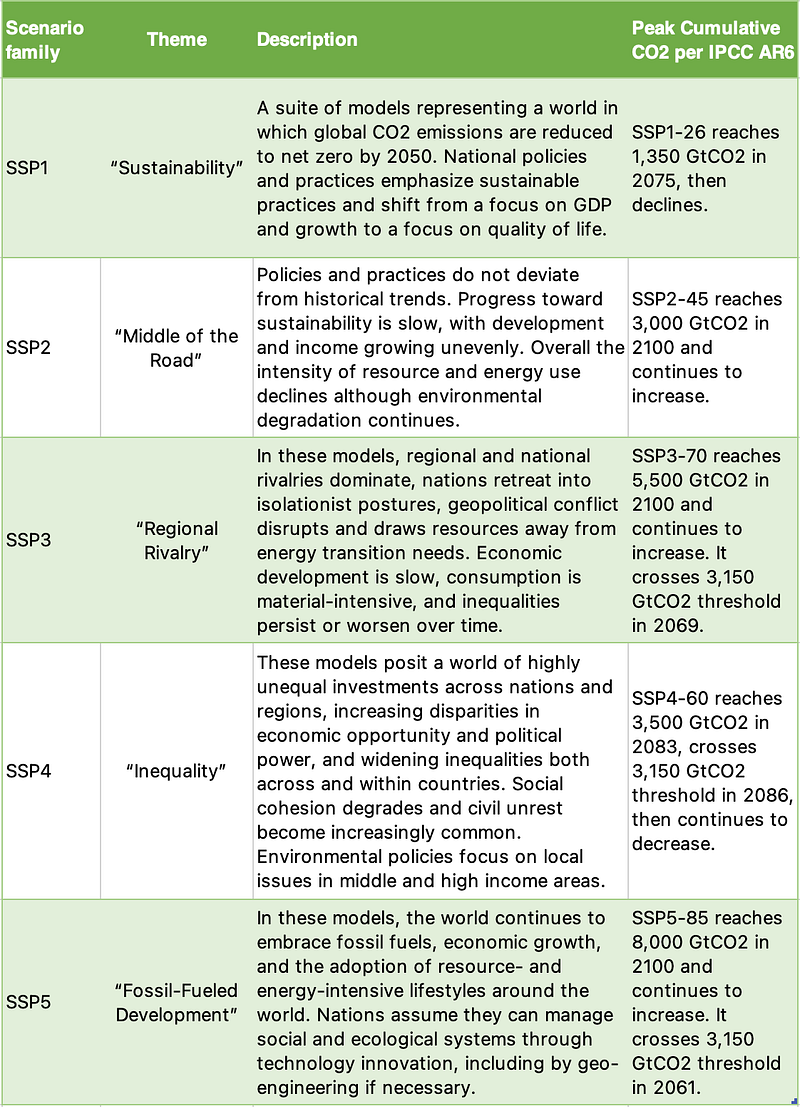
The graphic below visualizes how many cumulative gigatons of CO2 are projected to be emitted by each of these models between now and 2100. When we combine this data with the new fossil fuel reserve estimates, it becomes clear that the most dire scenarios are predicting temperature increases that would require emitting more CO2 into the atmosphere than currently exists in the ground.
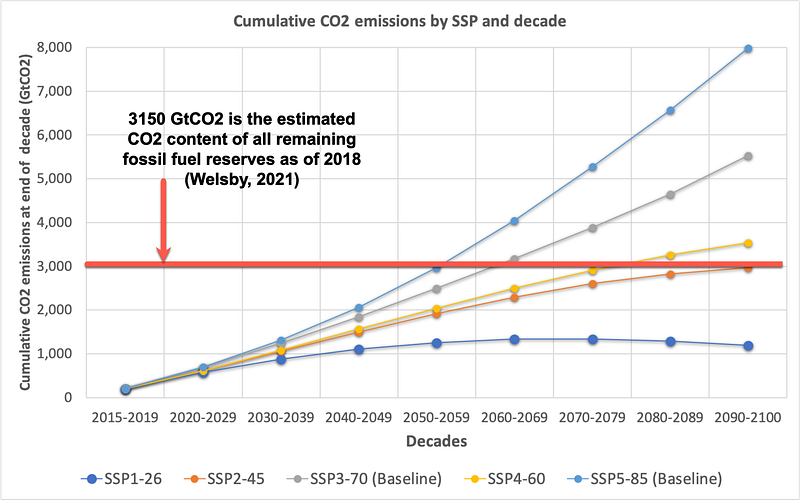
What is most interesting about this graph is the obvious observation that some of the IPCC’s climate models are projecting far more global warming than our remaining fossil fuel reserves could possibly produce. In particular, both SSP5 (“Fossil Fueled Development”) and SSP3 (“Regional Rivalry”) project CO2 emissions before the end of the century that would exhaust existing fossil fuel reserves two to three times over. Similarly, projections for both SSP2 (“Middle of the Road”) and SSP4 (“Inequality”) manage to burn all remaining fossil fuels by the end of the century (assuming this estimate of remaining reserves in in the ballpark of accurate). Clearly, these scenarios cannot play out as their current modeling indicates.
While our remaining carbon budgets are constrained by physical limits like actual remaining fossil fuel reserves, our policy decisions are constrained only by our ambition and our imagination. Scanning the narratives for the five SSP scenarios, the most likely path forward would appear to include major elements of both the SSP3 “Regional Rivalry” narrative and the SSP4 “Inequality” narrative. Indeed, these two paths seem closely connected. If the Global North invokes policies and practices that retreat into protectionism, resource hoarding, and competitive conflict, the current trends toward more, not less, inequality seems likely to accelerate. Fewer resources will be available to address climate-driven disruption in the Global South. As I’ve argued elsewhere, this could lead to catastrophic impacts on human population, and not just in the South.
Climate modeling is hard. Particularly challenging is bidirectionality, that is, making sure key variables — like population and fossil fuel reserves — are captured accurately as both inputs and outputs. The IPCC’s Shared Socioeconomic Pathways are useful tools in understanding how humanity might confront global warming. But they need to be brought into better conformance with what we know about the real physical limits of our energy options here on Planet Earth.
Notes
- This does not mean these tipping points are not potential catastrophic developments for human civilization, it simply means they are unlikely to reach their full potential and/or become irreversible before 2100. McKay et al. also identify one other tipping point that might be triggered at a relatively low temperature rise (1.8°C), the Labrador Sea convection system. This circulation system in the northern Atlantic is heavily influenced by Greenland ice melt and interacts with the greater Atlantic circulation system (AMOC). Although McKay estimates this system could tip within 10 years, its effect is actually expected to be negative, in the sense that it would contribute to global cooling rather than warming. McKay and team estimate a global impact of -0.46°C globally and regional impact in the northern Atlantic of -3.0°C. (see also source).
- The 2021 Welsby study updates an earlier study by McGlade and Ekins, which found similar overall levels of available reserves as of 2010: 1,294 billion barrels of oil (containing 616 GtCO2), 192 trillion cubic meters of natural gas (containing 384 GtCO2), 1,004 gigatons of coal (728 gigatons of hard coal plus 276 gigatons of lower grade “brown” coal) (containing 2,430 GtCO2). This adds up to 3,430 GtCO2 of fossil fuel reserves in 2010, a number quite compatible with Welsby’s estimate of 3,150 GtCO2 remaining in the ground eight years later. A very detailed 2022 study of global oil reserves by Laherrére et al. finds many exaggerations in oil industry estimates of remaining reserves, but concludes that remaining conventional oil reserves as of 2019 may only be around 1,100 billion barrels, containing roughly 470 GtCO2, even less than the Welsby and McGlade estimates. The main takeaway from all these estimates is that there is less CO2 in remaining fossil fuel reserves than many IPCC models assume.
- We are now aware of significant potential sources of additional CO2 emissions that are not directly attributable to burning fossil fuels. The most dangerous of these is probably the release of massive amounts of CO2 from the wildfires currently laying waste to the critical Northern Hemisphere boreal forests. A recent post by Richard Crim discusses this looming threat in detail.
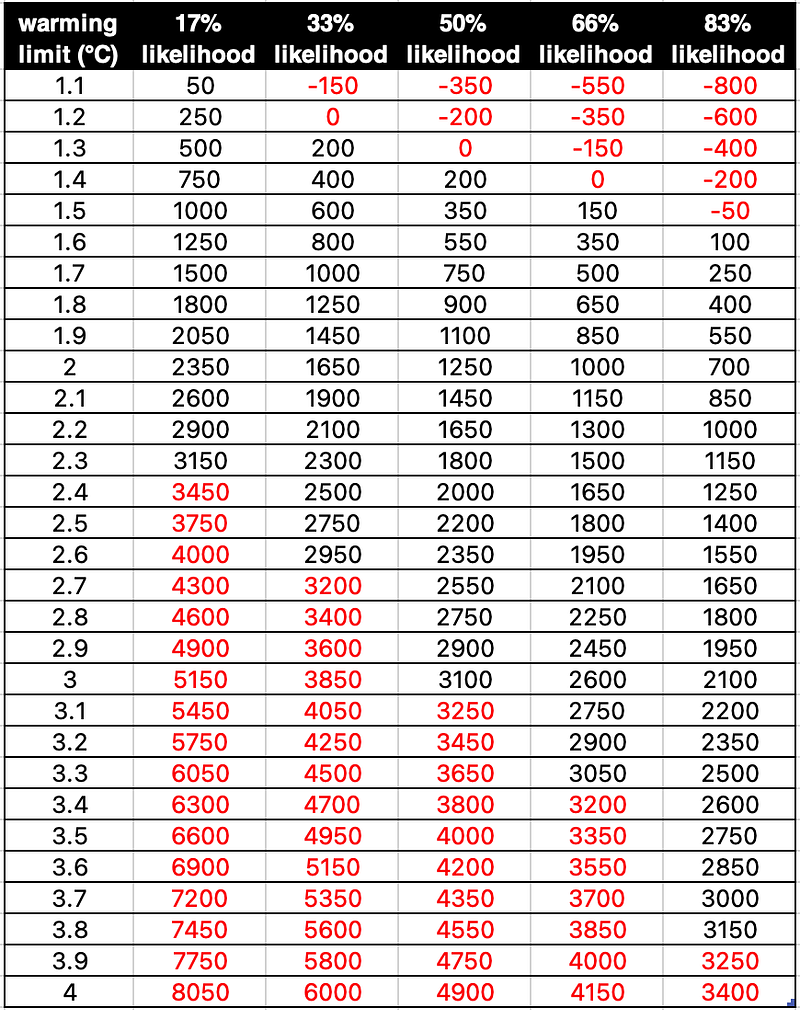
- A Python program for calculating remaining carbon budgets for different levels of warming, with different likelihoods, was recently made available here. Running this program, I was able to generate carbon budget estimates for warming up to 4.0°C. Here is the full table of results, assuming warming currently at 1.07°C, and following the authors’ practice of rounding all estimates to the nearest 50 GtCO2. “Unattainable” carbon budgets (above 3,150 GtCO2 or below zero) are shown in red: