The Greatest Documentary Ever Made
This documentary tracks the lives of 7-year old British children until they become 63
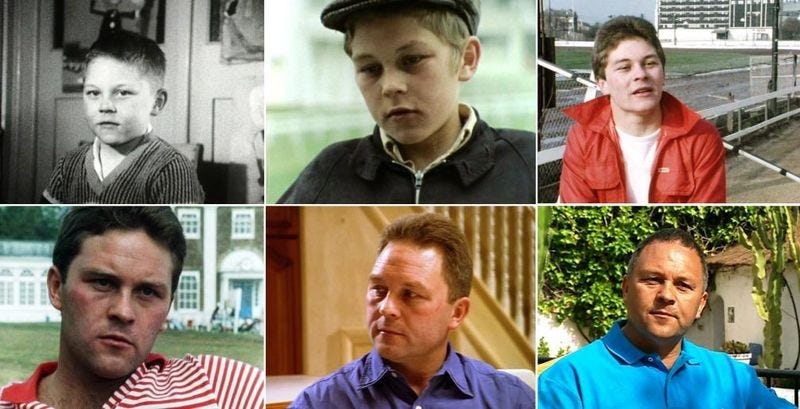
The Up series is one of the greatest documentary series ever made. It follows the lives of 14 British children since 1964 when they were 7 years old. The documentary re-visits them every 7 years when the subjects are 14, 21, 28 35, 42, 49, 56, and 63 years old.
The Up Documentary has 9 episodes in total and in total it spans 56 years in the lives of these individuals. You get a unique perspective into their lives, backgrounds, fears, dreams, and imagined vs. actual futures.
Roger Ebert has chosen the documentary (28 Up Episode) among the ten greatest films of all time.
Director Michael Apted revisited the same group every seven years. The subjects were interviewed as to the changes that have occurred in their lives during the last seven years.
One of the interesting features of the documentary is that the kids were chosen to represent a diverse range of socio-economic backgrounds in Britain at that time. The filmmakers assumed that the social class of each kid predetermined their future. Unfortunately, that turned out to be correct for most of the participants. The structural constraints society put over individuals were just as strong as an iron cage. Nevertheless, individuals were not without power. There were also big surprises in the documentary series that demonstrated evidence for individual agency, freedom, and creativity. The interplay between the structural and contextual dynamics and individual agency is very interesting to watch and learn about.
The documentary gives a snapshot of life in England over time. At the same time, it provides unparalleled insights into the different stages one goes through their lifetime. How is their personality manifested throughout different ages? How do they explain themselves, their desires, and their dreams at different junctions of their lives? How do they tell their stories?
Up Series is accepted as one of the most profound documentary series in the history of cinema. It is one of the longest-running documentary film series of all time — it spans across 56 years! The last episode was shown in 2019 and participants were 63 years old during this episode.
Director Apted thought that the series was too English to appeal to a wider audience, but this proved to be wrong. The documentary became a worldwide phenomenon. It was one of the deepest films ever made about human life and the human condition. Although the goal of the documentary was political, it ended up being very personal. In the words of Apted:
“People did respond to it, and not only here but all over the world. And then I had an epiphany: I realized for the first time, after 20 years on the project, that I really hadn’t made a political film at all. What I had seen as a significant statement about the English class system was in fact a humanistic document about the real issues of life.”
Here is what Roger Ebert wrote about Up series:
“No other film I have ever seen does a better job of illustrating the mysterious and haunting way in which the cinema bridges time. The movies themselves play with time, condensing days or years into minutes or hours. Then going to old movies defies time, because we see and hear people who are now dead, sounding and looking exactly the same. Then the movies toy with our personal time, when we revisit them, by recreating for us precisely the same experience we had before. Then look what Michael Apted does with time in this documentary, which he began more than 30 years ago. He made a movie called “7-Up” for British television. It was about a group of British 7-year-olds, their dreams, fears, ambitions, families, prospects. Fair enough. Then, seven years later, he made “14 Up,” revisiting them. Then came “21 Up” and, in 1985. “28 Up,” and next year, just in time for the Sight & Sound list, will come “35 Up.” And so the film will continue to grow… 42… 49… 56… 63… until Apted or his subjects are dead.
The miracle of the film is that it shows us that the seeds of the man are indeed in the child. In a sense, the destinies of all of these people can be guessed in their eyes, the first time we see them. Some do better than we expect, some worse, one seems completely bewildered. But the secret and mystery of human personality is there from the first. This ongoing film is an experiment unlike anything else in film history.
Watching “Up” series is a privilege. You learn and reflect a lot about the lives of these individuals as they grow up, get educated, get jobs, lose jobs, get married, get divorced, have children, and grow old. In the end, you travel in time and you feel a whole range of emotions about life.
Deborah Ross, from Sunday Mail, London wrote:
“The series, voted the greatest British documentary of all time is, in effect, a meditation on what it is to be alive.”
Reflection Exercise on Your Life Segments
In this exercise, you apply the life segments of this documentary to your own life.
The British Documentary “Up” was initiated in 1964 and interviewed children aged 7 about their lives and dreams. These children were tracked and interviewed again when they were 14, 21, 28, 35, 42, 49, 56, and 63.
You will now divide your life into 7-year segments and draw the phases based on these years.
1–7
8–14
15–21
22–28
29–35
36–42
43–49
50–56
57–63
64–70
71–77
78–84
85–91
92 -98
Please do the following for these segments above:
1. Draw the segments like a lifeline or a path.
2. Give a title to each segment.
3. What were the major life events or milestones during these years?
4. Think of places/cities/people significant during this segment.
5 Write down your major roles/jobs/projects and key institutions during this segment.
6. At what junction are you at currently?
7 . Where will you be heading next? Brainstorm possibilities and write down your dreams.
Write down or draw your segments on a few empty pages.
What did you learn from this documentary and from this exercise?
What are your reflections on your life? Where are you going with your life? What is next? What are your dreams, desires, and fears?
Can you make changes to your external conditions? How will you use your agency and creativity to rise over the conditions that surround you?
Write a letter to yourself addressing your responses to these questions and your reflections on what you have learned.


