
Unveiling the Mysteries of Hidden Layers in Artificial Neural Networks
Introduction
Artificial Neural Networks (ANNs) have revolutionized the field of machine learning and artificial intelligence. These networks are inspired by the human brain’s neural structure and consist of interconnected nodes, or artificial neurons, that process information. One of the key components of ANNs that plays a pivotal role in their success is the hidden layer. Hidden layers are the hidden gems within neural networks, responsible for transforming raw input data into meaningful output. In this essay, we will explore the significance of hidden layers in ANNs, their architecture, and their role in making ANNs such powerful tools for a wide range of applications.
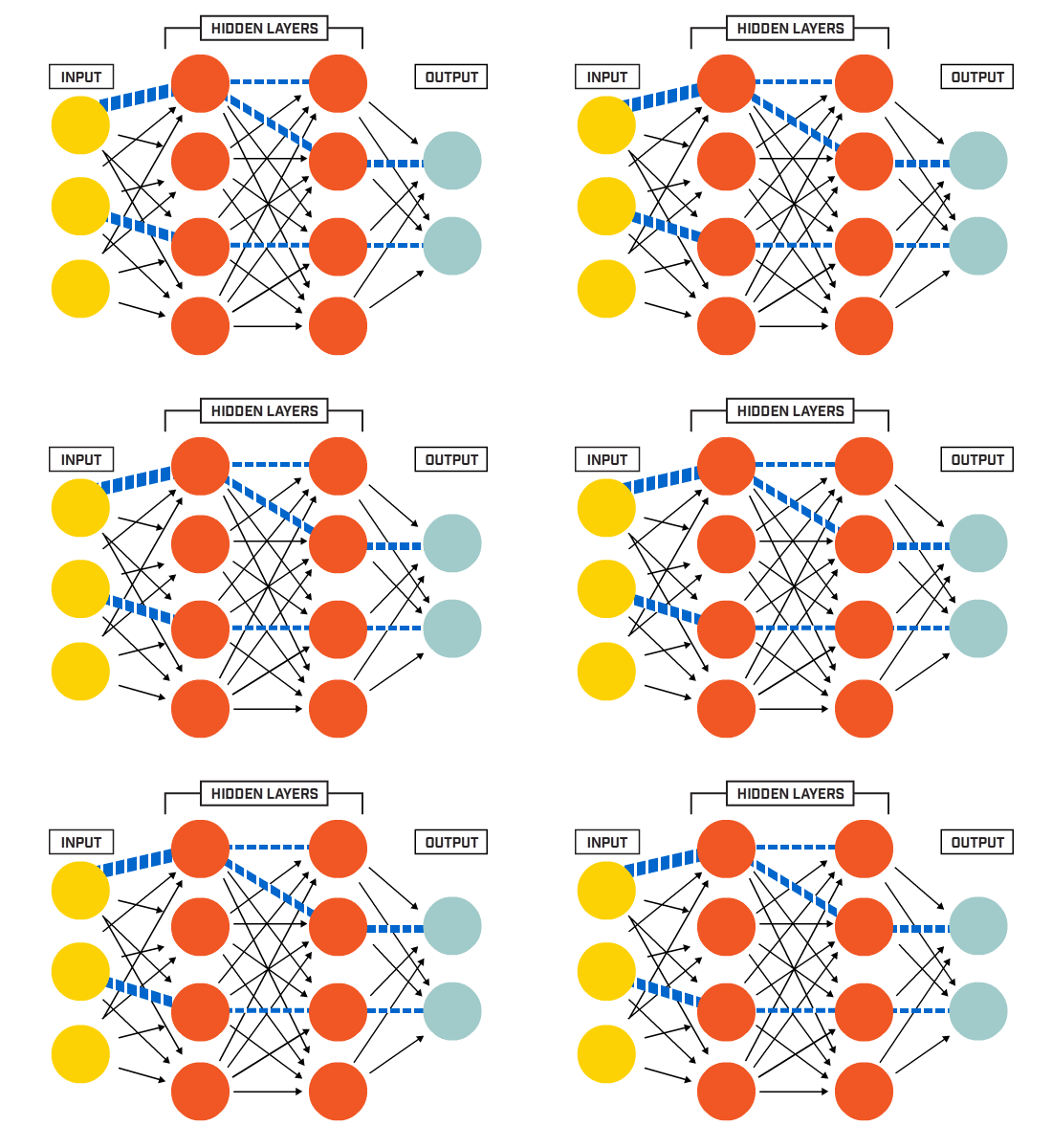
Exploring the depths of hidden layers, where neural networks whisper the secrets of understanding, we unveil the mysteries of intelligence within the machine.
The Anatomy of Hidden Layers
Hidden layers are intermediate layers within an artificial neural network, positioned between the input layer and the output layer. While the input layer receives data from external sources, and the output layer produces the final result, hidden layers perform the heavy lifting in terms of data transformation and feature extraction.
Each node in a hidden layer, often referred to as a neuron or unit, takes input from multiple neurons in the previous layer, processes this information through an activation function, and passes the result to neurons in the subsequent layer. The number of hidden layers and the number of neurons in each layer are known as hyperparameters and significantly impact the network’s performance.
The Power of Nonlinearity
One of the most critical aspects of hidden layers is the introduction of nonlinearity into the network. The activation functions applied to each neuron in a hidden layer enable ANNs to model complex, nonlinear relationships in data. Without hidden layers and nonlinear activation functions, ANNs would be limited to linear transformations, severely restricting their ability to solve complex problems.
Common activation functions used in hidden layers include the sigmoid function, hyperbolic tangent function (tanh), and rectified linear unit (ReLU). These functions introduce essential nonlinearities that allow ANNs to capture intricate patterns in data, making them capable of tasks such as image recognition, natural language processing, and even playing complex games like Go and chess.
Feature Extraction and Representation Learning
Hidden layers excel at feature extraction and representation learning. In many applications, raw input data is high-dimensional and contains noise and irrelevant information. Hidden layers play a vital role in learning relevant features from this input data and transforming it into a more meaningful and compact representation. This process reduces the dimensionality of the data, making it easier for subsequent layers to extract relevant information and make accurate predictions.
For example, in image recognition, the first hidden layers might learn to detect basic features like edges and corners, while deeper layers learn to recognize more complex shapes and patterns. In natural language processing, hidden layers can learn to represent words and phrases in a way that captures their semantic meaning, enabling the network to understand and generate human-like text.
Training and Optimization
Hidden layers are also crucial during the training phase of neural networks. During training, the network adjusts its internal parameters (weights and biases) using optimization algorithms like gradient descent. Hidden layers are responsible for propagating error signals backward through the network, allowing the network to update its parameters and improve its performance over time. The depth and architecture of hidden layers impact how effectively a neural network can learn from data.
Challenges and Considerations
While hidden layers offer immense power to ANNs, they also introduce challenges. Determining the optimal number of hidden layers and neurons, selecting suitable activation functions, and preventing overfitting are some of the challenges that researchers and practitioners face. Designing the architecture of hidden layers is often an empirical process that requires experimentation and fine-tuning.
Hyper Parametrization
Choosing the number of hidden layers and neurons in an artificial neural network (ANN) is a crucial step in designing an effective model. The optimal architecture depends on the specific problem you’re trying to solve, the nature of your data, and computational resources available. Here are some guidelines to help you make these decisions:
- Understand Your Problem: Begin by thoroughly understanding the problem you’re addressing. Consider the complexity of the task and the characteristics of your data. Simple tasks may require fewer layers and neurons, while complex tasks may benefit from deeper architectures.
- Start Simple: Simplicity often works best. Begin with a small network and progressively increase its complexity if necessary. You can add more layers and neurons as you assess the model’s performance.
- Use Existing Architectures as a Baseline: Look for existing architectures that have been successful in similar problems. For common tasks like image classification, architectures like Convolutional Neural Networks (CNNs) or pre-trained models like ResNet or VGG can serve as a good starting point.
- Rule of Thumb for Hidden Layers: For many tasks, a single hidden layer can be sufficient. For more complex tasks, you can experiment with adding additional hidden layers. A rule of thumb is to start with one hidden layer and then add more if the model isn’t learning effectively.
- Regularization Techniques: To prevent overfitting, you can use regularization techniques like dropout or L1/L2 regularization. These techniques can allow you to have larger networks without as much risk of overfitting.
- Cross-Validation: Use techniques like k-fold cross-validation to assess the model’s performance with different architectures. This helps you understand how changes in the architecture affect generalization to unseen data.
- Consider Computational Resources: The number of neurons and layers impacts the computational requirements of your model. Ensure that your hardware can handle the chosen architecture, or consider distributed computing if necessary.
- Domain Expertise and Experimentation: Sometimes, domain expertise plays a critical role in choosing the architecture. Experimentation and iterative refinement based on results are key. Don’t hesitate to try different architectures and see what works best for your specific problem.
- Use Frameworks and Libraries: Many machine learning frameworks and libraries, such as TensorFlow and PyTorch, offer high-level APIs and tools that can help you experiment with different architectures and hyperparameters efficiently.
- Regular Monitoring and Tuning: Continuously monitor the training and validation performance of your model. If you notice signs of overfitting or underfitting, adjust the architecture accordingly.
- Neurons in Hidden Layers: The number of neurons in a hidden layer can vary widely. There’s no one-size-fits-all answer, but some strategies include:
- Having a number of neurons equal to or less than the number of features in your input data.
- Using a number between the number of input and output neurons as a starting point.
- Experimenting with different numbers and assessing the model’s performance on a validation dataset.
In summary, choosing the number of hidden layers and neurons in an ANN is both a science and an art. It involves a combination of domain knowledge, experimentation, and iterative refinement. There is no one-size-fits-all answer, and the best architecture often emerges through a process of trial and error.
Code
Choosing the number of hidden layers and neurons in an artificial neural network often involves experimentation and hyperparameter tuning. In Python, you can use popular deep learning libraries like TensorFlow or PyTorch to create and train neural networks. Below is a code example using TensorFlow and Keras that demonstrates how to experiment with different architectures for finding an optimal configuration for your problem:
import tensorflow as tf
from tensorflow import keras
from tensorflow.keras import layers
from sklearn.model_selection import train_test_split
from sklearn.datasets import load_iris

# Load the Iris dataset (a classic dataset for classification)
iris = load_iris()
X_train = iris.data  # Features
y_train = iris.target  # Target variable

# Split your data into training and validation sets
X_train, X_val, y_train, y_val = train_test_split(X_train, y_train, test_size=0.2, random_state=42)

# Define a function to create and compile the neural network
def create_model(num_hidden_layers, num_neurons, input_dim):
    model = keras.Sequential()
    model.add(layers.Input(shape=(input_dim,)))

    # Add hidden layers based on the parameters
    for _ in range(num_hidden_layers):
        model.add(layers.Dense(num_neurons, activation='relu'))

    # Add the output layer (adjust the activation function and units for your problem)
    model.add(layers.Dense(1, activation='sigmoid'))

    # Compile the model (adjust the loss function and optimizer for your problem)
    model.compile(optimizer='adam', loss='binary_crossentropy', metrics=['accuracy'])

    return model

# Hyperparameters to experiment with
hidden_layers_list = [1, 2, 3]  # Number of hidden layers
neurons_list = [32, 64, 128]    # Number of neurons in each hidden layer

best_model = None
best_accuracy = 0.0

# Iterate through different combinations of hidden layers and neurons
for num_hidden_layers in hidden_layers_list:
    for num_neurons in neurons_list:
        # Create a new model with the current configuration
        model = create_model(num_hidden_layers, num_neurons, input_dim=X_train.shape[1])

        # Train the model on your training data
        model.fit(X_train, y_train, epochs=10, batch_size=32, validation_data=(X_val, y_val), verbose=0)

        # Evaluate the model on the validation set
        _, accuracy = model.evaluate(X_val, y_val, verbose=0)

        print(f"Hidden Layers: {num_hidden_layers}, Neurons per Layer: {num_neurons}, Validation Accuracy: {accuracy}")

        # Keep track of the best model configuration
        if accuracy > best_accuracy:
            best_accuracy = accuracy
            best_model = model

# Once you've found the best configuration, you can use it to make predictions on your test data
test_accuracy = best_model.evaluate(X_val, y_val)
print(f"Test Accuracy with Best Model: {test_accuracy[1]}")
In this code, we create a function create_model that allows you to specify the number of hidden layers and neurons in each layer. We then iterate through different combinations of these hyperparameters and train and evaluate models on a validation set. Finally, we select the best-performing model based on the validation accuracy and evaluate it on the test data.
Hidden Layers: 1, Neurons per Layer: 32, Validation Accuracy: 0.30000001192092896
Hidden Layers: 1, Neurons per Layer: 64, Validation Accuracy: 0.30000001192092896
Hidden Layers: 1, Neurons per Layer: 128, Validation Accuracy: 0.30000001192092896
Hidden Layers: 2, Neurons per Layer: 32, Validation Accuracy: 0.30000001192092896
Hidden Layers: 2, Neurons per Layer: 64, Validation Accuracy: 0.30000001192092896
Hidden Layers: 2, Neurons per Layer: 128, Validation Accuracy: 0.30000001192092896
Hidden Layers: 3, Neurons per Layer: 32, Validation Accuracy: 0.30000001192092896
Hidden Layers: 3, Neurons per Layer: 64, Validation Accuracy: 0.36666667461395264
Hidden Layers: 3, Neurons per Layer: 128, Validation Accuracy: 0.30000001192092896
1/1 [==============================] - 0s 23ms/step - loss: -4.2934 - accuracy: 0.3667
Test Accuracy with Best Model: 0.36666667461395264
Make sure to adapt this code to your specific dataset and problem by loading and preprocessing your data and adjusting the model architecture, loss function, and optimizer accordingly. Experiment with different hyperparameter values to find the architecture that works best for your problem.
Conclusion
Hidden layers are the heart and soul of artificial neural networks, enabling them to model complex relationships, perform feature extraction, and excel in various machine learning tasks. Their introduction of nonlinearity, feature learning capabilities, and role in training make them indispensable in the world of deep learning. As technology advances and our understanding of neural networks deepens, hidden layers will continue to play a pivotal role in pushing the boundaries of what artificial intelligence can achieve in fields ranging from healthcare to autonomous driving.
A Message from AI Mind

Thanks for being a part of our community! Before you go:
- 👏 Clap for the story and follow the author 👉
- 📰 View more content in the AI Mind Publication
- 🧠 Improve your AI prompts effortlessly and FREE
- 🧰 Discover Intuitive AI Tools


