
Unveiling OpenAI’s Best-Kept Secret: The Architecture of GPT-4

While the title of this article might come across as clickbait, there’s substantial evidence suggesting that the true performance of GPT-4 and what really sets it apart from its competitors lies in the very details I’m about to delve into.
The Evolution of OpenAI
2023 has been a pivotal year for text-generative AI, and at the heart of this revolution stands OpenAI. This organization has emerged as a leading figure in the AI landscape, but it carries an intriguing paradox. Despite its name, OpenAI has gradually moved away from the open-source ethos that was once a cornerstone of the deep learning community.
OpenAI’s journey began with a commitment to open collaboration and knowledge sharing, which was evident in its early days. The company was vocal about democratizing AI and making powerful tools accessible to all. This philosophy resonated with many in the academic and research communities, who have long relied on the open exchange of scientific papers and detailed methodologies to advance collective knowledge.
However, as OpenAI’s technologies like ChatGPT and DALL-E gained unprecedented popularity, the company’s approach began to shift. The irony of the ‘open’ in OpenAI became more pronounced. The firm started prioritizing the protection of its intellectual property, partly driven by the need to sustain its innovative edge in a highly competitive field.
This shift manifested in several ways. OpenAI’s once regular scientific publications gave way to more guarded technical reports. These reports, while extensive, often lacked the depth and transparency that academia values. OpenAI’s focus turned towards product development, and the scientific principle of reproducibility, a cornerstone of academic research, seemed to take a backseat.
The result of this transition is a more closed ecosystem, where the intricate details of models like GPT-4 remain under wraps. While this approach has undoubtedly helped OpenAI maintain a competitive advantage, it has also raised questions about the future of open collaboration in AI development. As we look back on 2023, it’s clear that OpenAI has not only shaped the trajectory of AI technology but also sparked a conversation about the balance between open science and proprietary innovation in the field of deep learning.
The Impact of ChatGPT and DALL-E
Two of OpenAI’s creations, ChatGPT and DALL-E, have been instrumental in catapulting the popularity of artificial intelligence to new heights. These technologies have not only showcased the profound capabilities of AI but have also altered the public’s perception of what AI can achieve.
ChatGPT, in particular, has emerged as a prominent figure in the landscape of generative text AI. Its ability to engage in coherent and contextually relevant conversations has amazed both the tech industry and the general public. This advancement in language models, epitomized by ChatGPT, has marked 2023 as the year of text-generative AI, underscoring the significance of large language models in our daily digital interactions.
DALL-E, on the other hand, has revolutionized the field of visual arts through its generative capabilities. By creating complex and intricate images from textual descriptions, DALL-E has opened up new avenues for creativity and has demonstrated the diverse potential of AI beyond text generation.
The rise of these technologies, however, has come with a paradigm shift within OpenAI. The company’s focus has increasingly leaned towards product development and the commercialization of its technologies. This change has been accompanied by a move away from the academic and open-source principles that were foundational to the company’s initial ethos. As OpenAI’s technologies have grown in sophistication and popularity, the company has become more protective of its intellectual property. This strategic shift is evident in their approach to sharing information about their latest models and advancements.
The transition from open scientific communication to a more guarded stance has significant implications. It represents a broader trend in the AI industry, where major players are becoming more secretive about their advancements. This shift raises questions about the balance between open scientific collaboration and the need to protect commercial interests in the rapidly evolving world of AI.
The Mystery of GPT-4’s Architecture
The intrigue surrounding OpenAI’s GPT-4 model has become a central topic in the AI community. As 2023 unfolds, a noticeable shift from the previous era of transparency in AI development is evident, with OpenAI adopting a more reserved stance regarding its groundbreaking model, GPT-4. Despite widespread interest and anticipation, the specifics of GPT-4’s architecture largely remain a mystery, marking a stark divergence from the earlier ethos of open sharing and collaboration.

In March, OpenAI released a technical report providing some insights into GPT-4, confirming its identity as a generative pre-trained transformer model. However, this revelation barely skims the surface of the in-depth knowledge eagerly sought by industry experts and academics. The report, despite its length of over a hundred pages, offers scant detail, fueling speculation about the intricacies of this advanced AI model.
Details about the scale of GPT-4 have emerged through various industry leaks and discussions. George Hotz, a notable figure in the tech community, shed light on the model’s structure in a July podcast. He revealed GPT-4’s impressive parameter count and its utilization of a mixture model architecture. Nevertheless, these insights come without official endorsement from OpenAI, placing them in the realm of educated conjecture and industry speculation.
The paucity of comprehensive information on GPT-4 has led to a heightened sense of uncertainty and curiosity regarding its operational mechanics. This opacity contrasts sharply with the past norm in AI research, where academic reproducibility and openness were paramount. OpenAI’s current approach underscores a significant pivot in the manner AI advancements are disseminated and debated within the wider community.
This limited disclosure about GPT-4 epitomizes a broader trend in the AI industry, wherein major entities are increasingly guarding their technological innovations. This evolution towards prioritizing industrial secrets over academic openness raises pivotal questions about the future trajectory of AI research. It highlights a growing tension between collaboration and competition in the quest for AI innovation, prompting a reevaluation of the balance between proprietary interests and the collective advancement of knowledge in the field.
The Dilemma of Large Language Models (LLMs)
2023 has witnessed the continuation and intensification of a trend that is reshaping the landscape of AI: the development of Large Language Models (LLMs). These models, epitomized by OpenAI’s series of GPT (Generative Pre-trained Transformer) models, have been at the forefront of the AI revolution. However, the race to build ever-larger models has brought with it a set of challenges and compromises that are worth exploring.
The allure of LLMs is based on a seemingly straightforward premise: larger models with more parameters tend to perform better. This idea has been a driving force behind the evolution of models from GPT-2 to GPT-3, and presumably to GPT-4. The logic is that with more data and more computational power, these models can capture a broader range of human language nuances and produce more accurate, contextually relevant outputs.
However, this approach reaches a point of diminishing returns. The cost of training and running these massive models escalates, not just in monetary terms but also in terms of computational resources and energy consumption. For instance, a larger model demands more processing power and, consequently, more energy, which raises environmental concerns. Moreover, the increased complexity of these models can lead to inefficiencies in certain types of tasks.
OpenAI’s GPT-4, as per speculation, is an embodiment of this dilemma. While details about its architecture are scarce, it is believed to be significantly larger than its predecessors, possibly housing trillions of parameters. This expansion, while potentially enabling more sophisticated responses, also implies greater demands in terms of computational resources.
Furthermore, the effectiveness of merely scaling up models has been called into question. The assumption that bigger is always better does not necessarily hold true, especially as models reach a scale where managing and optimizing them becomes increasingly challenging. It’s a complex balancing act between size, efficiency, and utility.
The challenges associated with LLMs also extend to their application. As these models grow in size, so does their carbon footprint, raising ethical and environmental concerns. Additionally, the cost associated with training and deploying such models can limit their accessibility, potentially leading to a concentration of power and capability in the hands of a few well-resourced entities, like OpenAI.
The Era of Mixture of Experts (MoE) Models in GPT-4
The AI community has seen a significant shift towards the implementation of Mixture of Experts (MoE) models, a concept particularly pertinent to the architecture of OpenAI’s GPT-4. This shift represents a crucial evolution in the design of large language models (LLMs), addressing some of the inherent limitations and inefficiencies of previous architectures.
Understanding the MoE Concept
The MoE architecture introduces a paradigm shift in how neural networks are structured and operated. Traditionally, models like GPT-3 were dense, meaning every part of the neural network was engaged in processing each piece of information. While effective, this approach was computationally intensive and less efficient, especially as the model size grew.

MoE models, however, adopt a different strategy. Instead of using a single, dense network, MoE divides the model into several sub-models or ‘experts’, each specialized in different tasks or aspects of data processing. This structure allows for more targeted and efficient computation, as only the relevant experts are activated based on the input’s nature.
GPT-4’s Implementation of MoE
Although OpenAI has not officially confirmed the specifics, there’s credible speculation that GPT-4 utilizes an MoE architecture. This hypothesis is supported by various industry leaks and analyses, suggesting that GPT-4 might be a significant departure from the dense model architecture of its predecessors.
If GPT-4 is indeed based on an MoE framework, it could be a game-changer in terms of efficiency and capability. The model is speculated to have a vast number of parameters, possibly in the trillions, distributed across multiple expert modules. Each module, with its specialized focus, could handle specific types of tasks more effectively than a dense model of comparable size.
This structure would not only enhance the model’s overall performance but also make it more resource-efficient. By activating only relevant parts of the network for specific tasks, GPT-4 could potentially deliver high-level AI performance with reduced computational overhead.
Implications of MoE in AI Development
The adoption of MoE models like GPT-4 marks a significant milestone in AI development. It addresses the dilemma of scaling up AI models — balancing the need for more extensive, more capable systems with the practical limitations of computational resources and efficiency.
Moreover, MoE models open new avenues for AI research and application. They offer a way to build more sophisticated and versatile AI systems that can adapt more dynamically to a wide range of tasks. This flexibility is crucial as AI continues to permeate diverse sectors and applications.
OpenAI’s Dominance and the Response from the Open Source Community
As OpenAI’s models like GPT-4 continued to push the boundaries of what’s possible with AI, there emerged a parallel narrative in the realm of open-source AI development. OpenAI, with its guarded approach towards GPT-4, inadvertently set the stage for a counter-movement. This movement is rooted in the principles of openness and collective advancement that once defined OpenAI’s ethos.
The Rise of Open Source AI Models
2023 has witnessed an unprecedented surge in open-source AI projects, driven by a community committed to maintaining the spirit of shared knowledge and innovation. This year, numerous organizations and independent developers have thrown their hats into the ring, introducing models that not only challenge the status quo but also offer viable alternatives to proprietary giants like GPT-4.
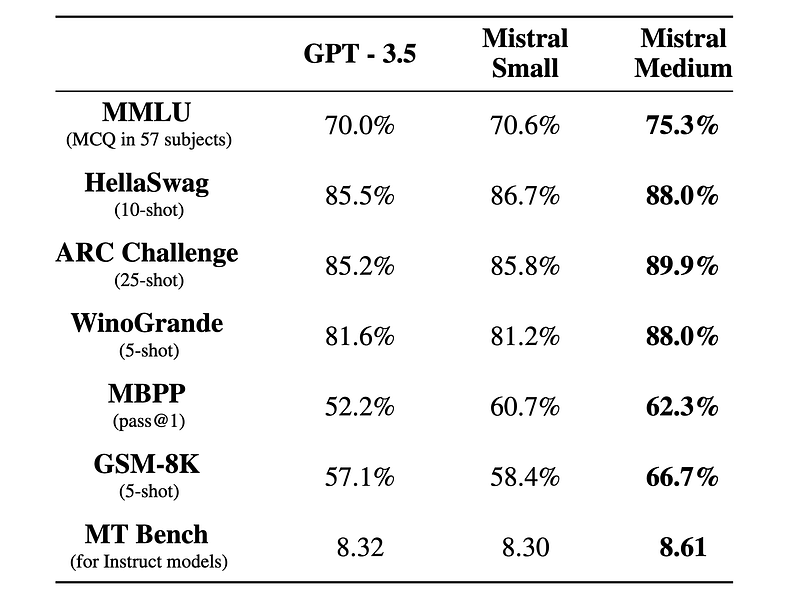
One notable example is the French company Mistral AI, which has been at the forefront of this open-source revolution. Their recent introduction of new open-source models has been a testament to the increasing capability and sophistication achievable outside the proprietary domain.
Mistral AI’s Contribution: Bridging the Gap
Mistral AI’s latest offering is a clear indicator of the open-source community’s potential to keep pace with, and in some cases, outperform proprietary models. The unique aspect of their model lies in its architecture and efficiency. Despite having a substantial number of parameters, their model is designed to operate with the speed and efficiency of a much smaller model.
The MoE Architecture in Open Source Models
Mirroring the speculated approach of GPT-4, Mistral AI’s model also employs a Mixture of Experts (MoE) architecture. This architecture allows for a more efficient utilization of computational resources by activating only the relevant parts of the model for specific tasks. It’s a strategic response to the challenges posed by the massive computational requirements of large-scale models like GPT-4.
The MoE approach in open-source models like Mistral AI’s represents a significant stride in AI development. It’s not just about keeping up with the likes of GPT-4 but also about innovating in ways that make AI more accessible and sustainable.
The Future Trajectory of Open Source AI
The developments in 2023 have set the stage for an intriguing future for AI. The open-source community’s response to proprietary models like GPT-4 is not just a competition for technological superiority. It’s a movement towards a more inclusive, collaborative, and transparent AI landscape.
As we look forward to 2024, the dynamics between proprietary models and open-source initiatives will likely shape the direction of AI development. This interplay between the two domains is not just a technological rivalry but a narrative about the ethos of AI development, where the principles of openness, collaboration, and accessibility play a central role. The open-source community’s efforts in 2023 have proven that the spirit of shared innovation is still very much alive and could be a defining feature of AI’s future trajectory.
The Evolution and Future of Generative AI
A Transformative Year in AI The year 2023 has emerged as a pivotal moment in the history of generative artificial intelligence. OpenAI, with ChatGPT and DALL-E, has not only exceeded expectations but also redefined the boundaries of what’s possible. This year will be remembered as the time when AI shifted from being a futuristic promise to an essential reality in our daily lives. The astonishing evolution of these technologies has marked a before and after, opening a window to a future where AI is omnipresent and increasingly integrated into our social and professional fabric.
Perspectives and Possibilities As we step into 2024, the prospects for generative AI are as exciting as they are challenging. The growing capabilities of models like GPT-4 and innovations in the open-source sector forecast a future where AI is not only more advanced and efficient but also more accessible and democratic. The open-source community, with its recent efforts, promises a path towards more collaborative and transparent AI, challenging the dominance of tech giants and opening new possibilities for innovation and creativity.

Join the AI Revolution This is a critical moment in the history of AI, and you can be a part of it. I invite you to reflect on the impact of these technologies in your life and society. Engage in the conversation, whether as a user, developer, academic, or simply as an interested citizen. Experiment with the available tools, contribute to open-source projects, or simply stay informed and critical about AI development and ethics. Together, we can ensure that the future of artificial intelligence is bright, inclusive, and beneficial for all.


