
Business and Entrepreneurship
Unusual Challenges Leading to Successes in Print-on-Demand Services
How to start and maintain your new venture with minimal financial investment

As an IT professional with 25 years of experience, I always look out for related businesses and leverage the doable ones as side hustles. One such opportunity was Print-on-Demand services. I’ve come across countless pieces of information about it. The topic piqued my interest when reviewing success stories. I watched many videos and read many articles to get informed.
Grandview Research states, “The global print-on-demand market size was valued at USD 6.18 billion in 2022 and is expected to grow at a compound annual growth rate (CAGR) of 25.8% from 2023 to 2030.” This research increased my confidence to grow my business and scale it as an entrepreneur.
I delved deeper into the topic and started pondering the idea of trying out this business opportunity myself with minimal risk. After months of planning and diligent work, I gained a more realistic view of this business opportunity, which I aim to present in this story.
Despite initial setbacks, I recognized the potential for success given my background in IT and familiarity with text-to-image AI applications. Despite low risk, the journey proved to be more complex than expected.
As this is a business opportunity, I structured my experience in different phases to provide an objective view of this increasingly popular side hustle and offer guidance based on my experiences. I am still not an expert, but what I have learned so far might be helpful to beginners.
Why did I decide to dive into this business?
While I’m not a designer or artist, as an experienced IT professional and enthusiast user of text-to-image AI applications, I saw potential and opportunity in this venture.
First, the low risk, simplicity of the process, and allure of starting a business without capital tempted me to invest time and energy in this completely new venture.
Moreover, it’s hard to ignore the appealing profitability of this modern business form, and I find myself naturally drawn to its potential. Although earning additional income is my goal, gaining a new skill for my personal and professional development is also important.
What is a Print-on-Demand Service?
There is an incredible amount of information available about the Print-on-Demand business opportunity. But what exactly does this online venture entail?
Print on Demand (POD) is an e-commerce model where you partner with a print provider to customize white-label products and sell them under your own brand on a pre-order basis.
Products are only printed upon receiving orders, eliminating the need for inventory. Yet, it’s not as simple as it sounds.
Choosing the right platform is crucial. It should align with your goals and offer the best combination of cost-effectiveness, product variety, and user-friendly interfaces.
There are various online sales channels for POD products. Let me summarize them for you.
- Artist marketplaces like Redbubble, Amazon Merch on Demand, and Teepublic make starting easy. You create an account and upload your designs, and the platform handles transactions and customer service. You earn a commission or royalty for each sale.
- Independent seller marketplaces such as Etsy and eBay provide more control over branding and product selection. However, they require handling order fulfillment and customer service, and there may be monthly or transaction fees.
- Selling through your own site. Using platforms like Shopify offers the most control but requires building your customer base and incurs expenses.
Technological Background
In recent times, the use of artificial intelligence (AI) and the applications built upon it have seen explosive growth. Surely, by now, everyone has either used or at least heard of chatbots.
The chatbots use natural language processing to create humanlike conversational dialogue. The language model can respond to questions and compose various written content.
Of course, many other large language models (LLMs) exist, and their basic operational mechanisms are similar. These models can be applied not only to written communication but also to many other areas.
The most popular chatbots responds to text input with text output by default. However, there are many other input and output combinations that are possible. For example, in text-to-image applications, artificial intelligence generates an image based on input parameters.
Educational Phase: Learning the core tools
Before diving into self-learning to acquire the skills necessary to launch and operate a Print-on-Demand service, I set a condition to only use freely available services and online tools.
Accordingly, the first essential skill I needed was familiarity with artificial intelligence-based image generator applications.
Since I could only choose from free AI-based text-to-image applications, my choice fell on Leonardo.ai, which I recommend to every beginner. Plenty of tutorial videos are available on YouTube for this freely available online tool.
Unfortunately, it’s impossible to immediately upload an image generated by artificial intelligence to any Print-on-Demand service provider’s website. More tools are needed to ensure that the design to be sold meets the appropriate size, shape, and appearance.
Since the tools I use for free, such as image resizers, background removers, vectorizers, etc., often transition into paid services, I won’t list the specific tools I use.
I want to emphasize that these tools are also necessary during the virtual product manufacturing process.
Initial Business Steps into the World of Print-on-Demand
After careful consideration, I decided to start with artist marketplace platforms due to their simplicity and quick market entry.
It’s important to emphasize that I intended to pursue this side hustle without investment and using free software only!
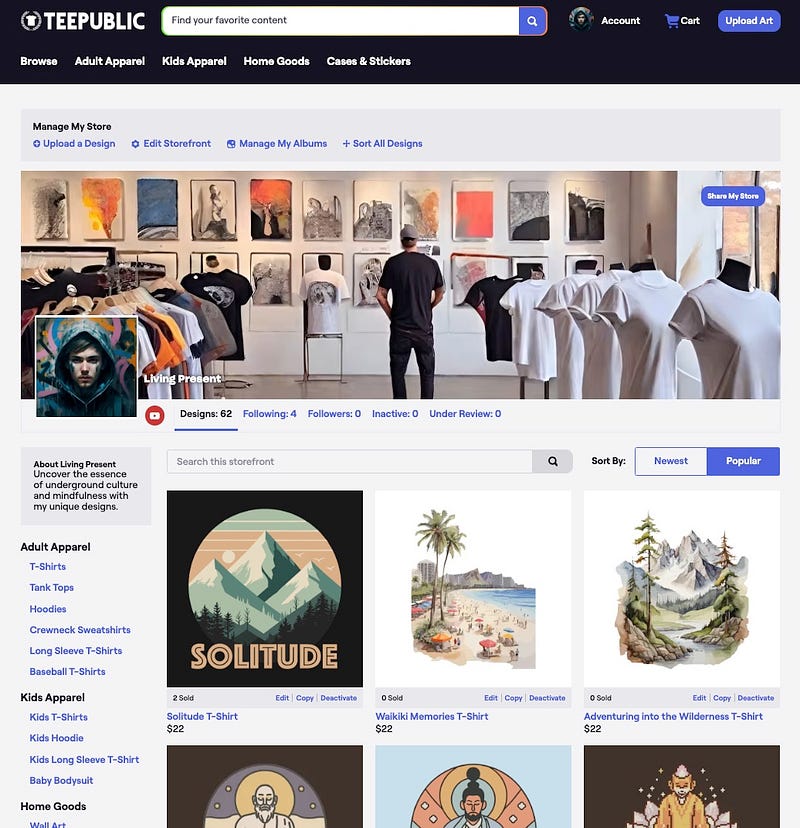
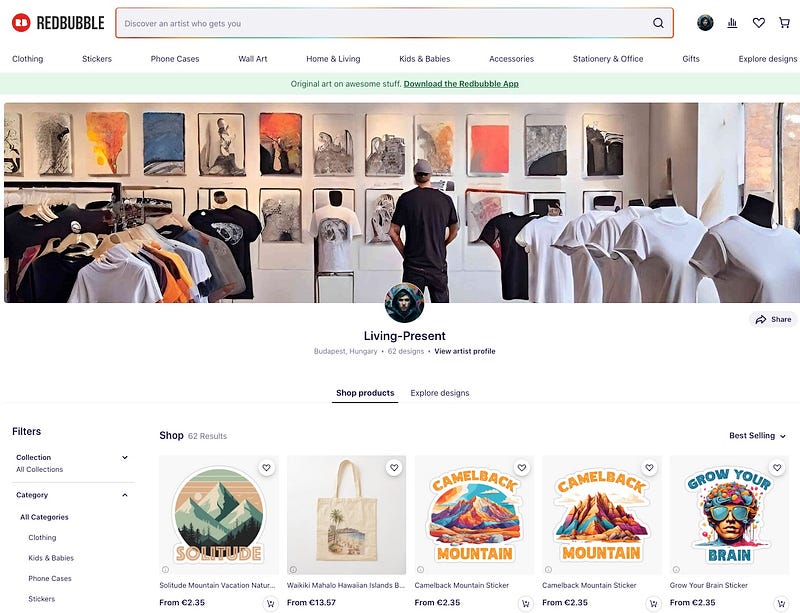
So, I created my online store on Teepublic and Redbubble, the most popular platforms. Registration was straightforward.
To set up my virtual store, I consulted the following YouTube tutorials:
TeePublic Beginner Tutorial | Everything You Need To Know about this Print-on-Demand Website
How To Create A Redbubble Account For Beginners — Make Money Online With Redbubble
The third option, Merch by Amazon, rejected my application twice. It was disappointing, considering its popularity and potential for sales.
Gaining Product and Sales Experience
Once platform settings were in place, the next step was creating designs for marketing. This seemed straightforward.
Due to a lack of thorough research, I decided to generate graphics related to my interests and hobbies using AI applications.
While designing and uploading vegan and meditation-themed graphics, I noticed no sales or significant traffic to my products after a month.
The lack of sales was evident despite setting relevant keywords, which ensured product visibility.
Both platforms allow linking with Google Analytics, providing clear statistics on store traffic.
Thus, I had to rethink my strategy and reassess the entire business.
So, I continued exploring.
Refinement and Results
I delved into further useful and freely available resources.
I recommend the following two articles by Michel Essek, which are accessible on his website.
Further insights provided by two print-on-demand specialized YouTubers, Philip Anders, and Detour Shirts, were invaluable in this regard.
I extend my gratitude to them for their dedicated work, which serves as a source of income for them.
Alongside existing settings, tips, and tricks, I had to use new fundamental principles:
1. Create and market evergreen products that sell well throughout the year.
2. Develop products that are currently trending and less available.
It’s crucial not to copy ideas outright but rather create similar or variant products.
With these new guidelines, I began creating and uploading new products to both platforms. At this point, I had nearly 50 designs available on each sales channel.
To my surprise, I soon received my first email notification of a successful sale. While I was delighted with this outcome, the subsequent sales were modest.
The sales of $20 over three months were not as impressive as the miraculous incomes advertised on YouTube videos.
Marketing Activities
Unsatisfied with the results, I explored various marketing opportunities while adhering to my no-investment, free fundamentals.
So, I found two options for advertising individual products on Pinterest and Instagram.
I created images for 40 products using online mockup generators and uploaded them to Pinterest. While the number of visitors increased compared to before, it didn’t result in additional sales immediately.
Financial Realities: Cost, Profit, and Revenue Flow
In delving into the Print-on-Demand (POD) landscape, it’s critical to consider the financial dimensions of such a venture.
The low initial investment and potential profitability are appealing, but balancing cost and profit is crucial for sustainable growth.
My journey into POD began with cautious optimism. As I made progress, I faced the shocking truth of modest initial sales and the need to tweak my strategy to achieve profitability.
Balancing the costs of tools, platform fees, and marketing efforts against revenue streams became a delicate task.
Despite the promise of lucrative returns, it is crucial to have prudent financial management. As well as a realistic understanding of profit margins to ensure long-term viability.
Conclusions and Takeaways
Starting a print-on-demand venture without financial investment presents both opportunities and challenges.
While the allure of potential earnings and the promise of a straightforward path to success may entice newcomers, the reality demands a cautious approach.
My exploration began with skepticism toward overly optimistic reports of print-on-demand profitability.
Despite initial setbacks, I recognized the potential for success given my background in IT and familiarity with text-to-image AI applications. But, the journey proved to be more complex than expected.
Creating designs and uploading products proved to be the first step in a challenging process.
Initial sales remained modest despite efforts to leverage free resources and marketing possibilities. The difference between expectation and reality prompted introspection and evaluation.
Perseverance is often praised as the key to success in navigating the print-on-demand landscape. Yet, it’s essential to temper optimism with realism and assess the feasibility of continued investment.
Balancing time and resources against outcomes is critical for maintaining motivation and avoiding disillusionment.
While my journey may have led to disappointment, it might be a valuable learning experience for others considering similar ventures.
Transparency about challenges and realistic expectations can better prepare individuals for the realities of print-on-demand entrepreneurship.
Thank you for accompanying me on this journey and considering the lessons shared.
I encourage anyone, whether new to the subject or more experienced in print-on-demand ventures than I am, to share their thoughts or advice.
Thank you for taking the time to read my story.
If you’ve enjoyed this article and are curious about my other startup and entrepreneurship stories, I suggest reading the following ones.
25 Years of Entrepreneurial Adventure in Information Technology Business
Lessons From the Frontline: Managing an International, Three-Year IT Integration Project
Hello, I’m Jozsef Kovacs. I’m writing about leadership, project management, and travel. Click here if you would like to be notified when I publish.


