
Unschooling with Kmart Resources: Maximising Learning Potential with Affordable Materials
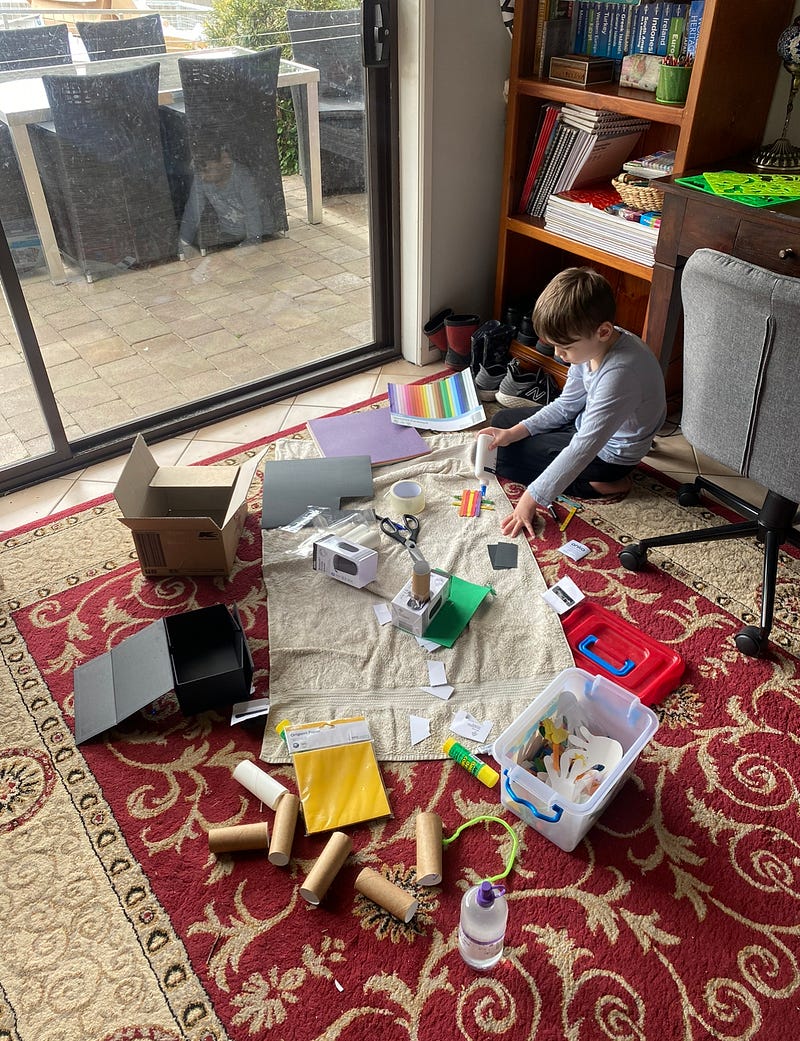
When I first began our unschooling adventure with my children, I faced the common misconception that quality learning resources come with a hefty price tag.
However, I soon discovered that everyday items, especially from affordable stores like Kmart, can be invaluable assets in our unschooling environment.
Unconventional Yet Effective Tools
It’s easy to underestimate the potential of basic stationery. At a glance, one might only see their conventional uses: pencils for sketching, markers for highlighting, and so on.
But when you’re on an unschooling path, the potential of these tools expands exponentially. Kmart’s selection of such materials has proven invaluable in our home, constantly surprising us with their multifaceted uses.
One of the most notable moments of creative inspiration was when my son looked at a pack of pencils and saw beyond their basic function. To him, they weren’t just tools for writing or drawing; they became the foundation for his makeshift abacus.
With a handful of pencils and some elastic bands, he constructed a counting device that not only served its mathematical purpose but also honed his problem-solving and engineering skills.
This simple project reinforced the idea that learning can be both tactile and visual, transcending the limitations of traditional textbook methods.
And it wasn’t just the abacus. The versatility of Kmart’s craft materials has repeatedly transformed our learning space. Coloured markers, for instance, became tools for categorising and sequencing during our science experiments.
They’ve been utilised for creating visual timelines in (informal) history lessons, and even for marking growth on our homemade height chart.
Craft paper, on the other hand, moved beyond just art projects. We’ve used it for mind maps, brainstorming sessions, and even to craft three-dimensional geometric shapes, offering a hands-on approach to understanding complex mathematical concepts.
The beauty of these tools lies in their simplicity. They don’t come with a hefty price tag or a designated educational label, but their potential is boundless.
Every time we utilise them, it underscores the idea that genuine learning isn’t always about fancy gadgets or specialized kits. Often, it’s about seeing the potential in the ordinary and letting creativity take the lead.
Playing with Purpose
The magic of board games and puzzles is often overlooked in the traditional educational setting, yet, in our household, these simple tools from Kmart have become the cornerstone of many learning experiences.
Take, for example, the classic game ‘Connect 4’. At a glance, it might seem like just a pastime, but dive a little deeper and you’ll find it’s a gateway to lessons in strategy, forward planning, and pattern recognition.
Every move requires the player to not only consider their own strategy but also anticipate their opponent’s moves.
‘Guess Who?’, on the other hand, hones the art of deduction and sharpens observational skills. It encourages players to ask pointed questions and make informed guesses based on accumulated evidence.
The game also teaches children the importance of eliminating possibilities, a critical thinking skill that’s valuable in many real-life scenarios.
Puzzles serve a different but equally important purpose. They aren’t just fragmented pictures waiting to be whole; they’re a testament to patience, persistence, and spatial intelligence.
Completing a puzzle requires a keen eye for detail and the ability to visualise the bigger picture from individual pieces. As my children sort through various pieces, they practice problem-solving and enhance their fine motor skills.
Additionally, games and puzzles offer the added benefit of promoting social skills. They require players to take turns, negotiate, and sometimes collaborate. It fosters a sense of fair play and teaches them how to deal with both wins and losses gracefully.
The beauty of these resources is that they don’t scream ‘education’ and yet, under the surface, they offer so much more than mere entertainment. It’s truly a matter of perspective.
By intentionally viewing playtime as a learning opportunity, we can turn even the most straightforward games into pivotal moments in our child’s intellectual and personal development.
Household Items as Learning Aids
In our unschooling experience, we’ve found that sometimes the most meaningful lessons come from the most unexpected places. Take, for example, a simple pack of paper cups from Kmart.
- Exploring Volume and Measurement: We started by filling one cup with water and then pouring that water into another to see if the volume remained consistent. This led to discussions about capacity and how we measure it. We then compared the paper cup’s volume to other household containers, predicting which held more or less, and then checking our hypotheses.
- Understanding Physics: By stacking and arranging the cups in various formations, we examined stability and balance. What makes a tower of cups stable? How can we increase its height without it toppling over? This naturally transitioned into a conversation about center of gravity and foundational support.
- Art and Creativity: Beyond the scientific, these paper cups became canvases for our imagination. We painted them, cut them into shapes, and even used them as moulds for plaster of Paris, producing interesting artworks and sculptures. This fusion of art and science prompted discussions on form and function.
- Economics and Sustainability: This might sound advanced for a paper cup lesson, but it’s amazing how a simple query like “Why are these cups disposable?” can lead to discussions on production costs, sustainability, and the environment. It provided an opportunity to understand the choices companies and consumers make, as well as the environmental impact of single-use items.
The magic of unschooling is in its adaptability and relevance. Everyday household items, like paper cups, can transform into versatile tools that cover multiple subjects. And while our paper cup day was particularly memorable, it’s just one example.
From kitchen utensils to gardening tools, almost any item can become a learning aid with a little creativity and curiosity.
It reminds us that education isn’t always about what’s in the textbook; it’s about seeing the potential in the world around us and being eager to explore it.
Encourage Self-directed Projects
One of the cornerstones of unschooling is nurturing a love for self-directed learning, allowing the child to naturally gravitate towards areas of interest and passion.
Such autonomy not only strengthens their motivation but also instills a sense of responsibility for their own education.
An example of this is a simple trip to Kmart’s craft section. For many, it’s just an aisle of coloured paper, glitter, and glue. But for an unschooling child, it’s a palette of infinite possibilities.
My daughter, inspired by a documentary we’d watched together, decided she wanted to explore the universe. Using basic craft supplies from Kmart, she embarked on a project to recreate the solar system.
But it wasn’t just about putting together a visual model; it became an immersive learning experience.
Before even starting on her model, she spent days immersed in research. She poured over books, watched videos, and even interviewed a local astronomer.
She took meticulous notes, sketching out each planet’s appearance, noting its size relative to the others, and even adding details about its atmosphere and any known moons.
When it came to the actual crafting, she employed a variety of materials to bring her vision to life. Cotton balls became the swirling storm clouds of Jupiter, while a mix of sand and glitter brought the rocky surface of Mars to the forefront.
Every choice was intentional, a reflection of the knowledge she had acquired.
Through this project, she didn’t just learn about the solar system either. She honed her research skills, developed patience through the crafting process, and learned how to source and utilise materials effectively.
In essence, self-directed projects like these encapsulate the spirit of unschooling. It’s about diving deep, fuelled by personal interest, and coming out the other side with not only knowledge about a particular topic but a range of skills that are invaluable in the real world.
And the best part? All it took was some affordable craft supplies and the freedom to explore.