
Unravelling the Symbolic Layers in Ford Madox Brown’s ‘The Coat of Many Colours’
This painting is all about jealousy and betrayal
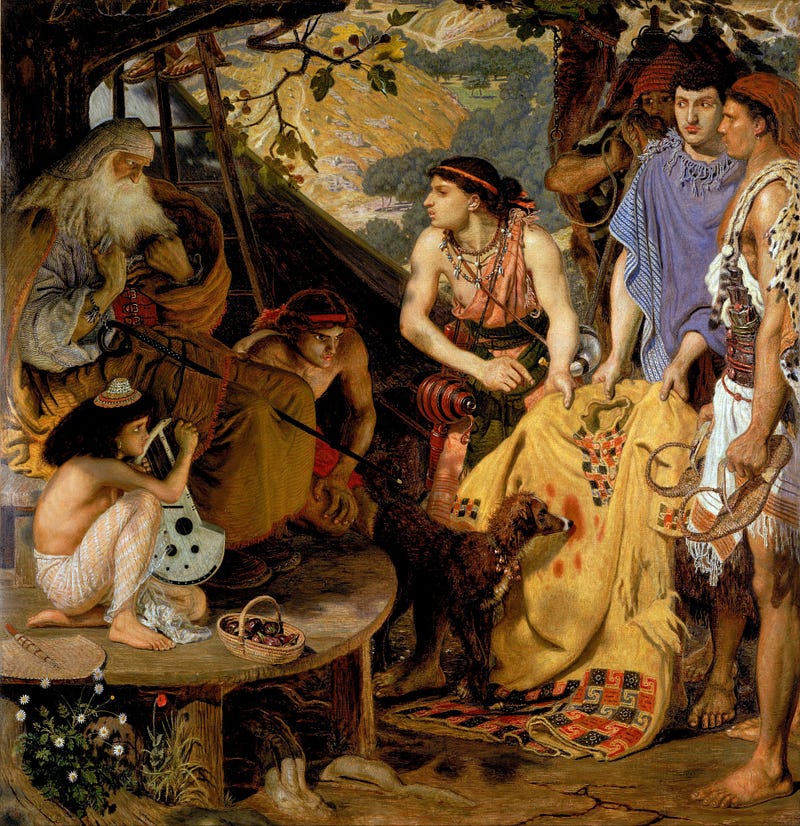

There are some paintings that last the test of being looked at again and again. They provide an experience for the eye, one that deepens with each visit. This image, with its rich and somewhat theatrical first impression, is one such painting.
Not a square inch of the canvas is without detail or some other visual incident. Painted by the British artist Ford Madox Brown in 1866, it tells the story of Joseph and his brothers, a biblical tale of jealousy, betrayal and retribution.
Before examining the painting and its details, it’s worth spending a moment looking at the way the space is illuminated — for this seems to me to dictate so much of the painting’s overall design, its mise en scène.
Scattered sunlight streams in from the left, falling first on the side of the seated boy with the musical instrument. Next, the light lands on the golden-coloured coat being proffered, as well as upon the men holding it. Meanwhile, the old man sat high on his platform — Jacob, the father of the other men — is distinctly in shadow.
The use of illumination in this way gives firm structure to the image: we have entered a private space, a rustic interior, one that is sharply divided between inside and out. The aged Jacob sits under the canopy of a fig tree (notice in the background that a camel has begun feeding on the fruit), whilst the slanting line that extends across the back of the space echoes the diagonal fall of sunlight.
A large section of the image is shaded; a mistrustful tension fills the air, commensurate with the story itself…
Joseph and His Coat
Joseph was the eleventh son of Jacob and his favourite wife, Rachel. As the youngest son of his beloved wife, Jacob has an especial fondness for Joseph.
One day, Joseph received a beautiful coat from his father. This coat was no ordinary garment; it was a coat of many colours, made from rich and vibrant fabrics. Joseph wore his coat proudly, unaware of the envy it prompted in his brothers. Joseph then had a series of vivid dreams that seemed to foretell his supremacy. Excitedly, he shared these dreams with his brothers, unknowingly fuelling their jealousy even more.
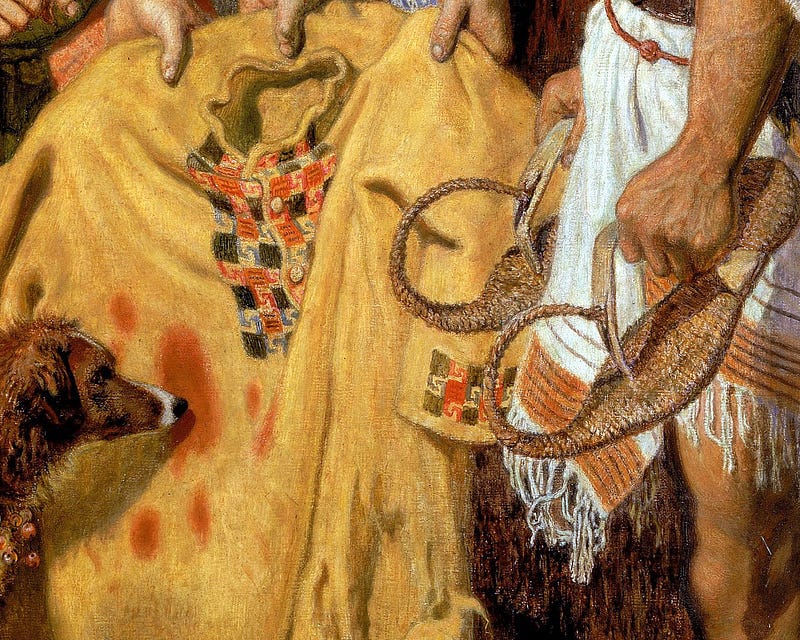
Unable to contain their bitterness, Joseph’s brothers conspired to be rid of him; they stripped their younger brother of his brilliant coat and threw him into a pit.
The painting portrays the moment when Joseph’s brothers brought back his coat —smeared with animal blood — and showed it to their father, pretending that Joseph had been killed by a wild beast. The torn bloodstained garment is held up by the conniving brothers, whilst Jacob is shown recoiling from the grievous news.
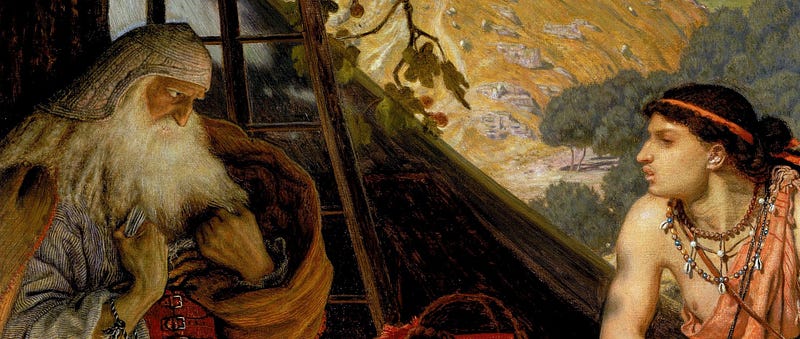
Brown rendered the scene with a rich colour palette and naturalistic style. He also scattered the canvas with points of symbolism that enrich the storytelling.
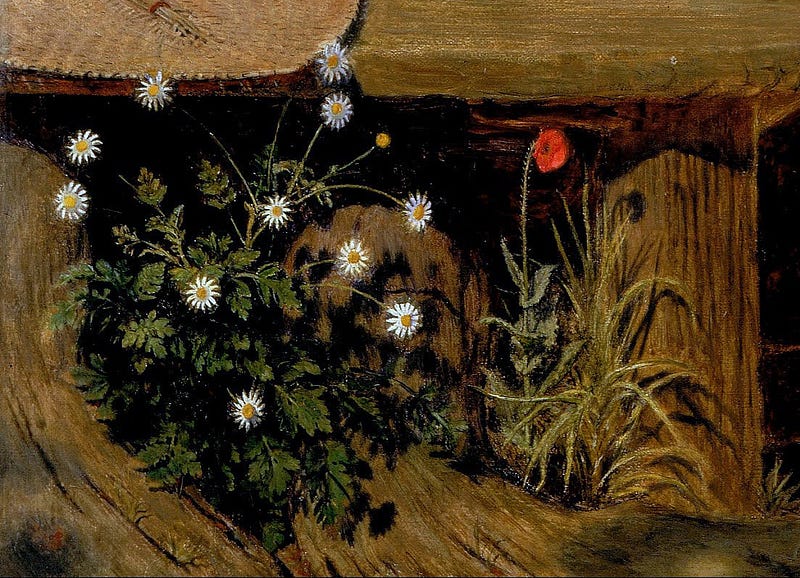
Notice for instance the flowers in the foreground, with eleven flowerheads to represent the children of Jacob and a single red bloom that refers to the fate of young Joseph.
The red poppy was apt for more than just its startling colour: it was a popular symbol amongst the Pre-Raphaelite painters to foreshadow death or to represent deep sleep — perhaps a reference to Joseph’s dreams.
Another clever detail is the unopened bud among the eleven flowers which suggests the youngest brother Benjamin, the likely identity of the boy sat clutching Jacob’s robe who is innocent in the brothers’ plot.
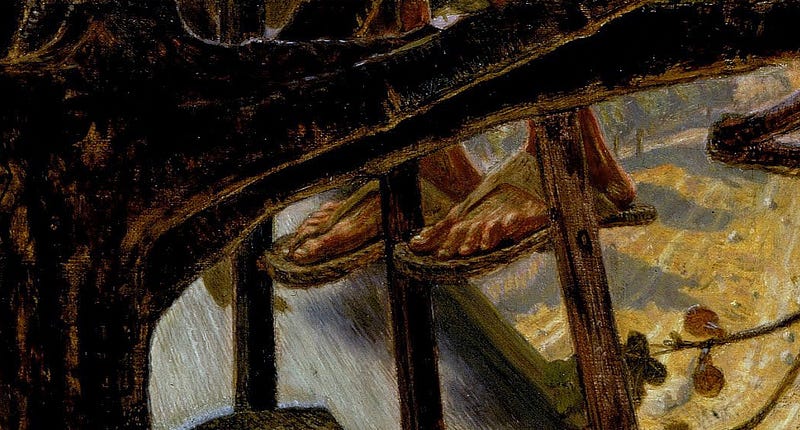
Notice too in the background a pair of feet on a ladder: this is probably an allusion to Jacob’s ladder, which he saw in a dream stretching from earth to heaven with angels ascending and descending — and when God promised Jacob that his descendants would be numerous and would inherit the land on which he slept.
The dog may symbolise faithfulness — and certainly appears to recognise that mischief is afoot as he sniffs the coat. Meanwhile, the basket of figs at the front may be a reference to the brothers’ sinfulness, since figs sometimes replaced the traditional apple as the emblem of Adam and Eve’s original sin.
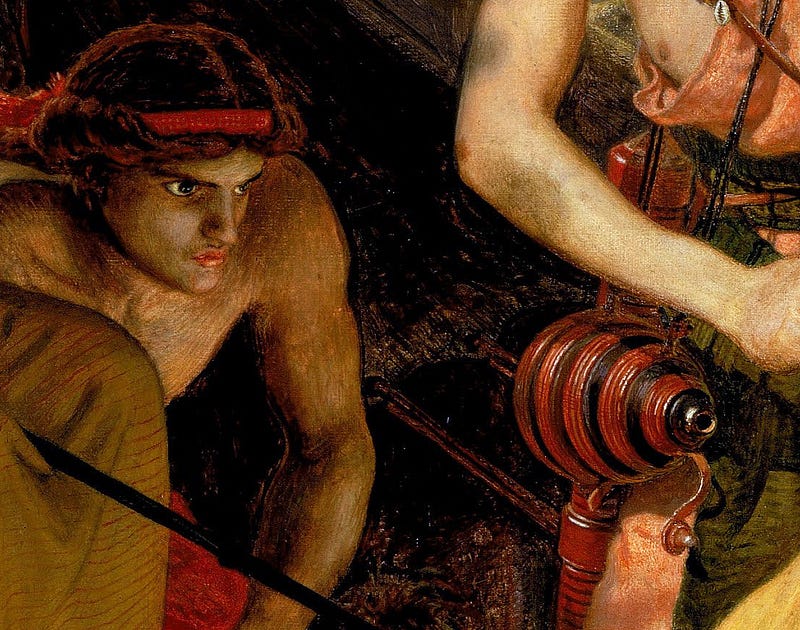
Much of the storytelling is also done through the characters’ eyes as they scrutinise one another.
The brothers — hiding their disgrace — await their father’s response. Meanwhile, crouched in the shadows and wearing a red headband is presumably the single conscience-stricken brother, Reuben, who, with glaring eyes, appears in the painting with a somewhat guilt-ridden expression.
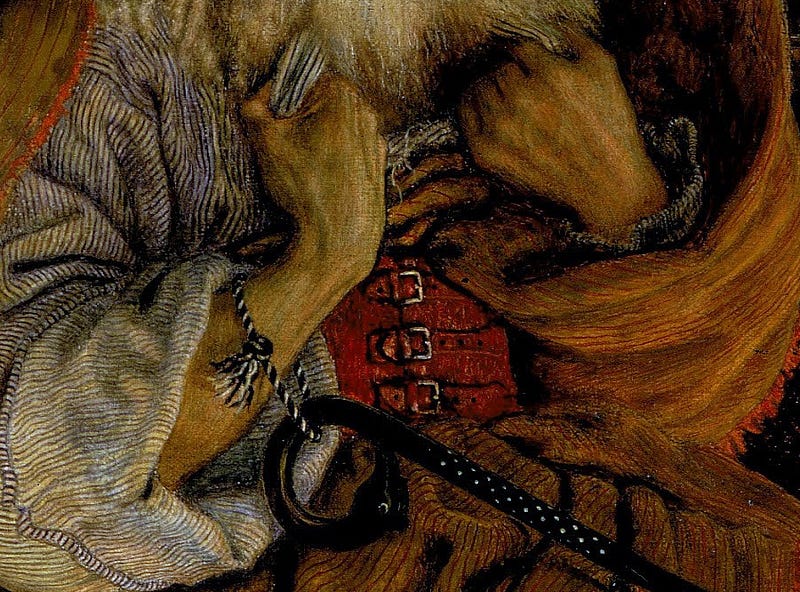
My personal favourite detail is the walking stick that Jacob has attached by a piece of string tied around his wrist — speaking not only of his aged frailty but of a certain degree of practical wisdom.
The Artist
Ford Madox Brown was an important artistic influence in the 19th century, associated with the Pre-Raphaelite Brotherhood of artists who aspired to paint with maximum realism and to assert their common interest in theology and medieval literature. Moving away from academic painting, Brown was well known for combining historical subjects with realistic detailing.
When it came to accuracy, he took great care to be as authentic as possible — as far as his experience would allow. He had never been to the Middle East so his means of creating the scene was from secondhand material.
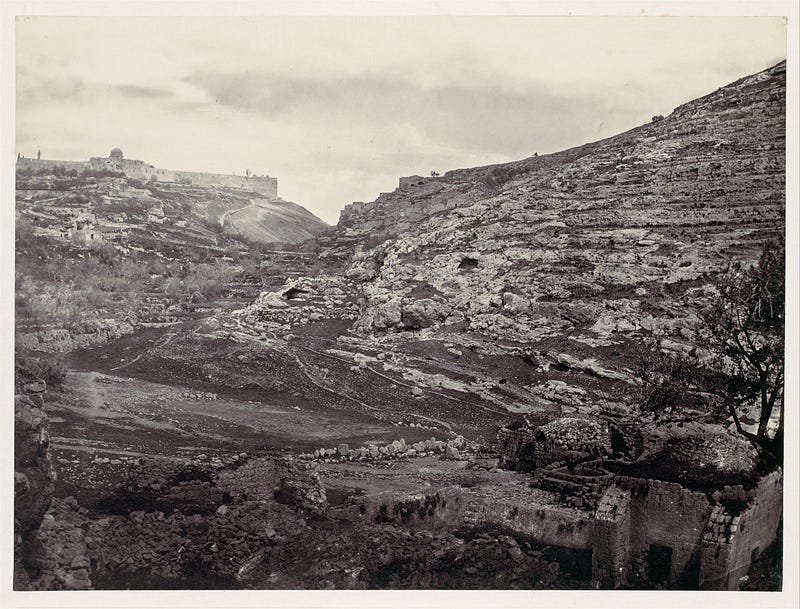

For the landscape in the painting, he borrowed from his friend, the artist Thomas Seddon (1821–1856), who painted a watercolour of The Well of Enrogel near Mount Moriah and Jerusalem — a sacred site in the Hebrew tradition.
For the costumes he used illustrations of Assyrian and Egyptian dress, and also took inspiration from the paintings of his Pre-Raphealite colleagues like William Holman Hunt, who stayed in Palestine in the 1850s and completed his impressive The Finding of the Saviour in the Temple in 1856.
Brown’s painting of The Coat of Many Colours was commissioned by George Rae, a British banker and stockbroker, and keen patron of the Brotherhood, who became one of the most significant collectors of Pre-Raphaelite art. He commissioned Brown in 1863 and took delivery of the work three years later. In all, he would come to own six pictures by Brown.
Brown’s painting met with uncertainty when it was first seen by the critics. One commentator, writing for London-based The Athenæum magazine, complained of its confused composition and “a certain horny yellowness” across the canvas.
Yet I can’t help feel that this critic reached his conclusions too quickly. My own response to the work agrees with the writer George Bernard Shaw (1856–1950) who judged the enigma of The Coat of Many Colours as its singular strength.

If you liked this, you may also be interested in my book Masterpieces of Art Explained, an examination of some of art’s most enthralling images.
Would you like to get…
A free guide to the Essential Styles in Western Art History, plus updates and exclusive news about me and my writing? Download for free here.
Join me…
On Instagram for more great paintings on the go!