
Trump’s Misconception: The Untold Story Behind the Massive Fraud Bond Posting
Unraveling Trump’s Confusion: The Mystery of the Massive Fraud Bond Posting
Decoding Trump’s Misunderstanding: The Enigma of the Huge Fraud Bond Posting

Table of Contents
Obligations and Legal Implications
Dates and Deadlines to Remember
The Bonds Situation: Defamation and Fraud Cases
The Potential Asset Sell-Offs
Trump’s Request to Trim Down Fraud Award Payment
The Impact on Trump’s Real Estate Empire
Conclusion
Obligations and Legal Implications
Has the world of bonds and securities always seemed enigmatic to you? You’re not alone. One can’t help but be confounded when even former President Donald Trump appears to be grappling with posting a massive fraud bond. The complex labyrinth of laws and regulations surrounding this process can pose challenges even to those familiar with the legal landscape. And in this situation, the stakes are incredibly high.
Bonds, specifically fraud bonds, are inherently a powerful tool against fraudulent financial activities. But when the requisites of posting one remain obscure to many, it begs the question — how can we make sense of it all? Strap in, dear reader. It’s time to delve into the fascinating world of bonds and how to post them efficiently.
“Understanding how to post a massive fraud bond is no simple task, but it’s crucial in many financial and legal situations. Even if it seems like a tangled web now, we’re here to help you untangle it.”
This article will serve as your guide, through the often befuddling maze of bond posting, with a specific focus on fraud bonds. There’s no need to worry about feeling lost in legality; we’re here to decode the jargon, demystify the process, and hopefully, shed some light on the matter for Mr. Trump as well.
The Bonds Situation: Defamation and Fraud Cases
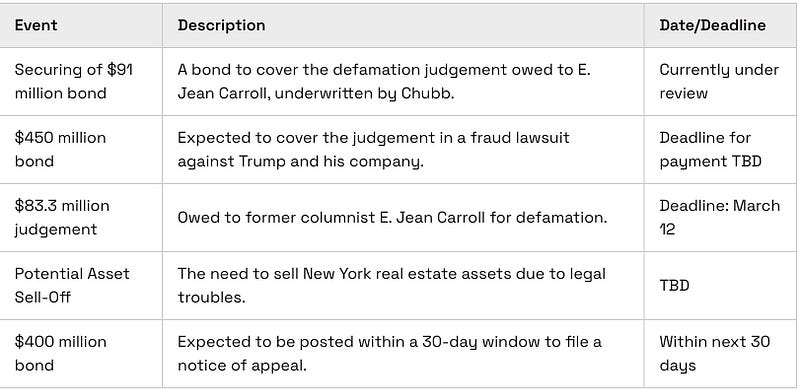
Mr. Trump, following quite a complicated legal predicament, has managed to secure a bond for over $91 million, pertaining to the defamation judgment he owes writer E. Jean Carroll. This bond was underwritten by insurance heavyweight, Chubb. But, it seems, there’s a larger storm brewing in the form of a separate $450 million bond expected to cover a larger judgment in the fraud lawsuit against him and his company. It is at this junction that we find Trump’s legal team scurrying for a delay in the deadline to pay up.
The Potential Asset Sell-Offs
Now, you might be wondering what all of these bonds and figures mean. A bond — in this case, a fraud bond — is essentially a way for the defendant (Mr. Trump, in this context) to put up a financial guarantee against the judgment. This guarantee should cover the entire sum of the judgment, allowing the defendant to carry on with their appeal process. But it’s not a simple matter of just writing a cheque or making a bank transfer. The bond needs approval, and in this case, it’s U.S. District Court Judge Lewis A. Kaplan who holding’s the green light.
Trump’s Request to Trim Down Fraud Award Payment
An interesting point to note here is that an appellate court judge has potentially paved a way for Trump to borrow the money required to put up the entire amount he owes. Here’s where the real estate mogul’s New York assets come into play. With his past business acumen, he has amassed a considerable geographic portfolio. But the question remains; will these assets need to be liquidated to cover the financial burden of his legal troubles?
Particularly, one might wonder about the process and implications of potentially converting these assets into cash, should Trump lose the appeal. But a glimmer of positive news for Trump is that the appellate Judge Anil Singh has lifted the trial court’s ban on him borrowing money from New York banks, perhaps offering some financial cushioning for his mounting debts.
The Impact on Trump’s Real Estate Empire
In summary, as the complexities of Trump’s financial dilemmas continue to unfold, the dice is still rolling. Tune in as we continue to unravel the mysteries of fraud bonds, and quite possibly, help Donald Trump Figure out how to post that massive bond.
Conclusion
Overall, the sequential financial challenges being faced by Trump reveal the seriousness of the legal actions against him. These financial obligations, which involve major bond payments and potential asset liquidation, provoke substantial questions about the future of his personal and business fortunes. As Trump navigates through these circumstances, it is essential to keep an eye on key dates and deadlines, particularly regarding the posting of bonds and potential sell-offs of assets. Lastly, the fact that Trump has requested to only pay a fraction of the civil fraud award underlines the gravity of this situation and the potential implications for his real estate empire in New York.


