
Unpopular Opinion: the Climate-Tech Lexicon is Unnecessarily Exclusive

If there’s one thing that I took away from my year teaching middle schoolers in Spain, it’s that the younger generations need hope. The are growing up in a world mired by bad news, false hype, and newscasters interrupting each other on live TV and they need some light at the end of the tunnel.
While I can only speak for what has worked for me and my students, I can safely say that climate-optimism is real— and it’s freaking awesome!! Solutions exist. We can do things to fix and reverse climate change, and people have already been doing this for decades. It’s called climate-tech.
For all the positives that climate-tech has, though, it can be rather difficult for beginners to understand. This is especially true for the climate-tech vocabulary, which can be daunting for anyone looking at it for the first time. Just look at Project Drawdown’s list of solutions.
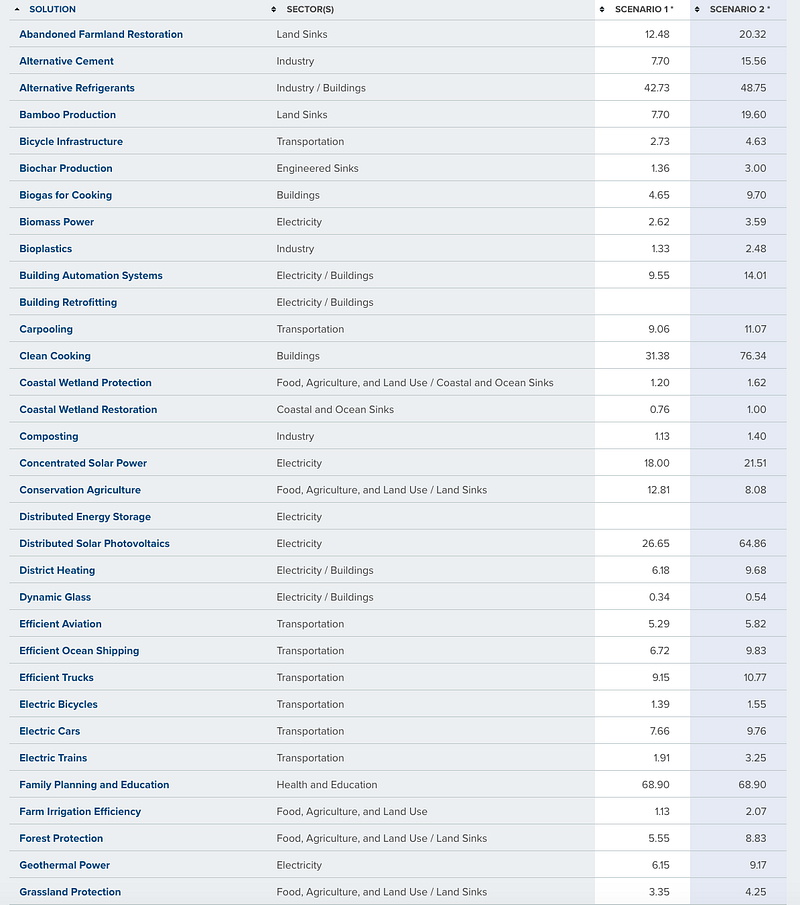
While I adore Project Drawdown and wish more people knew they existed, I wish more people could understand just what the heck they’re talking about. From carbon sequestration to engineered land sinks, not many people know what any of this means.
If it’s true that we need all hands on deck, then let’s start by being more inclusive with this crucial work. If it’s true that this is the greatest challenge that humanity has ever faced, then let’s begin by getting everyone on board.
So, whether you’re just starting out on your climate journey or want a refresher on some of the coolest up-and-coming solutions, below you’ll find a list of 20 climate solutions translated into simple English.
This is not meant to be a deep dive into any one climate solution. Instead, it is my best attempt to take some of the best and unnecessarily complicated solutions and describe them in simple English. Hope you enjoy!
Gigaton
So, in the United States, a ton is 2,000 pounds of something. Giga means one billion. So a gigaton is 2,000 billion pounds.
Now, how can we actually visualize one gigaton of something? let’s imagine whales. Blue whales, to be specific, since they’re really big

See those two cuties above? Now imagine 5 million adult blue whales. That’s 1 gigaton of carbon.
Now, it’s hard to get an exact amount of how much carbon is currently in our atmosphere, but I did ask chat GPT and it said that as of September 2021, there were 3,150 gigatons of carbon in the air. As we know, chat GPT can be unreliable at times, but if we take that number and run with it, that’s 500 billion adult blue whales of carbon in the atmosphere. Thats billion with a b.
Now that you get the picture, what can we do about it? Turns out, we can do a lot! And the wonderful people at Project Drawdown have come up with a list of solutions that people all over the world are working on. One of the best ways to stop climate change is what’s called carbon sequestration.
Carbon sequestration (pronounced see-ques-stration)
To sequester just means to store something, to keep it somewhere. All that carbon sequestration means is taking carbon (the stuff that causes global warming) out of the air and putting it back into the Earth. Yes, this is possible — plants and trees do it every day. There just currently isn’t enough plant life on the planet to “sequester” all the carbon we’ve put in the atmosphere from burning fossil fuels. That’s why we gotta plant more and come up with more ways to get carbon out of the air.
Drawdown
The word drawdown in Project Drawdown just refers to the point in time when the amount of greenhouse gasses in the atmosphere stops climbing and starts to decline. When this happens, we can all celebrate the end of fossil fuels and say “Yay! We’ve reached drawdown!” We can reach this target by 2050 if we’re ambitious.
Carbon sink
Similar to carbon sequestration, a carbon sink is simply something that can store carbon. Oceans and land are what the Earth is made up of, so carbon sinks get broken down into two categories: ocean sinks and land sinks.
When someone says “The oceans are the world’s biggest carbon sink,” all that they’re saying is that the oceans naturally absorb carbon every day and that they’re really good at it.
Distributed Solar photovoltaics
Again, why the necessarily complicated naming, people? Distributed solar photovoltaics just refers to the small-scale solar panels that go on people’s roofs.
Landfill methane capture
Methane, similar to carbon, is a leading greenhouse gas. The majority of methane in that gets released into the atmosphere comes from landfills. So, the idea is to *capture* all that methane before it gets released into the atmosphere. Pretty cool stuff.
Macro algae protection and restoration
This doesn’t lead to as much carbon sequestration as, say, reduced food waste, but it is my favorite climate solution. The word macroalgae here just means seaweed. Certain strains of seaweed can grow up to 2 feet a day, can capture carbon (like any plant), and can restore ocean habitats.
Methane leak management
“Methane, a potent greenhouse gas, is emitted during the production and transportation of oil and natural gas” (Project Drawdown). So, the idea here is to simply stop leakages in pipes, valves, compressors, and other small bits of machinery that are used to transport methane from one place to another.
Peatland protection and rewetting
“Peat is a thick, mucky substance made up of dead and decomposing plant matter. It develops over hundreds or thousands of years, as wetland vegetation slowly decays” (Project Drawdown).
The idea here is to simply to stop destroying peatlands (think bogs and the kind of wet area on a hiking trail that you wouldn’t want to get stuck in). In addition to not destroying peatland, we can protect all the peatland that still exists. Peatlands are usually very wet places, so the word “rewetting” here just refers to restoring drained peatlands. Also, despite only covering 3% of Earth’s land area, peatlands are second only to oceans in the amount of carbon they store — twice that held by the world’s forests, at an estimated 500 to 600 gigatons (Project Drawdown). Yay for peat!
Refrigerant management
So, the chemicals that make your fridges and air conditioners work actually cause global warming. This happens in two ways: when the refrigerant chemicals leak out of their appliances into the atmosphere and when these chemicals need to be disposed of at the end of their life.
Silvopasture
Silvo in Latin just means forest. So, silvopasture is the practice of bringing cows back into forests and not having as many treeless cow pastures out there. If you’re a farmer, letting your cows graze in a forest can also give you mushrooms, nuts, and fruit, all of which can help you generate more moola.
Utility-scale solar photovoltaics
I don’t know who invented the word photovoltaics, but it just means panels. We’re talking about solar panels. And utility-scale just means having a lot of solar panels. Like, enough to replace coal, oil, and natural gas power plants.
For a more in-depth understanding of what drawing down carbon from the atmosphere really means and how we can do it, look at this graph here.
Thanks for reading!