
Unpopular Opinion: How Perfectionism Can Boost Well-Being & Bring Greatness
There are two types of perfectionism. Most people don’t know about the good kind.

“You want things as perfect as they can be, understanding that nothing is ever perfect. But the challenge is to try to get them as perfect as they can be.” — Kobe Bryant in a podcast.
Most people say perfectionism is bad for you, but that’s a gross oversimplification.
Some of the greatest people the world has ever seen — Leonardo Da Vinci, Steve Jobs, Kobe Bryant, and Novak Djokovic, to name a few — are famously perfectionists.
So is perfectionism truly bad for us, or is it a powerful tool we don’t know how to wield?
In this article, I will help you develop a nuanced understanding of perfectionism and help you realize that contrary to popular belief, it can be extraordinary for your mental health. Let’s dive in!
Perfectionism: An Ideology That Stimulates Lifelong Improvement
Any kind of “growth” only happens in the presence of a stimulus. This stimulus is the gap between your current competence and your desired competence.
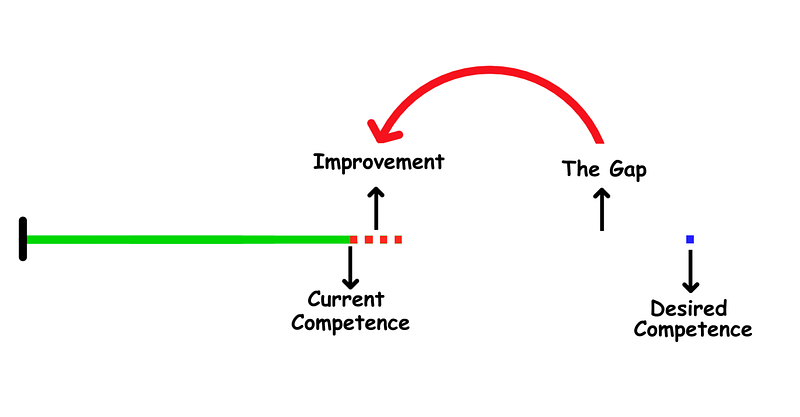
As long as this gap is present, growth happens. When the gap is closed, the stimulus is gone — and growth stagnates.
Let’s see how this concept fares in the case of a non-perfectionist versus a perfectionist.
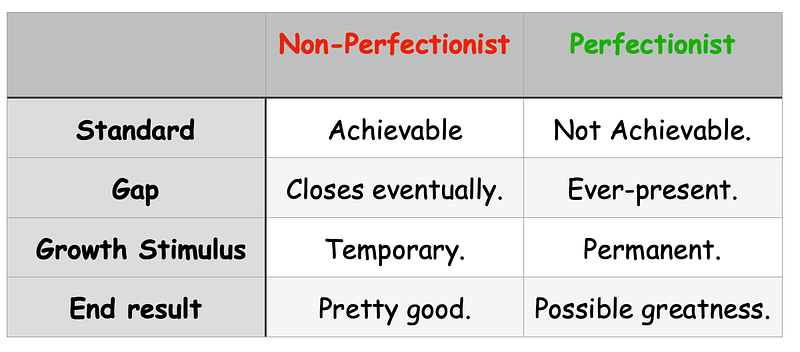
When we talk about standards:
- The non-perfectionist has a “good enough” standard for himself. This standard may differ between individuals but it is achievable.
- On the other hand, the perfectionist wants utter perfection in his craft which, by definition, is not achievable.
As both begin their journey, their competence is nil. Hence, in both cases, a gap is present — consequently, a stimulus is present — and growth occurs.
- Over time though, the non-perfectionist will eventually close this gap. Closure of this gap will appeal to their ego — momentarily — but they won’t realize that by closing the gap — they also remove the stimulus for growth.
- Contrary to this, even after the perfectionists’ competence grows a lot, they still feel they haven’t achieved perfection. By definition, they never will. And hence, the gap is always present — and so is the stimulus for growth.
And this eventually determines the fate of non-perfectionists and perfectionists.
- In the absence of any gap — and consequently any stimulus — the non-perfectionist stops growing. They become good enough, but not great.
- The perfectionist, on the other hand, keeps pushing and finding areas to improve long after non-perfectionists stop improving. Painfully, and slowly — they keep inching towards “perfect” never quite reaching it. But in the process, they achieve greatness.
Why is perfectionism portrayed in a bad light?
In 1978, D. E. Hamachek argued for two contrasting types of perfectionism, classifying people as tending towards normal — what I like to think of as joyful perfectionism — and neurotic perfectionism.
All the negative effects of perfectionism? They’re actually quite specific to neurotic perfectionism. Hamacheck argued at the time, and much of recent research concurs with him that positive perfectionism can be great for a person’s mental health.
But how exactly do these two types of perfectionism differ? And why do they lead to such dramatically opposite effects on someone’s mental health?
Let’s consider the doodle again.
In essence, the two types of perfectionists differ in perceiving the ever-present “gap” between their current & desired competence. Like all other things in life, this, too, comes down to perspective.
- The neurotic perfectionist sees the “gap” between their current and desired competence as a “lack” in their self. The fact they’ll never be perfect is torture for them— because they link their competence to their self-image.
- On the other hand, the positive perfectionist sees the “gap” as an opportunity for learning and growth. The notion of the slightest possible improvement excites them. They’re like, “Wow, here’s another refinement I can make!” The fact they’ll never be perfect is music to their ears — because they have an eternal stimulus for improvement. This lifelong improvement leads to them having extraordinary mental health. As Henry Ford once said, “Anyone who stops learning is old, whether at twenty or eighty. Anyone who keeps learning stays young.”
This difference in perspective consequently determines the intention with which they chase perfectionism, which leads to drastically opposite results.
- Perfectionism is a stressful compulsion for neurotic perfectionists because they feel the “need” to fill up this gap — as it is directly linked to their self-esteem. This compulsion is non-specific, as they link their “self” to everything. Everything they do is a vain attempt to fill the void in their sense of self — perfectionist concerns drive their actions. Leading to burnout, misery, self-hatred, and sometimes, actual neurosis.
- But for positive perfectionists, perfectionism is a joyful process because they don’t care about filling the gap or reaching a certain level; they just have fun advancing. Perfectionist strivings drive their actions. It’s not about their self-esteem. It’s purely about fun. And because their perfectionism is not linked to their self-image, it doesn’t appear everywhere. Rather, it’s highly specific to their craft. Example: Kobe said in his last interview, “I had a purpose, I wanted to be the greatest basketball player that ever played. And anything else that was outside of that lane, I didn’t have time for.”
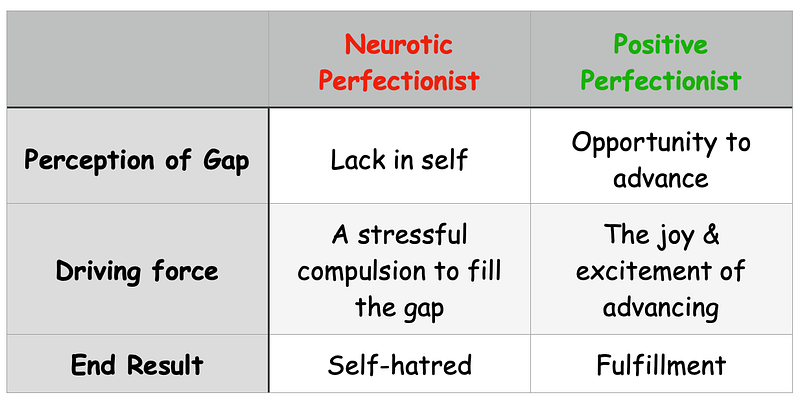
In essence, positive perfectionists are perfectionists from a position of strength, and neurotic perfectionists, are so from a position of weakness. And that's why, they experience diametrically opposite effects of perfectionism.
The immense benefits of striving to be a positive perfectionist
Perfectionism is portrayed in a bad light for two reasons.
- Imperfectionists claim that perfectionism is bad because, well, they have the opposite ideology. Bias much?
- Neurotic perfectionists say that perfectionism is bad because it causes them suffering.
But everyone would be better off adopting positive perfectionism for two simple reasons.
First, you will have a chance at greatness as opposed to non-perfectionists — because you would keep improving at your craft incessantly.
Second, as opposed to neurotic perfectionists, you will be able to bathe in the incessant joy and excitement of lifelong improvement.
How to be a Positive Perfectionist?
Step 1: Find out something you’re truly passionate about.
To be a joyful perfectionist, the impulse to improve endlessly must come from inner curiosity — rather than as an attempt to fill a gap. That’s only possible when you’re working on something you truly enjoy.
A good idea to figure out your inner inclinations is to think about what seems super exciting to you but feels pretty “meh” to others.

For instance, psychology and neuroscience fascinate me deeply, and that’s also why much of my writing is based on those topics. I geek out learning about how the human mind works. Even when I talk about these topics in a conversation, there’s a twinkle in my eye — and the excitement is palpable.
But this excitement is not always matched by the other person. At first, it baffled me — “This is so damn interesting! Why does it not excite them?” But now, I understand that everyone has their unique interests.
Find yours, dig deeper — and never let go.
Step 2: Stop linking your self-esteem to your competence.
The role of “ego” or your “sense of self” in raising your competence is tricky.
- From zero to good enough: Your “ego” supports you and helps you raise your competence. But…
- After you’re good enough: Your “ego” weighs you down, and stops you from achieving excellence.
To use a metaphor, your ego is like a rocket booster.
A booster propels the rocket off Earth, but eventually, the rocket must drop it off after reaching enough height — because carrying it would use unnecessary fuel and prevent the rocket from reaching its destination.
Your ego is like that as well.
That’s why, you must have noticed that extremely narcissistic people are often able to achieve a decent level of success, but then, it’s almost as if an invisible force pulls them down — and prevents them from achieving utter greatness.
Most narcissists aren’t ever able to realize that the very trait that brought them here (good enough) stops them from going there (greatness).
Ryan Holiday was right, Ego is the enemy.
In both non-perfectionism and neurotic perfectionism —on careful examination — you will realize that Ego is the culprit.
- Non-perfectionists subconsciously never aim for perfection because they are afraid that if they fail, they won’t be able to handle it. That failure is rooted in Ego.
- Neurotic perfectionists aim for perfection because they can’t handle anything less for themselves. The “lack” bothers their ego — and hence, they chase perfection out of desperation. But since desperation burns one out, they’re never able to go the distance — and fail to achieve greatness.
The answer? Dissolve your ego. Realize that it’s not about you. It’s not about being perfect. It’s about trying to be perfect. That’s a distinction you need to understand.
Once the “self” or the “ego” is removed from the equations, there are no fears left. And you can exploit that joy.
Step 3: Aim for perfect
Ego dissolution is a long and arduous process. But once it starts happening, you can slowly raise your standards and aim for perfection.
If any fears of failure arise, talk yourself out of it. Remind yourself that failure doesn’t matter because the ultimate goal is to keep improving, not to reach a level. It’s impossible to fail at trying to improve — because trying is entirely in your hands.
Ego dissolution and aiming for perfection — both processes will reinforce each other. Practiced long enough, you will truly be free of fear of failure — and aiming for perfection will become choiceless.
Step 4: Redefine your relationship with the gap
Your ego is sticky. That’s why you want to possess things — you want to call them yours. This stickiness will also make itself apparent as soon as you aim to be perfect. Because when you aim to be perfect, the “gap” will become apparent — and your ego will try to stick to it and associate your self-esteem with it.
Here’s an example of how this stickiness may manifest.
You may look at someone way ahead of you in the journey, and then, an instinctual comparison will arise on its own. You will feel “bad” that you’re not there yet. When that happens, catch yourself! And instead, consciously try to sublimate your feelings.
Instead of feeling “bad” that you’re not there yet — try to get excited & feel “good” about the “n” number of learnings and improvements you still get to experience.


Done enough times consciously, this excitement will become a subconscious instinctual response—and that’s when you can begin to derive the lifelong joy of being a positive perfectionist—and of course, a genuine chance at greatness.
Concluding Perspective: Perfectionism Isn’t About Perfect
In reality, among perfectionists, no one is a purely positive or a purely neurotic perfectionist. It’s a spectrum, and all perfectionists lie somewhere on it.
The goal is to get on the spectrum if you’re not on it — if you’re a non-perfectionist — and then move towards positive perfectionism.
When you do that, all the “negative” effects of perfectionism that you’ve read about or experienced yourself will start to vanish.
You will realize that you don’t have to worry about every project you create or the game you play to be perfect. The idea is to stretch your ideology of perfection in your craft over a lifetime — not over an afternoon.
This also means that as a beginner, you don’t have to take every step perfectly. Start, keep iterating, and keep inching toward perfection until you die. You’ll also realize that you don’t have to be perfect about everything. Just your chosen craft.
But most important of all, you will realize that perfectionism isn’t about perfect. It’s about lifelong, continuous improvement.


