Unmasking the Left-Digit Effect: A Glimpse into Human Psychology
Ever wonder why a $9.99 price tag seems cheaper than $10.00? Dive into the fascinating world of the Left-Digit Effect! Understand how our brains can be tricked by just a single digit change. Can you trust your perception? Read on and find out!
✨Don’t forget to 👏 and comment💬 to share your views/thoughts. ✨

Introduction
Hello dear reader! Have you ever found yourself at a store, pondering over a price tag that says $9.99, thinking it’s a fantastic deal? Funnily enough, had it been $10.00, you might’ve hesitated. Just a penny difference, yet the way we perceive these two prices is worlds apart. It’s intriguing, isn’t it? This little phenomenon, often unnoticed yet immensely powerful, is known as the Left-Digit Effect.
Imagine this: You’re at your favorite coffee shop, ready to buy that delicious muffin you’ve been craving all week. You see the price tag — $4.99. What a steal!, you think, handing over a $5 note with a big smile, barely noticing that teeny-tiny penny you’re getting back. Now, let’s say the price was $5.00. Somehow, the muffin seems a smidge more expensive, doesn’t it? Funny how our brain works!
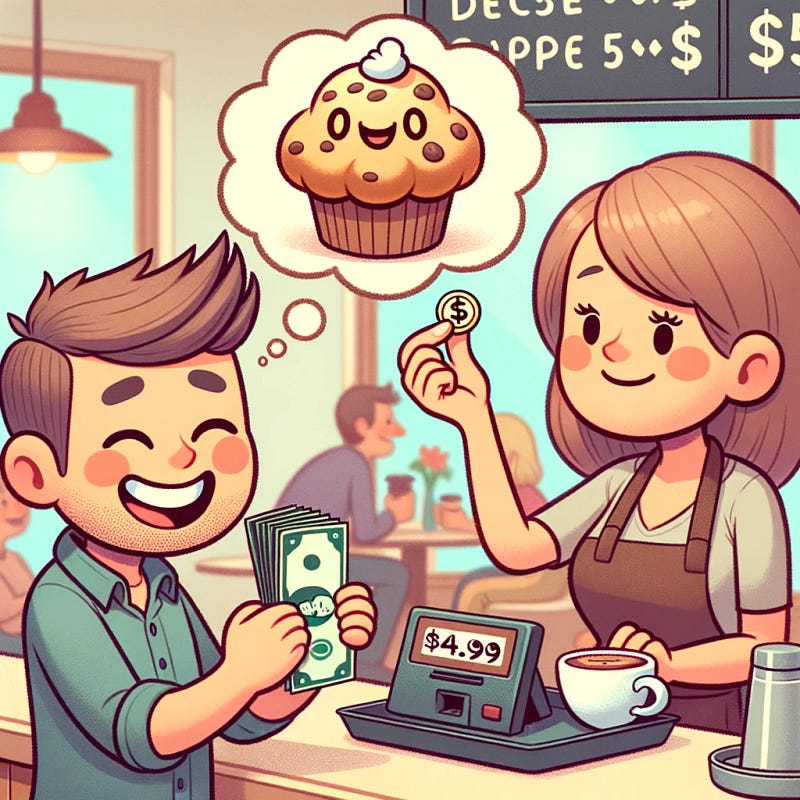
You might be surprised to learn that this isn’t just a coincidence. The way our brains perceive the difference between these prices has a significant influence on our purchasing decisions. And while we may think we’re making completely rational choices, our brains, in their wonderful complexity, are being influenced by this seemingly trivial distinction.
In this journey, we’re going to delve deep into this fascinating concept. We’ll explore why a simple change in the leftmost digit can sway our perception so greatly and how businesses use this understanding to their advantage.
“It’s not about the penny saved but the perception gained.” Remember this as we embark on this exciting journey into the world of numbers and human psychology.
The Underlying Principle
Ah, the ever-so-slight difference a mere digit can make. Have you ever wondered why that is? Let’s hop onto this train of thought together and explore what’s behind this curtain.
Humans are fascinating creatures, aren’t we? We’ve landed on the moon, created astonishing technology, and yet, something as trivial as the first number on a price tag can dramatically change our judgment. Funny, right? But why does this happen? Why do we give so much importance to that leftmost digit?
Well, the answer is simpler than you might think. It’s all about simplicity and efficiency. Our brains, magnificent as they are, love shortcuts. We’ve evolved over time to make quick judgments. Back in the day, it was all about, “Is that a snake?!” or “Is that berry edible?” Today, it’s about, “Is this a good deal?” or “Should I buy this?” Our ancestors didn’t have the luxury to sit and ponder, and neither do we, especially in today’s fast-paced world. So, our brain takes these shortcuts to help us make decisions faster.
Now, think about reading a number. Our eyes naturally move from left to right, and the first digit we see becomes the most prominent. Think of it as the leading actor in a movie — it sets the tone for everything else. Even though $9.99 and $10.00 are just a penny apart, our brain sees that ‘9’ and thinks, “Ooh, still in the single digits! Must be a good deal.” It’s almost as if the other digits are merely background dancers, important but not as attention-grabbing.
It’s akin to when you’re skimming a book. You might focus on the first few words of a sentence, drawing a general understanding, without diving deep into every word. Our brain does something similar with prices. It latches onto the leftmost number and forms an impression, often neglecting the rest.
“The devil is in the details,” as they say. But in the hustle and bustle of our lives, who has the time for details? Especially when it comes to quickly assessing the value of a product on a store shelf.
However, this doesn’t mean we’re doomed to fall for this trick every time. Being aware of this mental shortcut is the first step in understanding our own behaviors. After all, as Shakespeare wisely put it, “To know oneself is the beginning of wisdom.”
But wait, there’s more to this story. Let’s take a deeper dive into the experiments that illuminated this effect.
The Pioneering Experiment by Monroe (1979)
Ah, dear reader, we all love a good story, don’t we? Stories captivate us, teach us, and, often, make complex ideas a tad easier to understand. So, let’s take a stroll down memory lane, all the way back to 1979. Imagine a world where disco music reigned supreme, bell-bottom jeans were the height of fashion, and scientific curiosity was soaring high, especially in the realm of human psychology.
Kent Monroe, a brilliant researcher of his time, concocted a fascinating experiment. It was like setting a stage, only the actors were two seemingly identical products: let’s call them Product A and Product B. Both had a charming discount tag attached to them. Product A’s price tag was scribbled as $9.99, while Product B had the ever-so-slightly different $10.00. “A penny for your thoughts,” Monroe must have mused, observing the impact of that one-cent difference on the participants’ choices.
Participants in the experiment were presented with a simple task: pick the product that seemed to offer the better value for money. Now, remember, the discount on both products was essentially the same. Yet, like a moth to a flame, the majority of participants gravitated towards Product A, the one with the $9.99 price tag. Why? It wasn’t because they couldn’t do simple math or because they were enamored with the number nine. It was the beguiling power of the left-digit effect.
That leftmost “9” in $9.99, as innocent as it seemed, held a strange power. It whispered in the ears of the participants, convincing them that they were getting a steal of a deal. Never mind the rightmost digits; that first digit was the siren song that most couldn’t resist. It’s like when Shakespeare wrote, “All that glitters is not gold.” Sometimes, we get so caught up in the glitter that we fail to see the true value beneath.
Monroe, like a masterful storyteller, unveiled the twist in the tale at the end. Both products had equal discounts, but the perceived value was skewed by that cunning leftmost digit. It was an eye-opener, a simple yet profound demonstration of how our minds work (or sometimes, don’t work) when making judgments about value.
As you sip your next cup of coffee, ponder on this: How often have we let that leftmost digit dictate our choices? Monroe’s experiment from over four decades ago is still as relevant today as it was back then. Because, my friend, some things never change — especially the little quirks of our human minds.
The Science Behind the Left-Digit Effect
Once upon a time, in a world not too different from ours, John, a curious teenager, asked his mom, “Why do we think that $9.99 is so much cheaper than $10.00, even though they’re just a penny apart?” His mother smiled, recalling a time when she too pondered that exact question. Let’s delve into the science to answer John’s curious mind and perhaps satisfy our own inquisitiveness.

The Brain’s Shortcut Tactics
Our minds are incredible pieces of machinery. Always buzzing, always calculating. Yet, sometimes, to save energy, our brain looks for shortcuts. It’s like when you’re driving home and take the quicker route, even if it’s only a minute faster. Our brain does the same with numbers. The leftmost digit is the brain’s highway, while the other digits are more like side streets. This is because our minds often round numbers to simplify them, and the most significant digit takes precedence in this rounding process.
Shakespeare once wrote, “There is no art to find the mind’s construction in the face.” However, with the evolution of neuroscience, we are inching closer to understanding the complexities of our mind’s workings. The left-digit effect isn’t just marketing magic; it’s rooted deeply in how our brains process information.
Neurological Insights
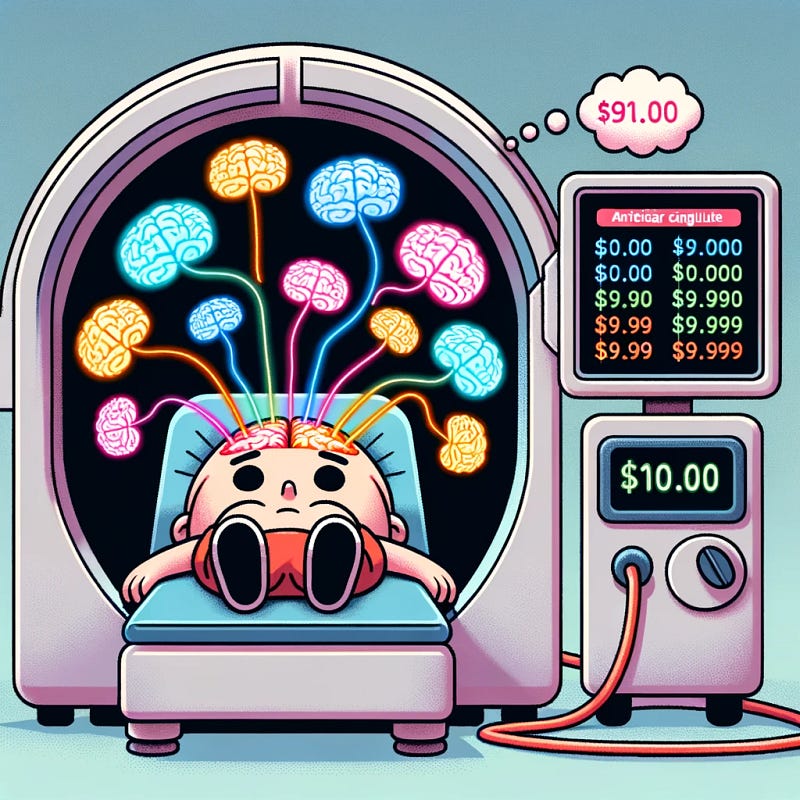
In the last few decades, scientists have placed individuals in brain imaging machines to study the neurological responses to prices. It’s fascinating how a tiny change, from say $10.00 to $9.99, activates different parts of our brains. The anterior cingulate cortex, a brain region responsible for decision-making and error detection, becomes more active when presented with prices ending in .99. This part of our brain recognizes the discrepancy and, in a split second, categorizes the price as ‘lower’.
Think about it. It’s similar to how we automatically feel a sense of nostalgia when we smell a particular perfume or hear an old song. The brain links certain stimuli with specific reactions. In the case of prices, it has conditioned itself to view anything ending in .99 as being of ‘good value’, even if it’s just a cent’s difference.
Mental Accounting: A Penny Saved is a Penny Earned
Benjamin Franklin, a wise old chap, famously quoted, “A penny saved is a penny earned.” This statement is especially true in the context of the left-digit effect. Our brain, in its inherent desire to save, perceives $9.99 as a saving, even if it’s just a mere penny. This form of mental accounting explains why we feel a small win every time we buy something on a minor discount.
Summing it Up
Imagine our brain as a diligent worker in a vast factory. It’s constantly sorting, packaging, and labeling information. When it comes across prices ending in .99, it quickly slaps a “Great Deal!” sticker on it. That’s the left-digit effect for you, deeply rooted in the way our mind functions, making sense of numbers, and helping us navigate a world full of choices.
In essence, the left-digit effect isn’t just a curious observation. It’s a testament to the intricate ways our brain works, always looking for patterns, always seeking the best for us, even if sometimes it’s just a perception. As the great poet Robert Frost might have mused, our brains have miles to go before they sleep, and numbers to process before they rest.
Everyday Examples and Relevance
Imagine walking into your local grocery store, strolling down the aisles, and finding a sign that reads, “On Sale! Now $4.99!” Right next to it, a similar product priced at $5.00. Even though there’s only a one-cent difference, doesn’t the $4.99 price tag look more attractive? That single cent, seemingly insignificant in the grand scheme of things, might be the very reason you choose the “discounted” item.
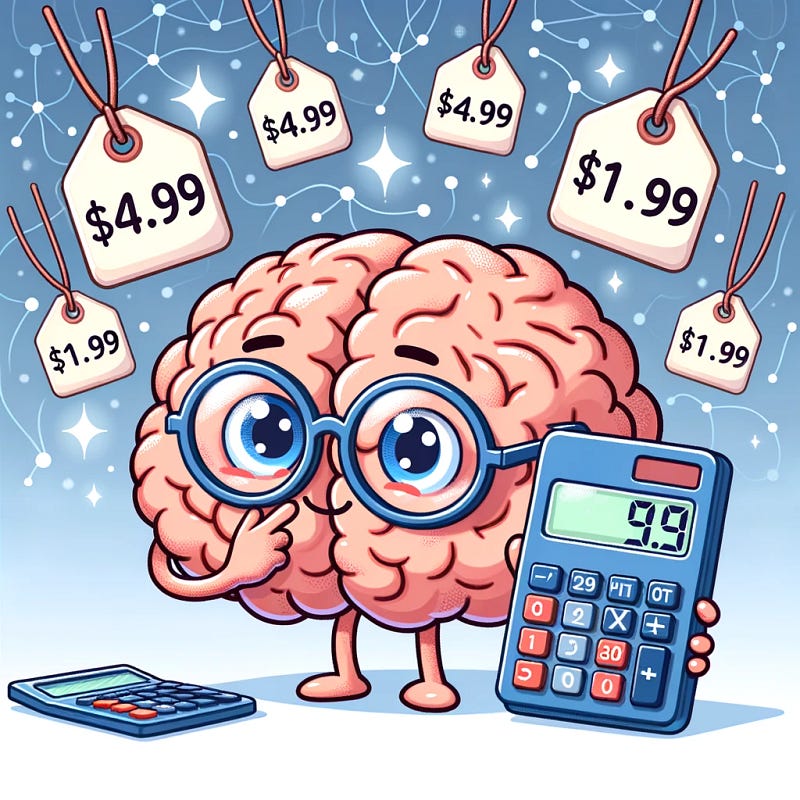
“A penny for your thoughts?” as the old saying goes. It’s fascinating to think how a mere penny can sway our choices. The Left-Digit Effect isn’t just present in the world of retail. Let’s explore its footprint in our everyday life.
A. Real-life instances of pricing strategies capitalizing on this effect.
- Gas Stations: Ever noticed that gasoline prices always seem to end in .9? $2.49.9 per gallon isn’t really $2.49, but $2.50. Yet, our brains often register it as the lower number, thinking we’re getting a deal. The gas station capitalizes on this by rounding up without many of us realizing.
- Restaurants: Look closely at the menu the next time you dine out. More often than not, you’ll find dishes priced at $14.99 instead of a round $15.00. It seems friendlier to the wallet, doesn’t it?
- Real Estate: The housing market, too, isn’t immune to this psychological trick. Houses are often listed for prices like $299,999 instead of $300,000. Such pricing makes the property feel “cheaper”, even if it’s just by a hair.
- E-commerce: Online platforms are perhaps the biggest playground for this pricing strategy. Digital price tags often flaunt numbers ending in .99 or .95, giving buyers the impression of a bargain, enticing them to click on that ‘Add to Cart’ button.
Shakespeare once said, “There is nothing either good or bad, but thinking makes it so.” Pricing, it seems, follows a similar philosophy. A change in perception, even by a tiny amount, can influence our thoughts and actions. Businesses, keenly aware of this, frequently harness the Left-Digit Effect to drive sales and decisions.
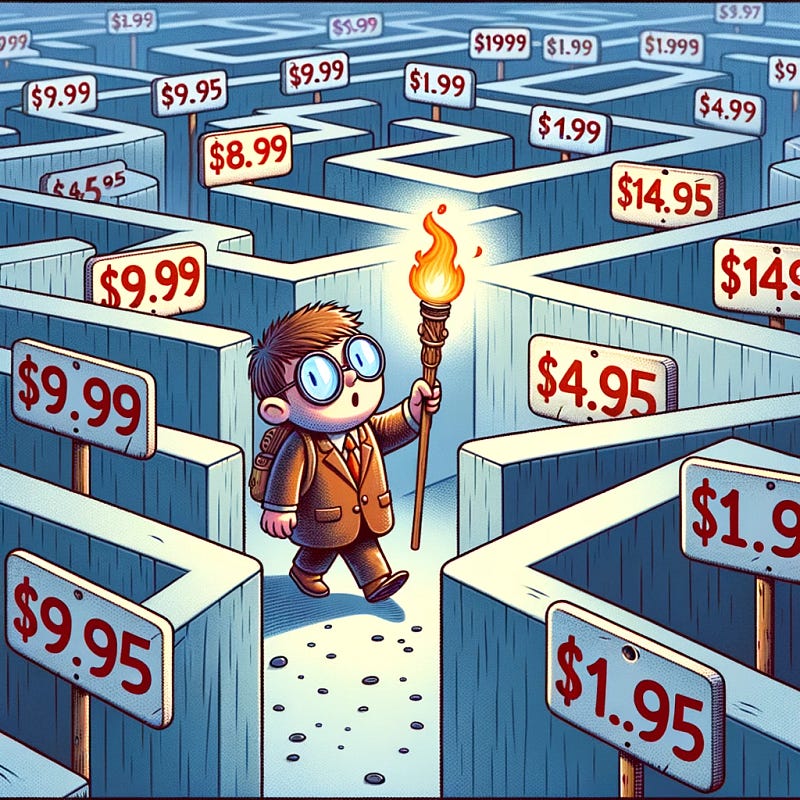
B. How consumers can make informed decisions despite this cognitive bias.
Awareness is the first step to wisdom. Now that you’re in the know about the Left-Digit Effect, you’ve got a superpower — the power of informed choice. Here’s how you can use it:
- Round Up: When you see a price tag ending in .99 or .95, round it up to the nearest whole number. This helps bypass the bias and see the price for what it really is.
- Focus on Value, Not Just Price: As Benjamin Franklin wisely remarked, “The bitterness of poor quality remains long after the sweetness of low price is forgotten.” Always assess if a product or service offers genuine value for its price.
- Stay Informed: Knowledge is power. Regularly read and educate yourself about market prices, especially if planning significant purchases. This way, you won’t be easily swayed by subtle pricing tactics.
- Practice Mindful Spending: Slow down. Take a moment to ask yourself if you really need the item. Sometimes, stepping back can offer clarity, helping you make better purchasing decisions.
In the end, it’s not about combating or resisting the Left-Digit Effect but understanding its nuances. As consumers, when we grasp the intricacies of such psychological pricing, we become empowered to make choices that align with our true desires and needs, rather than being led astray by a penny’s illusion.
Conclusion
Ah, dear reader, we’ve journeyed together through the labyrinth of the human psyche, haven’t we? All for a clearer understanding of that curious phenomenon, the Left-Digit Effect. Let’s take a moment, shall we? Take a deep breath and reflect on what we’ve unraveled together.
Imagine for a moment you’re back at that local store, a crisp ten-dollar bill in hand, pondering whether to buy that gadget priced at $9.99. Only now, you see that price tag with a fresh perspective. It’s not just about a penny less than $10. It’s a testament to the intricate workings of our brains, to the silent sway it holds over our choices.
To paraphrase the brilliant Oscar Wilde, “Nowadays, people know the price of everything and the value of nothing.” In a world flooded with prices that often play to our cognitive biases, the onus is on us to recognize these subtle nuances. The Left-Digit Effect isn’t a villain in our story, nor is it a hero. It’s a mere reflection of how our brains sometimes take shortcuts, often leading us astray.
However, awareness is the first step to empowerment. Now that you’re armed with knowledge, you have the power to make choices that are truly yours. It’s almost like having a superpower, don’t you think? The ability to see through the tricks and make decisions that truly align with your desires and needs.
As the wise Benjamin Franklin once said, “An investment in knowledge pays the best interest.” Every penny saved by not being swayed by these psychological pricing tricks can go a long way. Imagine all the delightful things you could do with that extra change, simply by being a tad more mindful!

So, my friend, next time you’re out shopping or browsing online, remember our little chat about the Left-Digit Effect. Pause, reflect, and ask yourself: is the allure of the price truly worth it, or is it just your brain taking a shortcut? Choose wisely, live well, and keep that ever-curious spirit alive.
Until our next adventure into the wonders of human behavior, take care and happy shopping!
Thanks for reading. ❤️ Leave your views/thoughts💭, I’d love to hear from you! ✨
If my words touched your soul, please consider supporting my journey: [Donate Link](https://www.buymeacoffee.com/tokyofullstack). Your generosity weaves into every story. ❤️