
Unmasking the Language of (White) Supremacy
How a mythical creature from medieval Europe haunts the 21st Century.
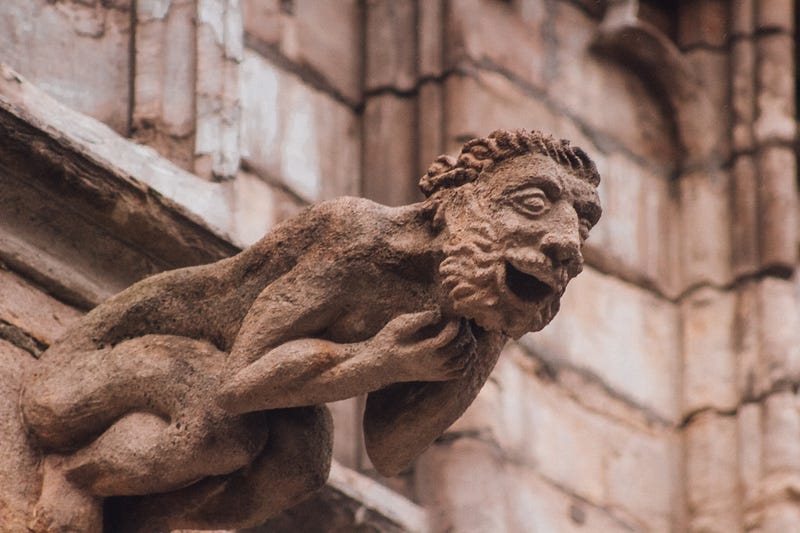
Power, dominion, and control over others have been a central theme for people since the birth of consciousness. In the Judeo-Christian tradition, it only takes three chapters of Genesis before God proclaims that men shall rule over women. The ninth chapter of Genesis discusses the existence of slavery when God curses Ham and his descendants to be “the lowest of slaves”.¹ Current events, particularly in the United States, demonstrate that these themes of inequality are structured into everyday life in the 21st Century, and they are categorically based on race. Modern forms of racial domination in America actually trace their origins to beyond the history of the bible, where ideas of a “wild man” appeared in the Epic of Gilgamesh over four thousand years ago.² The Historian of Religions Charles Long describes the wild man as such:
The wild man is a child of nature, his natural habitat is the forest. His great strength is matched by his appetite for carnal connections with human females and the flesh of human beings. Nothing about the wild man prepares him for participation in civil society. When confronted with human beings, he may take flight or, conversely, offer steadfast resistance to the death.³
This wild man was perhaps the most famous recurring character in the vast expanses of medieval European art. This savage character captured the imagination of the masses through textiles, tapestries, books, paintings, statues, and metalwork, right around the time Christopher Columbus set sail for India in 1492.⁴
For white men, stumbling upon the so-called “New World” made a staggering impact on their consciousness, and triggered a crisis of existential proportions. The first explorers believed that they had discovered the Garden of Eden, which teemed with forests filled with trees that yielded an abundance of fruit. The idea that these first explorers discovered a virgin land was quickly quashed, however, when it soon became clear that the inhabitants of this new land were, in many ways, more advanced and sophisticated than the Europeans themselves.⁵
The question of the Native American was of great importance to the colonizers. Were these inhabitants of this new land even to be recognized as people? Conveniently for the Europeans, the concept of the primitive and savage wild man that was essentially a part of their pop culture, and he provided an easy solution to their dilemma.
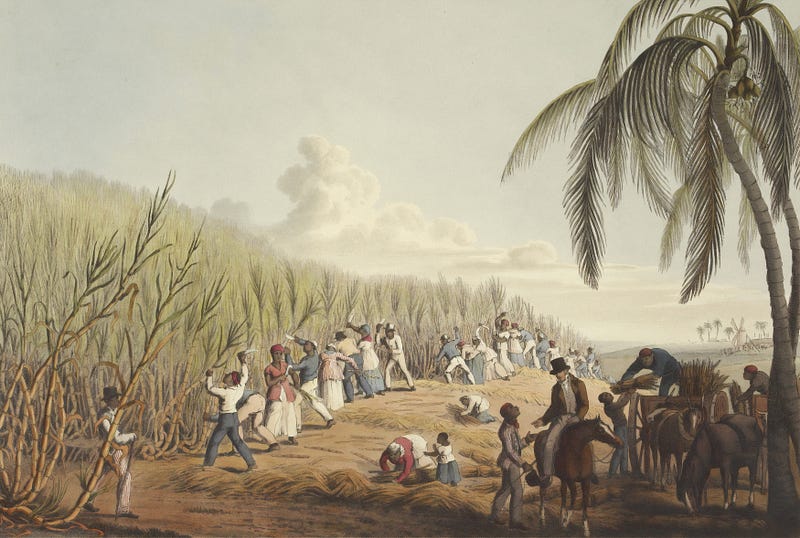
Over the course of time, the New World was “civilized” through the establishment of plantations and haciendas that were established to serve Europe as its economic engine. As slaves who were already deemed to be good-for-hard-labor-and-not-much-else entered the European theater of the “New World”, it became even easier for the colonizers to group what they saw as the loincloth toting, gibberish speaking, war mongering indigenous inhabitants in with the strong-bodied, savage Africans.
It is no coincidence that according to the 19th-century French diplomat, historian, and writer, Alexis de Tocqueville, the word “civilization”, was invented in French by Marquis de Mirabeau in 1757, and in English by James Boswell in 1772.⁶ It is also no coincidence that Adam Smith fashionably uses this new word “civilization” in his The Wealth of Nations — a book that has shaped the modern economic system — published in 1776.⁷ The word “civilization” had come to explain the West as scientifically and technologically advanced, well mannered, and all-knowing spiritually and religiously. This was of course in contrast to the rest of the world that was surely more primitive and unsophisticated compared to Europe.
As the Europeans imposed their social order in the New World, the racist rhetoric originating from the wild man seamlessly pervaded human consciousness. In the United States, this colonial-era re-orientation of the human mind towards white supremacy justified the nearly three centuries of slavery as well as a system of racial subjugation that officially existed into the latter half of the 20th century and still continues to this very day.

Just as the wild man influenced medieval forms of popular culture in Europe centuries ago, he continues to thrive in modern American culture. The most obvious example of the contemporary wild man is the portrayal of Native Americans as sports mascots. Aside from the blatant racism of calling a team the “Redskins”, as well as the passing off of screaming gibberish while doing a tomahawk hand chop as “tradition”, it is important to consider the less obvious implications of naming a team after Native Americans with relation to the medieval wild man. The wild man of yore was often depicted as having superhuman strength and belonging to the jungles and forests of faraway lands. These days, the Aztecs, Braves, Chiefs, Indians, Illini, Redskins, Seminoles, Utes, Warriors, and more are expected to compete on the same level as the Bears, Bobcats, Falcons, Panthers, and Seahawks. Moreover, almost all of these teams happen to be significantly represented by people of color.
Defenders of indigenous mascots will point to the innocence of the practice, insisting that naming a team after a derogatory slur or depicting their mascot as a clownish caricature is honoring the Native American while providing harmless entertainment. Yet, an objective look at the entire charade of dressing up mostly colored people as representations of noble savages, animals, and occasionally Cowboys, Patriots, and the Irish to fight a metaphorical war on a field is simply perverted. Perhaps more disturbing is the cold hard truth that the manifestation of the wild man in American culture points to more serious symptoms of widespread social disease.
First, let us consider cultural appropriation that is visible on the surface. White people have taken Native American identity and defined it within a limited scope. What exactly is a Native American good for? According to American culture, the Native American is good for a tough fight, though they will usually be vanquished by a more worthy foe. Never do we see an indigenous figure in pop culture serve in the government, open a business, or become a doctor. Likewise, those that are assigned to portray Native Americans as Warriors, Chiefs, and Braves in the sporting arena are simply expected to entertain, oftentimes in ways that would be characterized as violent assault outside of the metaphorical field of battle. For generations, many have assumed that African Americans are good for entertaining, but are otherwise dangerous to society, prone to criminal activity, and ill-suited to civilization. Rarely does American society encourage black people to become doctors, lawyers, or venture capitalists.
Tragically, the wild man has transcended popular culture to devastating consequences. In a chilling allusion to Charles Long’s description of the medieval European wild man, Democratic Presidential Candidate Joe Biden said at a United States Senate Judiciary hearing in 1977 that a “disorderly” integration of society would lead to a “racial jungle with tensions being built so high that it is going to explode at some point”.⁸ Of course, President Donald Trump built his entire political movement off the idea that Mexican people are rapists and criminals.

It is therefore hard to believe that it is merely a coincidence that African Americans are incarcerated and literally forced to live in cages and be secluded from society at more than five times the rate as white people.⁹ It also cannot be a coincidence that Elijah McClain, a 5’6, 140 pounds anemic African American, was described by a police officer that killed him to have “incredible, crazy strength” that took the energy of three officers to be restrained.¹⁰ The wild man thrives in the mind of American police officers.
The inconvenient truth about the infiltration of the wild man into modern human consciousness is that there is no immediate solution to the sins of racism and societal inequality. We are all prisoners of a draconian colonial European system, and it is of the highest importance that those who dare to confront the somber reality of the human condition, acknowledge the history of the white, European man as the source of racism and economic inequality in modern times. An equally inconvenient truth is that the redressive actions that society will likely take will not change these oppressive structures which are detrimental to the human spirit. Corporate diversity training and placing token black/colored faces in high places will only put a band-aid on a bullet hole, and civil unrest will only continue to grow. The blind faith in capitalist economic systems put forth by Adam Smith, which has ultimately led to exploitation of people and natural resources, endless wars, climate change, and the cultivation of a racist culture of perpetual subjugation has to stop. If humanity does not change its course in an instant, the futures of America and of humankind look to be endangered.
- Genesis 3–9
- Charles H. Long, Significations: Signs, Symbols, and Images in the Interpretation of Religion (Philadelphia: Fortress Press, 1986).
- Ibid, 81.
- Timothy Husband, The Wild Man: Medieval Myth and Symbolism (New York: The Metropolitan Museum of Art, 1980).
- Long, Significations, 100.
- Émile Benveniste, Problems in General Linguistics (Miami: University of Miami Press, 1971).
- Ibid.
- Busing of School Children, Hearings Before the Committee On the Judiciary, United States Senate, 1977., 251.
- NAACP Criminal Justice Fact Sheet
- Lucy Tompkins, “Here’s What We Know About Elijah McClain’s Death”, The New York Times, June 30, 2020.


