
Unmasking Mosquitoes
How They Find Us and How to Dodge Them
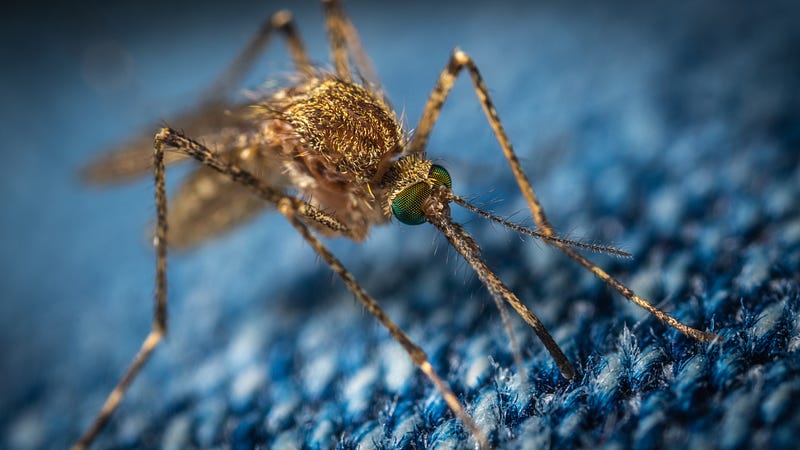
Hello, nature enthusiasts! Remember when we explored the bustling underwater cities of coral reefs? Today, we’re going to delve into another fascinating aspect of nature, but this time, it’s a bit closer to home. Have you ever wondered why mosquitoes, those tiny little vampires, always seem to find you, no matter where you hide? It’s not just your imagination. These little bloodseekers have a secret weapon that helps them locate their next meal: carbon dioxide (CO2).
The Invisible Trail: How Mosquitoes Find You
Picture this: you’re at a backyard barbecue, enjoying the warm summer evening. The air is filled with the aroma of grilled food, the sound of laughter, and the crackling of the fire. Suddenly, amidst all the hustle and bustle, you feel a familiar itch on your arm. A mosquito has found you. But how did it locate you in the midst of all these distractions? The answer lies in the invisible trail of CO2 that you leave in the air every time you exhale. But how exactly does this work? Let’s dive into the science behind these questions.

The Science Behind Mosquitoes’ CO2 Detection
According to a review of scientific literature by M. T. Gillies, the role of CO2 in host-seeking by mosquitoes comprises two distinct actions. Firstly, it acts as an attractant, with the mosquito’s orientation towards the host being mediated by kinesis (movement) and optomotor anemotaxis (movement in response to visual stimuli). Secondly, CO2 stimulates sustained flight, provided the level of the stimulus is varying. This is why mosquitoes can locate their hosts even when they are on the move 1.
In a different text, “The Biology of Blood-Sucking in Insects,” it is explained that mosquitoes are sensitive to very small changes in carbon dioxide levels. Changes as small as 0.05 per cent will elicit behavioural responses in a wind tunnel. The antennal receptors of mosquitoes are slightly less sensitive, responding to an increase in carbon dioxide levels of 0.023 per cent, but starvation lowers the response threshold of these receptors 2.

Mosquitoes and CO2: An Explanation
In simpler terms, think of CO2 as a trail of breadcrumbs that mosquitoes follow. When we exhale CO2, we create a path in the air that mosquitoes can detect and follow. It’s like we’re constantly blowing bubbles that only mosquitoes can see, and these bubbles are leading them straight to us.
The more CO2 we emit, the stronger the trail becomes, and the easier it is for mosquitoes to find us. It’s as if we’re blowing bigger and brighter bubbles that are even more attractive to these little buzz-bombers.
But there’s a catch. Mosquitoes don’t just follow a constant stream of CO2. Instead, they are attracted to changes in CO2 concentration. This means that every time we exhale, we refresh the trail and make it more attractive to mosquitoes. It’s like adding a fresh batch of bubbles into the mix, which makes the mosquitoes even more excited.
And it’s not just about the amount of CO2. Mosquitoes are also sensitive to very small changes in CO2 levels. Even a tiny increase can get their attention. So, even if we try to hold our breath or breathe less, the mosquitoes can still sense the CO2 we’re emitting.
In this way, mosquitoes are like tiny detectives, using the clues we leave in the air to find us. And no matter how much we try to hide, they’re always on our trail, following the invisible path of CO2 that leads them to their next meal.

Dodging the Vampires: Implications for Mosquito Control
This understanding of how mosquitoes use CO2 to locate their hosts has significant implications for mosquito control strategies. For instance, traps that emit CO2 have been shown to be effective in attracting and capturing mosquitoes. However, the design of these traps is crucial. Traps that emit CO2 at a constant rate may not be as effective as those that emit it in pulses, mimicking the natural breathing pattern of animals.
Here are some practical tips to keep the little vampires at bay:
- Use an air conditioning unit: The cool air from the AC disperses the CO2 we exhale, making it harder for mosquitoes to follow the trail. It also creates an environment that is less ideal for mosquitoes, as they prefer warmer temperatures.
- Light citronella candles: While it’s a common belief that lighting candles can deter mosquitoes, it’s not the flame or the CO2 it produces that keeps these pests away. Instead, it’s the scent of the candle, especially if it’s a citronella candle. Mosquitoes dislike the smell of citronella, so burning these candles can create a scent barrier that deters mosquitoes.
- Use insect repellent: Repellents that contain DEET or picaridin can provide long-lasting protection against mosquitoes.
- Wear long-sleeved clothing and pants: This can provide an extra layer of protection, making it harder for mosquitoes to find a spot to land and bite.
Remember, mosquitoes are attracted to CO2, heat, and certain scents. By understanding this, we can use strategies that disrupt their ability to detect these signals, making it harder for them to find us. So, the next time you’re planning a backyard barbecue or a summer garden party, consider these tips to keep the little vampires at bay.
Your support has been instrumental in my journey, and I’m truly grateful for it.
- Stay connected and receive updates directly in your inbox, by subscribing to my email list
- How I express myself musically? Give it a listen:
Your engagement helps me to continue sharing valuable content. Thank you!
Sources:
- Gillies, M. T. (1980). The role of carbon dioxide in host-finding by mosquitoes (Diptera: Culicidae): a review. Bulletin of Entomological Research, 70, 525–532.
- Lehane, M. J. (2005). The Biology of Blood-Sucking in Insects. Cambridge University Press.


