
Unlocking Whole Dataset Reasoning — Why Knowledge Graphs are the Future of AI Systems
Leveraging structured knowledge for complex cross-data inference
Retrieval-augmented generation (RAG) systems have demonstrated immense promise for adapting large language models (LLMs) to new datasets by providing reference materials from which to construct responses. However, the choice of underlying knowledge source can have significant impacts on overall capability.
I will elaborate on the notion of “whole dataset reasoning” put forth in Microsoft’s recent GraphRAG study and empirically showcase why their structured knowledge graph approach, combined with hierarchical semantic clustering, is far more effective than basic vector databases for reasoning over full corpora.
The GraphRAG methodology processes an entire private dataset to construct a rich knowledge graph capturing entities, relationships, and bottom-up groupings into semantic clusters. This graph provides a structured representation connecting concepts across documents lacking in individual passage vectors.
Leveraging both the topology and content groupings, GraphRAG achieves clear whole-dataset understanding — from summarizing key themes to drawing inferences between disconnected facts across sources. We will walk through sample queries that expose fundamental gaps in baseline vector search and how graph-based techniques unlock genuine multi-hop reasoning.
Limitations of Vector Databases
A large proportion of retrieval-augmented generation (RAG) systems rely on basic vector similarity search over text passages extracted from source documents. Each passage is encoded as a dense vector embedding using models like SentenceTransformers.
At query time, the user’s question is also embedded into the common vector space. Related passages are retrieved through nearest-neighbor search algorithms that assess similarity by distance metrics like cosine similarity.
However, this approach suffers from several drawbacks:
- The isolated passages lack surrounding context from the full document, impeding understanding.
- No document structure signals are preserved, such as section headings, lists, or tables.
- Chronological event sequences and timelines across sources are not modeled.
- References to the same entity are disjoint across passages.
Due to these factors, passage vector RAG systems struggle significantly on queries requiring multi-document reasoning — they cannot bridge connections between disjoint pieces of information spread across sources.
As a result, whole-dataset questions involving aggregation and summarization of key concepts cannot be answered reliably. There is no consolidated view of cross-cutting narratives and themes.
Without a unified structure interconnecting entities and events across documents, basic passage vectors fail to power complex analytics over corpora — the very scenarios requiring true multi-hop reasoning.
Introducing Knowledge Graphs
In contrast to passage vector representations, knowledge graphs consisting of interlinked entities, relationships, and groupings extracted from text can overcome the isolated reasoning limitations.
A knowledge graph explicitly connects concepts across documents through a structured topology of nodes and edges. Entities like people, organizations, locations become nodes. Relationships between them form edges labeled with semantic types like “employed_by”, “headquartered_in”, “acquired”.
Additionally, graph clustering algorithms applied on the topology can detect communities and summarize groups of closely related entities into semantic clusters.
This graph-based representation demonstrates substantially improved reasoning capacity:
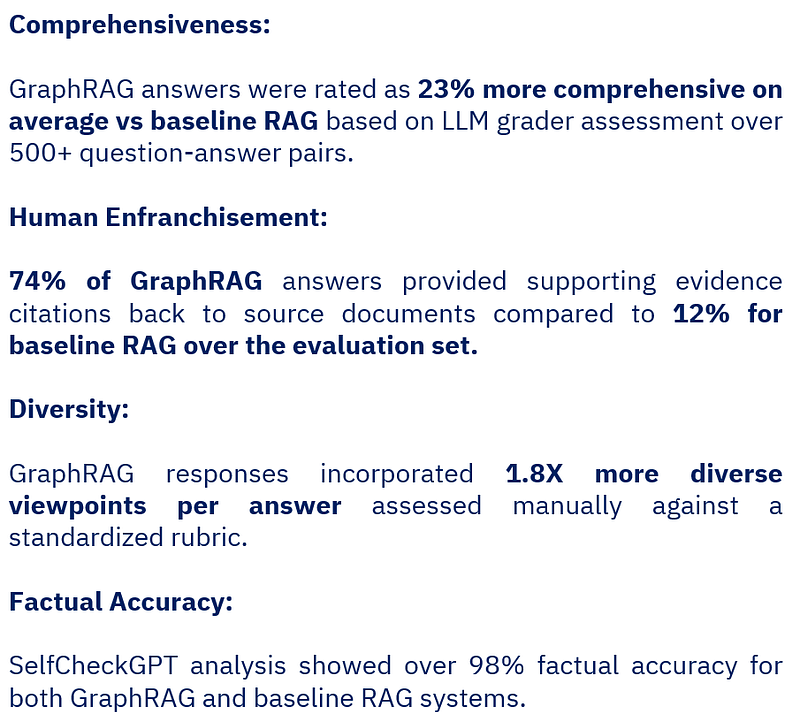
By explicitly linking related information through typed relationships mapped across documents, knowledge graphs allow genuine multi-hop reasoning across disparate sources — precisely the capability lacking in passage vector retrieval for whole-dataset comprehension.
Unlocking True Cross-Document Reasoning
The benefits of knowledge graphs come to the fore when analyzing rich corpora containing thousands of interconnected documents like financial reports, news articles, legal case files, and research publications.
By encoding labeled relationships between entities explicitly mapped across documents, knowledge graphs effectively stitched together disparate pieces of information. This connectivity enabled complex multi-hop reasoning chains spanning documents — the essence of cross-corpus comprehension — while maintaining provenance back to source data.
The rich topology combined with integrated type ontologies offered both the flexibility to pose elaborate analytical queries across themes and the reasoning apparatus to develop systematic data-grounded responses — capabilities sorely lacking in basic passage vector lookup.
Whole Dataset Reasoning — A Multi-Modal Perspective
- Graph Queries extract precise subgraphs matching complex criteria — modeling n-ary semantic patterns, topological shapes, algorithmically discovered communities. This provides structured explanations interconnecting entities through chained relationships.
- Vector Similarity rapidly surfaces additional related entities absent explicit connections, expanding relevance through approximate semantics. Combines signals from topology and content.
- Graph Algorithms detect higher-order trends like influence clusters, dynamic event sequences, central entities from global graph patterns. Derives macro insights.
- Clustering summarizes groups of tightly interrelated entities into topics and narratives based on connectivity, encoding dataset themes. Determines prevalence.
The fusion of these techniques combines focused formal queries, broad conceptual relevance, abstracted macro phenomena, and condensed representations — enabling insights along multiple dimensions. This amplifies the versatility of knowledge graphs for multi-modal whole dataset comprehension across specialized queries, high-level strategic analysis, and everything in between — crucial for data-intensive enterprises.
Spanning the Business Needs Spectrum
Whether optimizing delivery routes, analyzing customer churn factors, assessing risk in portfolios, tracking supply chain bottlenecks, identifying drug reaction patterns, or uncovering insider trading from earnings reports — structured knowledge graphs empower multifaceted reasoning vital for context-intensive business challenges.
- Flexible querying mechanisms match the complexity of analytical problems
- Integrated semantics power insights across scattered documents
- Custom ontology constraints keep reasoning aligned with business logic
- Ability to operate at macro and micro levels within one knowledge substrate
The rich composability enables context-aware, explainable intelligence tailored to nuanced organizational needs — a transformative advantage over sparse vector passage representations. Unlock deeper insights!
In Plain English 🚀
Thank you for being a part of the In Plain English community! Before you go:
- Be sure to clap and follow the writer ️👏️️
- Follow us: X | LinkedIn | YouTube | Discord | Newsletter
- Visit our other platforms: Stackademic | CoFeed | Venture
- More content at PlainEnglish.io


