
Unlocking the Johari window: what if your blind spots hold the key to success?
Metaphors can be a great tool to understand aspects of complex topics. Different people have different learning styles and whilst for some people, basic or complex metaphors and parallelism can work well, some others prefer learning through visuals, such as diagrams, pictures, schemas, or even doing some practical exercises. In this series of articles dedicated to awareness, I will try to cover different aspects around it and I will try to convey it in different ways for different people. In my previous article — “The mysterious nature of awareness: riding elevators and quantum particles”— I used some metaphors to show that defining awareness is not a linear discrete process. Becoming aware of the various aspects, properties and complexity of awareness is a progressive and continuous work in progress and we may find ourselves at different times closer to the “peak of mountain stupid” or to the “valley of despair” or anywhere in between and beyond. One of the tools that can help you to walk up “slope of enlightenment” is the Johari window.
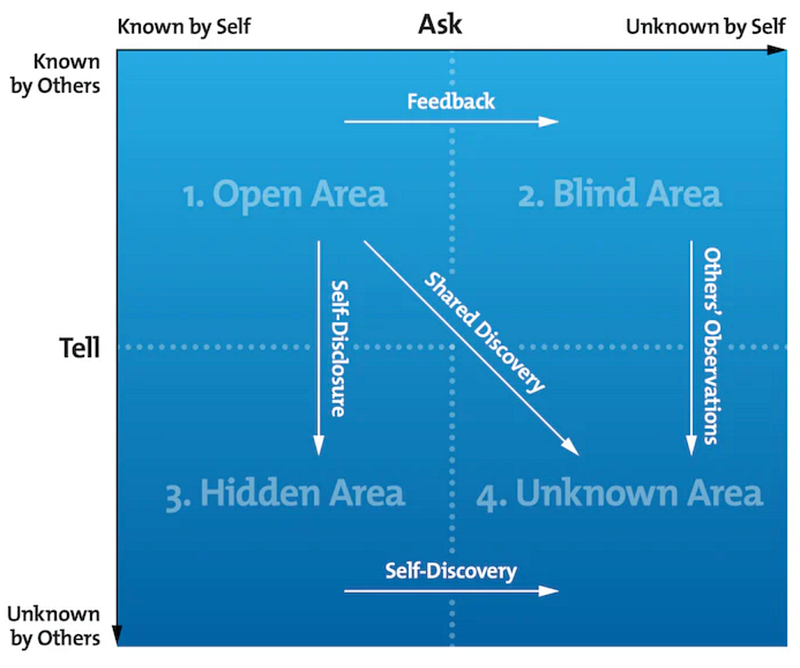
The Johari window model of awareness
The Johari window model is a tool that can be used while coaching teams or coaching individuals to increase their awareness on any topic (including “awareness” itself) but also to improve the skills necessary to grow as leaders, professionals, and people. This visual framework is a very simple and powerful tool to become aware of how our minds work and how we think, act, react, behave according to what we know (or don’t) and according to how much we are aware of many of our biases.
Let’s go in order and let me start with a question: have you ever thought someone forgot your birthday or an anniversary important to you? You may have filled your mind with assumptions, negative thoughts, voices, mental inner arguments, ruminating dissatisfactory thoughts and increasing your frustration. Thinking that people do not care about you despite you caring about them, how ungrateful or careless they are. But at some point, you find yourself being the protagonist of a marvellous surprise party or in a fancy restaurant for a romantic dinner or getting unexpected exciting presents, care, attention.
You ruined most of your day, you got distracted by assumptions and focused on negative feelings, you missed the opportunity to enjoy your day. That’s the huge impact that lack of correct information can have on our lives — especially if we substitute missing data making up theories and assumptions that aren’t real. Ignorance is a bad advisor; together with arrogance is like a bad advisor giving you army and munitions; the negative emotions generated by ignorance and arrogance in conjunction with behavioural biases can make people dangerously blind.
Using the birthday party metaphor let’s discover the meaning of the 4 quadrants of the Johari window.
Quadrant 1 — The open area
This area contains things you know and also others known. You invite your friends to your birthday party. You know about it and they know about it. Speaking of self-awareness this area contains elements of the conscious self (behaviours, attitudes, ways of living…). We are aware of these elements and we don’t hire from them. It can include physical and external elements (such as the colour of our eyes) or emotional and internal elements such as a phobia that we disclose to others.
Quadrant 2 — The blind area
This area contains things you don’t know but others know. Is the above example of you unaware that others are organising a surprise party in your honour. They know about it but you don’t. This area can contain information about ourselves that is known to others which we are not aware of. Could be an unconscious habit or pattern in the way we react to some situations. It could be physical, such as a little but visible pulsing vein in the forehead whenever we are stressed or the more famous “angry fist” but it could also be an emotional expression or an emotional trait known to people who observe us.
Quadrant 3 — The hidden area
This area contains things you know but others don’t know. You told some people you are not going to have a party this year but actually you booked a holiday abroad and you will party for an entire week. In terms of self awareness this area is known to us, but hidden to others. It could be something we know about ourselves, physical or emotional, but not noticeable or never disclosed to others. It could be anything like pain, private concerns, fears, secrets, ideas, thoughts… as far as it is consciously known to us and unknown to others.
Quadrant 4 — The unknown area
This area contains things you don’t know and others don’t know either. You have been swapped in the hospital with another baby and your real birthday is not what you and others around you think you know. Even your real name, family, background, genetics aren’t what you think. This doesn’t change who you are and who you become and your relationships, but in the moment you or others would move into this area there could be important impacts (e.g. you thought you were going to have a genetic disease and you will not). This is an area that contains things no one knows anything about, until something moves out of this area to enter into other quadrants. It could still be physical (an illness before being diagnosed or a lucky genetic mutation) or emotional (subconscious thoughts, unresolved traumas, forgotten dreams, sedimented beliefs, hidden values…).
“The eye sees only what the mind is prepared to comprehend” Henri Bergson

How to use this tool to improve our lives?
Most of us are unaware of the majority of behavioural biases and the actions we take, the things we do (or don’t) and we say (or don’t) are due to unconscious patterns, habits, defences, emotional reactions, fears, negative self-talk, judgements. Without awareness humans behave most of the time predictably irrational, getting stuck in their life (or painful, frustrating condition) and without knowing how to move on. The coach is not just a buddy. It is a professional partner that providing tools such as the Johari window can help people to move data and knowledge from unfavourable quadrants to more favourable, happy and productive quadrants.
From blind to open
For example, by asking feedback we can push and expand the open area (quadrant 1) in order to get visibility, knowledge and awareness upon information previously unknown to us: blind area (quadrant 2). This is valid not only for getting valuable feedback from other people but also learning to query information in the correct way. After all, we live in the Information Age and it is possible to access data about the world, the reality and ourselves with no cost (or minimal cost). Typical example is searching yourself on google and getting surprised by the amount of things you didn’t know others know about you. Another example is using psychometric tools and other online questionnaires to gather more insights about ourselves. Professional coaches can suggest some of these tools to evoke or increase client self awareness.
From hidden to open
Letting data move from the open area (quadrant 1) to the hidden area (quadrant 3 ) is now easier than ever and in some cases even concerning and sometimes out of our control. In the past you needed to publish a memoir or meet face to face with other people to disclose your feelings, pains, fear, situations, dreams. Nowadays you can call people to the other side of the world, chat with strangers, send messages or just publish on your social network profiles information that you decide you want to disclose to your friends, family or everyone. In case of breaches or errors you can even see your data disclosed in an uncontrolled way. But most of the time there are huge benefits from telling others our feelings and these benefits go well beyond the simple venting or stress relief. We can “use” others as a sounding board or asking for help, suggestions or just to let them know what we feel. Showing yourself vulnerabilities makes us more approachable and human. A trait that many managers and inexperienced leaders often forget: caring to be seen as human being, with defects, imperfections or simply capable of having emotions.
Pulling from the unknown area Pulling information from the unknown area can happen in different ways and once the information is pulled from there can move into any of the other 3 quadrants. Many people may observe things about you you are not aware of (and before observing you, those things were also unknown to them). People may have different reasons to tell you (or not) what they figured out due to their observation. Is it always good to tell? Does someone have an interest in not sharing that info with you? Is the observer locked in a relationship or environment where disclosing to you their observation is not appropriate, professional or permitted? Would someone share feedback trying to manipulate you?
Partnering with a professional coach -either as individual, team or organisation- allow the observations to be reflected in impartial ways and always in the best interest of the client. At the same time the professional coach supports the client during the self-discovery process without doing all the work on the client’s behalf. The coach keeps the gate open so that the client can focus on the exploration that, thanks to powerful questions, can unfold and bring up much unconscious or unknown information. The same dynamic can be used in a team where not only the workgroup as an entity will get aware collectively of new data about itself, but also the individuals inside the team will benefit from the shared-discovery process, giving and providing feedback, observations, ideas.
Coaching for agility, preparing for awareness The Johari window model of awareness can provide a static picture of in which quadrant, at a specific time, we think a piece of information is located. According to the quadrant we may have a sense of our awareness. Some people are totally unaware of this tool (or similar self-developed ideas) but surprisingly even the ones who came across these concepts refuse to move or to make any effort to change their level of awareness. They stick to their homeostatic behaviour, keeping the same beliefs, patterns, preconceived notions, assumptions, wrong perspectives, unhappiness, frustrations. It requires a proactive effort to inspire, trigger, exercise our own agility, our own capacity to ask around, seek for feedback, look things from unknown perspectives and new points of view in order to increase our own awareness. It requires a certain agility to transform the Johari window from a static picture to a movie, a living, continuous learning, always moving and improving awareness. Without such capacity to move ourselves comfortably and lighthearted from a quadrant to another we cannot acquire more information, awareness, consciousness. Agility — viewed also a capacity to embrace changes and small continuous improvements rather than statically complain about the situations we live in — is key to improving our knowledge of behaviour biases and particularly the ones we are subject to.

Reflecting upon our cognitive biases with agility provide a third dimension to the Johari window matrix, that in a cubic world can help us discovering that even around the things that we know, and we know others know there is the possibility that we -and others like us- are inhabiting the same room, living the same values, studying the from the same sources making the same observations or mistakes. Many people live their entire existence inside their comfortable echo-chamber, never moving either slowly nor with agility. Other people make diluted or inconsistent attempts of self-exploration but not true, deep and wide enough to bring them to any enlightenment — exactly like the drunk that searches for his lost keys only inside the little circle where the lamp projects the light (confirmation bias). If that sounds hilarious or ridiculous, what’s the difference between the unawareness of that drunk and the unawareness of who is looking for the key for their success in the wrong place?
A consistent partnership with a professional coach can open multiple perspectives, support explorations and growth, evoke awareness, provide powerful tools to improve the way we live our life and we take decisions as individuals, teams or organisations.
I write about organizational patterns, transformational leadership, healthy businesses, high-performing teams, future of workplace, culture, mindset, biases and more. My focus is in leading, training, and coaching teams and organizations in improving their Agile adoption. Articles are the result of my ideas, studies, reading, research, courses, and learning. The postings on this site and any social profile are my own and do not represent or relate to the postings, strategies, opinions, events, situations of any current or former employer.
This article may have been published for the first time on danieledavi.com by the author Daniele Davi’. © Daniele Davi’, 2020–2023. No part of this article or the materials available through this website may be copied, photocopied, reproduced, translated, distributed, transmitted, displayed, published, broadcast or reduced to any electronic medium, human or machine-readable form, in whole or in part, without prior written consent of the author, Daniele Davi’.