
Unlocking the Hidden SEO Strategies: What 99% of Medium Writers Don’t Know
Learn the Best Practices and Techniques to Optimize Your Content for Search Engines and Attract More Readers
Once you have completed your story and incorporated the recommended guidelines and exercises to enhance its quality, it is important to ensure that it receives the attention it deserves by standing out in search results. Increasing visibility on platforms like Google can attract more readers to your work. Tatiana Colligan, Medium’s SEO product manager, provides valuable tips, tools, and best practices to assist you in achieving this goal. By following these straightforward guidelines, you can effectively expand your readership and reach.
What is SEO?
Search Engine Optimization (SEO) is the practice of optimizing a website or content to improve its visibility and ranking in search engine results pages (SERPs). It involves various strategies and techniques aimed at enhancing the website’s relevance, authority, and user experience, ultimately helping it attract more organic (non-paid) traffic from search engines like Google. SEO encompasses on-page optimizations, such as keyword research and optimization, content creation, and technical improvements, as well as off-page factors like link building and social signals. The goal of SEO is to increase the website’s visibility, drive targeted traffic, and ultimately improve its chances of reaching a larger audience.
Updating the SEO settings for your story
These settings are available when you’re editing a story. Go to Menu → More Settings → SEO Settings, and do the following.
Setting the SEO Title
Before we explore the process of setting the SEO Title, it’s essential to evaluate your story headline. The headline should be concise, conveying a clear message about the story’s content to your readers. With that in mind, let’s now consider how Google will display your title. Typically, Google truncates the SEO Title if it exceeds 60 characters. Consequently, only the first approximately 60 characters will be visible in Google search results. Therefore, it’s crucial to make those characters count. Craft an informative and compelling title that entices readers to click. Prioritize clarity and precision by incorporating relevant keywords and phrases that people commonly search for on Google. Position these important elements at the beginning of your SEO Title, while placing less significant details towards the end.
Consider the following example:
Original Title: “Delicious and Healthy Recipes by Sarah’s Kitchen — Cookbook for Food Lovers”
Improved SEO Title: “Food Lovers’ Cookbook: Delicious and Healthy Recipes by Sarah’s Kitchen”
Compare the two titles. Which one would you be more likely to click on? The second option is more likely to appear in Google searches related to terms like “food lovers’ cookbook” or “healthy recipes.” It also increases the chances of attracting clicks from individuals specifically searching for those topics. This is because the key terms appear earlier in the title, making it more relevant. It’s worth noting that occasionally, Google may choose to display its own title for a webpage, particularly if it aligns with the searcher’s specific intent or if it doubts the credibility of the author-set title. However, such cases are infrequent.
Setting the SEO Description
The purpose of the SEO Description is to persuade individuals searching on Google to click on your story. It should provide a concise overview of what the story entails, sparking their interest and leaving them curious to discover more. This is an opportunity to effectively market your story and enhance its click-through rate. It’s important to note that Google often shortens SEO Descriptions that exceed 156 characters, so it’s crucial to keep them within that limit.
To illustrate the point, let’s consider the following example story:
6 Cutting-Edge Technologies Shaping the Future of Work
Unveiling the AI Revolution
pub.towardsai.net
Let’s examine how I determine the SEO settings and take note of the keywords utilized in the SEO Description. We will then compare them with the corresponding Google search results.
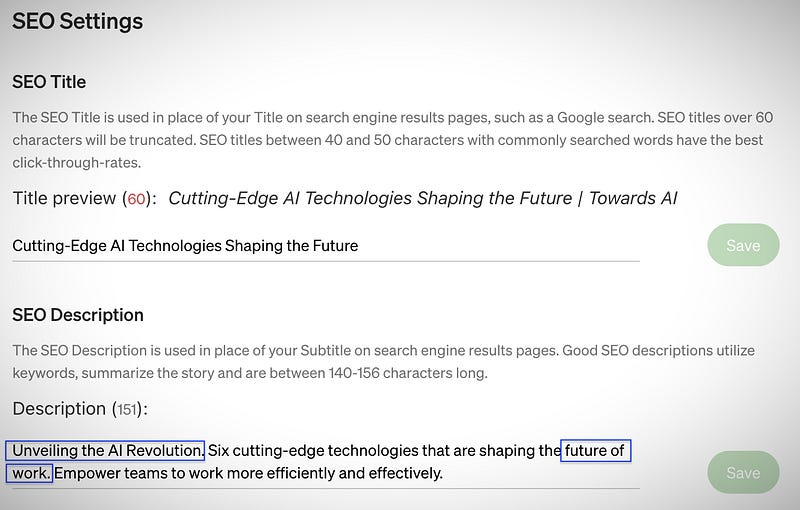
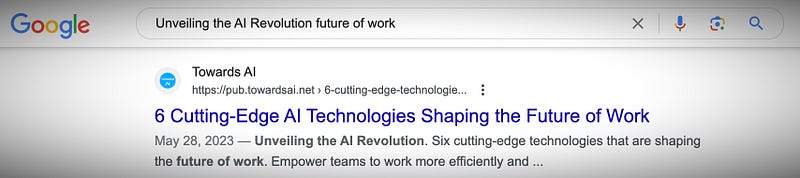
Upon closer observation, it becomes apparent that certain keywords mentioned in the SEO Description have been employed in the search query and are now highlighted in the search results.
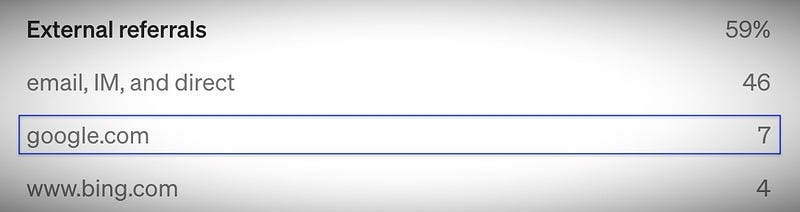
The Story Stats indicate that there is a certain amount of traffic originating from Google.
In the SEO Description field, we have the freedom to write up to 330 characters. However, Medium recommends keeping it within the range of 140–156 characters. Similar to the SEO Title, it is beneficial to include keywords that succinctly summarize the story at the beginning of the SEO Description.
The Bottom Line
In conclusion, mastering SEO techniques can amplify the reach of your Medium stories. By following the guidelines discussed here, craft compelling SEO titles and descriptions, optimizing your content for search engines. Stay updated on SEO strategies to enhance discoverability and engage a wider audience. Elevate your storytelling, expand readership, and unlock new possibilities.
Thanks for reading
- 👏 Please clap for the story (50 claps) to help the article to be spread
- 🌐 Share the story on Social Media
- ➕More stories about Programming, Career, AI and more.
- 🔔 Follow me: Medium | LinkedIn | Twitter
- 📝 Join the Medium Membership Program for only 5$ a month, and support me and other writers to keep on the tremendous work.