
Why Accurate Weather Forecasts Should Be Accessible to All
Unlocking Accurate Weather Forecasts: Why Everyone Deserves Access Now
Democratizing Precise Weather Predictions: The Necessity of Universal Access
Believe it or not, modern weather forecasts have gotten impressively accurate! Gone are the days where we had to glance up at the sky and play a guessing game about whether we should carry an umbrella or put on a sun hat. The advances in technology and atmospheric knowledge have greatly improved the accuracy of weather forecasting. While it’s not an exact science, weather predictions are now far more trustworthy than they were just a few decades ago. But now, having achieved this major improvement, how do we ensure that everyone, regardless of their location, benefits from this sophisticated forecasting?
“Forecasting the weather is like playing chess with nature, you need to think several moves ahead to anticipate the outcome.”
Just think about that for a moment. The science we have at our fingertips, the ability to accurately predict Mother Nature’s moods, is something we should celebrate. But more importantly, it should be accessible to everyone — farmers dependent on rainfall for their crops, mountain climbers gearing up for an ascent, or the general public planning their day. This posts explores how we can continue to improve weather prediction accuracy, and, even more crucially, make it universally available.
Over the years, weather forecasts have taken massive strides in accuracy. Thanks to advancements such as computerized numerical modeling — the process by which we transform huge amounts of meteorological data into manageable, comprehensive forecasts. However, this has also led to a startling disparity. Not everyone has equal access to these potentially life-saving predictions.
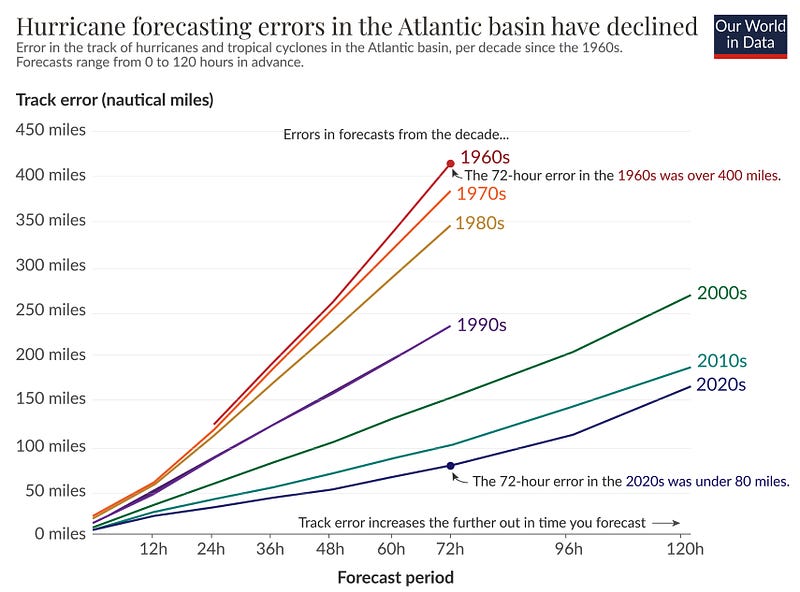
Why does this matter? Consider the billions of small-scale farmers worldwide, particularly in low-income countries. Accurate weather forecasts can be the difference between feast and famine for these individuals. An unexpected drought can wipe out crops, while a well-forecasted storm can provide ample time to safeguard them. Nevertheless, due to discrepancies in weather forecast spending per person and as a share of GDP, these populations may not have the necessary information at their disposal.
This isn’t just an issue for agriculture. Grid operators, pilots, sailors — indeed, almost every industry — rely on accurate weather forecasts for smooth operations. From emergency management safeguarding lives and property to industries like transportation, energy, and construction ensuring business continuity, concise predictions of weather changes are indispensable.
Yet, a significant proportion of the world’s populations operate in a vacuum when it comes to accurate weather information. According to the World Meteorological Organization, several countries, typically the poorer or remote, are without crucial early warning systems. Often, these are the areas that need these warnings the most — regions that experience severe storms, heatwaves, or other weather-related disasters. Such forecasts are vital not just to react to immediate disaster situations, but also to adapt to larger climate change patterns.
So, how do we bridge this gap? The key lies in our capacity to distribute these advanced forecasting resources more evenly. Emerging technologies offer an opportunity to accelerate weather forecasting in areas where it has historically been lacking. These can improve the accuracy of predictions regarding extreme weather events and make countries more resilient.
There’s a bright future for weather forecasting — one where accurate forecasts are not just a boon, but a basic right. By working together, we can make sure this powerful tool is within reach for everyone, regardless of their income level or geography.
Citation: Hannah Ritchie (2024) — Weather forecasts have become much more accurate we now need to make them available to everyone, Published online at OurWorldInData.org, Retrieved from ‘httpsourworldindata.orgweather-forecasts’.
Did you know your life today is made vastly easier by accurate weather forecasts? They are integral to virtually every field of human endeavor — helping pilots navigate, farmers sow and harvest, grid operators manage power supply, and sailors chart course.
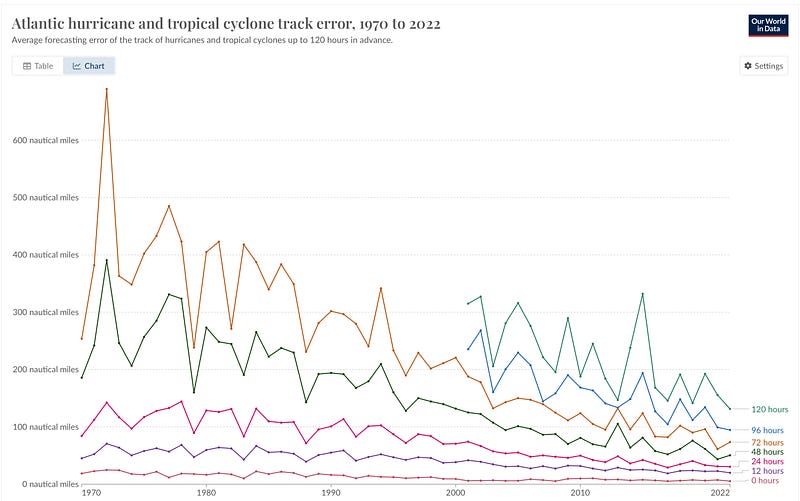
What makes these predictions increasingly accurate? The answer lies in the convergence of improvements in data collection, model resolution, and technique. Central to this revolution is the transformation of data quality. Thanks to advancements in data assimilation methods, forecast models can be fine-tuned with observational data, encapsulating weather patterns with an unprecedented level of precision.
Another factor fueling this rise in forecast accuracy is the increased resolution of weather forecast models. Now, fine details of weather phenomena can be accurately captured, offering predictions at an altogether different level than was possible before.
We’ve also seen cutting-edge computerized numerical modeling techniques bring about a marked enhancement in forecast accuracy. Coupling these techniques with the improved data quality has led to the transformation of weather prediction into a more precise science than ever.
Besides the applications for various sectors, these accurate forecasts have the potential to save lives. They can serve as effective early warning systems for storms, heat waves, and various other disasters, buying us time to brace for impact or evacuate if necessary. Thus, the implications of this enhanced forecast accuracy extend far beyond convenience — they reach into the realm of personal safety.
But what’s next for weather forecasting? There’s considerable potential for technology to revolutionize weather forecast distribution. Emerging tech platforms can help distribute these vital forecasts to wider audiences, catering to even the deepest corners of the globe, giving every individual access to this life-saving information.
So, the question we need to explore is not just how accurate weather forecasting has become, but equally important, how do we make these forecasts universally accessible? Accurate weather forecasts shouldn’t be a luxury, they should be a right. So let’s make them universally available and take another significant step towards a safer tomorrow.
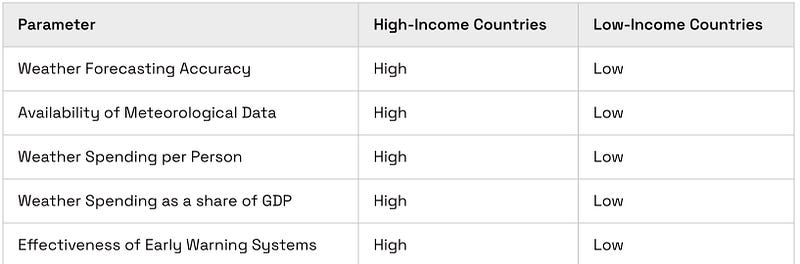
In conclusion, the unequal distribution of accurate weather forecasting systems is an issue that urgently needs addressing, particularly in low-income countries. These regions often suffer the most from severe weather conditions and climate change, yet they are the least equipped to predict and prepare for such events.
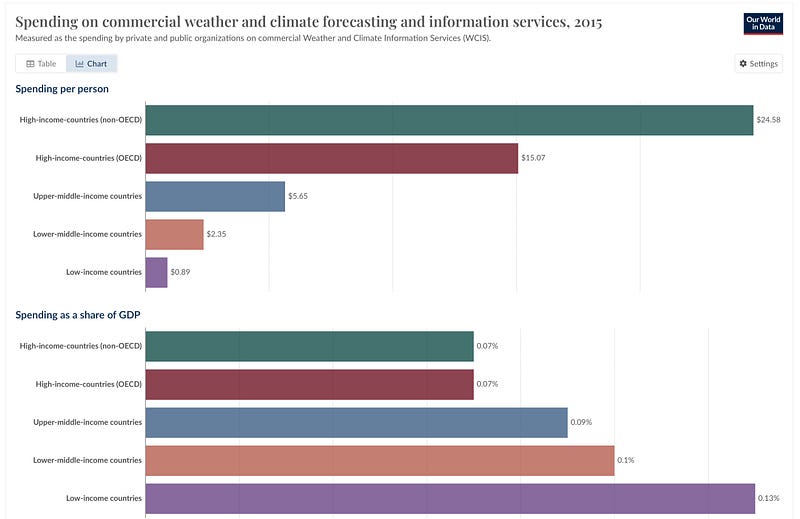
We should view this not only as a challenge but also as an opportunity for innovation. Leveraging mobile technologies to disseminate accurate weather information could democratize access to this lifesaving data, helping secure livelihoods and bolster economies, particularly in rural and impoverished areas.
The enhanced accuracy in weather forecasting is not just an advancement to celebrate but a call to action. It’s high time we prioritize making these accurate weather forecasts universally accessible. In doing so, we can work towards a world where no one is left at the mercy of the weather, but instead, empowered to adapt and thrive, whatever the forecast may bring.
A personal reflection from Jason

I can still vividly recall the pivotal moment I realised the pressing need for universally accessible weather forecasts while attending Apple’s 2016 Worldwide Developer’s Conference. I distinctly remember the day when the glaring gap in weather forecasting for the visual-impaired community hit home. I had previously taken for granted the privilege of accessing meteorological information, due to my sighted status.
Every weather app I’d encountered up until that point was designed for sighted users, with little thought for those who needed different modes of interaction. This revelation spurred the birth of two personas within my app project — a design for sighted users and an alternate version for our visually impaired counterparts. In truth, this was a profound acknowledgment of inclusivity.
My experiences as a software mgmt leader where I had the opportunity to work on software for tracking hurricanes, were instrumental in this endeavor. They enabled me to bring scientifically accurate weather forecasting to the palm of everyone. However, striving toward universal accessibility, I understood that mere accuracy wasn’t enough. It had to be paired with easy comprehension and dissemination of forecast information.
This mandate led me to collaborate closely with the blind community via AppleVis, transforming Weather Gods from a standard app to a platform that is now not only usable by but also tailored for, visually impaired users. What started as an app project, transformed into a mission of bringing inclusive design to the forefront of technology.
I’m deeply indebted to the many engineers 🧑💻 👩💻 I worked with who generously poured insightful comments and critical feedback into this world. My journey to meld meteorological accuracy with inclusive design might have begun out of a simple realization, but it continues, fueled by the knowledge that forecasts, like weather, are an integral part of everyone’s lives. Every landmark we achieve means another stride towards the universal accessibility of meteorological information, so that no one ever feels left out in the storm.