
Universal Dividend
One of the Right’s favourite illusions is that wealth is produced individually before it is collectivised by the state, through taxation, and re-distributed. Progressives must challenge with motivated error: Wealth was always produced collectively and privatised by those who had the power to do it. — Yanis Varoufakis
We think of production outsourced to China, cheap labour.
Donald Trump says he will bring these jobs back to America.
What jobs?
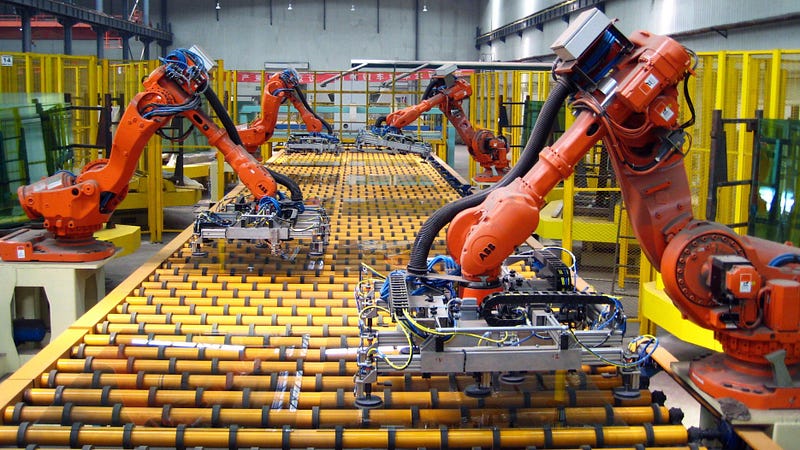
Changying Precision Technology Company has replaced 90% of its workers with robots. Productivity has increases by 250%, rejection rate fallen from 25% to 5%. Only 60 of 650 workers remain, and these will be reduced leaving 20 to mind the robots.
An Oxford study has suggested nearly half of all jobs could be replaced by robots and automation. The only thing that is stopping it is what David Graeber calls the creation of bullshit jobs, jobs that exist to employ people who perform no useful function.
The classic bullshit jobs is half a dozen migrants with dirty rags and a bucket of dirty water replacing an automated car wash.
Henry Ford prided himself that he paid his workers a high enough salary to buy the cars they made.
If robots displace people, who buys what the robots make? Who owns the robots? Do the robots earn for their work or do they earn for their owners?
In the US, wages have flat lined since the 1970s, but productivity has continued to rise.
This means workers, as opposed to the owners of capital, share less and less in the created wealth of a country.
Mass transfer of wealth from the 99% to the 1%.
Post-capitalism, we could see the economy and employment diverge.
Do we want a world of serfs working for apps, Uber, task rabbit, Deliveroo, Wheelys, atomised workers bidding against each other in negative auctions to drive wages below the minimum wage, of zero hours, bullshit jobs, of workers standing in the market place, the literal job market, hoping to be offered a job.
When a worker offers his labour, it is a perishable good, if not sold today, it cannot be sold tomorrow.
Or we can have a world of open source, peer-to-peer, sharing, collaborative commons, open coops.
Several countries are carrying out city-wide trials of Basic Income. In each trial, it has been a success.
Pay people a Basic Income, they are then free to pursue whatever they wish, not forced to earn a living in degrading employment, like for example working for Sports Direct or McDonald’s.
If employers wished to attract people, they would have to offer far better pay and conditions.
Basic Income is one of the proposals Paul Mason puts forward in PostCapitalism. It is also advocated by P2P Foundation.
People are no longer forced to work to earn a living. The work that people wish to do, but cannot afford to, will now be able to.
Would this not encourage the feckless and the idle, and if no one working, how do we pay for it?
The same question, no one working, if we are all displaced by robots and if we have a society of serfs working for apps, precarious work, low paid, they are already being subsidised by the state.
But, and a big but, how is it to be paid for?
I and others have suggested a windfall tax on the massive cash piles companies have accumulated, also on environmentally damaging industries, coal, gas, fracking, deal with tax dodging.
This would certainly provide funding in the short term, but would it be sufficient in the long term?
We should also need to note, Basic Income would not have to be high, not if it forms an integral part of the sharing economy, collaborative commons and open coops. The basic needs of people would be lower, were they to participate in the sharing economy.
We would also have no need for Job Centres or at least Job Centres in their present form, centres of bullshit job creation. Other than maybe as advice centres. But certainly not as they see their current role, harassment of Jobseekers.
At the London launch of DiEM25 UK, Yanis Varoufakis proposed an alternative approach, Universal Dividend as an alternative to a Basic Income.
Varoufakis pointed out that one of the greatest fallacies of capitalism and of free market ideology is that wealth is created individually and then appropriated through the tax system by the state. The reality is, he noted, exactly the opposite — wealth is created collectively and then privatised. Since capital is produced socially it should be enjoyed socially. In the light of this Varoufakis told the meeting that DiEM25 has been developing a policy, not of a Universal Basic Income, but of a Universal Basic Dividend. This would not be funded by taxation but through a Trust Fund into which a percentage of the shares of every corporation is to go, where the dividends amass, and which are then distributed to all as a Universal Basic Dividend. In Varoufakis’ opinion this is the only way to share the returns of automation across society.
As Yanis Varoufakis correctly states, wealth is not created individually, then appropriated through the tax system by the state, wealth is generated collectively, then privatised. If we collectively generate wealth should we not collectively share that wealth?
If I have an idea, it does not, or rarely does, occur spontaneously, it occurs and draws upon my experience, my interactions with others and my environment, even if it is only to plant a germ of an idea that I then expand upon.
When Starbucks tried to justify their non-payment of tax, or worse claim they pay tax because they pay VAT and their employees pay tax, they are missing the point.
Who pays for the education of their workers, who pays for the police when anarchists stove in their windows, who pays for the roads their delivery trucks and workers travel upon?
We all draw upon our collective commons, therefore we should all contribute to those commons.
If we look at a smart phone, the camera inside, a camera on a chip, the technology was developed by NASA.
Post-WWII, when we saw growth in the economy, when Harold Macmillan told us we had never had it so good, when Harold Wilson or was it Tony Benn talked of the white heat of technology, workers were reasonably well paid, they shared in the fruits of their labour.
In the 1970s, the head of a British bank was paid one hundred times the lowest paid, now it exceeds three hundred times.
During this period there was also a social dividend, free education, free public libraries, students were actually paid to go to university with a grant, we had a viable NHS.
There was a broad consensus within society and across political parties, much to the chagrin of far-right think tanks. This all changed, as Naomi Klein describes in This Changes Everything, when everything changed with Ronald Reagan and Margaret Thatcher, when they pushed neo-liberalism, which up until then had been confined to the lunatic fringes. Destroy trade unions, cap wages, and end the social dividend. And as Margaret Thatcher once infamously said, there is no such thing as society.
The Trust Fund that Yanis Varoufakis proposes could be used to help kick start coops, either through grants or soft loans, or maybe taking a collective stake.
We need to go further, as I write DiEM25 has launched a Green New Deal for Europe.
Nor should we consider the political space as separate and distinct, we have to collectivise the political space, follow the example of Spain, Barcelona, A Coruña, ordinary citizens seize control of their local Town Halls, open to full public participation, then network these citizen-controlled Town Halls across Europe.
No sharp boundaries between the political space and work space.
Decide Madrid, a software platform for citizen participation, would in the normal way, have been outsourced to external consultants, instead it was developed internally as open source with public participation, it then can be shared with other citizen-controlled Town Halls.
If we created local area community owned local electricity grids these could be part-owned by the local municipality. Into which feed renewables guaranteed a fair price. Consumers pay a fair price. Any surplus generation fed to other local grids via a publicly owned National Grid. Any ‘profit’ ploughed back into the local network or used to fund local community projects. The Big Six would not be able to compete and would go out of business.