
This Is Us
I Miss Weird Smells
Social distance means we can no longer create shared memories by smelling the world — and each other
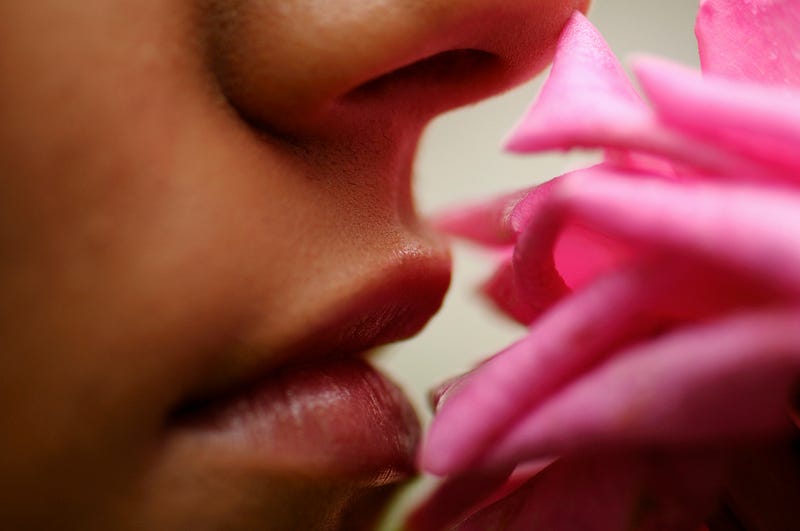
What’s the worst smell you can think of? Skunk? Brussels sprouts? Sour milk?
For me, it was a mixture of Coca-Cola, coffee, Gatorade, and rotting bones. The smell was so pungent it clung to my hair and clothes for hours after the air had cleared. I was a student teacher in a regional high school in Vermont, and I had asked my students to do an experiment on bone density. They each chose a liquid to soak a chicken bone in for a week.
I knew the acidic liquids would leach the calcium out of the bones and make them rubbery. What I did not anticipate were the angry, horrific smells that would fester in the sealed containers in the back of the room as I cheerfully drew diagrams of calcium molecules on the board up front.
At the end of the week, the first student opened his container and a pretty horrific smell wafted out. With each new open container, a slightly different but equally unbearable smell joined the chorus until the air in the room was so thick and heavy with stench, it felt like we had been engulfed by a noxious cloud. Students were shrieking and gagging and holding their shirts up over their noses.
Of course, as bad smells do, it drifted out of the room and down the hall into neighboring classrooms.
My supervising teacher took the students out to the parking lot while I remained inside to try to clear out the smell and explain to the custodians why emergency box fans needed to be brought to the B-wing science room.
That was more than 10 years ago, and though a lot of things have changed, I still teach high school science. And I still remember the harsh smell of the rotting bones as if I just sniffed it yesterday.
Earlier this week, I was on a Zoom call with my students explaining how our sense of smell works. After describing our nose as a passageway to specialized cells that detect the presence of certain airborne chemicals, I showed them a YouTube video about The Great Stink of 1858. True to its name, this event happened in London during a particularly hot summer. After decades of crowding and improper sanitation, the city streets were piled up with raw sewage and manufacturing and slaughterhouse waste. The waste ran to the Thames River, where it bubbled and oozed, releasing odors so terrible it caused many to flee the city.
Historically, it was an interesting event because the terrible smell led to legislative action. When the smell hit Parliament, lawmakers took action. They quickly accepted a proposal by civil engineer Joseph Bazalgette to build a sewer system that would properly dispose of human waste. The system was successfully built and an updated version of it still operates in London today.
Scientifically, though, it’s even more interesting.
Take a minute to think of our sense of smell on an evolutionary scale. Seven hundred million years ago, primitive fish had a version of scent detectors that allowed them to sense the presence of certain chemicals in the water. Three hundred seventy-five million years ago, early reptiles walked out of the water to explore life on land. When they did, they brought the beginnings of our sense of smell with them. One hundred seventy-five million years ago, mammals joined the party, followed by early humans just about 4 million years ago.
All those early fish, lizards, and humans used their sense of smell for survival. In a technical sense, we can smell things because of a patch of skin high up in our nostrils called the olfactory epithelium. There, specialized receptor cells lie in wait as the air we breathe in passes over them. When the right molecule hits a receptor cell, it triggers an electrical impulse to travel to a certain part of our brain. This evokes a certain thought, feeling, or memory.
Talking about our sense of smell made me realize what a sensory desert virtual meetings are.
For many species, the ability to detect smells is still a matter of survival. Finding prey, sniffing out someone to have sex with, and avoiding predators all rely on a keen sense of smell, especially in the dark. Our early human ancestors, eking out an existence without smartphones, weapons, or Home Depot, relied on smell for survival.
Imagine an early version of yourself taking a stroll with your children across the desert in sub-Saharan Africa a few million years ago. You catch a whiff of fresh dung. Knowing whether it came from a leopard or a duiker might save your life. The former is a terrifying predator that could rip your face off, while the latter is a small deer that could feed your family.
The modern version of this scenario — standing at the food court in the mall and letting your nose help you decide between Auntie Anne’s pretzels and Sbarros pizza — is far less dramatic. And certainly not a matter of survival.
So let’s go back to London in 1858 and the Great Stink. Innovations like houses, clothing, and farming reduced our reliance on our sense of smell for survival. You could live in a city, safe from the dangers faced by early humans. And yet the very features that provided this safety were the ones that created the unbearable smells.
In Victorian London, you didn’t have to go out and hunt for your own food. Animals were raised and slaughtered right in the streets. And the result was rotting piles of bones and organs that I imagine smelled much like the science experiment I did with my students back in 2008.
A funny thing happened to me this week as I was explaining all of this to my biology class. As I sat at home at my desk, hot coffee by my side and dog at my feet, I felt a profound sense of loneliness wash over me.
If we had all been in my classroom together, the class would have been far different. I’d have passed around some stinky cheese or doused a paper towel with vanilla extract or tea tree oil. We would have guessed what the cafeteria was serving for lunch or closed our eyes and tried to guess the names of the scents of a bunch of Yankee Candles I have leftover from a fundraiser last year.
Instead, my students appeared each in their own little black rectangle on my screen. They were scattered around town, connected to me and each other by the modern wonder of the internet. On one hand, it’s an amazing feat. We’re able to see and hear each other at the click of a button. And their faces are so close, I can see their pimples and overdrawn eyeliner.
But, at the same time, we’re not together. Talking about our sense of smell made me realize what a sensory desert virtual meetings are. When we see each other in person, we obviously use our eyes and ears. But we also shake hands or exchange a pat on the arm or shoulder. Sometimes we share food — here in New England, it’s almost always Dunkin’ Donuts munchkins. And strange though it is, we exchange smells too.
In the past, I would have told you that I’d prefer not to have to smell the scents of teenagers. They smell like Axe bodyspray, dirty socks, bubblegum, cat pee, Doritos, cigarette smoke, fake maple syrup, cheap Target perfume, hormones, rage, sweat, new sneakers, tears, nail polish remover, Jolly Ranchers, grass stains, baby powder, acne medicine, chocolate, and cherry passionfruit vape juice.
Smells are unique in that they don’t discriminate.
But now I’m not so sure. It’s not that I like those smells now, but breathing the same air and experiencing the same smells can bring people together. You could step onto an elevator with total strangers and if one last person steps on carrying a hot apple pie (not sure the scenario where this happens… maybe a CBS show from the ’90s?), you all exchange glances and nod in approval as the scent molecules bump up against those receptor cells in your nose.
And it’s not just good smells that bring us together. The students who did the bone experiment talked about the “Smell Incident” for the rest of the semester.
Smells are unique in that they don’t discriminate. You’ll never be so rich that you don’t have to smell a fart, and no matter how poor you are, you can still smell fresh bread from the bakery or summer rain on pavement. You can fence in your property and grow shrubs so nobody can see you, but you’d better believe the whole neighborhood will still smell your honey-mustard-glazed chicken when it goes on the grill.
The fact that a symptom of Covid-19 is a sudden loss of smell almost feels like a metaphor for how we’re living right now. In an attempt to not catch or transmit the virus, we’re staying home and missing out on the smells of our favorite restaurants, our friend’s fabric softener, and our mom’s mashed potatoes. We’re not smelling movie theater popcorn, baseball stadium hotdogs, or other people’s weed in concert parking lots.
It’s not fair, but it’s also not forever.
In 1858, the Great Stink ended when new sewer lines drained the waste out of the city.
It’s possible that our current olfactory abyss will end when tech companies, sensing opportunity and need, will develop new technology that allows us to share scents over our phones just like emojis or gifs.
But to be honest, I’m hoping for a vaccine instead.